
2026 Guide: Corporate Duty of Care for Lone Workers
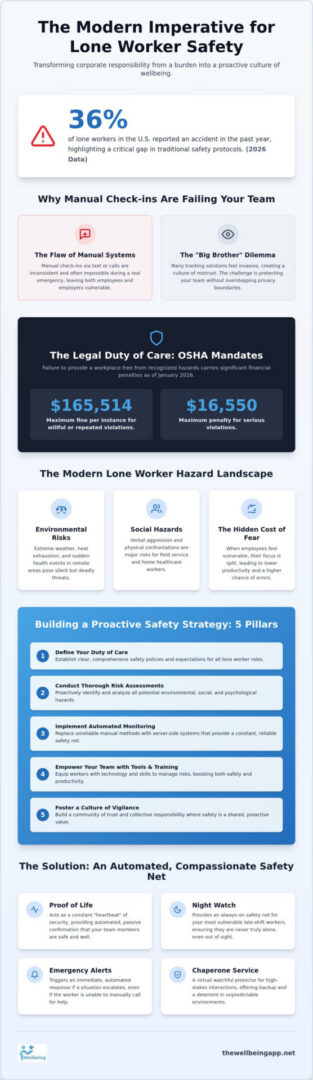
According to recent 2026 data, 36% of lone workers in the United States reported experiencing an accident while working alone in the past year. This startling figure explains why corporate responsibility for lone worker safety is no longer just a checkbox for HR, but a vital pillar of operational health. You likely worry about the legal liability of an incident, yet you also want to avoid the “Big Brother” stigma that comes with invasive tracking. It is a difficult position to be in when you want to protect your team without overstepping their privacy.
We recognize that manual check-ins are often inconsistent and fail during real emergencies, leaving both you and your staff vulnerable. This guide will show you how to transform safety from a legal burden into a proactive culture of wellbeing and automated protection. You’ll discover how to align with OSHA duties and build a robust safety policy framework. We will explore how tools like Proof of Life and Night Watch provide the mental tranquility of 24/7 monitoring, ensuring your team is never truly alone, even when they’re working out of sight.
Key Takeaways
- Explore the evolving 2026 definition of duty of care and why protecting remote staff is now a cornerstone of organizational health and mental tranquility.
- Learn why manual texting is an unreliable safety net and how to better meet your corporate responsibility for lone worker safety with automated, server-side monitoring.
- Identify the modern hazards facing your team and understand how addressing safety concerns can directly improve employee productivity by removing the hidden cost of fear.
- Implement a structured five-pillar strategy to build a safety policy that fosters a culture of collective responsibility and proactive empowerment.
- Discover how automated features like Proof of Life and Night Watch provide a compassionate, always-on safety net for your most vulnerable late-shift workers.
Defining the Duty of Care: Why Lone Worker Safety is a Corporate Priority
The landscape of modern work has fundamentally changed, shifting the focus from reactive responses to a standard of empathetic vigilance. In this new era, corporate responsibility for lone worker safety isn’t merely a logistical hurdle to clear; it’s a profound commitment to the people who power your organization. Duty of Care is an employer’s non-delegable commitment to worker wellbeing. It represents a promise that no matter how remote the job site or how late the shift, every team member remains under a protective wing. Moving toward proactive safety management means anticipating risks before they manifest, ensuring that mental tranquility is a shared reality for everyone on the payroll.
The Moral Imperative of Compassionate Guardianship
Building a safety culture is about more than ticking boxes; it’s about fostering deep trust within a remote workforce. When an employee knows they’re part of a community that values their life as much as their labor, their engagement levels rise. There’s a significant psychological benefit when a Lone worker understands they’re never truly alone. This sense of connection transforms the workspace from a place of potential anxiety into an environment of empowerment. By moving beyond basic compliance, you create a culture where safety is a shared effort. Features such as Proof of Life act as a heartbeat of security, providing a constant indicator that everything is well, which manual check-ins often fail to provide.
Legal Foundations: OSHA and General Duty Clauses
From a strictly legal perspective, corporate responsibility for lone worker safety is anchored in the OSHA General Duty Clause. This mandate requires employers to provide a workplace free from recognized hazards that could cause serious physical harm or death. Isolated work environments present unique challenges that standard office protocols simply don’t cover, making specialized risk assessments a necessity rather than an option. As of January 2026, the financial consequences of failing this duty are steep. OSHA has set maximum fines for willful or repeated violations at $165,514 per instance. Serious violations now carry a maximum penalty of $16,550.
Beyond these immediate financial hits, the reputational risks of safety negligence can be devastating in a socially conscious market. True leadership involves recognizing that automated alerts and server-side monitoring are essential tools for modern protection. By implementing robust systems like Night Watch or Emergency Alerts, you protect your staff from harm and your business from the crushing weight of liability and lost trust.
Identifying the Risks: The 2026 Lone Worker Hazard Landscape
Corporate responsibility for lone worker safety extends far beyond the construction site or the warehouse floor. It encompasses the real estate agent showing a secluded property at dusk and the night-shift custodian working in a quiet office tower. These roles are often invisible until something goes wrong. In 2026, the “Hidden Cost of Fear” has become a documented drain on organizational performance. When employees feel vulnerable, their productivity suffers because their focus is split between their work and their personal security. A distracted worker is not only less efficient but also more prone to making errors that could lead to accidents.
Environmental hazards have also intensified in recent years. Field workers now encounter more frequent extreme weather patterns and “silent” health risks, such as heat exhaustion or sudden cardiac events, while working in remote areas. Fulfilling your duty means looking at the whole person and the specific environment they inhabit, rather than just checking a compliance box. True safety is about providing a sense of harmony and protection that allows your team to focus entirely on the task at hand.
Social Hazards: Aggression and Confrontation
Social hazards, including verbal aggression or physical confrontation, are a primary concern for home healthcare and field service teams. These professionals often enter private residences or unpredictable public spaces where the atmosphere can change in an instant. While de-escalation skills are a great first line of defense, they aren’t a fail-safe in a crisis. Using a Chaperone service allows workers to have a watchful protector by their side during high-stakes interactions. If a situation escalates, automated emergency alerts can trigger a response even if the worker is unable to manually activate an alarm or reach for their phone.
Health and Environmental Risks
The most dangerous incidents are often the quietest. A simple trip or a fall can leave an employee unconscious or unable to reach their device for help. Simply having GPS location sharing isn’t enough; you need to know their status, not just their coordinates. It’s vital to understand your legal duties to protect lone workers and implement systems that provide real-time indicators of wellbeing. We view Proof of Life as the gold standard for corporate check-ins because it doesn’t rely on the worker being able to move or speak. By using automated safety indicators, you bridge the gap between a “silent” incident and a life-saving response, ensuring your staff always feels empowered and secure.
Beyond the Text Message: Why Manual Check-ins Fail the Safety Test
For many years, the informal “text me when you’re safe” has been the default safety protocol for many businesses. While well-intentioned, this approach is fundamentally flawed. It places an unfair burden on both the worker and the manager, creating a fragile link that often breaks when it’s needed most. Fulfilling your corporate responsibility for lone worker safety requires a system that doesn’t sleep or get distracted by a meeting. You need a solution that acts as a compassionate guardian, ensuring that if a worker can’t reach out, the system reaches out for them. Relying on a chain of manual messages is not a safety plan; it’s a gamble with your team’s wellbeing.
The Fallacy of Manual Monitoring
Manual monitoring relies on two fallible human elements: the worker remembering to send the text and the manager being available to read it. In an actual emergency, a phone might be out of reach in a pocket or damaged during a fall. If a manager is in a meeting or driving, a missed check-in might go unnoticed for hours. This delay in response time is the difference between a minor incident and a tragedy. Workplace safety standards and best practices emphasize that monitoring must be effective and regular, something manual texting rarely achieves under pressure. It’s a critical component of corporate responsibility for lone worker safety to move beyond these fragile manual methods.
The Power of Automated ‘Proof of Life’ Indicators
We believe safety should be proactive, not reactive. Automated Proof of Life indicators, such as those offered by The Wellbeing App, shift the responsibility from the individual to a robust, server-side system. By setting scheduled check-in windows, you create a digital safety net that hums quietly in the background. If a worker misses their Proof of Life window, the system doesn’t wait for a human to notice; it immediately triggers an automated notification dispatch. Because this monitoring happens on the server, alerts are sent even if the phone is destroyed or loses signal after the window is set. This technical robustness provides the mental tranquility that comes with knowing your team is truly protected, regardless of the circumstances.
| Feature | Manual Check-ins | Automated Notification Dispatch |
|---|---|---|
| Reliability | Prone to human forgetfulness and distraction. | Consistent, server-side logic that never sleeps. |
| Response Time | Depends entirely on manager availability. | Instant, automated alerts if a window is missed. |
| Device Failure | Fails completely if the phone is damaged. | Alerts trigger even if the device is destroyed. |
| Mental State | High anxiety for both staff and supervisors. | Mental tranquility through certain protection. |
Building a Proactive Safety Strategy: 5 Pillars of Protection
Creating a truly safe environment for remote staff requires more than a signature on a document. It demands a living strategy that evolves with your team. A proactive safety strategy ensures that corporate responsibility for lone worker safety is woven into the very fabric of your company culture. This framework isn’t designed to monitor every movement but to provide a watchful protector that steps in only when needed. By focusing on these five pillars, you transition from reactive compliance to a state of empowered vigilance and mental tranquility.
Pillar 1 & 2: Risk Assessment and Policy Drafting
A modern 2026-standard risk assessment begins by identifying specific “danger zones” unique to your industry. This involves looking beyond physical hazards to include social risks like client aggression or late-night travel vulnerabilities. Once these risks are mapped, your policy must clearly define the boundaries between safety and personal privacy. Employees are more likely to embrace safety protocols when they know the data is used for protection, not surveillance. Your policy should establish clear expectations for check-in intervals that reflect the risk level of the task. For example, a high-risk field visit might require a Proof of Life indicator every thirty minutes, while a standard remote shift might only need a Night Watch set for the duration of the work.
Pillar 3, 4, & 5: Tech Integration, Training, and Review
Technology should support your safety culture, not replace it. Selecting a safety monitoring app that fits your team’s existing workflow is essential. Avoid the barrier of proprietary hardware; instead, opt for software that turns the tools your staff already carry into instruments of empowerment. Once your tech is in place, training is the next vital step. Conduct regular Emergency Drills to test alert dispatch protocols. These drills ensure that both the worker and the emergency contacts know exactly how the system responds during a crisis.
The final pillar is the feedback loop. Regular policy audits allow you to refine your approach based on real-world usage. Ask your team for their input on check-in frequencies and the ease of using features like Chaperone. This collective responsibility ensures the system remains relevant and trusted. When safety is a shared effort, everyone feels more secure. Fulfill your corporate responsibility for lone worker safety by choosing a partner that prioritizes human wellbeing. Protect your team today by exploring our automated safety monitoring solutions.
Cultivating a Culture of Vigilance with The Wellbeing App
Fulfilling your corporate responsibility for lone worker safety requires more than a policy; it requires a partner that understands the weight of your duty. The Wellbeing App is designed to be that partner, acting as a watchful protector for every member of your team. We’ve moved beyond the cold, technical nature of traditional security to provide a service rooted in sincere concern and mental tranquility. By integrating automated monitoring into the tools your staff already use, you create an environment where safety is a constant, quiet presence rather than a sporadic interruption. This approach ensures that your commitment to worker wellbeing is felt in every remote location and during every late-night shift.
Empowering Workers Through Personal Agency
True safety begins when an employee feels empowered rather than anxious. Our software serves as an instrument of personal agency, allowing field staff to manage their own security with ease. When a worker enters a high-stakes environment or begins a late-night commute, they don’t have to feel vulnerable. The Chaperone feature acts as a virtual companion, providing a sense of harmony and protection during high-risk interactions. This proactive protection reduces the psychological burden on your team, allowing them to focus on their mission with the confidence that a compassionate guardian is always looking out for their best interests.
- Night Watch: Provides 24/7 protection for late-shift workers, ensuring they’re never truly alone.
- Location Sharing: Offers real-time visibility to designated contacts without the invasive feel of constant tracking.
- Emergency Alerts: Dispatches immediate notifications if a worker is unable to call for help themselves.
Seamless Integration and Scalability
Modern businesses need solutions that grow alongside them without the friction of proprietary hardware. Because The Wellbeing App is an app-based solution, you can deploy it across your entire organization in minutes. Our subscription-based model allows you to scale your safety efforts as your team expands, ensuring that corporate responsibility for lone worker safety remains a priority regardless of your company’s size. You won’t have to worry about maintaining expensive devices or managing complex logistics. Instead, you can focus on building a community where everyone looks out for one another.
Your team members are more than just employees; they’re individuals with families and loved ones who count on their safe return. Choosing a sophisticated, server-side monitoring system is a powerful way to honor that duty. It’s time to replace the uncertainty of manual check-ins with the reliable, always-on protection of a system that cares. By choosing a solution that prioritizes both technical robustness and human connection, you’re not just meeting a legal requirement; you’re fostering a culture of lasting peace and security for everyone involved.
Empowering Your Team Through Proactive Protection
True safety is found in the quiet moments between check-ins, when your team knows they aren’t truly alone. We’ve explored how the transition from unreliable manual texts to automated indicators like Proof of Life preserves mental tranquility for everyone involved. By building a strategy around the five pillars of protection, you move beyond simple compliance. You create a culture where every remote worker feels seen and supported. Embracing your corporate responsibility for lone worker safety transforms your organization into a sanctuary of trust and collective care.
As a trusted national safety provider, we offer 24/7 server-side monitoring that remains active even if a device is lost or damaged. Our automated check-ins ensure that help is dispatched the moment a window is missed, providing a reliable safety net for your most vulnerable staff. It’s time to replace the “hidden cost of fear” with the harmony of certain protection. Your duty toward your team is a sacred commitment, and we’re here to help you honor it with sophisticated, compassionate technology.
Protect your team today with The Wellbeing App’s automated safety tools. Together, we’ll foster a workplace where every employee returns home safely, every single day.
Frequently Asked Questions
What is the legal definition of a lone worker in 2026?
A lone worker is any individual who performs their duties by themselves without close or direct supervision. This category includes people in fixed establishments, such as a late-shift custodian, as well as mobile workers like home health aides. In 2026, the definition focuses on the lack of immediate physical assistance rather than just the absence of other people. It covers any situation where isolation increases the vulnerability of the employee during their shift.
Does OSHA require specific monitoring for employees working alone?
OSHA utilizes the General Duty Clause to mandate that employers provide a workplace free from recognized hazards. While the regulations don’t always specify a single technology, they do require a functional plan for regular communication and emergency assistance. Fulfilling your corporate responsibility for lone worker safety involves conducting thorough risk assessments and implementing a reliable monitoring system. This ensures that if an incident occurs, a response is triggered promptly to protect the employee.
How often should lone workers be required to check in?
Check-in intervals depend entirely on the specific risk level identified in your assessment. High-risk tasks, such as working with hazardous materials or in isolated field sites, may require contact every 15 to 30 minutes. For standard remote work, check-ins might only occur at the start and end of a shift. The goal is to create a rhythm of safety that provides mental tranquility without becoming a burden on the worker’s productivity.
Is a safety app better than a dedicated GPS hardware device?
App-based solutions are often superior because they utilize the sophisticated technology workers already carry. Unlike proprietary hardware, which can be expensive and easily forgotten, an app offers server-side monitoring that remains active even if the device is damaged. This software-first approach allows for seamless updates and easier scalability across your team. It eliminates the need for maintaining extra equipment while providing robust features like Chaperone and Night Watch protection for every staff member.
Can an employer be held liable if a lone worker misses a check-in?
Yes, an employer can face significant liability if they fail to act when a check-in is missed. If a worker is injured and the company’s monitoring protocol fails to trigger a timely response, it could be seen as negligence. Effective corporate responsibility for lone worker safety involves having automated systems in place. These systems ensure that alerts are dispatched immediately, reducing the window of vulnerability and demonstrating a proactive, compassionate commitment to your duty of care.
How do I balance employee privacy with safety monitoring requirements?
Transparency is the key to balancing privacy with protection. Clearly communicate that monitoring features, such as Location Sharing, are instruments of empowerment rather than surveillance. We recommend using a policy where tracking is only active during work hours or specific high-risk tasks. By focusing on status indicators like Proof of Life rather than constant movement tracking, you respect personal boundaries while maintaining a watchful eye over the wellbeing of your remote team members.
What happens if a worker misses a Proof of Life check-in on the app?
When a Proof of Life window is missed, our server-side system immediately initiates an automated notification dispatch. It doesn’t wait for a manual prompt from a manager or supervisor. The app sends alerts to designated emergency contacts, providing real-time location data and status updates. This proactive response ensures that help is on the way even if the worker is unconscious or unable to reach their phone to call for assistance themselves.
Are automated safety alerts more reliable than manual phone calls?
Automated alerts are significantly more reliable because they remove the risk of human error or distraction. Manual phone calls depend on a supervisor being available and remembering to call at the exact right time. Automated systems work quietly in the background, triggered by server-side logic that never sleeps. This ensures an uninterrupted digital safety net, providing the mental tranquility that comes from knowing the monitoring process is constant, objective, and fail-safe.