
Study Abroad Safety Tools for Parents: Practical 2026 Guide
What if the best way to stay connected with your student abroad isn’t checking their location all day, but agreeing on what to do when plans change? It’s natural to worry when a call or message goes unanswered, but constant monitoring can strain trust. The right study abroad safety tools for parents can support communication while respecting a student’s independence.
This guide will help you choose a practical set of tools and agree on a calm response if a check-in is missed. Scheduled check-ins, such as Proof of Life, can prompt an alert to designated contacts after a missed check-in. Location sharing can keep families informed when everyone agrees to it, while emergency alerts serve a different purpose. Travel insurance addresses travel-related financial and assistance needs, not check-ins.
We’ll compare these options with university resources and official travel information, then explain how to set a respectful check-in and follow-up routine before departure. With clear expectations and tools suited to the trip, families can stay connected while giving students room to explore with confidence.
Key Takeaways
- Build a layered plan that combines family communication agreements with tools suited to different situations.
- Match each tool to its purpose: official travel updates, insurance, location sharing, scheduled check-ins, or emergency contacts.
- Compare scheduled check-ins, continuous location sharing, and manual messages to find a routine that balances reassurance with student independence.
- Before departure, agree on check-in timing, time-zone expectations, backup communication, key contacts, and what to do after a missed check-in.
- Use study abroad safety tools for parents as part of a wider plan. Proof of Life can send designated contacts an automated alert when a scheduled check-in is missed.
Study abroad safety tools for parents: start with a layered plan
Parents want reassurance that their student is okay. Students need room to make decisions, explore, and build confidence. A useful safety plan respects both needs. Combine agreed communication habits with tools chosen for specific situations instead of treating constant tracking as the only way to stay informed.
Study abroad programs can take different forms, from exchanges to other arrangements for learning in another country. A general overview of the Student exchange program can help families understand the broader context. A safety plan should reflect the student’s actual program, itinerary, preferences, and access to reliable connectivity.
What parents mean by study-abroad safety tools
Study-abroad safety tools are services and routines that help a student prepare, communicate, and reach support when needed. Safety planning means agreeing on how to share updates and respond to specific situations. It doesn’t require constant surveillance.
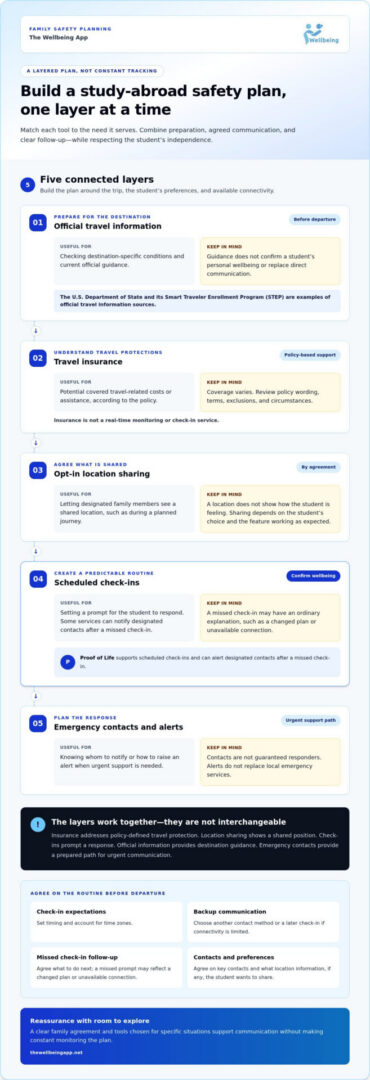
Different tools serve different purposes. Official travel information helps families prepare using current guidance. Travel insurance addresses eligible travel-related costs or assistance according to the policy. Location sharing can provide visibility when the student agrees to share. Scheduled check-ins create a routine for confirming wellbeing, while emergency contacts and alerts help direct communication when urgent support is needed. These functions can work together, but they aren’t interchangeable.
Why one tool rarely covers every need
An insurance policy can’t tell a parent whether a student arrived safely after a late journey. Location sharing can show a position, but it doesn’t confirm that the student is available to talk or needs help. A scheduled check-in prompts a clear response, while official advisories provide information that a family messaging routine can’t replace.
Choose tools around the trip. A student moving between destinations may need a different communication routine from one staying in a single place. Consider the student’s comfort with sharing their location and the likelihood of limited connectivity. Agree on a practical backup, such as a later check-in or another contact method, rather than assuming every app or message will work in every situation.
The Wellbeing App’s Proof of Life supports scheduled check-ins and can notify designated contacts after a missed check-in. This adds structure to a family plan without requiring continuous location sharing. Digital tools support communication, but they can’t guarantee safety or replace local emergency services. The strongest plan combines preparation, suitable protections, and clear expectations agreed on by both the parent and student.
Compare study-abroad safety tools by what they help families do
The most useful study abroad safety tools for parents address different needs, from preparing for a trip to knowing when a student has checked in. Compare options by their purpose, not by how much monitoring they provide. Consider each tool’s limitations so you know what it can and can’t do.
| Tool type | Best-fit need | Useful benefit | Limitation |
|---|---|---|---|
| Official travel information | Preparing for destination-specific conditions | Provides guidance and updates from official sources, such as the U.S. Department of State and its Smart Traveler Enrollment Program (STEP). | Doesn’t confirm a student’s personal wellbeing or replace direct communication. Check current destination guidance through official sources. |
| Travel insurance | Understanding potential covered costs and travel assistance | Can provide protections according to the policy’s terms. | Coverage varies. Review the current policy wording; insurance isn’t a real-time monitoring or check-in service. |
| Opt-in location sharing | Sharing whereabouts by agreement | Can help designated family members see a shared location, which may be useful during a planned journey. | A location doesn’t confirm how the student is feeling, and sharing depends on the student’s choice and the feature working as expected. |
| Scheduled check-ins | Creating a predictable routine for confirming wellbeing | Offers a set prompt to respond; some services can notify designated contacts after a missed check-in. | A missed check-in may have an ordinary explanation, such as a changed plan or unavailable connection, so families still need an agreed follow-up. |
| Emergency contacts and alerts | Knowing whom to notify or how to raise an alert | Gives the student and family a prepared contact path when urgent support is needed. | Contacts are people to notify, not guaranteed responders. Alerts don’t replace local emergency services. |
Official information and travel protections
Use the U.S. Department of State and STEP for official travel information, and review current destination guidance before departure. Insurance serves a separate purpose: its protections depend on policy terms, exclusions, and the circumstances involved. Enrollment or insurance alone won’t establish a family check-in routine. Read the policy documentation to understand what it covers rather than assuming it includes a particular service.
Location sharing, check-ins, and alert tools
Insurance, location sharing, and check-ins aren’t interchangeable: insurance concerns policy-defined travel protections, location sharing shows a shared position, and check-ins prompt a status update. Choose between opt-in location visibility and scheduled check-ins based on the student’s comfort and itinerary. Some families may agree to use both in specific situations. The Wellbeing App offers Location Sharing, Emergency Alerts, and Proof of Life scheduled check-ins, which can notify designated contacts after a missed check-in. These tools support a family plan, not a guaranteed outcome. Explore scheduled check-in and safety tools as one option to include in that plan.
Do study-abroad safety apps undermine student independence?
They can if monitoring is imposed without discussion, but constant tracking isn’t the only way to create a safety routine. Families can choose an approach that offers reassurance while letting the student decide what information to share and when. The best study abroad safety tools for parents support an agreement rather than replace trust.
Each communication option has a different balance of structure and privacy:
- Scheduled check-ins set an agreed time to confirm that all is well. They create a predictable routine without requiring a continuous view of the student’s movements, though a missed check-in still calls for calm follow-up.
- Continuous location sharing may be useful for a particular journey or situation when the student agrees to share. It can provide location visibility, but may feel intrusive without a clear purpose or end point.
- Manual calls or messages are flexible and personal. They depend on both people remembering to reach out and being available, so expectations can become unclear when plans or time zones change.
Set boundaries before the student leaves
Have the student help shape the arrangement. Agree on what they’ll share, who can see it, and why. Set a check-in window that fits around classes, travel, sleep, and social plans rather than expecting a response at any hour. Decide how to pause, revise, or end location sharing if the student’s needs change. Clear boundaries make the arrangement easier to trust.
Define a simple follow-up sequence in advance: send a message, try the agreed alternate contact method, then take further steps only if the situation and prior agreement justify them. This prevents a late reply from automatically triggering alarm.
Understand what an app can and cannot tell you
A missed check-in is a prompt to follow up, not proof that an emergency has occurred. The student may be in class, asleep, traveling, or unable to connect. A location signal can also be affected by permissions, battery level, device settings, or connectivity. Location information may not reflect the student’s exact or current circumstances.
Before departure, discuss what an alert means and what the designated contact is expected to do. App notifications can support communication, but they don’t guarantee a connection, an accurate location, or intervention. Emergency services and local procedures remain separate, so the student should know how to seek appropriate help directly. The aim is a shared routine that gives everyone a clear next step without treating technology as certainty.
How to prepare a study-abroad check-in and alert plan
A useful check-in plan is specific enough to guide everyone but flexible enough to fit student life. Agree on it together before departure. These steps turn study abroad safety tools for parents into a shared routine, not an expectation of constant availability.
Agree on a routine that works across time zones
Choose a predictable check-in window based on the student’s schedule and local time. Decide what counts as a missed check-in and how long to wait before following up. A class, late journey, or time-zone mix-up may explain a delayed reply, so follow the agreed plan before drawing conclusions.
- Choose the check-in cadence. Agree how often the student will check in and whether plans such as overnight travel call for a temporary adjustment. Keep the routine manageable for both sides.
- Set time-zone expectations. Write down the relevant local times so neither person has to guess whether a message is late. Include a simple way to flag a changed plan.
- Name a backup communication method. If the usual method isn’t working, the student might try an agreed alternative, such as a call or text. Discuss what to do if the phone battery is depleted or connectivity is limited, such as contacting an agreed trusted person when practical.
- List trusted contacts. Identify who may receive a check-in alert, how they know the student, and what their role is. Make sure the student understands who may be notified and agrees to the arrangement.
- Set escalation boundaries. Write a short sequence: send a calm follow-up, try the backup method, then take the next step the family agreed on. Distinguish routine missed messages from a credible urgent concern. In an emergency, use appropriate local emergency services rather than waiting for a check-in.
Prepare contacts and next steps together
Review the plan before departure and after any major itinerary or schedule change. Agree when location sharing or scheduled check-ins will be used, who can see information, and how the student can pause or revise the arrangement. A missed check-in notification is a prompt to follow the agreed steps, not proof that something has happened.
For a structured check-in option, explore The Wellbeing App’s safety tools. Proof of Life supports scheduled check-ins and can notify designated contacts after a missed check-in as one part of the family’s wider communication plan.
Where The Wellbeing App fits in a family safety plan
The Wellbeing App can be one layer in a family’s plan, alongside official travel information, suitable travel protections, and a check-in agreement shaped by the student and family. It doesn’t replace destination guidance, direct communication, or local emergency services. Use it to add structure to agreed check-ins and communication, not as a guarantee of safety.
Match the app features to agreed family needs
Start with the situation you want a tool to support. If the priority is a regular way to confirm wellbeing, Proof of Life supports scheduled check-ins. When a scheduled check-in is missed, automated alerts can notify designated contacts and prompt them to follow the family’s agreed next steps.
Location Sharing offers a way to share real-time location within boundaries the student and family have discussed. Agree on when sharing is useful and who may see the information instead of assuming it needs to stay on continuously. Emergency Alerts are another tool, but an alert shouldn’t be treated as guaranteed rescue or a substitute for contacting emergency services when needed.
Chaperone and Night Watch are also available offerings. Families can consider whether these tools fit their agreed needs without assuming that every feature is necessary for every trip. The goal is a small, purposeful set of tools that the student understands and feels comfortable using.
Choose a next step without overcomplicating the plan
Begin with one agreed check-in routine. Decide together when the student will check in, which contacts may receive a missed-check-in alert, and what those contacts should do next. Review the arrangement if the itinerary or student’s preferences change. Automated monitoring can supplement direct messages, but works best as part of a shared plan that leaves the student in control of agreed information.
The Wellbeing App offers recurring subscription plans for individual or family access to premium monitoring and alerts. Explore The Wellbeing App and build a more connected safety routine to learn about its tools and subscription options, then choose what fits your family’s communication agreement.
Build a safety routine that supports confidence and connection
A thoughtful plan helps parents stay connected while letting students make their own choices. The most effective study abroad safety tools for parents serve distinct purposes: official travel information helps families prepare, insurance addresses policy-defined protections, and agreed check-ins or location sharing support communication.
Start with a routine the student is comfortable following. Decide who receives updates, what counts as a missed check-in, and how to follow up without treating a delayed reply as proof of an emergency. Technology can add structure, but it can’t guarantee safety or replace local emergency services.
Proof of Life supports scheduled check-ins and can send automated notifications to designated contacts after a missed check-in. The Wellbeing App also offers Chaperone, Night Watch, Location Sharing, and Emergency Alerts, giving families options to consider within their agreed plan.
Explore The Wellbeing App’s safety tools and subscription options to find a practical way to support your family’s communication routine. With clear expectations and a plan made together, students can explore with greater independence while families stay connected with care.
Frequently Asked Questions
Is a safety app enough to keep a student safe while studying abroad?
No. A safety app can’t guarantee a student’s safety or replace local emergency services. Treat it as one layer alongside preparation, official travel information, insurance considerations, trusted contacts, and an agreed check-in routine. Location sharing or an alert can help family members communicate, but what an app reports may depend on connectivity, device access, battery, and settings. Make sure everyone knows how to seek help outside the app.
Can parents track a student abroad without making them feel monitored?
Yes. Parents can stay connected without assuming continuous tracking is necessary. Before departure, discuss consent and agree together on scheduled check-ins or limited, purpose-based location sharing. Decide who can see information, when sharing is expected, and what steps follow a missed check-in. Keep the student involved, and revisit the arrangement as classes, travel plans, or comfort levels change. Clear boundaries help the routine feel supportive rather than intrusive.
What happens if a student misses a scheduled safety check-in?
A missed check-in is a prompt to follow the family’s agreed sequence, not automatic proof of an emergency. Start with a direct message or call, then try the backup contact method and follow the next agreed step. If there’s a credible immediate emergency, use appropriate local emergency channels. Automated alerts can notify designated contacts after a missed check-in, but can’t guarantee that someone will respond.
How can parents stay in touch with a student in a different time zone?
Agree on realistic check-in windows that fit the student’s classes, sleep, and travel schedule. Set expectations using the student’s local time, and define what counts as a missed check-in before departure. Choose a backup method for periods of weak connectivity, such as an agreed call or text option. Keep the routine simple and revisit it as plans change. Scheduled check-ins and alerts can support direct communication, not replace it.
Does travel insurance include location sharing or family safety alerts?
Not necessarily. Travel insurance and digital safety tools serve different purposes: policy terms define covered travel or medical benefits, while location sharing and check-in services support communication or notifications. Don’t assume one includes the other. Review current policy documents to understand which services, circumstances, and contacts are covered. Discuss communication tools separately with the student so everyone knows how updates and alerts fit into the broader plan.
Do automated check-in alerts work if a student’s phone has no internet connection?
Don’t assume an alert or location update will arrive during a connectivity outage. App notifications and location information may depend on device access, permissions, battery, settings, and network connection. Before departure, agree on a reasonable response window and a backup contact method for times when the phone can’t connect or its battery is depleted. Automated alerts add a communication layer, but they don’t replace a working connection or emergency procedures.
What safety tools should parents set up before a student studies abroad?
A practical set of study abroad safety tools for parents can include official travel information, relevant travel protections, trusted contacts, and an agreed check-in routine. Location sharing or automated alerts may also suit the student’s preferences and itinerary. Make these choices together, consider likely connectivity, and review current official advice and policy terms. Keep the plan clear and easy to revise as schedules, travel plans, or communication needs change.