2026 Guide: Safety Apps for Night Shift Workers
Imagine walking to your car at 3 AM, the silence of the empty streets pressing against you while your family sleeps soundly at home. You don’t want to wake them with a routine check-in, yet the “what if” lingers in the back of your mind. It’s a heavy burden to carry alone. Finding a reliable safety app for night shift workers isn’t just about tracking your location; it’s about ensuring something is always looking out for you. You deserve to feel a deep sense of mental tranquility, knowing that your safety doesn’t depend on your ability to reach for a phone in a crisis.
We understand that true security comes from proactive vigilance rather than passive observation. In this 2026 guide, you’ll discover how automated safety technology provides a protective digital shield for those working while the rest of the world sleeps. We’ll explore how specialized tools like Proof of Life indicators and the Chaperone feature offer professional-grade monitoring without the need for extra hardware. By the end of this article, you’ll understand how to implement a Night Watch system that triggers automated alerts even if you’re incapacitated, ensuring you’re never truly alone during the late hours.
Key Takeaways
- Identify the hidden risks of the night shift “safety gap” and learn how proactive technology fosters mental tranquility while you work.
- Compare active and passive safety features to understand why automated server-side monitoring is essential for managing silent emergencies.
- Discover how a dedicated safety app for night shift workers eliminates the “guilt factor” of waking loved ones for routine check-ins.
- Explore specialized tools like Chaperone and Proof of Life that act as a watchful protector during your commute and late-night hours.
- Learn to establish a professional-grade safety protocol that ensures help is summoned automatically even if you are incapacitated.
Understanding the Night Shift Safety Gap in 2026
The “safety gap” represents a profound vulnerability for those working outside standard business hours. It’s the silent window when the world is asleep, professional help is at its most distant, and your primary support network is unavailable. For many, this gap creates a constant state of empathetic vigilance. You’re trying to stay safe while simultaneously protecting your family from the anxiety of your shift. Relying on a phone call at 3:00 AM simply doesn’t work; it’s intrusive and depends entirely on your ability to make the call in the first place. If something goes wrong, you don’t want to be the reason a loved one loses sleep, yet you need to know someone will notice if you stop responding.
A digital safety net has become a modern workplace essential. It bridges the distance between isolation and assistance. By using a safety app for night shift workers, you transform your phone into a compassionate guardian that watches over you when no one else can. This technology preserves your mental tranquility, allowing you to focus on your duties without the underlying fear of being forgotten in an emergency.
The Reality of Lone Working at Night
Many professions rely on individuals working in total isolation. Nurses moving between wards, security personnel patrolling dark perimeters, and warehouse staff managing inventory are often classified as lone workers. What is a Lone Worker? Generally, it’s someone who works without direct or close supervision, a status that carries unique risks during the late-night hours. The “invisible commute” to and from these roles is often the most vulnerable time because you’re transitioning between secure environments. Using the Chaperone feature within a safety app for night shift workers provides a proactive guardian for these isolated professionals, ensuring that silence is never mistaken for safety.
Why 2026 Demands More Than Just GPS
Simple location sharing has significant limitations in a crisis. Knowing your coordinates is useless if no one is awake to check them or if you cannot trigger an alert yourself. GPS is reactive; it only helps after someone realizes you’re missing. We’ve moved into an era where we need Proof of Life indicators that monitor your well-being automatically. These tools detect when you’ve stopped moving or haven’t checked in, shifting the burden of safety from the individual to the technology. This proactive approach is exactly what the Night Watch system provides. It ensures that your digital shield remains intact even when you’re unable to call for help, offering a level of protection that simple tracking could never achieve.
Core Features of an Effective Safety App for Night Shift Workers
Many security tools rely on the user to initiate a call for help. This is an “active” safety feature, such as an SOS button. While these are useful, they assume you’re conscious and able to reach your device. For those on the late shift, physical exhaustion is a reality. OSHA recognizes worker fatigue as a serious safety hazard, which means you might not always be in a position to hit a button during a crisis. A proactive safety app for night shift workers shifts the responsibility from you to the technology. It uses “passive” monitoring that triggers help when you don’t take an action, solving the terrifying problem of silent emergencies.
True protection requires server-side monitoring. If your phone runs out of battery or is destroyed, a standard tracking app simply goes dark. A professional system keeps a “heartbeat” on the server. If that connection breaks, the system knows immediately. This provides a digital shield that remains active even when your hardware fails. You can find this level of sophisticated protection by exploring how automated monitoring tools provide a constant safety net and preserve your mental tranquility.
Automated Proof of Life Checks
The core of a watchful protector is the Proof of Life system. Instead of manual texting, which is easily forgotten during a busy shift, the app prompts you for a simple check-in at scheduled intervals. It’s a gentle nudge that confirms you’re okay. If you miss a check-in, the system doesn’t just wait. It begins a structured escalation process, notifying your chosen emergency circle or professional monitors. This automation provides immense mental tranquility. You don’t have to worry about whether someone is watching; the system is designed to act when you can’t.
Virtual Chaperone and Night Watch Services
High-risk transitions, like walking to a parking garage at 4 AM, require more than just a map. The Chaperone feature acts as a digital companion during these vulnerable moments. It maintains a live connection until you safely reach your destination. For stationary shifts where you might be alone in a building, Night Watch provides continuous, server-side monitoring. While Location Sharing serves as a supportive secondary layer, these primary services ensure that your safety is actively managed throughout the entire night. It’s about personal agency and proactive management rather than just passive tracking.
Manual vs. Automated Safety: Why Texting Isn’t Enough
Well-meaning friends often suggest a simple solution: “Just text me when you get there.” While this comes from a place of love, it’s a fragile strategy for anyone working the late shift. Manual check-ins rely on two people being perfectly attentive at odd hours. If you forget to send a message because of a busy shift, or if your phone battery dies, your silence is usually interpreted as forgetfulness rather than danger. A safety app for night shift workers removes this ambiguity. It replaces the “no news is good news” mindset with a system where silence is treated as a call for help.
There’s also a significant psychological barrier known as the “guilt factor.” Most night workers are deeply considerate of their family’s sleep. You might hesitate to send a routine “I’m safe” text at 4:00 AM because you don’t want to wake your spouse or parents. This hesitation creates a safety gap. When you use an automated system, you aren’t burdening your loved ones with routine pings. The technology holds the line of vigilance, only alerting your emergency circle if a Proof of Life check is missed. This preserves their rest while ensuring your protection remains absolute.
The Problem with Sleeping Emergency Contacts
Consider the reality of a 3:00 AM emergency. If you manage to send a manual text, it will likely sit unread behind a “Do Not Disturb” setting or a heavy sleeper’s pillow. Help could be hours away simply because your emergency contact is resting. Automated systems bypass these human limitations by using persistent, multi-channel alerts that are much harder to ignore. Incorporating NIOSH guidance on night shift safety into your routine emphasizes the need for reliable communication channels. A safety app never sleeps, ensuring 24/7 coverage that a human partner simply cannot provide.
Reliability and Server-Side Security
Manual texting and simple GPS sharing both share a single point of failure: your phone. If your device is stolen, broken, or runs out of power, your safety net vanishes instantly. Professional-grade automation uses server-side triggers to prevent this. When the server expects a check-in and doesn’t receive a signal, it assumes the worst and acts immediately. This creates a fail-safe against incapacitation. Whether you’re dealing with a medical issue or a security threat, the system doesn’t need you to reach for your pocket to know that something is wrong. It provides the mental tranquility of knowing that your safety isn’t dependent on a piece of hardware that can fail.
How to Build Your Night Shift Safety Protocol
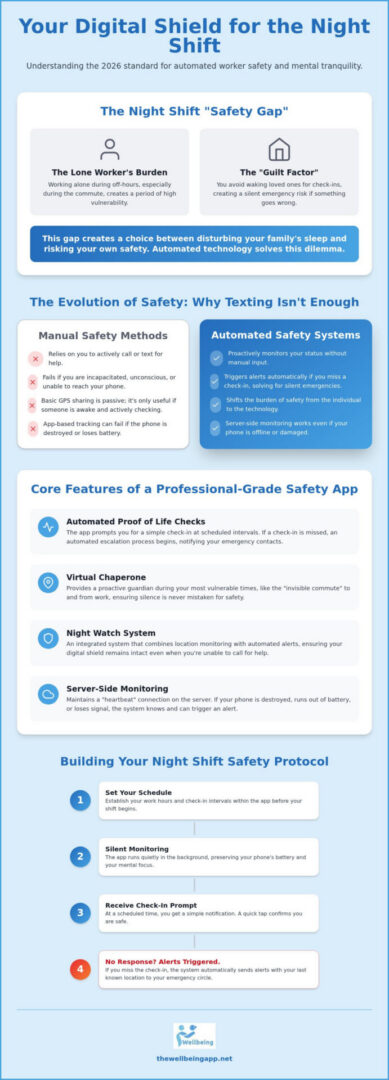
Building a personal safety protocol is about turning technology into a reliable habit. While having a safety app for night shift workers is the first step, its effectiveness depends on how you integrate it into your nocturnal routine. A well-designed protocol ensures you never have to think twice about your security, allowing you to maintain mental tranquility throughout your shift. Start by identifying the high-risk moments of your night, such as the transition from your vehicle to your workplace or periods of total isolation during your duties. Setting realistic check-in intervals is vital; a high-risk commute might require a check-in every ten minutes, while a stationary shift might only need one every two hours.
Setting Up Your Safety Circle
Selecting the right emergency contacts is the foundation of your digital shield. When you work at night, your primary contact shouldn’t just be the person you love most, but the person most likely to be responsive at 4:00 AM. Consider adding a “night owl” friend or a family member who lives in a different time zone where it’s currently daylight. Creating multiple layers of protection ensures that if one person misses an alert, another is ready to act. Once you’ve chosen your circle, sit down with them to explain your plan. They need to understand that an automated alert from your safety app for night shift workers isn’t a casual notification, but a signal that requires immediate attention. Fostering a sense of community-based vigilance protects everyone involved and honors your duty to those who care for you.
The Commute and Shift Routine
Your safety protocol should begin the moment you leave your front door. Use the Chaperone feature during your “invisible commute,” especially when walking through dimly lit parking structures or transit stations. Digital companionship remains active until you confirm you’ve reached your entrance. Once you’re on the clock, transition to the Night Watch system for continuous monitoring. Integrate a Proof of Life check for the midpoint of your shift, particularly if you’re working alone in a large facility. Verification of well-being happens without requiring a disruptive phone call. Finally, conclude your protocol with a final check-in once you’re home. Ending the period of high vigilance allows both you and your loved ones to rest without lingering anxiety. To start building your own custom protocol, you can set up your safety circle with The Wellbeing App and take control of your late-night security.
The Wellbeing App: Your Watchful Protector for the Night Shift
The Wellbeing App stands as the logical conclusion for anyone seeking a comprehensive safety app for night shift workers. It’s far more than a collection of technical features; it’s a compassionate guardian designed to bridge the gap between isolation and security. By focusing on the preservation of your mental state, this technology allows you to perform your duties with a sense of harmony. You’re no longer just a lone worker navigating the dark hours. Instead, you’re part of a monitored system that values your well-being as much as you do. This digital shield is built for the specific challenges of the 2026 workforce, ensuring that your safety remains a constant, uninterrupted priority.
Empowerment Through Technology
True security comes from transforming a passive user into a proactive manager of their own safety. The Wellbeing App achieves this through a calm and supportive interface designed specifically for high-stress environments. It doesn’t rely on aggressive alerts that increase anxiety; it uses steady, rhythmic monitoring that provides a sense of protective reassurance. The Proof of Life system is a cornerstone of this empowerment. It ensures that your safety isn’t dependent on a single piece of hardware that might fail or be lost. By using server-side indicators, the app detects silence and acts on your behalf. This level of sophisticated protection allows you to focus on your professional responsibilities, knowing that your digital guardian is always awake and vigilant.
Getting Started with Your Digital Guardian
Taking the first step toward mental tranquility is a gift to yourself and those who care for you. We believe that safety is a shared responsibility, and our technology is the instrument that makes this collective vigilance possible. Choosing a professional-grade safety app for night shift workers is a powerful appeal to your sense of duty toward your loved ones. It eliminates the “guilt factor” of potentially waking them, replacing it with a structured, reliable protocol. The subscription model is not just a service fee; it’s a vital investment in your personal agency and long-term peace of mind. By implementing the Night Watch and Chaperone features into your nightly routine, you’re fostering social cohesion and ensuring that help is always within reach. Don’t wait for an incident to realize the value of proactive protection.
Protect your night shift with The Wellbeing App
Step Into the Light of Proactive Protection
Working while the world sleeps shouldn’t mean working in fear. We’ve explored how a dedicated safety app for night shift workers transforms the experience from one of isolation to one of empowered security. By prioritizing automated Proof of Life monitoring, you ensure that help is summoned even if you’re incapacitated. This proactive approach bridges the safety gap, replacing the uncertainty of the late hours with a structured digital shield that preserves your well-being and mental tranquility.
Specialized features like the Chaperone for your commute and 24/7 Night Watch protection offer more than just technical security; they provide the harmony you and your family deserve. You have the personal agency to manage your own safety without burdening those you love with routine check-ins. It’s time to embrace a system that never sleeps and always watches over you. Secure your peace of mind. Download The Wellbeing App today. You’re never truly alone when you have a watchful protector by your side.
Frequently Asked Questions
How does a safety app differ from a standard GPS tracker like Find My?
A safety app for night shift workers provides proactive monitoring rather than just passive location sharing. While standard trackers show your coordinates, they don’t know if you’re in trouble unless a loved one checks the map. Our system uses automated indicators to verify your well-being. If you stop moving or miss a check-in, the app initiates an alert sequence immediately. This ensures help is summoned even if no one is watching the screen.
Will the app work if my phone loses signal or the battery dies?
Yes, the system remains vigilant through server-side monitoring. Unlike standard apps that simply go offline when a phone dies, our server expects a “heartbeat” from your device. If that connection is lost unexpectedly, it triggers a “lost signal” protocol. This fail-safe ensures that hardware failure or a dead battery doesn’t leave you unprotected. It provides mental tranquility by guaranteeing that your digital shield doesn’t vanish just because your phone does.
What happens if I accidentally miss a scheduled Proof of Life check-in?
Missing a Proof of Life check-in triggers a compassionate escalation process. First, the app sends a series of persistent notifications and audible pings to your device to ensure you’re simply busy. If you don’t respond within a grace period, the system automatically alerts your designated emergency circle. This structured response prevents false alarms while ensuring that a real crisis is never ignored. It’s a reliable way to maintain safety without constant manual texting.
Can I use the Virtual Chaperone feature for my commute every night?
You can and should use the Chaperone feature for every late-night commute. It’s designed to be a digital companion for those vulnerable walks between your car and your workplace. By establishing this as a daily habit, you ensure that your most isolated moments are always monitored. The feature remains active until you confirm you’ve safely reached your destination. This routine use builds a consistent safety protocol that protects your well-being throughout the entire year.
Is the app only for seniors, or is it suitable for younger night workers too?
This safety app for night shift workers is designed for anyone navigating isolated environments, regardless of age. While seniors often use similar tools, younger professionals in nursing, security, and logistics face unique risks during the late hours. The interface is modern and sophisticated, focusing on empowerment rather than frailty. It serves as a professional-grade tool for any independent worker who wants to ensure they have a reliable, automated protector watching over them while they work.
How do automated alerts bypass a contact’s “Do Not Disturb” settings?
Automated alerts utilize “Critical Alerts” on iOS and “Emergency Channels” on Android to bypass silencers. When you set up your safety circle, your contacts are prompted to grant permission for these high-priority notifications. This ensures that if a Night Watch alert is triggered at 4 AM, their phone will ring even if it’s on silent. It’s a vital feature that overcomes the human limitation of sleep, ensuring your call for help is always heard.
Does the app require a monthly subscription to function?
Access to our professional-grade monitoring services requires a subscription. This investment supports the server-side infrastructure and automated systems that provide 24/7 protection. It ensures that your safety net is always active and technologically robust. By choosing a subscription, you’re prioritizing your personal agency and ensuring that your protective shield is never compromised by lack of resources. It’s a small commitment for the immense mental tranquility and proactive security it provides to you and your family.
Is my location data private when I am not actively using a safety feature?
Your privacy is a core pillar of our mission. Location sharing is only active when you’ve engaged a specific feature like Chaperone or Night Watch. We don’t believe in constant, invasive tracking. You remain in control of your data, and the app only monitors your coordinates when it’s necessary for your protection. This approach respects your personal boundaries while ensuring that the system is ready to act the moment you step into a high-risk situation.