
No-Hardware Personal Safety Apps: 2026 Security Guide
The most reliable safety device in 2026 isn’t a bulky pendant or expensive proprietary hardware that you’ll inevitably forget to charge; it’s the smartphone already resting in your pocket. We often believe that real security requires dedicated devices, yet the reality is that a personal safety app no hardware solution is often more dependable because it’s part of our daily rhythm. You already know the anxiety of wondering if a parent is okay or if a friend made it home safely from a late shift. You don’t want to nag them with constant calls, but you need to know they’re protected by a watchful eye that never sleeps.
This guide will show you how to transform your phone into a compassionate guardian that offers true mental tranquility for your whole family. We’ll explore how modern features like Proof of Life and Night Watch provide a silent, automated safety net that doesn’t carry the social stigma of traditional medical necklaces. You’ll discover how server-side monitoring ensures help is always on the way, even if a phone is turned off or lost. It’s time to embrace a more human, proactive way to manage your family’s well-being without the burden of extra gear.
Key Takeaways
- Discover why a personal safety app no hardware solution is the most reliable choice in 2026 because it leverages the smartphone you already carry and charge every day.
- Learn how proactive Proof of Life monitoring removes the burden of pressing an SOS button by automatically verifying your status through scheduled check-ins.
- Understand the cost and convenience benefits of software-only security, which eliminates the high upfront fees and stigma associated with traditional medical pendants.
- Explore how server-side technology ensures your safety net remains active even if your phone battery dies or you lose your signal during travel.
- Gain peace of mind by establishing a Circle of Protection that receives automated alerts only when something is truly wrong, preserving both your independence and your privacy.
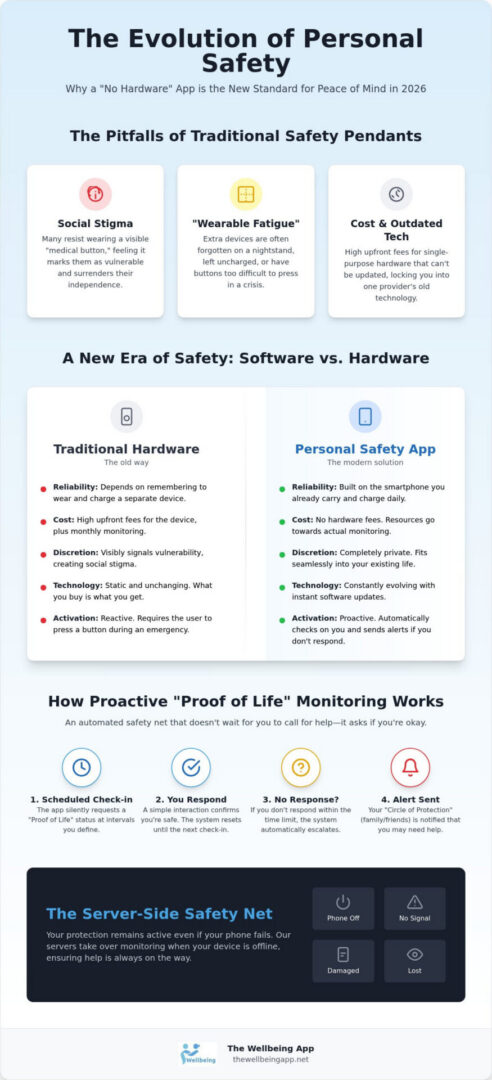
The Evolution of Personal Safety: Why “No Hardware” is the Standard in 2026
For decades, personal security meant wearing a plastic pendant or a bulky wristband. These devices were reactive; they sat dormant until a crisis occurred. By 2026, the industry has shifted toward a more integrated and empathetic approach. Hardware-free safety is a proactive digital net that utilizes the smartphone you already carry. This transition reflects a deeper understanding of human behavior. We don’t need more gadgets to manage; we need the tools we already use to work harder for our protection. Using a personal safety app that requires no hardware allows for a seamless layer of security that fits into your existing life without friction.
Many families invest in expensive safety hardware only to find the device sitting on a nightstand. This “wearable fatigue” occurs because separate devices require separate habits. You have to remember to put it on, remember to charge it with a proprietary cable, and remember to test it. When a device becomes a chore, it stops being a lifesaver. By choosing a personal safety app no hardware solution, you eliminate these points of failure. Your phone is already a central part of your routine. It stays charged, it stays with you, and it’s already connected to the world.
The financial logic is equally compelling. Traditional hardware often comes with high upfront costs for a device that only does one thing. Transitioning to software-based monitoring removes these barriers. There are no specialized batteries to buy and no shipping delays for replacement units. You gain sophisticated security features through a simple download. This ensures that your resources go toward actual monitoring and mental tranquility rather than plastic and circuitry.
The Problem with Traditional Medical Alert Hardware
Traditional pendants often fail the people who need them most. Physical limitations are common; buttons can be too hard to press or the plastic casings can crack after a minor drop. Beyond the physical, there’s the heavy weight of social stigma. Many adults resist wearing a “medical button” because it feels like a surrender of their independence. It’s a visible marker of vulnerability. Additionally, these devices often lock you into a single manufacturer’s ecosystem. This makes it difficult to switch services without buying entirely new equipment.
The Smartphone Advantage: Habitual Reliability
Smartphones offer a level of habitual reliability that no dedicated tracker can match. We’ve been conditioned to charge our phones every night, which means the battery is rarely the reason a safety net fails. These devices also house a sophisticated suite of multifunctional sensors including GPS and accelerometers. These are far more advanced than those found in older hardware. Software agility is the final piece of the puzzle. While a physical pendant is stuck with the technology it had the day it was manufactured, a personal safety app no hardware solution can receive instant updates. This ensures your protection evolves as quickly as the world around you, positioning the technology as a compassionate guardian rather than just a passive tool.
Understanding Proactive Protection: How “Proof of Life” Monitoring Works
Traditional safety measures rely on a person’s ability to act during their most vulnerable moments. If you’re incapacitated or in shock, you can’t reach for a button or make a phone call. Proactive protection flips this logic entirely. It doesn’t wait for you to call for help; it asks if you’re okay. Using a personal safety app no hardware solution means you have a system that monitors your well-being silently. It offers a profound sense of mental tranquility because you know help will arrive even if you’re unable to ask for it.
Research indicates that a vast majority of people rely on their smartphones for their daily sense of security. Proof of Life technology takes this habit and turns it into a professional-grade safety protocol. By using automated indicators, the system verifies your status at intervals you define. This approach significantly reduces “false alarm” anxiety. Family members don’t have to make intrusive wellness calls just to check in, as the system only alerts them when a check-in is missed.
The Role of Automated Check-Ins
For seniors living alone or individuals with medical concerns, automated check-ins provide a gentle, non-intrusive safety net. You simply set a schedule that matches your routine. The system prompts you to acknowledge a notification at a specific time. If you respond, the cycle resets. If you fail to acknowledge the prompt, the system recognizes this as a potential emergency. You can customize the frequency of these checks, allowing you to balance your personal privacy with the need for empathetic vigilance.
Server-Side Monitoring vs. Device-Only Apps
A common concern is that an app might crash or a phone battery might die. While device-only apps are vulnerable to these issues, server-side monitoring provides a robust solution. Because the safety timer lives on a secure remote server, it doesn’t matter what happens to your physical phone. Server-side monitoring acts as a “dead man’s switch” for personal security. If the server doesn’t receive a signal from your device by the designated time, it triggers the alert process immediately. This fail-safe ensures that even if your phone is lost or destroyed, your emergency contacts receive an automated notification. It’s a sophisticated way to maintain safety through The Wellbeing App, ensuring you remain empowered and protected at all times.
Software vs. Hardware: A Comprehensive Safety Comparison
Choosing between a physical device and a personal safety app no hardware solution often comes down to the balance between visibility and utility. While hardware manufacturers claim their dedicated buttons are simpler, they often overlook the “lost or forgotten” factor. A device that sits in a drawer can’t protect you. A smartphone, however, is a tool you’ve already integrated into your life. It benefits from billions of dollars in research and development, resulting in GPS accuracy and cellular signal strength that proprietary pendants rarely match. When you rely on your phone, you’re using the most sophisticated communication tool ever built to maintain your mental tranquility.
Discreetness is another area where software excels. The “stigma factor” is a significant hurdle for younger seniors and active solo travelers. Wearing a visible medical necklace can feel like an unwanted broadcast of vulnerability. In contrast, a personal safety app remains entirely invisible to those around you. It allows you to maintain your independence without sacrificing your style or privacy. Furthermore, apps offer a feature density that hardware cannot match. Tools like Night Watch and Chaperone provide active layers of protection, such as walking with you virtually or checking in after a late-night event, which a simple SOS button simply cannot do.
Comparison Table: App-Based Safety vs. Traditional Pendants
| Feature | App-Based Safety | Traditional Pendants |
|---|---|---|
| Upfront Cost | None | High (Device + Activation) |
| Charging Habit | Daily (Habitual) | Weekly (Easy to forget) |
| Discreetness | Total (Invisible) | Low (Highly visible) |
| Proactive Alerts | Yes (Proof of Life) | No (Reactive only) |
The Hidden Costs of Safety Hardware
The true cost of hardware extends far beyond the initial purchase. Physical devices are prone to wear and tear, often requiring expensive replacement fees or battery service contracts. If a pendant breaks, you may face activation delays and shipping times that leave you unprotected for days. There is also an environmental cost to consider. Proprietary trackers contribute to the growing problem of electronic waste once they become obsolete. Software-as-a-service models eliminate these issues, providing instant updates and a smaller ecological footprint. By choosing a personal safety app no hardware option, you’re investing in a system that is as sustainable as it is reliable, ensuring you are always empowered by the latest security protocols.
Setting Up Your Digital Safety Net: A Step-by-Step Guide
Setting up a professional safety system shouldn’t feel like a technical chore. Because you’ve chosen a personal safety app no hardware solution, the process is streamlined and focused entirely on your personal routine. This phase is about building a customized shield that moves with you, ensuring that your mental tranquility remains undisturbed throughout the day. It’s a proactive way to manage your safety without adding more physical gear to your life. The goal is to create a safety net that is always active but never intrusive.
Phase 1 involves establishing your monitoring schedule. This is where you configure Proof of Life and Night Watch to act as your silent observers. Phase 2 moves into defining your Circle of Protection. These are the trusted individuals who will be notified if a check-in is missed. In Phase 3, you’ll set the escalation protocol, determining the order in which contacts are reached. Finally, Phase 4 integrates the Chaperone feature, providing active protection during specific high-risk activities like walking home after dark or traveling solo in unfamiliar areas.
Establishing Your Daily Safety Rhythm
The most effective safety net is one that aligns with your existing habits. Start by setting Proof of Life check-ins during natural transition points in your day, such as when you have your morning coffee or right before bedtime. For those who feel more vulnerable overnight, optimizing Night Watch during late-night hours provides an extra layer of empathetic vigilance. Choose emergency contacts who are most likely to respond quickly, such as neighbors or family members who keep their phones nearby at all times. This ensures that any alert is met with immediate action rather than a missed notification. By integrating these checks into your rhythm, you ensure the system remains a helpful companion rather than a burden.
The Virtual Chaperone: Safety for the Modern Commuter
For the modern commuter, the Chaperone feature acts as a virtual companion during solo travels. You simply set your destination and an expected arrival time. If you don’t arrive when planned, the system initiates a status check. Real-time location sharing can be activated during these trips, providing your Circle of Protection with your exact coordinates only when it’s necessary. This maintains your privacy while ensuring help can find you. The silent alert feature is particularly powerful, allowing you to signal for assistance without escalating a situation visually or audibly. To begin building your customized shield, set up your profile on The Wellbeing App and experience the peace of mind that comes from proactive protection.
Why The Wellbeing App is the Logical Choice for Hardware-Free Security
The Wellbeing App stands apart by embracing the Watchful Protector philosophy. While other services focus on raw data and basic coordinates, we prioritize genuine care and the preservation of your mental state. Choosing a personal safety app no hardware option shouldn’t mean sacrificing authority or reliability. Our proprietary features, specifically Proof of Life and Night Watch, provide a level of specialized protection that standard tracking apps cannot match. We’ve designed every indicator and automated alert to empower you, replacing the constant hum of anxiety with a steady sense of tranquility. Whether you’re traveling across the country or just walking the dog, our national reliability ensures there are no regional gaps in your safety net within the United States.
Our approach is rooted in the concept of collective responsibility. We believe that safety is a shared effort between technology, the individual, and their community. By removing the physical barriers of traditional security, we allow the technology to become a means to a social and emotional end. This persona is disciplined and serious about safety, yet it remains accessible and friendly. It’s about more than just software; it’s about being a reliable, always-on partner dedicated to the welfare of others.
A Compassionate Approach to Senior Safety
Maintaining independence is a core value for many adults, yet it shouldn’t come at the cost of family peace of mind. Our non-intrusive monitoring supports your autonomy while fostering a sense of community unity. Families often tell us that the greatest gift is the silence of a system that works perfectly. One user shared that their daughter finally stopped worry-calling every hour because she knew the Proof of Life system would alert her if something was actually wrong. This reassurance allows families to reconnect through love rather than fear. It’s a subtle but powerful appeal to your sense of duty toward your loved ones, framed through personal agency and proactive management.
Technical Robustness Without the Bulk
Technical credibility is the backbone of our service. Our server-side notification system is built for efficiency, ensuring that alerts are dispatched even if your device is compromised. You don’t have to worry about app crashes or battery failures because the heavy lifting happens on our secure servers. We also understand that every family has different needs, which is why we offer subscription flexibility. You can choose from monthly or annual plans that fit your specific situation. This ensures that sophisticated security remains accessible to everyone without the burden of long-term hardware contracts. Protect your peace of mind with The Wellbeing App today.
Embrace a Future of Proactive Protection
The shift toward hardware-free safety isn’t just about convenience; it’s about building a more reliable and empathetic safety net. By choosing a personal safety app no hardware solution, you leverage the device you already trust and carry every single day. You’ve learned how specialized features like Proof of Life and Night Watch move beyond simple tracking to offer genuine mental tranquility for your entire family. These tools prioritize your independence while ensuring that help is always a heartbeat away, even if you can’t reach for your phone.
Our server-side monitoring ensures that alerts are dispatched even if your phone is off or lost, providing a robust fail-safe that traditional pendants simply cannot match. It’s time to step into a world where safety is a shared, seamless experience that empowers everyone involved. You deserve the peace of mind that comes from knowing a compassionate guardian is always looking out for your best interests. Start your hardware-free safety journey with The Wellbeing App today and discover the harmony of a truly protected life.
Frequently Asked Questions
Is a personal safety app as reliable as a hardware panic button?
A personal safety app no hardware solution is often more reliable because it integrates with the device you already use and charge daily. Traditional hardware buttons frequently fail because they are left on a nightstand or forgotten in a drawer. Smartphones offer superior GPS technology and constant cellular connectivity compared to basic pendants. By using the phone’s existing sensors and habitual charging cycle, you ensure your safety net is active exactly when you need it most.
What happens if my phone battery dies or I lose signal?
If your phone loses power or signal, our server-side monitoring acts as a vital fail-safe. Unlike device-only apps that stop working when the phone dies, the safety timer for features like Proof of Life lives on our secure remote servers. If the server doesn’t receive your scheduled check-in, it automatically triggers an alert to your designated contacts. This ensures your protection remains uninterrupted even if your physical device is completely compromised or out of reach.
Does a “no hardware” safety app drain my smartphone battery?
Modern safety apps are designed for extreme energy efficiency to ensure they don’t impact your daily phone usage. While continuous GPS tracking can consume more power, proactive features like Proof of Life only activate the phone’s sensors during your specific check-in windows. This targeted approach allows you to maintain high levels of security without constantly searching for a charger. You can go about your day with mental tranquility, knowing your battery will last through your entire routine.
Can I use this app for an elderly parent who is not tech-savvy?
Our interface is intentionally built for simplicity, making it an ideal choice for seniors who prefer straightforward technology. The app doesn’t require complex navigation; a user simply taps a single notification to acknowledge a Proof of Life check-in. This non-intrusive design allows elderly parents to maintain their independence without the social stigma of wearing a medical pendant. It’s a compassionate way to provide family peace of mind while respecting their personal agency and daily comfort.
What is the difference between location sharing and “Proof of Life”?
Location sharing tells your family where you are, but Proof of Life confirms that you are actually okay. Standard tracking is a reactive tool that requires someone else to check your status. In contrast, Proof of Life is a proactive indicator that asks you to verify your well-being at set intervals. If you fail to respond, the system recognizes the silence as a potential emergency. It moves beyond passive tracking to provide active, empathetic vigilance for your safety.
How much does a hardware-free personal safety app typically cost per month?
While pricing for a personal safety app no hardware service varies by provider, it almost always costs significantly less than traditional hardware systems. You avoid the high upfront costs of buying a physical device and activation fees. Most services offer flexible monthly or annual subscriptions that can be adjusted to fit your family’s specific needs. This software-as-a-service model ensures you’re always using the latest security updates without having to purchase a new physical tracker every few years.
Will the app alert emergency services (911) automatically?
The system is designed to alert your designated Circle of Protection first to ensure a compassionate and immediate response from people you trust. While some professional monitoring tiers can facilitate emergency dispatch, the primary goal is to notify your family or neighbors through automated Emergency Alerts. This protocol allows your loved ones to verify the situation before escalating to local authorities. It reduces unnecessary emergency calls while ensuring that help is dispatched quickly when a true emergency is confirmed.
Can I set different emergency contacts for different times of the day?
You can absolutely customize your escalation protocol to match the availability of your contacts throughout the day. For example, you might set a coworker as a primary contact during business hours and a family member for the Night Watch period. This flexibility ensures that the person receiving the alert is the one most likely to respond immediately. It allows you to build a sophisticated safety net that adapts to the real-world schedules of your community and family.