Emergency Alert Systems: A Comprehensive Guide to Public and Personal Safety in 2026
Imagine your elderly mother misses her usual morning call, but you don’t realize it until evening because your own day was swallowed by meetings. It’s the silent gap between a normal routine and a potential crisis that creates the most anxiety for modern families. You likely feel that relying on manual check-ins is a fragile solution, as they’re easily forgotten during a busy afternoon or impossible to send if someone is incapacitated. This is why many are integrating an automated wellness check app into their daily lives to act as a compassionate guardian when they cannot be there in person.
We understand that your mental tranquility is tied to the safety of those you love. This guide will help you discover the critical differences between national warning systems and personal proactive monitoring to build a foolproof safety net. We’ll explore how government alerts handle broad public emergencies while specialized tools like Proof of Life, Chaperone, and Night Watch provide the specific, reliable oversight needed to ensure help triggers automatically if a check-in is missed. You’ll gain a clear roadmap for combining public resources with sophisticated personal technology to protect your family’s well-being and maintain a sense of harmony.
Key Takeaways
- Learn how to layer national warning systems with personal monitoring to ensure there are no gaps in your family’s safety net.
- Understand the critical shift from reactive devices to proactive triggers that provide help even if you are unable to reach your phone.
- Discover how an automated wellness check app like Proof of Life removes the burden of manual texting by notifying loved ones only when you fail to check in.
- Gain peace of mind with server-side monitoring that ensures emergency alerts are delivered even if your device is destroyed, offline, or out of battery.
- Explore specialized protection for high-risk moments through Night Watch sleep monitoring and Chaperone transit services.
Understanding Emergency Alert Systems: Public vs. Personal Protection
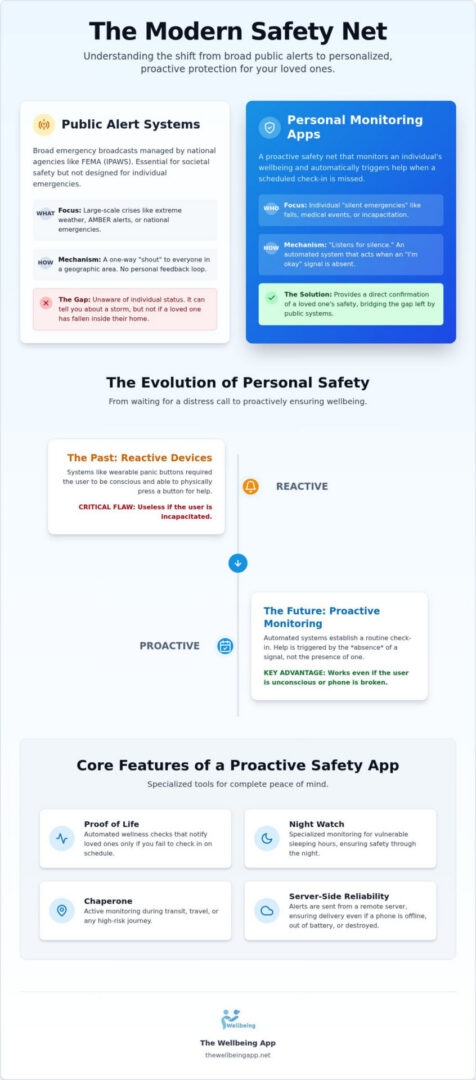
Emergency alert systems are fundamentally designed as broad emergency communication systems that deliver critical instructions during large-scale crises. While these networks are essential for societal stability, they’re often misunderstood as a complete safety solution. Public systems focus on the “what” and the “where” of a disaster, yet they remain entirely unaware of the “who” at an individual level. They don’t know if your father is safe in his home or if your daughter arrived at her destination. This creates a dangerous gap in personal security that only a dedicated, proactive layer of protection can fill.
The Role of FEMA and IPAWS in National Safety
The Integrated Public Alert and Warning System (IPAWS) is the backbone of American public safety. Managed by FEMA, this system coordinates various channels to send Wireless Emergency Alerts (WEA) directly to your smartphone. As FEMA continues its 2026 national EAS testing schedules, the reliability of these broadcasts is at an all-time high. These alerts are incredibly effective for weather events or AMBER alerts because they don’t require an app or a subscription. However, these are broadcast tools. They’re designed to shout a warning to everyone in a geographic area. They can’t listen for a signal of distress from a single person who has fallen or become incapacitated. Relying solely on these broadcasts means you’re informed about the storm, but your family is still vulnerable if an individual crisis occurs simultaneously.
Why You Need a Personal Emergency Alert System
A personal safety net addresses the “silent emergency.” These are the moments when a loved one is unable to reach their phone or dial 911. Traditional reactive systems, such as wearable buttons, often fail because they require the person to be conscious and mobile enough to press them. In contrast, an automated wellness check app shifts the responsibility from the victim to a compassionate guardian. This technology doesn’t wait for a cry for help; it looks for the absence of a “safe” signal.
By utilizing features like Proof of Life, the system monitors for a “pulse” of activity. If a scheduled check-in is missed, the technology takes over. This proactive approach offers a deep sense of mental tranquility for families. You don’t have to live in a state of constant anxiety, wondering if a lack of response to a text message signifies a busy afternoon or a genuine emergency. It empowers independent living by ensuring that if the unthinkable happens, the silence itself becomes the trigger for help. Collective responsibility becomes effortless when you have an always-on partner watching over those who matter most.
The Evolution of Personal Monitoring: From Reactive to Proactive
For decades, the gold standard for home safety was the reactive button. These Personal Emergency Response Systems (PERS) provided a sense of security, but they relied entirely on the user’s ability to act during a crisis. If a medical event renders someone unconscious or unable to reach their wristband, the system remains silent. This is the critical vulnerability of reactive technology. It assumes the victim can always be their own first responder, which often isn’t the case in high-stakes emergencies.
Modern safety has evolved into a proactive model that anticipates needs before they become catastrophes. Instead of waiting for a manual trigger, an automated wellness check app establishes a recurring “all-is-well” signal. This is similar in spirit to state-sponsored wellness check programs, which have successfully used automated check-ins to confirm the safety of seniors for years. Today’s software takes this further by integrating server-side monitoring. Because the check-in timer lives on a remote server, not just your phone, the emergency alert will trigger even if your device is crushed, stolen, or runs out of battery.
The Shift to Automated Safety Alerts
Automation effectively removes the “human error” factor from family safety protocols. We’ve all forgotten to send that “I’m home” text, causing unnecessary panic for our loved ones. By using a structured system, these check-ins become a non-intrusive part of daily life for independent seniors and solo adults. These proactive alerts act as a digital heartbeat for family unity, providing a constant, quiet assurance that everyone is accounted for without the need for constant, pestering phone calls. This allows families to focus on their connection rather than their fears.
Location Sharing and Real-Time Vigilance
While traditional systems were tethered to the home, modern safety is mobile. GPS technology allows for real-time vigilance, which is vital for family members during solo commutes or late-night travel. This goes beyond simple “Find My Phone” features; it involves active Location Sharing during specific windows of risk. For example, using a tool like Chaperone ensures that your path is monitored during transit, providing a compassionate guardian that follows you until you’re safely behind your own door. An automated wellness check app provides the structural support needed for true real-time vigilance. If you’re looking for a way to bridge the gap between independence and security, exploring proactive safety tools can provide the mental tranquility your family deserves.
Proof of Life and Night Watch: Protecting Vulnerable Hours
True safety isn’t found in a device you have to remember to use, but in a system that remembers to check on you. While previous sections discussed the transition from reactive to proactive monitoring, it’s essential to understand the specific mechanisms that provide this constant oversight. Proof of Life is a specialized protocol designed to confirm well-being without the intrusive nature of constant texting or phone calls. It establishes a quiet, digital handshake between the user and the system, ensuring that harmony is maintained within the family dynamic without sacrificing privacy.
The beauty of this automated wellness check app lies in its response to silence. If a scheduled check-in window passes without a response, the system recognizes this as an indicator of a potential crisis. It doesn’t wait for a manual distress signal that may never come. Instead, it immediately triggers automated alerts to your designated emergency contacts. This ensures that help is on the way even if you’re incapacitated, providing a critical safety net that bridges the gap between independence and isolation.
Automated Safety Alerts for Independent Living
Living alone shouldn’t mean being alone in a crisis. Many independent seniors and solo adults harbor a deep-seated fear of an undetected medical event or a fall. Traditional wellness checks often involve a stressful cycle of “are you okay?” texts that can feel like a burden to both the sender and the receiver. Proof of Life replaces this anxiety with a structured, reliable process. By automating the confirmation of safety, you remove the emotional weight of manual check-ins. This allows family members to fulfill their sense of duty toward their loved ones while preserving everyone’s mental tranquility.
Night Watch: Security While You Sleep
Nighttime presents a unique set of vulnerabilities. When we’re asleep, we’re at our most defenseless, and the primary caregivers in our lives are often asleep as well. Night Watch is specifically engineered to protect these vulnerable hours. It automates well-being checks during the late-night and early-morning periods when a medical emergency could otherwise go unnoticed until the following day. Because the system operates on server-side logic, it ensures that help can be dispatched even if your primary contact’s phone is on silent or they’re in a deep sleep. This creates an environment of empathetic vigilance that never rests, allowing the whole family to sleep soundly knowing a watchful protector is always on duty.
Building Your Personal Safety Net: A 2026 Checklist
Creating a foolproof safety net requires a structured approach that combines public resources with personal vigilance. In 2026, safety is no longer a solitary burden but a shared family endeavor. Since over 95% of adults aged 60 to 75 now own a smartphone, the infrastructure for a sophisticated personal alert system is already in your pocket. Your first step is a thorough risk assessment. Consider your daily routines: do you commute alone after dark, live in a solo household, or manage a chronic health condition? Identifying these specific moments of vulnerability allows you to apply the right level of protection where it’s needed most.
While government alerts like Wireless Emergency Alerts (WEA) provide a necessary baseline for environmental hazards, they are broad broadcasts. To achieve true mental tranquility, you must layer this with an automated wellness check app. This proactive layer monitors your personal status and ensures that if a Proof of Life signal isn’t received, your family is notified immediately. Establishing a clear protocol for your emergency contacts is equally vital. They should know exactly who to call and what steps to take the moment an alert reaches their device, transforming a passive notification into a life-saving action.
The Virtual Chaperone for Solo Commuters
For students or late-shift workers, the walk from a parking lot or transit station can be a source of significant anxiety. Activating a Chaperone service during these solo commutes provides an active layer of monitoring. Unlike standard GPS tracking, this mechanism uses a pre-set end-time. You tell the system when you expect to be safe inside your destination. If you don’t confirm your arrival by that time, the system triggers an alert. This ensures that help is dispatched to your last known location without you ever needing to reach for your phone during a struggle or medical event.
Integrating Community and Family Unity
Safety thrives in an atmosphere of collective responsibility. We view family safety not just as a technical feature, but as a commitment to one another’s well-being. Selecting your inner circle of emergency contacts is a high-stakes decision. These individuals should be reliable and trained on how your safety app functions. When everyone understands their role, the entire family operates as a cohesive unit of protection. This structured approach to collective responsibility reduces the bystander effect in personal emergencies by ensuring that specific, designated individuals are empowered to take immediate action. If you’re ready to secure your family’s future, you can start building your proactive safety net today with our specialized monitoring tools.
The Wellbeing App: Proactive Guardian for Modern Living
The Wellbeing App isn’t just a software solution; it’s a compassionate guardian that integrates seamlessly into your family’s daily rhythm. By combining Proof of Life, Chaperone, and Night Watch into a single automated wellness check app, we provide a comprehensive safety net that covers every hour of your life. Whether you’re navigating a solo commute or settling in for the night, the system maintains a watchful presence. This integration ensures that your family remains a cohesive unit of protection, rooted in the preservation of your mental state and collective harmony.
One of the most critical technical advantages we offer is server-side monitoring. Traditional safety apps often fail if a smartphone runs out of battery, loses its signal, or is destroyed during an accident. We’ve eliminated this single point of failure. Because your check-in timer lives on our secure, remote servers, the alert sequence remains active regardless of your device’s status. If you don’t check in, the system knows immediately. This technical robustness provides a level of professional-grade monitoring that manual check-ins simply can’t match, ensuring help is triggered even if your phone is offline.
Mental Tranquility Through Empathetic Vigilance
We believe safety should empower you rather than make you anxious. Our approach moves away from fear-based security and toward peace-based well-being. The user interface is designed with simplicity and reliability in mind, ensuring that seniors and solo adults can use the service with ease. You can tailor your safety subscriptions to fit your specific family dynamic, ensuring everyone has the protection they need. This focus on personal agency allows you to manage your safety proactively, turning the app into an instrument of empowerment that preserves your independence.
Getting Started with Your Proactive Safety Plan
Setting up your safety net takes less than five minutes, providing immediate Proof of Life protection. Once configured, the service becomes a natural part of your activities of daily living (ADLs). You won’t find yourself burdened by complex hardware or intrusive requirements. Instead, you’ll find a steady, rhythmic pace of protection that mirrors the constant nature of our service. By taking this small step, you’re fulfilling a vital duty toward your loved ones and ensuring that your family’s harmony remains undisturbed.
Secure your peace of mind with The Wellbeing App today.
Embracing a Future of Proactive Safety and Family Harmony
True safety in 2026 is about more than just hearing a siren; it’s about knowing your loved ones are secure even when you’re apart. You’ve seen how public alerts provide a necessary baseline, yet they leave a gap that only personalized, proactive monitoring can fill. By shifting from reactive hardware to an automated wellness check app, you ensure that help is triggered by silence rather than a manual cry for assistance. This transition preserves both independence for seniors and mental tranquility for their families, ensuring that no one is ever truly alone in a crisis.
Our mission is to serve as a compassionate guardian for your household. With server-side monitoring, your safety net remains intact even if a device is lost or destroyed. Comprehensive features like Chaperone and Night Watch offer specialized protection for the most vulnerable hours of the day, from solo commutes to late-night rest. It’s time to replace the anxiety of forgotten texts with the reliable, rhythmic care your family deserves. Start your proactive safety journey with The Wellbeing App to secure the well-being of those you love. Empower your family with a watchful protector that never rests.
Frequently Asked Questions
What is the difference between EAS and WEA emergency alerts?
EAS stands for the Emergency Alert System, which primarily broadcasts through radio and television stations to reach a broad audience. In contrast, WEA refers to Wireless Emergency Alerts that arrive directly on your smartphone as text-like notifications. While EAS handles wide media coverage, WEA uses cell towers to target specific geographic areas during weather events or AMBER alerts. Both are essential public safety tools but don’t provide individual well-being monitoring.
Can an emergency alert system work if my phone is dead or offline?
Yes, our system remains effective even if your device is destroyed or powered off. Unlike standard tracking tools, this automated wellness check app utilizes server-side monitoring. This means the countdown for your safety check-in happens on our secure remote servers. If your phone goes offline and the server doesn’t receive your scheduled signal, the alert sequence begins automatically. This technical redundancy ensures your safety isn’t tied to a battery or signal.
How do automated Proof of Life check-ins actually work?
Proof of Life functions as a digital heartbeat that confirms your well-being through scheduled interactions. You set specific times throughout the day to check in with the app. If you acknowledge the prompt, the system remains silent and your family isn’t disturbed. However, if a window passes without your confirmation, the system recognizes the silence as a potential emergency. It then immediately notifies your chosen contacts to ensure help arrives quickly without delay.
What is a Virtual Chaperone and when should I use one?
Chaperone is a specialized transit service designed for moments when you’re walking alone or traveling through unfamiliar areas. You activate it by setting a destination and an estimated arrival time. This creates a window of active monitoring where the system tracks your progress. If you don’t confirm your safe arrival by the pre-set end-time, an alert triggers. It’s an ideal tool for students, late-shift workers, or anyone seeking a compassionate guardian during their commute.
Are safety apps better than traditional medical alert buttons for seniors?
Safety apps offer a proactive layer of protection that traditional medical alert buttons lack. While buttons require you to be conscious and mobile enough to press them, an automated wellness check app looks for the absence of your safety signal. If you’re incapacitated and cannot reach a device, the app still triggers an alert. This shift from reactive to proactive monitoring provides superior security for seniors who value their independence and their family’s mental tranquility.
How does the Night Watch feature protect me while I sleep?
Night Watch is engineered to protect you during your most vulnerable hours while you sleep. It establishes a monitoring window during the late-night and early-morning periods when you’re unlikely to be using your phone. By automating a well-being check during these hours, the system ensures that a medical crisis doesn’t go undetected until morning. It provides a quiet, watchful presence that allows both you and your caregivers to rest with a deep sense of harmony.
Who receives the alert if I miss a scheduled check-in on the app?
Your designated inner circle of emergency contacts receives the alert the moment a check-in is missed. You choose these individuals during your initial setup, selecting those you trust to act as your primary protectors. When an alert triggers, they receive a notification with your last known location and status details. This direct communication ensures that collective responsibility is shared among those who care most about your well-being, fostering a stronger sense of family unity.
Is my location shared at all times, or only during an emergency?
Your privacy is a priority, so your location is typically shared only during active safety sessions or an emergency trigger. For instance, when you use Chaperone, the system monitors your GPS path until you arrive safely at your destination. Otherwise, the app focuses on your well-being status rather than constant tracking. This balance ensures you maintain your personal agency while knowing that your location will be available to loved ones exactly when help is needed.