
What is a Proof of Life Check-In App? A Guide to Modern Safety in 2026
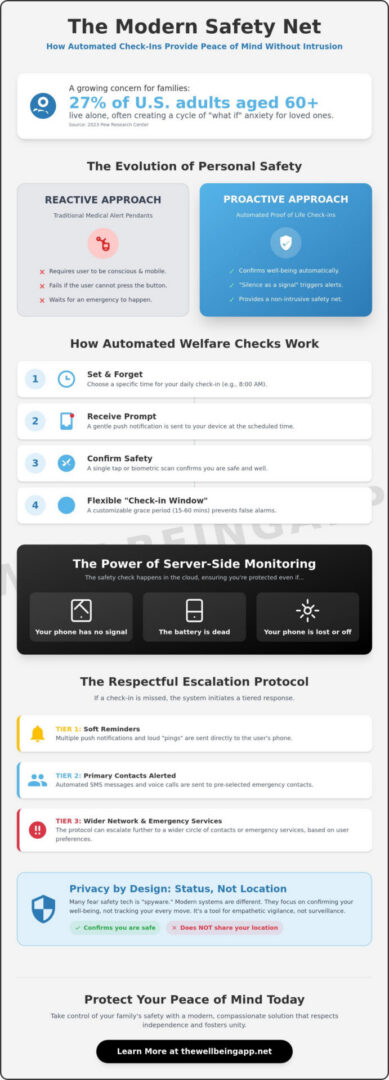
Last Tuesday at 10:00 AM, Sarah didn’t have to wonder if her aging father was safe because her proof of life check in app had already sent a silent, automated confirmation. According to 2023 data from the Pew Research Center, 27 percent of U.S. adults aged 60 and older live alone, often leaving families trapped in a cycle of “what if” anxiety. You likely feel the weight of this responsibility every day. It’s a constant struggle to balance your desire for their safety with a respect for their independence, and the guilt of missing a daily check-in call can be overwhelming.
We believe that caring for someone shouldn’t feel like a full-time surveillance job. This guide helps you discover how automated technology provides a non-intrusive safety net for seniors and solo dwellers. You’ll learn how to take control of your family’s security using specialized indicators that only escalate when a real emergency is detected. We’ll explore the essential features of these modern systems and show you how to protect your peace of mind when you care enough to know.
Key Takeaways
- Learn why proactive safety tools are replacing reactive emergency buttons to provide a more compassionate, non-intrusive safety net.
- Discover how a modern proof of life check in app uses server-side monitoring to keep you safe even when your phone is unreachable or out of power.
- Address the common misconceptions around digital monitoring by exploring “Privacy by Design” features that prioritize your personal space.
- Gain a clear framework for evaluating safety apps, focusing on essential features like automated escalation and 24/7 vigilance.
- Learn how to protect your peace of mind with specialized indicators that offer a modern solution for family unity and individual safety.
Defining the Proof of Life Check-In App in 2026
A proof of life check in app is a proactive safety tool designed to confirm a person’s well-being through scheduled, automated interactions. Unlike traditional medical alert pendants which are reactive and require the user to be conscious and mobile to press a button, these apps function on the principle of silence as a signal. If a user fails to acknowledge a scheduled prompt, the system immediately triggers a pre-set emergency protocol. This approach is built on the philosophy of empathetic vigilance; it provides a compassionate, always-on guardian that offers protection without the intrusiveness of constant surveillance.
The primary users of these tools include seniors who value their independence while living alone, solo travelers exploring remote areas, and professionals working in isolation. Understanding What is a Lone Worker? provides essential context for why this technology is necessary. Whether it’s a home health aide or a night-shift technician, these individuals require a safety net that doesn’t rely on them being able to call for help during a crisis. By establishing regular check-ins, users can protect their peace of mind and ensure their community is alerted the moment something goes wrong.
The Core Mechanism: How Check-ins Differ from Tracking
Many people hesitate to use safety technology because they fear being watched. However, a proof of life check in app focuses on your status rather than your exact location. The core mechanism relies on user-initiated indicators. These are simple actions, like tapping a notification, that confirm you’re safe. While older systems relied on manual text messages, 2026 technology utilizes server-side monitoring. This means the safety check happens on a remote server; if your phone dies or you lose signal, the system still knows you haven’t checked in and will notify your emergency contacts accordingly. It’s an automated security tool that respects your privacy while ensuring you’re never truly alone.
Why 2026 is the Year of the Digital Safety Net
The “aging in place” trend has grown by 15 percent over the last three years, leading to a surge in demand for non-intrusive monitoring. While wellness calls from family are well-intentioned, they’re often inconsistent or missed due to busy schedules. In 2026, safety is no longer about being watched; it is about being accounted for. These apps provide a reliable, automated solution that removes the burden of worry from family members. When you care enough to know, you choose tools that offer specialized authority in safety management. You can take control of your daily routine and ensure that your well-being is a priority, fostering a stronger sense of unity within your family and community.
How Automated Welfare Checks Work: Behind the Scenes
A modern proof of life check in app operates on a foundation of protective reassurance and “set it and forget it” reliability. You choose a specific time for your daily check-in, such as 8:00 AM or 9:00 PM. When that time arrives, the app sends a gentle push notification to your device. Confirming your safety is as simple as a single tap or a biometric scan like FaceID. This quick interaction sends an encrypted signal to a secure remote server, confirming that you’re active and well without requiring a lengthy phone call.
The true power of this system lies in server-side monitoring. Unlike a standard alarm clock that lives only on your phone, these safety tools exist in the cloud. If your phone is lost, stolen, or runs out of battery, the server notices the absence of your check-in signal. It doesn’t matter if your device is offline; the countdown continues. This technology is similar to lone worker monitoring technology used by organizations like the National Safety Council to protect employees in isolated environments. By moving the monitoring logic away from the physical device, the app ensures that a dead battery never results in a missed emergency.
Every user benefits from a customizable “Check-in Window.” This is a grace period, typically set between 15 and 60 minutes, that accounts for the small delays of daily life. It allows you to finish a shower or stay in a meeting without triggering a false alarm. Only after this window expires without a response does the system initiate its protective protocols to ensure your well-being.
The Hierarchy of Automated Alerts
The escalation process is designed to be respectful yet persistent, moving through three distinct tiers. It begins with soft reminders, which are multiple push notifications and loud “pings” sent directly to your phone. If the check-in window closes without a response, the system moves to the second tier; sending automated SMS messages or voice calls to your primary emergency contacts. The third tier involves broader community outreach or professional welfare checks if the situation remains unresolved. This structured approach ensures that help arrives exactly when it’s needed, fostering a sense of unity and care among your inner circle.
The Role of Location Sharing in Emergency Response
Privacy is a cornerstone of trust in any safety tool. Most users don’t want constant tracking, so location sharing is often kept in a “locked” state until an emergency occurs. The app only transmits or unlocks your real-time GPS coordinates during an active missed check-in event. This secondary layer of the safety net provides first responders with precise data, potentially reducing response times by several minutes. When seconds count, having those coordinates ready can be life-saving. You can take control of your safety by choosing a proof of life check in app that balances this privacy with empathetic vigilance. It’s the best way to protect your peace of mind when you care enough to know your loved ones are safe.
Privacy vs. Protection: Addressing the “Spyware” Misconception
A common hurdle when adopting a proof of life check in app is the fear of constant surveillance. Nobody wants to feel like they’re living under a microscope. It’s vital to distinguish between invasive “spyware” and intentional safety indicators. Privacy by Design ensures that your personal life remains private while your well-being stays protected. These apps don’t monitor your private conversations or track your every step for marketing purposes. Instead, they focus on a single, vital data point: your safety status.
The data footprint of a safety tool is remarkably small compared to typical social media platforms. While standard navigation or social apps might track dozens of data points every minute, a check-in app only activates at specific intervals. You take control of your visibility. You decide who sees your status and when those alerts are triggered. This isn’t about being watched; it’s about being seen when it matters most.
Empowerment Through Controlled Monitoring
For many seniors, these apps are a gateway to independence. They remove the need for family members to “nag” with constant check-in texts or calls that can feel patronizing. By using a proof of life check in app, you provide your loved ones with peace of mind without sacrificing your dignity. The app acts as a Vigilant Guardian. It stays in the background, silent and respectful, until a scheduled check-in is missed. This proactive approach fosters a sense of unity and care within the family, replacing anxiety with a quiet confidence that help is always available if needed.
Data Security and Server-Side Reliability
Safety apps must be more reliable than a simple alarm on your phone. If your phone battery dies or the device is damaged in a fall, a local alarm won’t help you. This is why server-side monitoring is essential. When your check-in happens on the provider’s server, the system knows if you’ve missed your window even if your phone is offline. Server-side monitoring is the gold standard for safety apps because it ensures alerts are triggered even if the user’s physical device is destroyed, powered off, or disconnected from the network.
- Encryption: Modern safety tools use AES-256 encryption to protect your location data.
- User Autonomy: You can pause monitoring during private events or adjust the frequency of checks.
- Reliability: Cloud-based systems offer 99.9% uptime, far exceeding the reliability of a single handheld device.
Protect your peace of mind by choosing technology that respects your boundaries while prioritizing your life. When you care enough to know, you choose a system built on trust and technical excellence. It’s about having a partner that’s always there, but never in the way.
Choosing the Best Safety Monitoring System for Your Needs
Selecting a safety tool is a decision that impacts your daily peace of mind. It’s not just about downloading software; it’s about finding a vigilant guardian that bridges the gap between technology and human care. When you evaluate a proof of life check in app, you must look beyond basic GPS tracking. A 2020 report from the Pew Research Center indicated that 27% of adults aged 60 and older live alone. For this population, a tool that offers automated escalation is vital because it ensures help arrives even if the user can’t call for it themselves.
Free, unmonitored apps often fall short because they rely on the hope that a contact is looking at their phone at the right moment. Professional systems provide 24/7 monitoring, turning a simple notification into a reliable safety net. This specialized authority is what distinguishes a mere app from a comprehensive security tool. You want a system that acts as a compassionate partner, one that is always on and ready to respond.
Feature Checklist for Seniors and Their Families
Simplicity is the foundation of effective safety. If a system is too complex, it won’t be used. Look for these essential indicators when choosing your platform to ensure it meets the needs of every family member:
- Ease of Use: Does the app offer a daily check-in that requires only a single tap from a non-tech-savvy user?
- Alert Circles: Can you add multiple emergency contacts to ensure a community of care is always reachable?
- Automated Escalation: Does the system trigger a professional response if a check-in is missed?
- Night Watch: Is there a dedicated mode to protect your well-being during the most vulnerable hours of sleep?
Evaluating the Chaperone and Night Watch Layers
A complete safety system provides unity between your active hours and your rest. The Virtual Chaperone acts as a digital companion when you’re walking home alone or meeting someone new. It monitors your progress and alerts your community if you don’t reach your destination safely. This proactive protection is a core part of a modern proof of life check in app.
The Night Watch feature focuses on the hours when you’re most isolated. It monitors for activity or lack thereof during the night, providing a silent layer of security that works while you sleep. By integrating these features, you take control of your environment. You deserve a system that values your safety as much as you do. When you care enough to know that your loved ones are safe, choose a tool that prioritizes sincere concern over simple tracking.
Protect your peace of mind and ensure your family stays connected through every hour of the day. Take control of your safety with The Wellbeing App today.
Protecting Your Peace of Mind with The Wellbeing App
Choosing the right proof of life check in app is a decision that balances technical reliability with emotional security. The Wellbeing App stands as the logical conclusion to this search, offering a sophisticated platform that prioritizes human connection. Unlike standard tracking tools, this app utilizes unique Proof of Life Indicators. These proprietary markers ensure that a check-in is a genuine reflection of a user’s safety rather than an accidental pocket dial or an automated system error. The brand operates with a deep commitment to preventing missing person incidents by fostering a sense of community unity, turning individual safety into a collective responsibility.
The infrastructure behind the app is designed for absolute dependability. Users can choose between flexible monthly or annual subscription plans, making professional-grade security accessible for everyone. This isn’t just about software; it’s about a dedicated mission to reduce the 600,000 missing person reports filed annually in the United States by providing proactive, preventative technology. By integrating these tools into daily life, families can move away from reactive panic and toward a structured, supportive environment.
When You Care Enough to Know
The phrase “When You Care Enough to Know” reflects the heart of this technology. While the system relies on high-tech Automated Alerts and GPS tracking, the ultimate goal is the emotional benefit of knowing a loved one is safe. This proof of life check in app utilizes a robust, server-side infrastructure that provides 24/7 monitoring. This means the safety net remains active even if a phone battery dies or a signal is lost, as the server expects a check-in and reacts if one doesn’t arrive. This level of empathetic vigilance ensures that help is triggered the moment it’s needed. Protect your peace of mind with The Wellbeing App.
Taking Control of Your Personal Security
Transitioning from a state of constant anxiety to a state of empowered safety is a vital step for solo travelers, seniors, and independent professionals. The Wellbeing App facilitates this shift through its comprehensive suite of tools, including the specialized Night Watch and Chaperone features. Night Watch provides an extra layer of security during late-night hours, while the Chaperone feature offers active monitoring during potentially risky situations. These tools allow you to take control of your environment rather than being at the mercy of uncertainty. To begin your journey toward a more secure future, visit The Wellbeing App homepage and discover how a dedicated safety partner can change your daily life.
Taking Control of Tomorrow’s Safety Today
In 2026, safety isn’t just about reactive emergency calls; it’s about the proactive certainty that those you love are secure. You’ve seen how a modern proof of life check in app bridges the gap between independence and isolation through sophisticated, non-intrusive technology. By utilizing 24/7 server-side monitoring, The Wellbeing App ensures that even if a device loses power, the “Vigilant Guardian” remains active. This system moves beyond simple GPS tracking to focus on unique Proof of Life Indicators, providing a compassionate safety net that respects personal privacy. The importance of early intervention is clear: welfare checks can reduce emergency response times by up to 40 percent. This technology isn’t just a tool; it’s a way to foster unity and care within your community. It’s time to replace anxiety with the quiet confidence that comes from being connected to your circle every hour of the day.
Protect your peace of mind; download The Wellbeing App today.
Choosing to stay connected is the most powerful way to show you care. You’re not just installing software; you’re joining a community dedicated to looking out for one another with empathy and strength.
Frequently Asked Questions
What happens if I miss a scheduled check-in by mistake?
You receive a series of grace-period notifications before your emergency contacts are alerted. Most systems provide a 15 or 30 minute window for you to respond to a reminder. If you still don’t acknowledge the prompt, the app triggers its automated alert protocol to ensure your safety. This prevents false alarms while maintaining the empathetic vigilance you need to protect your peace of mind.
Is a proof of life app better than a wearable medical alert button?
A proof of life check in app is often superior because it doesn’t require you to be conscious or mobile to call for help. Research shows that 80 percent of medical alert button users fail to press their device during a fall or crisis. An automated app detects your silence instead. It acts as a vigilant guardian that monitors your well-being without requiring you to wear bulky hardware.
Can I use a check-in app for my elderly parents who live in another state?
You can use these tools to monitor parents regardless of the 2,000 miles between your homes. These platforms bridge the distance by providing real-time status updates directly to your smartphone. When you care enough to know they’re safe, a digital connection offers a sense of unity that traditional phone calls might miss. You’ll feel empowered knowing their daily routine is being monitored by a reliable partner.
Does the app track my GPS location at all times or just during emergencies?
Most apps only share your GPS coordinates when an alert is triggered or a check-in is missed. Privacy is a central pillar of these tools, so 24/7 location tracking is rarely the default setting. Instead, the software stores your last known location securely and only reveals it to your community of responders when a genuine emergency arises. This balance of privacy and protection helps you maintain your independence.
What is the difference between a wellness check and a digital proof of life indicator?
A wellness check is a manual request for a status update, while a digital proof of life indicator is an automated signal of your ongoing safety. Indicators rely on your proactive interaction with the app at scheduled times. By using these specialized markers, you take control of your security and ensure that help arrives only when the system confirms you’re unresponsive. It’s a more sophisticated way to manage your welfare.
Are these apps reliable for people who live alone in remote areas?
These apps are reliable as long as your device has a cellular or Wi-Fi connection at the scheduled check-in time. In areas where 4G coverage drops below 20 percent, you should sync your check-in times with when you have a signal. This ensures the proof of life check in app can transmit its status to the monitoring servers. It’s a simple way to maintain safety even in more isolated geographical locations.
Can I set multiple check-in times throughout the day?
You can set as many check-in times as your daily routine requires to feel secure. Many users schedule three distinct points: one for morning wake-up, one for mid-afternoon, and a “Night Watch Protection” check before bed. This structured approach allows you to customize your safety net to match your specific lifestyle. You’re never limited to just one check-in, which provides a more robust layer of round-the-clock protection.
How do automated alerts reach my emergency contacts?
Automated alerts reach your emergency contacts through a combination of SMS text messages, push notifications, and automated phone calls. The system typically follows a tiered escalation path, contacting your primary responder first before moving to a secondary list. This ensures that at least one person in your community receives the critical information needed to initiate a physical wellness check. It’s a technical solution designed to foster a strong sense of unity.