Emergency Alerts: A Comprehensive Guide to Public and Personal Safety Systems in 2026
On a Tuesday evening in 2026, Martha, who is 82, misses her nightly check-in; however, because there is no hurricane or wildfire, the standard government siren remains silent. This is the reality of the silent emergency, a gap where traditional emergency alerts simply don’t reach. You likely feel a sense of security when your phone buzzes with a weather warning, yet you still carry that nagging weight of what if regarding your parents or children living alone. With 27% of seniors now living alone as of 2025, it’s natural to worry that a personal crisis might go unnoticed because it isn’t a headline-grabbing disaster.
When you care enough to know that your family is safe, relying solely on public systems isn’t enough. We’ll show you how to integrate government-issued notifications with proactive personal safety tools to ensure your loved ones are never out of reach. This guide explores the 2026 evolution of public safety systems, the critical difference between mass and personal alerts, and how to build a fail-safe communication plan that offers true peace of mind through automated Proof of Life indicators.
Key Takeaways
- Understand the vital distinction between broad public broadcasts and the personal safety tools required to protect your family during individual crises.
- Master the hierarchy of government-issued emergency alerts to stay informed about large-scale threats and ensure your community remains connected.
- Identify the “silent emergency” gap and learn how to audit your device settings to trigger help even when you cannot reach your phone.
- Build a multi-layered safety circle that empowers your trusted friends and family to act as compassionate guardians for your well-being.
- Discover how proactive “Proof of Life” monitoring can watch over you around the clock, helping you take control and protect your peace of mind.
Understanding the Emergency Alert Landscape: Public vs. Personal
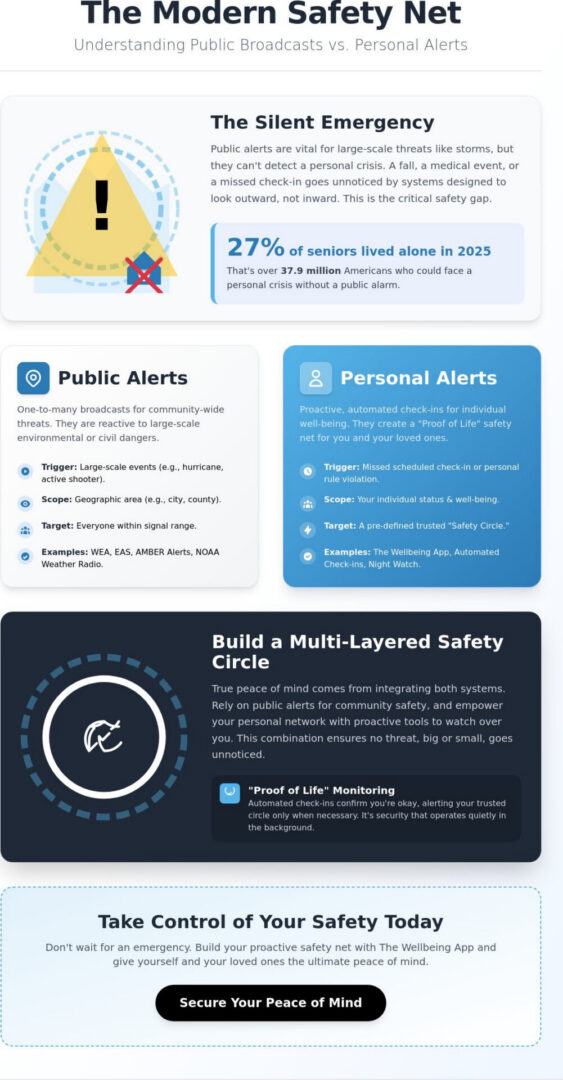
Emergency alerts are time-sensitive notifications designed to protect life and property during critical moments. They act as a digital heartbeat, connecting you to vital information when seconds matter most. Traditionally, we think of these notifications as loud, government-issued broadcasts meant for everyone in a specific zip code. However, a modern safety strategy requires a dual approach that balances public warnings with personal, automated check-ins. Relying solely on public systems leaves a dangerous safety gap for the 37.9 million Americans living alone, as these broad systems can’t detect a personal medical crisis or a missed arrival home.
This safety gap exists because public systems are designed to look outward at the environment, while personal systems look inward at the individual. If you live alone or work solo, a weather radio won’t help if you experience a fall in your kitchen. By understanding the distinction between these two layers of protection, you can build a more resilient safety net for yourself and your loved ones. It’s about moving from general awareness to specific, individual care.
The Role of Public Warning Systems
Public systems focus on large-scale threats like civil danger or extreme weather. Wireless Emergency Alerts (WEA) reach your phone automatically, using cell tower technology to target specific geographic areas. Since their inception in April 2012, they’ve helped locate over 1,000 missing children through AMBER alerts. Parallel to this, the Emergency Alert System (EAS) provides critical information via radio and television broadcasts. For environmental threats, the NOAA Weather Radio network provides a continuous flow of data. These systems are excellent for community safety, but they don’t have the intimacy needed to monitor your daily well-being.
The Rise of Proactive Personal Alerts
Personal alerts represent a shift from reactive security to empathetic vigilance. This technology uses automated triggers to confirm you’re okay, forming the foundation of Proof of Life indicators. It moves beyond the old-fashioned panic button, which is often out of reach during a sudden medical event. By setting up these check-ins, your smartphone becomes a virtual guardian. If you miss a scheduled notification, the app sends emergency alerts to your trusted circle. You can take control of your safety and protect your peace of mind, knowing your community is always looking out for you.
This layer of protection is especially vital for those who value their independence but want to remain connected to their family. It creates a safety net that operates quietly in the background, offering Night Watch Protection and daily monitoring without being intrusive. When you care enough to know, these personal connections become your strongest security tool. By integrating both public and personal emergency alerts, you ensure that no threat, whether it’s a regional storm or a personal health event, goes unnoticed.
How Public Emergency Alert Systems Work in 2026
Understanding the technology that keeps your family safe provides a profound sense of peace. In 2026, the backbone of our national safety infrastructure is FEMA’s Integrated Public Alert and Warning System (IPAWS), which coordinates various pathways to deliver life-saving information. This system acts as a central hub; it ensures that whether a message comes from the National Weather Service or local law enforcement, it reaches your device with precision and speed. By unifying these channels, the system creates a protective shield of information around your community.
The hierarchy of emergency alerts is designed to prioritize your well-being without causing unnecessary alarm. Presidential Alerts, now frequently referred to as National Emergency Alerts, are reserved for the most grave national crises and cannot be disabled on any device. Imminent Threat alerts warn you of immediate dangers like extreme weather or active shooters. Public Safety messages provide essential information on how to stay secure during less urgent local incidents. By 2026, location-based targeting has reached a 100% accuracy rate within a 0.1-mile radius. This means you only receive notifications that directly impact your physical space, reducing “alert fatigue” and keeping your focus on what truly matters.
A common concern involves privacy and phone tracking. It’s vital to remember that these systems are “one-way” broadcasts. The government doesn’t track your individual phone to send these; instead, cell towers broadcast the signal to every device within their specific reach. You remain anonymous while staying protected. When you care enough to know that your loved ones are safe, understanding these boundaries helps you take control of your digital environment.
WEA 3.0 and Beyond
The 2026 standard for Wireless Emergency Alerts (WEA 3.0) focuses on visual clarity and enhanced geo-fencing. If a flash flood is approaching, your phone won’t just buzz with text; it will display a high-resolution map of the evacuation zone. This prevents confusion for people on the edge of a hazard area. WEA 3.0 is a broadcast technology that delivers high-priority, location-specific safety messages including multimedia content to mobile devices without requiring user registration or individual tracking.
Opting In vs. Opting Out
While you can disable most notifications in your device settings, keeping ‘Public Safety’ and ‘Imminent Threat’ alerts active is a simple act of care for yourself and your community. These carrier-based alerts are different from third-party app notifications because they use a dedicated radio frequency. This ensures they get through even when mobile networks are congested during a crisis. Third-party tools complement these by providing personalized “Proof of Life” indicators and deeper community connection, but the foundational emergency alerts are your first line of defense. Protecting your peace of mind starts with staying connected to the pulse of your local area.
The Critical Gap: When Public Alerts Aren’t Enough
While public safety officials use timely and reliable systems to alert you about external threats like hurricanes or civil unrest, these one-way emergency alerts don’t account for the “Silent Emergency.” A silent emergency occurs when the crisis is internal or isolated, such as a sudden medical event or a fall where you cannot reach your device. In these moments, the technology designed to protect you stays quiet because it’s waiting for your input.
The primary limitation of 911 is its reactive nature; first responders can only act once they are notified. If you’re incapacitated, the system stalls. This creates a dangerous “Missing Person” window. Statistics show that one in four Americans aged 65 and older falls each year. If a fall results in a long lie, the delay in notification complicates recovery and increases the risk of dehydration or internal trauma. Relying on manual check-ins with family often fails because human forgetfulness is inevitable. A forgotten “I’m home” text creates false alarms, while a missed crisis goes unnoticed because everyone assumes you’re simply busy.
Addressing the #1 Safety Objection
Many people believe they don’t need automated tools because they’ll just call 911 if trouble strikes. The reality is that many emergencies happen too fast for a manual call. A stroke can impair speech in seconds. An intruder or a sudden accident can leave you without access to a keypad. Automated monitoring provides a safety net when you’re incapacitated. By using a “Proof of Life” indicator, you ensure that help is summoned even when you cannot speak. It’s about having a guardian that watches over you when you’re most vulnerable.
Protecting Vulnerable Populations
For seniors living alone, a delayed medical response can be life-altering. Specialized protection fills the gap between sleep and safety, providing a “virtual chaperone” for those who value their independence but recognize their risks. Late-night workers and commuters face similar anxieties during the quiet hours of the morning. Our “Night Watch” protection is designed for these specific windows of time. It ensures that if you don’t check in as expected, your community is notified immediately. You deserve to take control of your safety. When you care enough to know that your loved ones are safe, automated emergency alerts transition from a luxury to a necessity. Protect your peace of mind by ensuring you’re never truly alone in a crisis.
Building a Multi-Layered Personal Safety Plan
Safety isn’t a single action; it’s a series of intentional layers that work together to protect your peace of mind. While emergency alerts provide the necessary signal when trouble arises, a comprehensive plan ensures that help is already moving before a situation escalates. You can take control of your environment by following these five strategic steps.
- Step 1: Audit your device settings. Ensure your Medical ID is complete and your SOS triggers are active. On most smartphones, pressing the side button five times quickly will initiate a call to local authorities.
- Step 2: Establish a Safety Circle. Select three to five trusted friends, family members, or neighbors who understand their role as your primary responders.
- Step 3: Implement Proof of Life indicators. Use automated tools to confirm you’re safe at specific intervals, reducing the need for manual check-ins.
- Step 4: Enable real-time location sharing. During high-risk moments, such as walking home after a 10:00 PM shift, active sharing provides your circle with your exact coordinates.
- Step 5: Review your plan quarterly. Set a calendar reminder every 90 days to verify that your contact list is current and your software is updated.
The Power of Scheduled Check-ins
Automated Proof of Life indicators transform safety from a chore into a seamless part of your day. By setting specific morning and evening safety windows, you eliminate the friction of constant nagging from worried relatives. If you don’t check in by a designated time, such as 8:30 AM, the system notifies your circle automatically. This structure creates a profound sense of unity and relief for everyone involved. It allows family members to rest easy, knowing that no news truly is good news. This empathetic vigilance ensures that your well-being is monitored without intruding on your independence.
Virtual Chaperone Services
A Virtual Chaperone is a digital safety monitor that tracks a user’s progress toward a specific destination and triggers automatic emergency alerts if the individual fails to arrive within a predetermined timeframe. Unlike a physical guard, a virtual escort provides a discreet layer of security that stays in your pocket. If your typical 15-minute walk takes longer than 25 minutes without an update, the system recognizes the anomaly and alerts your contacts. This proactive monitoring ensures that help is summoned even if you’re unable to reach for your phone. When you care enough to know that your loved ones are secure, these tools offer the ultimate reassurance.
Take the first step toward a more secure future and protect your peace of mind today.
Proactive Protection: How The Wellbeing App Secures Your Future
The Wellbeing App operates as a Vigilant Guardian for individuals and families who refuse to leave safety to chance. While standard emergency alerts are essential for broad public warnings, they often only reach you once a crisis is already underway. This platform shifts the focus toward proactive monitoring, ensuring that silence is never mistaken for safety. It provides a compassionate layer of oversight that bridges the gap between technology and human care.
At the heart of this protection is the automated Proof of Life monitoring system. This sophisticated tech watches over you when you can’t watch over yourself. Instead of waiting for a manual distress signal, the app looks for consistent indicators of well-being. If those indicators aren’t met, the system triggers a series of tiered notifications to your trusted circle. This ensures that help is mobilized even if the user is incapacitated or unable to reach their device.
Specialized features like Night Watch and Chaperone provide 24/7 security for specific high-risk scenarios. These tools ensure that emergency alerts are backed by personalized safety checks for students walking across campus or seniors living alone. This approach fosters community unity by turning safety into a shared responsibility. It isn’t just about individual security; it’s about creating a network where everyone looks out for one another through a reliable, automated framework.
When You Care Enough to Know
Checking in on a loved one can often feel like an intrusion, yet checking on them is a necessity of care. The Wellbeing App bridges this gap by automating the process. It reduces the constant mental burden on family members who worry about their relatives’ status throughout the day. You don’t have to send a dozen texts asking if someone is okay when you have a system that provides consistent reassurance. The emotional value of knowing a guardian is always monitoring your status allows families to focus on their connection rather than their anxiety.
Take Control of Your Peace of Mind
Getting started doesn’t require a complex technical background or expensive wearable hardware. The app integrates seamlessly into your daily routine using the smartphone you already own. Setup is simple, allowing you to establish your safety parameters in minutes. With flexible subscription tiers available for both individuals and families, professional-grade monitoring is accessible to everyone. Don’t wait for a crisis to wish you had a backup plan. Protect your peace of mind with The Wellbeing App today.
Take Control of Your Safety and Protect Your Peace of Mind
Navigating the safety landscape of 2026 requires more than just listening for sirens. While public emergency alerts provide a vital first layer of defense, they often rely on active cellular connections and functional hardware. You’ve learned that a multi-layered plan bridges the critical gap between government notifications and personal well-being. The 2026 Global Safety Initiative emphasizes that redundant systems are essential because they don’t fail when your device loses power. The Wellbeing App addresses this specific vulnerability by utilizing server-side monitoring to ensure alerts go out even if your phone’s battery hits 0% during a crisis. You can rely on proprietary Proof of Life indicators to maintain a constant, caring connection with your inner circle. This approach fosters a sense of community unity and proactive protection that keeps your family secure. It’s about shifting from a reactive stance to a state of empathetic vigilance. When you care enough to know, you choose tools that act as a vigilant guardian for those you love most. You deserve to feel empowered and connected every single day.
Start your proactive safety journey with The Wellbeing App
Frequently Asked Questions
What is the difference between WEA and EAS emergency alerts?
WEA messages are sent directly to mobile phones based on location, while EAS broadcasts are delivered via radio and television. Both systems serve as critical emergency alerts providing real-time instructions during crises. While EAS started in 1997, the WEA system arrived in 2012 to reach the 97 percent of Americans who own a mobile device. These systems work together to ensure you receive vital information, protecting your peace of mind during natural disasters.
Can I receive emergency alerts if my phone is on ‘Do Not Disturb’?
You can still receive high level emergency alerts even when your phone is set to “Do Not Disturb” or silent mode. Most modern smartphones are programmed to bypass user settings for Presidential alerts and extreme weather warnings. You should check your device settings under “Notifications” to ensure that “Critical Alerts” are toggled on. This ensures you remain connected to life saving information when you care enough to know about local threats.
What happens if I miss a scheduled check-in on The Wellbeing App?
When you miss a check-in, our system initiates a protective sequence to ensure your safety. The app sends a reminder, and if you don’t respond, it triggers our Proof of Life Indicator to alert your trusted circle. This automated process ensures that your community is notified even if you can’t reach your phone. It allows you to take control of your personal security by creating a reliable safety net for your daily routine.
Are personal safety apps better than wearable medical alert buttons?
Safety apps offer more comprehensive features like GPS tracking and Night Watch Protection without the need for extra hardware. While 10 percent of seniors use wearable buttons, apps provide a more discreet way to maintain empathetic vigilance. Apps utilize the sophisticated sensors already in your phone to monitor your well-being. This creates a sense of unity and care that traditional buttons, which only function when pressed, simply cannot match in a modern environment.
How do automated emergency alerts help seniors living alone?
Automated emergency alerts offer a vital safety net for the 27 percent of Americans over age 60 who live alone. These tools monitor daily activity through Proof of Life Indicators, sending a notification to family members if a senior fails to check in at a set time. It provides a sense of unity and care, ensuring that help is on the way even if the individual is unable to call for assistance themselves during an emergency.
Is my location data private when using a safety monitoring app?
Your location data is encrypted and only shared with your designated emergency contacts when an alert is actually triggered. We prioritize your privacy by ensuring that constant tracking isn’t visible to others during your normal daily activities. We believe that true peace of mind comes from knowing you’re protected without sacrificing your personal digital boundaries. Our security tool is designed to be a vigilant guardian that respects your individual privacy and data sovereignty.
Do I need to pay a monthly fee for government emergency alerts?
You don’t have to pay any fees to receive government emergency alerts on your mobile device or television. The FCC and FEMA mandate that wireless providers deliver these life saving messages to the public at no cost. This ensures that every citizen has access to critical information regarding local threats or national emergencies. It supports the collective well-being of our entire community by removing financial barriers to essential public safety information and warnings.
Can emergency alerts be sent to my family if I lose my phone?
The Wellbeing App uses server side monitoring to ensure alerts are sent even if your phone is lost, broken, or powered off. If our system doesn’t receive your scheduled check-in, it automatically notifies your emergency contacts regardless of your device’s status. This fail safe approach allows your family to stay connected and informed. It’s the ultimate way to protect your peace of mind, knowing that the system watches over you round the clock.