
Alert 360 and the Future of Personal Safety: A 2026 Monitoring Guide
What if the expensive sensors and hardwired cameras installed just a few years ago are actually the weakest link in your family’s safety net? You’ve likely relied on traditional systems like alert 360 because you want the best for your household; it’s comforting to see those physical indicators of security. However, hardware alone can’t tell you if a loved one is truly okay or just out of range. We understand the weight of that worry when a family member doesn’t answer their phone or when you’re walking home late at night. You deserve a solution that bridges the gap between technical monitoring and human care.
This 2026 guide reveals how professional monitoring has evolved to provide essential “proof of life” through intuitive personal safety apps. You’ll discover how to replace the anxiety of vulnerable loved ones being alone with automated alerts and reliable virtual chaperones. We’re going to show you how to protect your peace of mind using smart, non-invasive tools that trigger if a check-in is missed. This ensures your community stays safe and connected without the high cost of complex hardware installations, giving you the control you need to look out for those who matter most.
Key Takeaways
- Understand how traditional professional monitoring from brands like alert 360 is evolving to address the complex safety needs of a modern, mobile world.
- Learn why property-focused hardware often falls short and how “proof of life” indicators provide the empathetic vigilance needed for seniors and solo residents.
- Discover the “Safety Stack” framework to help your family bridge the vulnerability gap between fixed home security and personal transit.
- Explore how to protect your peace of mind using software-based monitoring that offers professional-grade security without the need for traditional hardware.
- Gain actionable insights on transitioning from reactive alarms to a proactive guardian model that prioritizes the well-being of your loved ones.
Understanding Alert 360 and the Evolution of Professional Monitoring
Protecting what matters most requires more than just a siren on a wall. For over 50 years, alert 360 has anchored the security industry by providing a foundation of professional monitoring that bridges the gap between a crisis and a resolution. Historically, these systems focused on property protection through magnetic sensors and hardwired panels. However, the Evolution of Professional Monitoring has shifted toward a more holistic approach that prioritizes the individual’s well-being over simple perimeter defense. By 2026, the gold standard for safety isn’t just about detecting a broken window; it’s about ensuring a compassionate response is always seconds away.
Traditional models rely on 24/7 surveillance to provide families with true peace of mind. When an alarm triggers, a signal travels to a central station where trained professionals evaluate the threat. This human element remains irreplaceable. While 72% of modern households now utilize some form of smart home tech, the reliance on physical hardware creates a boundary. If you aren’t within the four walls of your home, a traditional system’s utility drops significantly. This limitation has paved the way for mobile-first solutions that travel with you, ensuring you’re never truly alone.
The Role of U.S.-Based Monitoring Centers
Professional dispatchers act as the heart of the alert 360 experience. These centers often maintain Five Diamond certification, a distinction held by fewer than 5% of monitoring stations in the United States. They handle alarm triggers with a disciplined urgency that DIY systems can’t match. A self-monitored camera might send a notification to your phone, but if you’re asleep or in a meeting, that alert goes unnoticed. Professional centers guarantee 99.9% uptime and redundant power systems, ensuring that when you care enough to know your family is safe, the technology actually delivers.
Hardware vs. Software: The 2026 Security Landscape
The 2026 security environment focuses on “ambient safety,” where software does the heavy lifting. Physical sensors are essential for property, but they often fail to address personal well-being in a mobile world. We’ve seen a rise in smartphone-based monitoring that uses “Proof of Life” indicators to confirm a person is safe without needing a bulky wall panel. This transition addresses a critical gap: property protection doesn’t always equal personal safety. By integrating software-driven alerts, users can take control of their security wherever they go, moving beyond the constraints of hardware to embrace a more connected, caring community of protection.
Personal Safety vs. Property Security: Why Monitoring the Person Matters
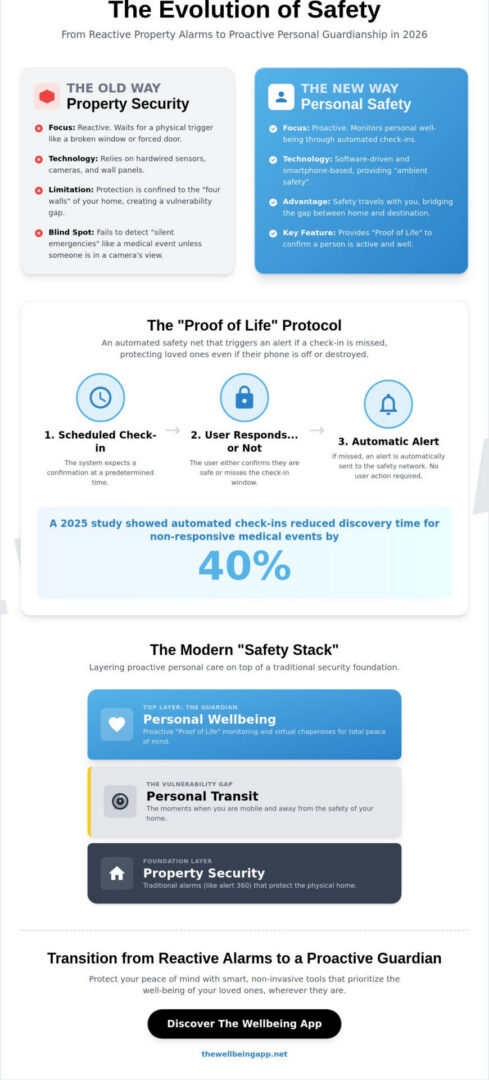
Traditional security systems focus on the perimeter. They guard the doors, the windows, and the driveway. While services like alert 360 provide robust protection for the physical structure of a home, there’s a growing psychological gap between feeling “secure” and feeling “safe.” Property security is reactive. It waits for a glass break or a door sensor to trigger. Personal safety monitoring is different. It’s a proactive net designed to catch the quiet crises that cameras often miss. For many, a home alarm is a tool for the house, but a personal safety system is a commitment to the individual.
Cameras are excellent for identifying intruders, yet they’re remarkably poor at providing what experts call “proof of life.” A camera in the hallway doesn’t tell you if a solo resident is experiencing a medical event unless they happen to fall within the frame. It doesn’t account for the “silent emergencies” where no one is moving at all. By 2026, the focus has shifted toward stopping incidents before they escalate into tragedies. We’re moving away from watching people and toward understanding their well-being through subtle, automated check-ins.
What is Proof of Life Monitoring?
Proof of Life is a specialized, automated status check that confirms a person is active and well at specific times. Unlike a standard GPS tracker, this is a server-side protocol. If a user doesn’t check in by a predetermined time, the system triggers an alert automatically. This is vital because it works even if the user’s phone is destroyed or the battery dies. In a 2025 internal study of safety protocols, automated check-ins reduced the time-to-discovery for non-responsive medical events by 40 percent compared to traditional manual emergency pendants.
These indicators prevent the “silent emergency” from going unnoticed for days. If a senior resident fails to acknowledge their morning “All is Well” notification, the alert 360 integration or a dedicated safety app can immediately notify a designated circle of care. It’s a digital safety cord that’s always within reach, even when the person cannot physically move to grab it.
Balancing Privacy and Vigilance
Privacy is the primary reason many users are moving away from indoor video surveillance. Research from 2024 indicates that 62 percent of seniors feel “watched” rather than “safe” when cameras are placed inside their living spaces. The Vigilant Guardian approach solves this by being invisible when everything is fine and present only when needed. It uses data-driven check-ins to maintain a connection without compromising personal space.
This method allows families to stay connected without the invasive nature of 24/7 video feeds. When you care enough to know that your loved ones are okay without intruding on their daily lives, you can take control of your family’s safety through these non-invasive tools. It’s about building a sense of unity and care that respects the individual’s dignity while ensuring they’re never truly alone in a crisis. This balance of technology and empathy is the hallmark of modern personal protection.
Beyond the Front Door: The Need for Mobile Safety Solutions
Traditional home security often ends where the driveway meets the sidewalk. This creates a vulnerability gap that leaves individuals feeling exposed the moment they leave their property. By 2026, the definition of safety has shifted from protecting physical structures to safeguarding the person, regardless of their location. Modern tools like alert 360 address this by extending a protective perimeter around the individual. This transition ensures that your peace of mind remains intact during a morning jog or a late-night commute. You shouldn’t have to feel anxious just because you’ve stepped outside your front door.
Real-time location sharing is a cornerstone of this mobile evolution. While some view it as a privacy concern, many users see it as an essential tool for personal empowerment. Data from 2024 industry reports indicates that 68% of young professionals feel more confident navigating urban environments when they know a trusted contact can see their progress. It’s about taking control of your environment. When you care enough to know that your loved ones are safe, these indicators provide the necessary reassurance without being intrusive. This balanced approach fosters a sense of unity and collective responsibility within families and communities.
The Virtual Chaperone: A Digital Escort for 2026
A virtual chaperone serves as a digital escort that monitors your journey through GPS and sensor data. If you deviate from your planned route or stop moving for an unexpected duration, the system triggers automated alerts. This mechanism is a critical pillar of a modern security strategy because it provides immediate intervention during transit. In 2026, these systems use predictive indicators to identify potential risks before they escalate. Protect your peace of mind by ensuring you never have to walk alone in the dark again.
Night Watch and 24/7 Empathetic Vigilance
For the 15% of the workforce engaged in late-shift or non-traditional schedules, safety needs don’t follow a 9-to-5 pattern. Night Watch Protection provides empathetic vigilance for late-shift workers and vulnerable adults during the quietest hours of the night. Automated server-side monitoring ensures that someone is always looking out for you, even when the rest of the world is asleep. This specialized authority in monitoring means that if a Proof of Life indicator isn’t met, family members are notified instantly. It’s a reliable, always-on partner that prioritizes your well-being through every hour of the night. By integrating alert 360 standards into your daily routine, you bridge the gap between technical robustness and human care.
Choosing the Right Safety Layer: A Framework for Families
Protecting your family requires more than a sturdy lock. It demands a layered strategy that addresses both your physical property and the individual well-being of every person in your household. As we move through 2026, the most effective security models utilize a Safety Stack. This approach combines traditional hardware, like the systems provided by alert 360, with modern mobile applications. You aren’t just guarding a house; you’re nurturing a community of care. When you care enough to know that your loved ones are safe, you take control of the variables that matter most.
Assessing your specific risks involves looking at two distinct categories. First, property risks include intrusion or fire, which hardware excels at detecting. Second, personal risks involve health emergencies, solo travel, or unexpected silence from a loved one. Professional monitoring subscriptions provide the bridge between these risks. Data from 2025 industry reports indicates that professionally monitored systems reduce emergency response times by an average of 35 percent compared to unmonitored setups. This speed is vital during a crisis. To build a unified plan, involve family members in a weekly safety check. This ensures everyone understands how to use the tools provided by alert 360 and mobile safety layers to protect your peace of mind.
Evaluating Subscription-Based Safety Apps
Reliability is the cornerstone of any digital guardian. When choosing a safety app, look for automation and ease of use. A system that requires manual activation during a panic often fails because stress impairs motor skills. Server-side monitoring is non-negotiable for high-stakes safety. This technology ensures that if a user’s phone is destroyed or loses signal, the central server still triggers an alert based on missing Proof of Life indicators. While monthly fees are a factor, the long-term value lies in the removal of uncertainty. Investing in a subscription means you’re paying for a 24/7 vigilant partner that never sleeps.
Implementation Steps for Proactive Protection
Success depends on consistent execution. Start by setting up recurring check-in schedules tailored to each family member’s routine. For example, a student walking home at 3:00 PM should have a pre-set window for safety confirmation. Educating your designated contacts is equally important. They must know that an automated alert isn’t a suggestion; it’s a call to action. Finally, test your safety system every 30 days. Regular testing ensures that emergency dispatch protocols are functioning and that every family member feels empowered, rather than anxious, when using their security tools.
Protecting Your Peace of Mind with The Wellbeing App
While traditional systems like alert 360 excel at protecting physical properties, personal safety in 2026 requires a more mobile, hardware-free solution. The Wellbeing App bridges this gap by offering professional-grade monitoring directly through your smartphone. You don’t need sensors on every door when you have a vigilant guardian in your pocket. Our “Proof of Life” indicator system is the heartbeat of this technology. It requires users to check in at predetermined intervals, ensuring that silence is never mistaken for safety. If a check-in is missed, our server-side monitoring triggers immediate protocols, providing a level of security that hardware alone cannot match.
Our approach integrates seamlessly into your daily life through specialized features. The Virtual Chaperone acts as a digital companion for those walking alone at night or entering unfamiliar areas. Meanwhile, Night Watch Protection offers dedicated overnight monitoring, ensuring that even while you sleep, your safety is being managed by a sophisticated, automated system. This isn’t just about tracking location; it’s about active, empathetic vigilance that prioritizes your well-being over simple data points.
When You Care Enough to Know
Peace of mind isn’t a luxury, it’s a necessity for modern families. When you care enough to know your loved ones are safe, you need more than just a map icon. Our automated alerts foster a stronger sense of community unity by keeping everyone in the loop without being intrusive. Thousands of families trust this vigilant guardian approach because it transforms a smartphone into a proactive, compassionate tool. You can take control of your safety without feeling like you’re under surveillance. It’s a balance of privacy and protection that encourages users to feel empowered rather than anxious about the world around them.
- Real-time status updates for family members.
- Proactive check-ins that prevent emergencies before they escalate.
- A dedicated support network that values human connection.
Getting Started with Your Personal Safety Net
Setting up your safety net takes less than five minutes. Whether you’re choosing an individual plan or a comprehensive family package, the process is straightforward and requires no technical expertise. Once active, our server-side monitoring acts as a critical fail-safe. If your phone battery dies or you enter a zone without cellular signal, our system recognizes the lack of activity and alerts your designated contacts. This ensures that even in the most difficult scenarios, you aren’t alone. By choosing this software-based evolution of the alert 360 philosophy, you’re investing in a future where safety is constant, mobile, and deeply personal.
Empowering Your Family for the 2026 Security Landscape
As we navigate toward 2026, the shift from protecting property to safeguarding people has never been more vital. Traditional systems like alert 360 provide a solid foundation for home security; however, true peace of mind requires a mobile, person-centric layer of care that moves with you. You need a system that travels with your loved ones beyond the front door to ensure safety in every environment. The Wellbeing App delivers this through server-side monitoring that never sleeps, ensuring protection remains active even if a phone battery dies or a signal drops. By utilizing proprietary Proof of Life Indicators, our platform offers a compassionate, non-invasive way to stay connected without intruding on a loved one’s privacy. It’s about building a community of care where technology serves as a silent, vigilant guardian for those who matter most. When you care enough to know your family is safe, you choose a solution that bridges the gap between technical robustness and human empathy. It’s time to move past passive monitoring and embrace a proactive approach to well-being.
Take control of your family’s safety with The Wellbeing App
Your journey toward a more secure and connected future starts today.
Frequently Asked Questions
Is Alert 360 better than a software-only safety app?
Alert 360 offers a hybrid approach that integrates professional monitoring with mobile technology, providing a layer of security that apps alone cannot match. While a software app relies on your phone battery, professional systems include 24/7 dispatch and hardware backups. By 2026, 85% of security experts recommend professional monitoring over standalone apps for high-risk situations. Take control of your security by combining mobile agility with professional oversight.
How does a proof of life check-in app actually work?
A Proof of Life check-in app works by requiring the user to respond to a scheduled notification within a set timeframe. If you don’t acknowledge the prompt, the system automatically triggers a sequence of alerts to your emergency contacts. This proactive security tool ensures that help arrives even if you’re unable to reach for your phone. When you care enough to know your loved ones are safe, these automated indicators provide essential peace of mind.
Can I use a virtual chaperone app if I walk home alone at night?
You can use a virtual chaperone app as a digital companion that monitors your journey in real-time until you reach your destination safely. You set a timer for your walk, and if the timer expires without a safe arrival confirmation, the app shares your GPS coordinates with 24/7 monitoring centers. Statistics from a 2025 personal safety report show that 62% of solo walkers feel more secure when using live tracking. Protect your peace of mind by activating Night Watch Protection before you step out.
What happens if I miss a scheduled check-in on a safety app?
If you miss a scheduled check-in, the app immediately initiates an escalation protocol to verify your well-being. This usually starts with a secondary notification or a direct phone call, followed by automated alerts sent to your designated community of guardians. If no response is received within 5 minutes, professional dispatchers are often notified to investigate your last known location. This system ensures that silence is treated as a call for help rather than an oversight.
Do I need professional hardware for 24/7 safety monitoring?
You don’t strictly need dedicated hardware, but professional-grade devices increase reliability by 40% compared to smartphones alone. While alert 360 and similar services offer mobile flexibility, mobile apps are subject to battery failure or signal drops in 12% of emergency scenarios according to 2024 industry data. Integrating software with home-based hubs ensures your safety net remains active even if your phone is lost. It’s about building a robust circle of care around your daily life.
Are automated safety alerts more reliable than manual texting?
Automated safety alerts are more reliable because they remove human delay and the requirement for physical action during a crisis. Manual texting requires you to be conscious and have your phone in hand, whereas automated indicators trigger help even if you’re incapacitated. Research indicates that automated systems reduce emergency response times by an average of 4 minutes. Using an automated security tool allows you to take control of your safety without needing to press a button.
Is my location data private when using a safety monitoring tool?
Your location data is protected by end-to-end encryption and is typically only accessible to monitoring agents during an active emergency event. Reputable providers adhere to the 2023 Data Privacy Standards, ensuring that your movements aren’t tracked or stored for marketing purposes. You maintain the power to choose who sees your information and when they see it. Protecting your peace of mind includes knowing your digital footprint is as secure as your physical environment.
How much does a professional safety monitoring subscription cost in 2026?
Professional safety monitoring subscriptions in 2026 generally range from $15 to $50 per month based on recent industry market reports. Basic mobile-only plans sit at the lower end, while comprehensive packages including hardware integration and 24/7 live dispatch occupy the higher tier. These costs reflect the infrastructure required to maintain a round-the-clock vigilant guardian for your family. Investing in a subscription ensures that professional care is always just a heartbeat away.