
The Ultimate Guide to Family Safety Alert Systems in 2026
What if the greatest risk to your loved one isn’t the emergency itself, but the silence that follows when they’re unable to reach for help? For many families, the traditional panic button offers a fragile sense of security; it relies entirely on a person’s ability to react during their most vulnerable moment. You likely feel a constant tug of anxiety, balancing the respect for a relative’s independence with the terrifying “what if” of them being incapacitated and alone.
It’s a heavy burden to carry, but true safety shouldn’t feel like a clinical surveillance operation. This guide explores the next generation of the family safety alert system, moving away from expensive, stigmatizing hardware toward intelligent, automated protection. You’ll discover how proactive tools like Proof of Life and Chaperone provide a digital safety net that triggers automatically if a check-in is missed. We’ll show you how to achieve genuine mental tranquility through a system that serves as a compassionate guardian, ensuring your family is never truly alone, even when they’re living independently.
Key Takeaways
- Understand why the modern family safety alert system has evolved from bulky hardware pendants to sophisticated software that stays active even if a device fails.
- Learn the critical difference between reactive SOS buttons and proactive automated alerts that trigger when a loved one fails to check in.
- Explore how specialized monitoring modes like Chaperone and Night Watch provide tailored protection for different daily activities and times of day.
- Discover how to implement a safety protocol that prioritizes personal agency and dignity, framing protection as supportive care rather than intrusive tracking.
- See how tools like Proof of Life offer true mental tranquility by ensuring help is always on the way, even when your loved one cannot call for it themselves.
What is a Family Safety Alert System in 2026?
In 2026, a family safety alert system is no longer just a plastic pendant sitting on a bedside table. It has transformed into a proactive digital guardian that lives where we do: on our smartphones. This shift represents a fundamental move from reactive emergency response to a state of constant, empathetic vigilance. The goal isn’t just to respond to a crisis; it’s to provide families with a sense of mental tranquility, knowing that a silent protector is always watching over their most vulnerable members. By focusing on software rather than proprietary hardware, these systems offer a more integrated and reliable way to ensure help is always within reach.
The Evolution of Personal Security
The history of personal emergency response systems began with simple wall-mounted alarms and wired pull cords. These tools were landmarks for their time, but they required the user to be conscious and mobile enough to reach them. Modern technology has moved toward passive monitoring. This means the system doesn’t wait for a manual alarm; it looks for indicators of well-being. If a daily rhythm is broken, the system acts. This approach fosters family unity by creating a shared safety net where everyone plays a role in collective responsibility, ensuring no one is ever truly alone.
Why Families are Moving Away from Proprietary Hardware
Many people find traditional medical alert bracelets stigmatizing. They feel like a clinical label of vulnerability. By integrating safety into a smartphone app, protection becomes discreet and empowering. It’s a tool of personal agency rather than a badge of frailty. Cost is another major factor. Traditional hardware often involves high upfront fees and complex equipment. Modern software models are significantly more accessible and often more reliable. Local device-only alarms can fail if a battery dies or a signal is blocked. A server-side suite ensures that if a user misses a scheduled check-in, the alert is triggered from the cloud. Even if the phone itself is destroyed, the failure to check in still notifies the family.
Standard emergency services are vital, yet they often lack the granular detail needed for the fastest possible response. A modern family safety alert system provides a supplemental “visual map” of the situation. It gives responders and family members immediate context through precise location sharing and recent activity indicators. This data bridges the gap between a generic emergency call and a targeted, life-saving intervention, providing the peace of mind that comes from a truly proactive safety protocol.
Reactive vs. Proactive: Why Automated Alerts are the New Standard
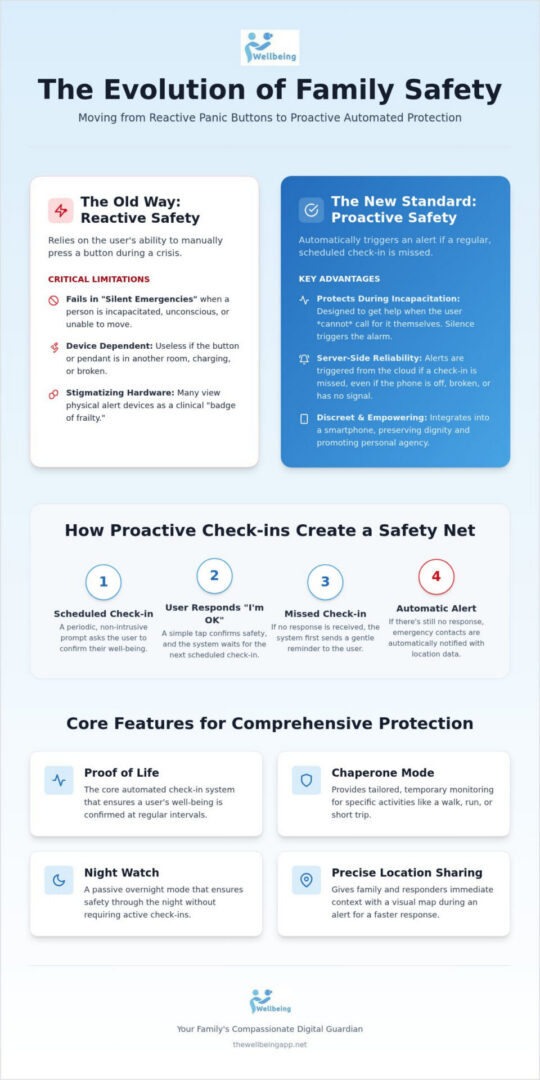
Traditional security relies on a single, high-stakes action. You press a button, and help arrives. This is reactive safety. It’s the classic “help, I’ve fallen” model. While useful, it contains a dangerous flaw: it assumes the person in trouble is conscious, mobile, and has their device within reach. Proactive safety flips this script. A modern family safety alert system doesn’t wait for a signal of distress; it looks for a signal of life. It triggers an alarm when a user fails to check in, ensuring that silence is never mistaken for safety.
This approach is the only effective way to handle a “silent emergency.” These are the critical moments where a loved one might be incapacitated, unconscious, or simply unable to move. In these scenarios, the gap between an incident and its discovery can be hours or even days. Automated alerts bridge this gap by setting a maximum window of silence. This provides a proactive net that catches those who cannot call out for themselves, offering a level of protection that manual buttons simply cannot match.
The Limitations of the SOS Button
SOS buttons are often left on chargers or in different rooms. During a fall or a sudden medical event, reaching for a phone or a pendant can be impossible. There’s also the panic response to consider. High-stress incidents can make even the simplest interface feel complex. Proof of Life serves as a fail-safe mechanism that activates automatically when the user remains silent, removing the burden of action from the person in crisis.
How Automated Check-ins Work
These systems use scheduled indicators to confirm well-being throughout the day. It isn’t about constant tracking, but rather a periodic “I’m okay” signal that preserves the user’s dignity. If a check-in is missed, the system begins a structured escalation. It starts with a gentle reminder to the user. If they still don’t respond, the system automatically notifies emergency contacts. Integrating this technology into your family emergency communication plan ensures that everyone knows exactly how to react when the system flags a potential issue.
Server-side monitoring provides the technical robustness required for true reliability. If a phone is lost, stolen, or broken, a local app-based alarm might fail to send a signal. However, because the monitoring happens on a remote server, the alert is triggered by the absence of a check-in. This digital safety net remains intact even if the hardware is compromised. Supporting a loved one’s independence becomes easier when you have a comprehensive safety suite to provide that essential mental tranquility.
Core Features for Comprehensive Protection: Beyond GPS Tracking
While location sharing is a standard expectation in 2026, relying solely on GPS coordinates is a baseline, not a complete safety strategy. Knowing where a loved one is doesn’t tell you if they are safe, conscious, or in need of help. A true family safety alert system must provide context through status indicators and automated monitoring. This combination creates a “watchful protector” that remains active even when the family is asleep or busy, offering a profound sense of mental tranquility that simple map markers cannot provide.
When families discuss the risks and benefits of digital monitoring, the conversation often centers on the balance between autonomy and security. Modern systems solve this by focusing on indicators of well-being rather than constant surveillance. By using specialized monitoring modes tailored to different times of day, you can ensure protection that feels supportive rather than intrusive. This approach empowers the user to live their life while providing the family with a reliable fail-safe.
Proof of Life: The Foundation of Daily Safety
The constant cycle of “Are you okay?” texts can be draining for both adult children and their aging parents. Proof of Life replaces this friction with a seamless, automated check-in process. You can customize check-in intervals based on the specific risk level of the user, whether they are living alone with a medical condition or simply enjoying their retirement. This system maintains the user’s independence by only escalating to an alert if a scheduled indicator is missed. It’s a compassionate way to stay connected without being overbearing, ensuring that help is dispatched only when it’s truly needed.
Chaperone and Night Watch: Protection on the Move
Safety needs change as we move through our daily routines. The Chaperone feature acts as a virtual escort for vulnerable moments, such as walking home late or commuting through unfamiliar areas. It provides real-time monitoring that triggers an immediate response if the user doesn’t reach their destination or check in within a set timeframe. This proactive approach is a significant step up from traditional home-based security systems that leave you unprotected the moment you step out the front door.
Similarly, Night Watch offers specialized protection during the hours when we are most vulnerable: while we sleep. By setting a dedicated monitoring window for the night, the system ensures that if an emergency happens in the early morning hours, the family is notified instantly. These automated alerts provide a digital safety net for solo travelers and those living alone, turning a smartphone into a sophisticated tool for proactive safety management.
Implementing a Safety Protocol Without the “Big Brother” Feel
The most common barrier to adopting a family safety alert system is the fear of constant surveillance. No one wants to feel like they’re being policed or that their independence is under threat. It’s vital to frame these tools correctly from the start. Rather than a tracking device, the system should be viewed as an instrument of empowerment and proactive safety management. It’s a silent partner that allows a loved one to live life to the fullest, knowing that a safety net exists only when it’s truly needed.
When you sit down to discuss safety apps with elderly parents or independent teens, focus on the concept of mental tranquility. Explain that the goal isn’t to watch their every move, but to remove the burden of the “worry cycle” from the family dynamic. The user remains in total control of their check-in schedule, deciding when and how the system confirms their well-being. This shift in perspective turns a clinical monitoring tool into a supportive guardian that respects personal agency.
Balancing Privacy and Protection
There’s a fundamental difference between policing and watchful protection. Policing is intrusive and constant; watchful protection is a background presence that only steps forward during a missed indicator. By setting clear boundaries, users can choose which contacts receive alerts and under what specific conditions. Ironically, an automated system often leads to a greater sense of privacy. Because the family knows they’ll be notified if something is wrong, they don’t feel the need to send those repetitive, intrusive “Are you okay?” texts throughout the day. This creates a more harmonious relationship where communication is based on connection rather than anxiety.
Creating a Family Safety Culture
Safety is most effective when it’s treated as a collective responsibility rather than a one-way street. Establishing a family safety culture means everyone agrees to look out for one another’s well-being. This shared commitment acts as a bridge for family unity, turning technical features into a daily practice of care. Automated alerts foster social cohesion by making safety a shared effort, ensuring that the responsibility for protection is distributed across the entire support network.
By integrating these protocols into your daily life, you’re not just installing software; you’re building an environment of trust. If you’re ready to provide your loved ones with a discreet, respectful way to stay safe, you can explore our compassionate monitoring features to see how we prioritize both dignity and security.
The Wellbeing App: Your Family’s Compassionate Digital Guardian
The Wellbeing App isn’t just a collection of code; it’s a manifestation of sincere concern for those we love. While other services treat security as a series of hardware sensors, we view the modern family safety alert system as a proactive partner in your family’s daily life. We’ve built a suite that balances technical robustness with a deep understanding of human vulnerability. Our mission is rooted in the preservation of your mental state, ensuring that the technology works tirelessly in the background so you can focus on the joy of connection rather than the weight of worry. It’s about creating an atmosphere of safety where every family member feels empowered rather than anxious.
By integrating features like Proof of Life, Chaperone, and Night Watch, we provide a specialized authority in personal protection. These tools don’t just track location; they monitor indicators of well-being. This approach ensures that safety is a shared effort, fostering a sense of collective responsibility within the family. When you choose a compassionate guardian over a simple software utility, you’re choosing a partner dedicated to the harmony and well-being of your entire community.
Why Our Server-Side Monitoring is Different
The true strength of our digital safety net lies in its independence from the physical device. Traditional apps often fail if a phone is turned off, loses signal, or is destroyed during an incident. Our server-side monitoring operates on a different logic. Because the Proof of Life indicators are tracked on our secure servers, an alert is triggered by the absence of a check-in. This means that if your loved one’s phone goes offline or the battery dies, the system recognizes the silence as a potential emergency. It ensures continuous 24/7 vigilance without the need for expensive, specialized hardware that can be easily forgotten or lost. This reliable automated notification dispatch goes directly to your designated emergency contacts, bridging the gap when the user cannot reach for help.
Take the First Step Toward Mental Tranquility
Providing a circle of protection shouldn’t be a complex or high-cost endeavor. We’ve designed our subscription model to be low-friction, allowing you to start protecting your family today with either a monthly or annual plan. Setting up your first Proof of Life indicator takes only a few moments, yet it provides an immediate layer of security that traditional systems can’t match. Whether you’re setting up a Night Watch window for an elderly relative or using Chaperone as a virtual escort for a teenager walking home, the process is intuitive and empowering. It’s time to move past the anxiety of the unknown and embrace a system built on empathetic vigilance. You have a duty to ensure your loved ones are never truly alone. Preserve your mental tranquility and protect your loved ones today.
Embracing a Future of Empathetic Protection
Safety in 2026 is no longer about waiting for a crisis to occur. It’s about a proactive digital guardian that watches over your loved ones when they cannot reach for help. By moving away from stigmatizing hardware and embracing automated, server-side monitoring, you ensure that silence never goes unheard. Features like Night Watch and Chaperone provide tailored protection for every hour of the day, allowing your family to maintain their independence while you achieve true mental tranquility.
Implementing a modern family safety alert system is a profound act of care that fosters family unity without compromising personal agency. It’s a commitment to collective responsibility and a shared sense of harmony. You have the power to replace constant anxiety with reliable, empathetic vigilance. Secure your family’s peace of mind with The Wellbeing App and take the first step toward a more secure, connected future for those you hold dear. You don’t have to carry the burden of worry alone; let us be the watchful protector your family deserves.
Frequently Asked Questions
What is a Proof of Life check-in app?
It’s an automated monitoring tool that confirms a user’s safety through scheduled check-ins. Unlike reactive buttons, it looks for a signal of life. If a user doesn’t respond to the prompt, the system triggers an alert. This ensures help is on the way even if the person is incapacitated. It’s a proactive way to maintain mental tranquility for the whole family.
Can a safety alert system work if my phone dies or loses signal?
Yes, our server-side monitoring suite is specifically designed for these scenarios. Since the check-in schedule is managed on our remote servers, the system knows if you haven’t checked in. If your phone is destroyed, dead, or out of range, the lack of a “safe” signal triggers the automated alert process. This digital safety net remains active regardless of your device’s physical state.
How much does a family safety alert system cost per month?
Costs for digital safety tools vary depending on whether you choose a monthly or annual subscription model. Unlike traditional systems that require high upfront hardware fees, app-based solutions are generally more accessible. We recommend checking our current subscription plans to find the best fit for your family’s needs. This low-friction approach allows you to start protecting your loved ones without a major financial commitment.
Is an app better than a medical alert necklace for seniors?
An app offers several advantages over a traditional necklace, primarily by removing the stigma of a clinical device. Most seniors already carry a smartphone, making the family safety alert system a discreet, integrated part of their life. Additionally, apps provide proactive monitoring like Proof of Life, whereas necklaces are purely reactive and useless if the wearer is unconscious or cannot reach the button.
What happens if I miss a scheduled check-in on the app?
The system initiates a structured escalation process to ensure your safety. It starts with a gentle reminder notification on your phone. If you still don’t respond within the grace period, our server-side logic automatically dispatches emergency alerts to your designated contacts. This fail-safe mechanism ensures that silence is never ignored, providing your family with the reassurance that help is always available if needed.
Can I use a virtual chaperone for walking home alone at night?
Absolutely. Our Chaperone feature is designed to act as a virtual escort during vulnerable moments. You simply activate the mode before starting your walk. The system monitors your progress and requires a check-in once you reach your destination. If you don’t check in as planned, your emergency contacts are notified immediately with your location, ensuring you’re never truly walking alone.
Do I need to buy any special hardware for The Wellbeing App?
No, the app is designed to work entirely on your existing smartphone. We believe safety should be accessible and non-intrusive, so we’ve eliminated the need for proprietary hardware devices. By using the technology you already own, we provide a robust family safety alert system that is easy to set up and maintain. This reduces complexity and allows you to focus on well-being rather than equipment.
How does a family safety alert system protect my privacy?
We prioritize personal agency by ensuring you stay in control of your data. The system doesn’t track your every move; instead, it focuses on well-being indicators and scheduled check-ins. You choose who receives alerts and when they are sent. This approach transforms the tool from a surveillance device into a supportive guardian, preserving your dignity while providing your family with essential mental tranquility.