
Safety Monitoring Tools in 2026: A Comprehensive Guide to Personal and Family Protection
What if the most loving thing you could do for your family was to stop sending “Are you okay?” texts altogether? We’ve all felt that cold spike of anxiety when a routine check-in goes unanswered for too long, just as we’ve felt the frustration of being the one who has to constantly prove we’re fine. It’s an exhausting cycle that often does more to create worry than to prevent it. Modern safety monitoring tools are finally changing this dynamic by moving beyond passive tracking and into the realm of active, compassionate vigilance.
You likely agree that true safety shouldn’t feel like a surveillance state or a burden on your relationships. This guide will help you discover how modern innovations bridge the gap between technical surveillance and compassionate care to provide true peace of mind without sacrificing anyone’s dignity. We’ll explore the transition to automated reassurance through Proof of Life indicators and Night Watch services, while navigating the critical 2026 data privacy updates that keep your family’s information secure. You’ll learn how to maintain independence for seniors and ensure rapid emergency response, all while fostering a sense of collective harmony rather than constant fear.
Key Takeaways
- Learn why modern safety monitoring tools have evolved from reactive emergency buttons into proactive digital safety nets that verify well-being before a crisis occurs.
- Discover how automated Proof of Life check-ins and Virtual Chaperone services provide continuous protection during high-risk moments without the friction of manual texting.
- Understand the psychological limitations of “Are you okay?” texts and how automated systems prevent the “Bystander Effect” from leaving your loved ones vulnerable.
- Master the art of balancing personal privacy with physical security to select a solution that fosters independence rather than a sense of surveillance.
- See how a unified interface for Night Watch and location sharing can transform family anxiety into a shared sense of collective responsibility and mental tranquility.
What are Safety Monitoring Tools in 2026?
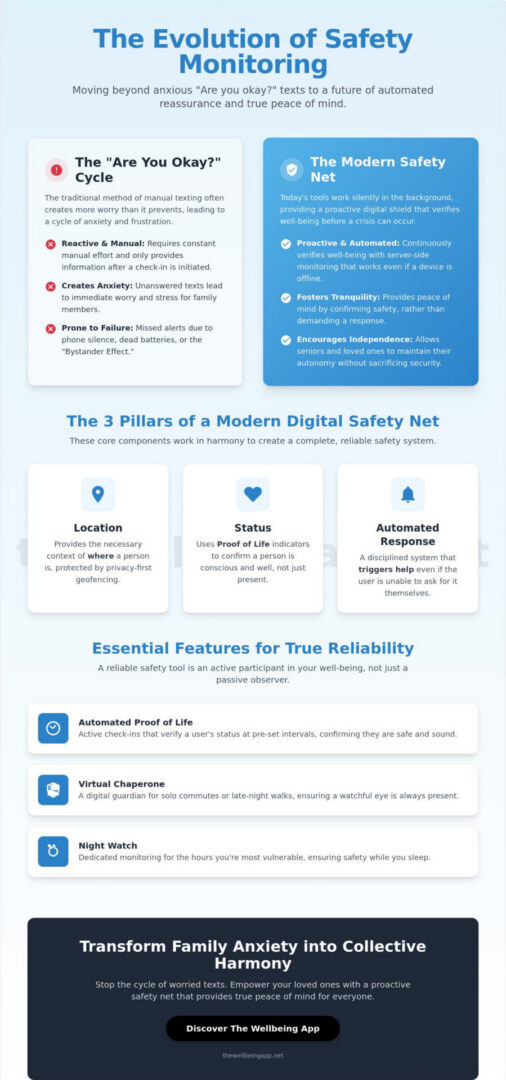
Safety is no longer just a response to a crisis; it’s the active prevention of one. In 2026, safety monitoring tools function as a proactive digital safety net that works silently in the background of our daily lives. We’ve moved past the era of loud, reactive “emergency buttons” that only matter once trouble has already arrived. Today’s technology focuses on status verification, ensuring you aren’t just found after an incident, but are looked after before one can escalate. This evolution is rooted in the pursuit of mental tranquility, prioritizing the user’s internal peace of mind over the mere collection of coordinates.
The modern safety landscape is built upon three essential pillars that work in harmony to protect the vulnerable. First is location, providing the necessary context of where a person is. Second is status, which uses Proof of Life indicators to confirm a person is conscious and well. Third is the automated response, a disciplined system that triggers help even if the user is unable to ask for it. When these pillars stand together, they create an atmosphere of safety that encourages independence rather than anxiety.
The Evolution from Industrial to Personal Safety
Enterprise-grade reliability once reserved for high-stakes industries like aviation or construction is now accessible to the average family. While workplace fatalities still exceed 5,000 annually in the United States, the rigorous technology used to mitigate those risks has migrated into the personal safety app market. We’ve learned that location alone isn’t safety. If a phone sits still for three hours, a GPS tracker says it’s at home, but status monitoring asks if the person is okay. Modern systems utilize server-side monitoring to prevent missed alerts. If a device loses power or signal, the system doesn’t just go dark. It notices the silence and initiates a protective protocol to ensure no one is left behind.
Key Categories of Monitoring Tools
Understanding the landscape requires distinguishing between active and passive monitoring. Active tools require a user to interact, providing a Proof of Life indicator at set intervals to confirm their well-being. Passive tools, like smart rings or sensors, monitor vitals or movement without intervention. While the smart ring market has grown with devices like the Samsung Galaxy Ring or Oura Ring 4, many families prefer software-based solutions for their versatility. These tools enable sophisticated services like a Virtual Chaperone. This feature acts as a digital guardian during high-risk transitions, such as a solo walk home or a late-night commute, ensuring a watchful eye is always present until the user is safely behind their own door.
Essential Features of Reliable Safety Monitoring Tools
Reliability in 2026 is measured by a tool’s ability to act when you cannot. A simple GPS tracker is a passive observer, but high-quality safety monitoring tools are active participants in your well-being. These systems provide a sophisticated blend of location intelligence and status verification, ensuring that the burden of safety is shared among a trusted circle rather than resting solely on the shoulders of the vulnerable. When evaluating a platform, the focus should be on features that provide continuous, non-intrusive protection.
- Automated Proof of Life: Active check-ins that verify a user’s status at pre-set intervals throughout the day.
- Virtual Chaperone: A digital guardian that stays with you during solo commutes, late-night walks, or unfamiliar transitions.
- Night Watch: Dedicated monitoring for the hours when you’re most vulnerable: while you sleep.
- Privacy-First Location Sharing: Real-time coordinates protected by smart geofencing to ensure data is only visible when it’s necessary for safety.
- Multi-Channel Alerts: Instant notifications delivered via SMS, email, and push notifications to ensure your circle is never out of the loop.
Choosing a service that integrates these features into a single, intuitive interface allows families to breathe easier, knowing their loved ones are never truly alone. If you’re looking for a way to centralize these protections, you can explore how these features work together to create a seamless, supportive safety net for your household.
The Concept of Proof of Life
Proof of Life check-ins revolutionize the way we care for others by replacing the intrusive “Are you okay?” text with a structured, automated process. Instead of constant phone calls that can feel like a loss of independence, a user simply confirms their status through the app at scheduled times. If a check-in is missed, the system doesn’t immediately panic. It follows a disciplined escalation path: first a gentle reminder, then a louder alert, and finally a comprehensive notification to the emergency circle. This smart filtering effectively reduces alarm fatigue, ensuring that when your family receives an alert, they know it’s a moment that requires their sincere attention and action.
Virtual Chaperone and Night Watch
True protection doesn’t punch a clock. A Virtual Chaperone acts as a digital companion for those high-stakes transitions, like walking to a car in a dimly lit garage or traveling through an unfamiliar neighborhood. It maintains a constant connection until you confirm you’ve reached your destination safely. Similarly, Night Watch provides a layer of security during sleep hours, monitoring for safety when your own awareness is at its lowest. These features rely on 24/7 server-side vigilance. Because the monitoring happens in the cloud, the protection remains active even if your phone battery dies or you lose cellular service. This provides a level of reliability that manual check-ins simply can’t match, fostering a sense of empowerment for the user and tranquility for their family.
Automated vs. Manual Monitoring: Why Texting Isn’t Enough
Relying on a text message to confirm a loved one’s safety is a fragile strategy. We often think of the “Are you okay?” text as a caring gesture, but in reality, it creates a cycle of dependency and intermittent anxiety. If the recipient doesn’t reply instantly, the sender’s mind often spirals into worst-case scenarios. This is the fundamental weakness of manual check-ins. They rely on two fallible human minds being perfectly synchronized. By contrast, automated safety monitoring tools remove the guesswork, replacing emotional friction with a disciplined “Proof of Life” metric that functions silently in the background.
Digital family groups frequently suffer from a phenomenon known as the “Bystander Effect.” When several people have access to a shared location map, each individual often assumes that someone else in the group is already keeping watch or has already reached out to check on a stationary icon. This diffusion of responsibility can lead to hours of silence during a critical window of time. Automated systems solve this by establishing a clear, non-negotiable chain of accountability. If the system doesn’t receive a status indicator at the expected time, it triggers a specific, pre-defined protocol that doesn’t wait for a human to notice something is wrong.
During an actual emergency, the human brain often enters a state of intense “tunnel vision.” Adrenaline spikes, and the logical task of sending a “Help” text or calling a family member frequently falls by the wayside as the individual focuses entirely on the immediate threat or medical crisis. This is where human memory fails but server-side automation excels. Because the monitoring is managed by a remote server, it doesn’t matter if the user’s phone is destroyed or if they are too panicked to act. The system expects a signal; if that signal doesn’t arrive, the alarm sounds automatically.
The Fallacy of “Call Me When You Get Home”
We’ve all promised to call when we arrive at a destination, only to get distracted by a conversation or a dead phone battery. These “silence gaps” are the primary source of family stress. Automated tools bridge this gap by monitoring the transition itself rather than the final phone call. If a phone dies during a Chaperone session, the server-side monitoring recognizes the abrupt disconnection as an alert state. This removes the emotional burden from the person being monitored, allowing them to focus on their journey while the technology handles the duty of reassurance.
Data-Driven Reassurance
In 2026, safety is defined by the ability to recognize patterns and deviations. Modern tools use historical data to identify when a routine has shifted in a way that suggests a problem. If a senior usually interacts with their device by 8:00 AM but hasn’t done so by 8:30 AM, the system notices the deviation before a family member even finishes their morning routine. This “proof of safety” is further enhanced by integrating biometric indicators from wearables, providing a high-fidelity view of well-being without the need for intrusive calls. It’s a way to stay connected that respects personal agency while ensuring that if the “normal” changes, the right people are notified instantly.
How to Choose the Right Safety Tool for Your Family
Selecting the right protection for your loved ones is a profound expression of duty and care. It requires a delicate balance between maintaining a watchful eye and respecting the personal agency of the person being protected. If a tool feels like a tether, it will likely be abandoned; if it feels like a supportive companion, it becomes a natural part of a person’s daily life. When evaluating safety monitoring tools, you must look beyond the technical specifications and consider the emotional impact the service will have on your family’s harmony. The goal is to foster a sense of empowerment, not a feeling of being under surveillance.
Your choice should begin with a clear assessment of the vulnerable person’s specific needs. A university student walking home late at night requires different features than a senior living alone who wants to maintain their independence. You must also ensure cross-platform compatibility between iOS and Android devices, as a family’s safety net is only as strong as its weakest link. While the 2026 market offers various one-time hardware options like the RingConn Gen 2 or the Samsung Galaxy Ring, these often focus on health metrics rather than active safety. Subscription-based software models are generally superior for continuous, server-side vigilance and rapid emergency response.
Finding a service that aligns with your values is the most important step in this journey. To see how a modern system integrates these complex needs into a simple, caring interface, you can compare the best safety features for your household. This ensures your choice is rooted in both technological robustness and sincere concern for your family’s mental tranquility.
Evaluating Reliability and Server Uptime
A safety app that only works “locally” on a smartphone is a significant risk. If the phone is lost, stolen, or the battery dies, a local-only app becomes silent and useless. Reliable safety monitoring tools must utilize server-side monitoring. This means the watchful protection happens in the cloud; if the user’s device goes offline unexpectedly, the server notices the silence and triggers a protective protocol. Additionally, with new 2026 data privacy laws taking effect in states like Indiana, Kentucky, and Rhode Island, you must ask providers how they secure sensitive personal information. A trustworthy guardian is always transparent about data protection and regulatory compliance.
User Experience for Seniors and Vulnerable Adults
Simplicity is the gold standard for any safety interface. For seniors or those who may be under intense stress during a crisis, high-friction apps with complex menus are a liability. The ideal user experience focuses on “one-button” interactions and intuitive status indicators. You should avoid apps that require constant, high-tech literacy or frequent manual updates. The UI design should be empathetic and non-alarmist, using warm colors and clear language to provide reassurance rather than stoking fear. This disciplined approach to design ensures that the technology remains an accessible tool of empowerment for every member of the family, regardless of their comfort level with technology.
Empowering Your Circle with The Wellbeing App
Embracing modern technology shouldn’t feel like a compromise on your family’s privacy. The Wellbeing App represents a shift in how we approach safety monitoring tools, moving away from cold data points toward a philosophy of mental tranquility. It acts as a watchful protector, standing by to ensure that the people you love are never truly alone, even when you can’t be physically present. By unifying sophisticated indicators into one seamless interface, we’ve created an environment where safety is a shared responsibility rather than a source of constant worry.
The platform’s strength lies in its integrated approach. Instead of juggling multiple apps for different needs, you can manage Proof of Life check-ins, Chaperone sessions, and Night Watch protection from a single, intuitive dashboard. This cohesion is vital for maintaining a consistent safety net. It allows you to move from a state of reactive anxiety to one of proactive peace. You’ll find that when the technology handles the heavy lifting of vigilance, the emotional weight on your family begins to lift. It’s about more than just alerts; it’s about the preservation of your mental state and the well-being of your household.
A Compassionate Guardian in Your Pocket
Security is most effective when it feels human. Our approach to safety is deeply rooted in the concept of social cohesion, framing our services as instruments of empowerment. For a senior living independently, a daily Proof of Life indicator isn’t a chore; it’s a quiet confirmation of their agency and well-being. For a student traveling home after dark, the Chaperone feature provides the warmth of a digital companion. These real-world applications demonstrate that safety isn’t just about preventing incidents. It’s about fostering trust and harmony within your family circle. We believe that by looking out for one another, we build stronger, more resilient communities.
Getting Started with Proactive Protection
Taking the first step toward a more secure future is a simple, purposeful process. You can begin by setting up your first Proof of Life indicator, choosing the times and frequencies that best fit your loved one’s routine. This customization ensures that the protection feels supportive rather than intrusive. Once your primary indicators are active, you can easily invite family members to join your safety circle, creating a network of collective responsibility. This isn’t just about software; it’s about fulfilling your duty to those you care for most. We invite you to Protect your loved ones with The Wellbeing App today and experience the profound difference that proactive, compassionate monitoring can make in your daily life.
A Future Rooted in Proactive Care and Mental Tranquility
We’ve explored how the landscape of safety monitoring tools has shifted from reactive hardware toward compassionate, server-side intelligence. You now understand that while manual check-ins often fail during high-stakes moments, automated systems provide a disciplined bridge of reassurance. By choosing a solution that balances privacy with proactive vigilance, you’ll empower your loved ones to maintain their independence while ensuring they’re never truly alone. It’s about creating a culture of care that respects personal agency and fosters collective harmony.
True safety is about the preservation of your mental state as much as it is about physical security. With 24/7 server-side monitoring and automated Proof of Life indicators, you can replace a cycle of anxiety with a steady, reliable rhythm of well-being. Our empathetic, non-fear-based design ensures that protection feels like a warm embrace rather than a restrictive tether. It’s a commitment to the harmony and social cohesion of your household, turning technology into a supportive companion.
Secure your peace of mind with The Wellbeing App’s Proof of Life monitoring. Fulfilling your duty to your family is a noble journey, and we’re honored to walk it alongside you. Together, we can foster a world where everyone feels safe, seen, and supported.
Frequently Asked Questions
What exactly are safety monitoring tools for personal use?
These tools are specialized digital applications designed to act as a proactive safety net for individuals and families. Unlike traditional security systems that focus on property, personal safety monitoring tools prioritize the well-being and mental tranquility of the user. They utilize features like automated status indicators and location intelligence to ensure a person is safe before an emergency occurs, shifting the focus from reaction to prevention.
How does an automated check-in app differ from a standard GPS tracker?
A standard GPS tracker only tells you where a device is; it doesn’t tell you if the person holding it is okay. Automated check-in apps bridge this gap by requiring a “Proof of Life” indicator at scheduled intervals. While a tracker might show a phone sitting still for hours, an automated tool will actively notice the lack of interaction and trigger a protective protocol to alert your family circle.
Is safety monitoring too invasive for seniors who want independence?
Safety monitoring is designed to empower independence rather than restrict it. By replacing intrusive “Are you okay?” phone calls with simple, scheduled status indicators, seniors can go about their day without feeling monitored. It preserves their personal agency while providing the family with the reassurance they need. This balance ensures that help is always available without the need for a constant, hovering presence that can feel like a burden.
What happens if the monitored person’s phone dies or loses signal?
Reliability is maintained through 24/7 server-side monitoring. If a device loses power or signal unexpectedly, the remote server recognizes the silence as an alert state. Because the system expects a regular signal, it doesn’t just go dark when the hardware fails. Instead, it initiates an automated escalation path to notify the emergency circle, ensuring that a dead battery never results in a “silence gap” during a crisis.
Can safety monitoring tools help with “Night Watch” for people living alone?
Yes, specialized features like Night Watch are specifically designed to protect vulnerable adults during their most stationary hours. While you sleep, the system remains in a state of empathetic vigilance, monitoring for any indicators that suggest a deviation from safety. It provides a layer of security for those living alone, ensuring that if something goes wrong during the night, an automated alert will reach their trusted circle immediately.
Are these tools reliable enough to replace a traditional medical alert bracelet?
Modern safety monitoring tools offer a more proactive approach than traditional reactive bracelets. While a bracelet requires the user to be conscious and able to press a button, automated indicators trigger help even if the user is incapacitated. These digital tools provide a sophisticated, multi-layered safety net that monitors status continuously, making them a more comprehensive choice for families who want to prevent incidents rather than just responding to them.
How do automated alerts prevent missing person incidents?
Automated alerts prevent incidents by identifying deviations from normal routines as they happen. If a user fails to provide a status indicator at a set time, the system notifies their circle within minutes. This early detection is critical for rapid response, ensuring that the search begins long before a manual “Are you home?” text would have been sent. It creates a disciplined timeline of accountability that protects the vulnerable.
What is a virtual chaperone and when should I use one?
A virtual chaperone acts as a digital companion during high-risk transitions, such as walking to a car late at night or traveling through an unfamiliar neighborhood. You should use it whenever you feel a need for extra vigilance. The tool maintains an active connection with your safety circle until you confirm you’ve reached your destination safely, providing a sense of collective responsibility and mental tranquility throughout your journey.