
Life Alert Monthly Cost vs. App-Based Safety: A 2026 Comparison Guide
What if the high monthly bill you pay for a traditional medical alert system is actually buying a false sense of security? Many families choose legacy hardware because they want a reliable safety net, yet they often find themselves locked into three year contracts with startup fees reaching nearly two hundred dollars. When you compare the life alert monthly cost vs app based safety, it becomes clear that the price of protection shouldn’t include the stigma of a bulky pendant or the constant fear that a button might not be pressed in time. You deserve a solution that acts as a compassionate guardian rather than a financial weight.
We know that your search for safety is rooted in a deep desire for mental tranquility and the well being of those you love. You’re likely looking for a way to bridge the reactive gap where help only arrives after a crisis is already in motion. This 2026 comparison guide explores how modern applications are replacing heavy hardware with proactive tools like Proof of Life and Night Watch services. You will learn how to secure protection that empowers your independence while ensuring a community of care is always watching over you. It’s time to find a safety net that is as technologically sophisticated as it is sincere.
Key Takeaways
- Compare the life alert monthly cost vs app based safety to uncover the hidden financial commitments of traditional hardware versus the flexibility of modern mobile solutions.
- Identify the psychological benefits of choosing discreet, smartphone-based monitoring that preserves personal dignity and eliminates the social stigma of wearing a visible medical device.
- Evaluate the critical difference between reactive panic buttons and proactive Proof of Life check-ins to ensure a safety net is triggered even if a user is unable to call for help.
- Discover how specialized features like Chaperone and Night Watch provide a protective presence for active seniors, offering mental tranquility during late-night walks or solo transitions.
- Determine which safety solution best aligns with your loved one’s tech-fluency to foster independence while maintaining a constant, compassionate connection to their community.
The True Cost of Safety: Beyond the Monthly Bill
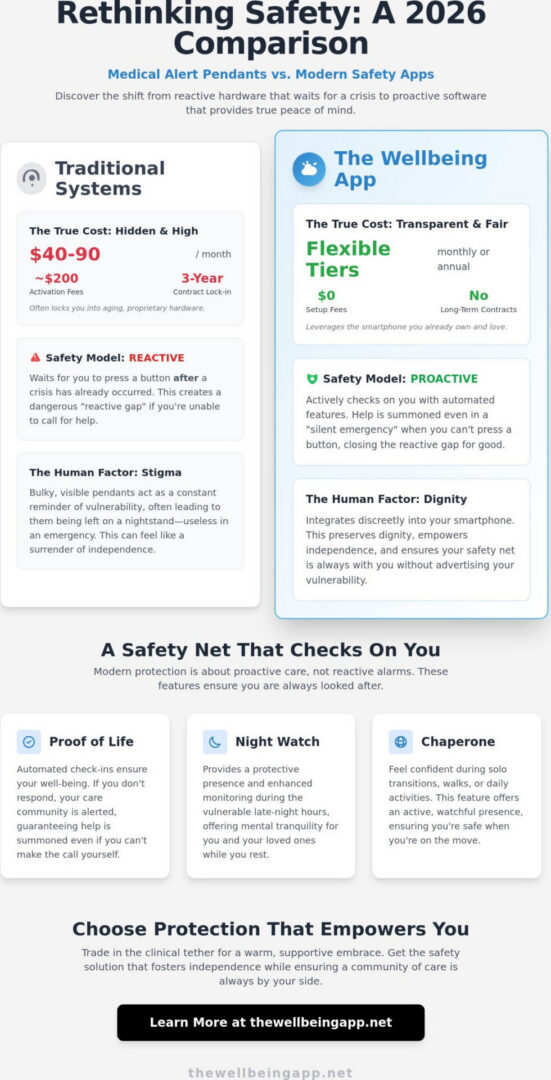
Traditional security models often frame safety as a simple transaction. You pay a monthly fee and receive a plastic button in return. However, when we look at the life alert monthly cost vs app based safety, the numbers on the invoice tell only half the story. Traditional hardware systems typically command between $40 and $90 every month, yet they often fail to account for the human element of safety. If a device is too bulky to wear or too clinical in appearance, it stays on the dresser. A safety net that isn’t with you is no safety net at all. You deserve a solution that prioritizes your presence, not just your subscription.
Financial Transparency in the Alert Industry
Choosing a Personal Emergency Response System (PERS) shouldn’t feel like signing a high-stakes financial treaty. Many traditional providers justify their margins by requiring proprietary hardware, which often comes with activation fees near $200 and three-year contract lock-ins. These companies prioritize the hardware lease over the actual well-being of the individual. In contrast, modern safety applications leverage the smartphone you already own, removing the need for expensive, specialized devices that quickly become obsolete. This shift toward software-based monitoring allows for more agile updates and a focus on your actual daily needs without the burden of long-term debt.
The Emotional Impact of Wearable Hardware
There is a hidden cost to traditional pendants that isn’t found on a balance sheet; we call it the stigma cost. For many seniors, wearing a visible medical alert device feels like a surrender of their independence. It is a constant, plastic reminder of vulnerability that can lead to feelings of anxiety rather than empowerment. This is why so many pendants end up on nightstands or in kitchen drawers. App-based safety preserves your dignity by integrating into everyday technology. It transforms your phone into a watchful protector through features like Proof of Life, allowing you to move through the world with confidence and grace.
A proactive approach changes the dynamic of safety entirely. Instead of waiting for a crisis where you must reach for a button, systems that utilize automated check-ins ensure that help is summoned even during a “silent emergency.” If you cannot press a button, the reactive gap becomes a life-threatening void. A reactive button is only effective if it’s within arm’s reach at the exact moment of a fall or medical event. Modern safety apps provide a proactive safety net that doesn’t rely on your ability to act under duress. By choosing a system that checks on you, rather than one that waits for you to fail, you cultivate true mental tranquility for yourself and your family. Protection should feel like a warm, supportive embrace, not a clinical tether.
Life Alert vs. Safety Apps: A 2026 Comparison
Directly comparing the life alert monthly cost vs app based safety reveals a significant gap in how technology serves the user. Traditional systems rely on a proprietary pendant, a piece of hardware that requires manual testing and physical maintenance. If the internal battery degrades or the plastic casing cracks, the safety net fails until a replacement arrives. In contrast, safety apps utilize the sophisticated smartphone you already own. These devices receive automatic software updates that enhance functionality without requiring you to mail back a device or wait for a technician. You’re choosing between a static tool and a living, evolving guardian.
Comparing Monthly Subscription Models
Legacy providers often use “Price Lock” marketing to obscure the reality of three-year contracts and equipment leases. While the monthly rate might stay the same, you’re tethered to aging hardware that lacks the agility of modern software. App-based safety offers a more transparent relationship with flexible monthly or annual tiers. There are no hidden shipping fees or installation costs. Software-based services provide frequent updates, ensuring that your Emergency Alerts and monitoring features benefit from the latest security protocols the moment they’re released. This model prioritizes your ongoing mental tranquility over a long-term financial commitment.
Hardware Reliability vs. App Accessibility
In 2026, the GPS chipsets found in modern smartphones offer precision that often surpasses dedicated legacy hardware. While a pendant might be forgotten on a bedside table, 78% of adults over 65 now use smartphones regularly, and these devices rarely leave their side. This “Always With You” factor is the strongest indicator of a safety system’s success. App-based safety leverages 24/7 server-side monitoring to ensure that your status is constantly verified without requiring your active intervention. Choosing a solution that grows with your family can enhance your sense of shared responsibility; you might explore how modern safety applications simplify this transition.
Scalability is another area where apps outperform traditional hardware. Adding a spouse or a family member to a legacy plan usually requires purchasing a second device and paying an additional monthly lease. With app-based solutions, Location Sharing and family-wide protection are often integrated into a single, cohesive plan. This collective approach reinforces the idea that safety is a shared effort among loved ones. By focusing on the technology you already carry, you remove the barriers to protection and replace them with a sophisticated, caring partner that is always ready to act. It’s a shift from carrying a burden to carrying a sense of peace.
Reactive Buttons vs. Proactive Proof of Life
Most families focus on the immediate life alert monthly cost vs app based safety, but the functional difference between reactive and proactive systems is where the true value resides. A traditional button is a promise that help is a click away. But what happens when you can’t click? Traditional safety models are built on a reactive foundation. They wait for a crisis to occur and then rely on the victim to initiate the rescue. A pendant is a passive tool. It sits silent until you press it. This creates a dangerous “reactive gap” during the very moments when you are most vulnerable. By shifting to a proactive model, you aren’t just buying a gadget; you’re investing in a system that actively verifies your well-being.
The Failure Point of Traditional Pendants
The statistical reality of falls is sobering. Falls are the leading cause of both fatal and nonfatal injuries for older adults in the U.S. In 2021 alone, unintentional falls resulted in 38,742 deaths among individuals aged 65 and older. Many of these incidents involve a “Silent Emergency” where the individual is unconscious or unable to move. In these cases, a reactive button is effectively useless. Home-based systems also suffer from limited physical range. If you’re in the garden or a distant laundry room, the base station might not receive the signal. This makes legacy hardware a half-measure for anyone who values true, mobile independence.
How Automated Check-ins Bridge the Gap
Our Proof of Life feature replaces the fear of the unknown with a structured, supportive routine. This mechanism requires a simple daily check-in that acts as a wellness indicator. If that indicator isn’t met, the system doesn’t just wait for a button press. It proactively triggers Emergency Alerts to your designated circle of care. This ensures that a lack of action becomes a clear signal for help. We also provide Night Watch protection for those quiet hours when you may feel most alone.
Safety shouldn’t stop at your front door. Features like the Chaperone extend this vigilance to your movements outside the home, providing a virtual companion while you run errands or walk through the neighborhood. It’s about creating a safety net that is always on, even when you aren’t thinking about it. When your family knows that Location Sharing and proactive check-ins are active, it fosters a deep sense of mental tranquility. You aren’t just carrying a device; you’re carrying the collective responsibility of a community that cares for your safety. This proactive logic ensures that you are never truly alone, even in the moments you cannot speak for yourself.
Choosing the Right Safety Net for Your Lifestyle
Selecting a safety solution requires a deep understanding of your loved one’s daily rhythms and personal preferences. When you weigh the life alert monthly cost vs app based safety, it’s essential to look past the initial invoice and consider the three-year cost of ownership. Traditional systems often lock families into 36-month contracts with activation fees reaching nearly $200 in early 2026. This long-term financial weight can be a significant burden for those on a fixed income. Modern safety apps provide a more flexible alternative, allowing you to scale protection as needs change without the clinical look of proprietary hardware.
Lifestyle Assessment for Safety Tech
Does your loved one enjoy daily walks, community events, or visiting friends? For an active senior, a home-bound base station is a severe limitation that can feel like a tether. Smartphone ownership among those aged 65 and older reached 78% in 2026, making the “tech-fluency” barrier lower than it’s ever been. An app-based system travels wherever the phone goes, utilizing GPS-enabled Location Sharing to keep family members connected. If a senior often forgets to wear a pendant, an app solves the problem because the phone is already a natural part of their daily habit.
Consider these factors when assessing your family’s needs:
- Mobility: Does the user frequently leave the home for errands or social visits?
- Habitual Use: is the user more likely to carry a phone than a specialized neck pendant?
- Family Involvement: Does the circle of care want real-time updates on wellness indicators?
The Hybrid Approach: When Both Might Be Needed
There are specific situations where a multi-layered strategy is beneficial for everyone involved. If a senior manages a high-risk medical condition, integrating app-based monitoring with their existing check-in routines can provide an extra layer of security. You can combine manual triggers with automated Emergency Alerts to ensure no crisis goes unnoticed, even during a “silent emergency.” The ideal user for a subscription-based safety app is an independent adult who wants a watchful protector without the clinical look of traditional hardware.
Safety is a collective effort that thrives on interpersonal connection and shared responsibility. By choosing a system that includes features like Night Watch and the Chaperone, you’re selecting a partner that understands the nuances of modern life. These tools don’t just wait for a fall; they provide a supportive presence during late-night hours or solo outings. If you’re ready to transition to a more intuitive form of protection, explore the benefits of app-based safety today. This choice isn’t just about a monthly bill; it’s about the mental tranquility that comes from knowing your loved ones are never truly alone.
The Wellbeing App: Modern Protection for Modern Families
Transitioning from traditional hardware to a digital safety net represents a shift toward personal agency and collective responsibility. When evaluating the life alert monthly cost vs app based safety, the most profound difference lies in how the service integrates into your daily life. The Wellbeing App replaces the burden of high recurring bills and bulky pendants with a sophisticated, software-driven guardian. It leverages the technology already in your pocket to foster a sense of security that is both invisible and omnipresent. You aren’t just buying a tool; you’re joining a community dedicated to the preservation of mental tranquility.
Our approach centers on the idea that safety should be a shared effort. By utilizing Location Sharing and automated Emergency Alerts, we build a safety net that connects you to your loved ones in real time. This isn’t just about technical robustness; it’s about the emotional reward of knowing someone is always looking out for the group’s best interests. Whether you are at home or exploring your community, the app remains a reliable, always-on partner that prioritizes your well-being over proprietary equipment leases.
Why Proof of Life is the New Standard
Traditional systems rely on the user’s ability to act during a crisis, but we believe safety should be proactive. Our Proof of Life feature moves beyond the reactive “Help, I’ve fallen” mindset to a state where the app confirms “I’m okay” through automated indicators. This shift reduces the constant anxiety family members feel and eliminates the need for intrusive wellness check calls that can sometimes disrupt a senior’s sense of independence. If an indicator is missed, the system acts with empathetic vigilance to notify your circle of care immediately.
For those moving through suburban or urban environments alone, the Chaperone feature acts as a virtual companion. It provides a protective presence while you walk home or run errands, ensuring you are never truly alone in potentially vulnerable moments. Similarly, Night Watch extends this vigilance into the evening. It offers round-the-clock monitoring of your status without the need for intrusive cameras or physical hardware, respecting your privacy while maintaining a constant heartbeat of safety.
Getting Started with App-Based Security
Setup is designed to be simple and supportive, allowing you to move from download to active monitoring in just a few minutes. You don’t need to wait for a technician or ship hardware back and forth. You can choose between individual protection or family-wide plans that empower every member of your household. This collective approach ensures that protection is a shared experience, reinforcing the bonds of family and community. It’s a disciplined, serious approach to safety that remains accessible and friendly for users of all tech-fluency levels. Secure your peace of mind with The Wellbeing App today and experience the harmony of proactive, modern protection.
Secure Your Future with Empowered Safety
Choosing between a traditional pendant and a modern application is about more than just the bottom line. When you analyze the life alert monthly cost vs app based safety, you see a choice between a reactive past and a proactive future. True security shouldn’t require you to wear a clinical device or sign a multi-year contract. It should live where you do; on the smartphone you already carry and within the community that cares for you. This transition allows you to move away from the stigma of legacy hardware toward a life of unhindered independence.
By prioritizing Proof of Life Indicators and 24/7 Automated Monitoring, you bridge the dangerous gap that reactive buttons leave behind. There is No Proprietary Hardware Required, which means your safety net is as mobile and active as you are. You have the power to preserve your personal agency while ensuring that your circle of care is always connected to your well-being. It’s time to replace anxiety with the steady, calm assurance of a system designed for the modern world.
Start your proactive safety journey with The Wellbeing App and reclaim your mental tranquility today. You deserve a partner that watches over you with sincere concern and technological sophistication.
Frequently Asked Questions
Is a smartphone app as reliable as a Life Alert button?
Reliability is often higher with an app because the smartphone is already a deeply ingrained daily habit. Unlike a traditional pendant that might be forgotten on a nightstand, a phone is carried by 78% of seniors throughout the day. App-based safety also benefits from continuous software updates that improve functionality without requiring you to replace physical hardware or wait for a technician to arrive.
How much does a typical safety app cost per month compared to hardware?
Apps typically eliminate the high activation fees and expensive monthly equipment leases found in traditional systems. When you analyze the life alert monthly cost vs app based safety, you’ll find that software-based solutions offer transparent tiers without the weight of three-year contracts. You pay for the monitoring and features you need, rather than subsidizing the manufacturing of proprietary plastic devices.
What happens if I forget to check in on a Proof of Life app?
If you miss a scheduled check-in, the system initiates a structured sequence of escalating Emergency Alerts to your designated circle of care. This proactive approach ensures that your family is notified the moment your routine is broken. It transforms a simple lack of action into a clear signal for help, providing a safety net even when you cannot speak for yourself.
Do safety apps work if I don’t have a cell signal or Wi-Fi?
Safety apps require a data connection to transmit real-time alerts and location data to your family. However, many modern smartphones utilize robust cellular networks that cover the vast majority of populated areas. If a signal is lost, the server-side monitoring can still flag your last known location or the absence of a required Proof of Life check-in to your contacts.
Can the app detect falls automatically like some medical alert pendants?
Many modern safety apps utilize the high-precision accelerometers and sensors built into smartphones to identify sudden movements or impacts. While hardware pendants have traditionally offered this feature, an app integrates this protective technology into a device you already use for communication. This ensures you have sophisticated detection capabilities without needing to wear an additional, clinical-looking device that may cause social stigma.
Is my location data private and secure with a safety app?
Privacy is a core pillar of our protective philosophy, utilizing advanced encryption to ensure your data remains confidential. You have total personal agency over who sees your information through your Location Sharing settings. Your movements are only visible to the specific family members or trusted friends you have chosen to be part of your supportive safety community.
What is a ‘Virtual Chaperone’ and how does it work?
The Chaperone feature provides a virtual companion that stays active during the moments you feel most vulnerable, such as walking to your car at night. It creates a temporary window of empathetic vigilance where the app monitors your progress in real time. If you don’t reach your destination within the expected timeframe, the system automatically alerts your loved ones to ensure you are safe.
Can I use the app for my elderly parents if I live in a different state?
Distance is no barrier to the compassionate guardian model of app-based safety. You can monitor wellness indicators and receive Emergency Alerts from any location, making it an ideal solution for families separated by many miles. This shared responsibility helps maintain mental tranquility for everyone involved, knowing that a watchful protector is always active regardless of where you live.