Automated Daily Check-in Service: The Complete Guide to Personal Safety in 2026
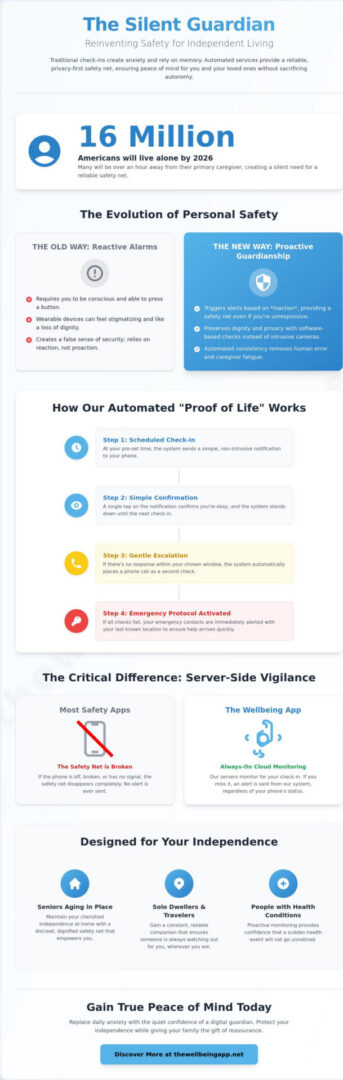
What if the greatest threat to your independence isn’t a lack of mobility, but the silent fear of being found too late? By the end of 2026, nearly 16 million Americans will live alone while their primary caregivers reside over an hour away. It’s a staggering reality that often leads to a cycle of guilt for relatives and intrusive check-in calls that disrupt your daily rhythm. You deserve to live on your own terms without the constant shadow of “what if” hanging over your family. An automated daily check-in service changes this dynamic by acting as a compassionate, digital guardian that watches over you without ever invading your privacy.
We understand that you value your autonomy and don’t want to rely on wearable buttons or cameras that feel like a loss of dignity. You want a system that works in the background so you can focus on living your life. This guide will show you how to build a multi-layered ecosystem of proactive guardianship through features like Proof of Life and Night Watch. You’ll discover how these services provide a reliable safety net that ensures help is always on the way when it matters most. We will also walk through the latest 2026 privacy regulations to ensure your personal data remains as secure as your home.
Key Takeaways
- Replace the daily anxiety of manual “good morning” texts with an automated daily check-in service that provides a consistent, digital safety net.
- Discover why server-side monitoring is essential for Proof of Life technology, ensuring alerts reach your family even if your phone’s battery fails.
- Master a five-step framework to evaluate safety systems based on your unique threat model, focusing on redundant indicators rather than just reactive buttons.
- Learn how a multi-layered ecosystem of Night Watch and Chaperone offers proactive guardianship while preserving your dignity and independence.
- Find the ideal balance between technical security and mental tranquility by selecting verification methods that don’t cause notification fatigue.
What is an Automated Daily Check-in Service?
An automated daily check-in service acts as a silent, digital companion that verifies your well-being at pre-set times throughout the day. It’s a proactive safety net designed to replace the traditional, often stressful “Good Morning” text ritual. While family members have the best intentions, they can get busy, forget to check their phones, or experience caregiver fatigue. This technology removes human error from the equation, ensuring that your safety is never dependent on someone else’s schedule. It provides a consistent pulse of connection that protects your independence while offering your family profound peace of mind.
The core mechanism of this service is built on a “check-and-verify” logic. At your scheduled time, the system reaches out via a simple notification or call. Your response acts as a “stand down” signal, telling the system that all is well. If you don’t respond within a specific window, the service automatically triggers an emergency protocol. This ensures that help is dispatched even if you’re unable to reach a phone or press a button. In 2026, our Proof of Life technology has become the gold standard for solo dwellers because it prioritizes action over reaction. It doesn’t wait for a crisis; it looks for the absence of well-being.
The Evolution of Personal Safety Monitoring
Safety technology has moved far beyond the reactive panic buttons of previous decades. Those older systems required you to be conscious and physically capable of reaching a device during a fall or medical event. We’ve transitioned toward a more sophisticated model of lone worker monitoring adapted for personal use. By utilizing software-based “Virtual Guardians,” we’ve eliminated the need for bulky, proprietary hardware. Modern solutions prioritize your privacy, opting for digital verification rather than intrusive cameras or microphones that can make your home feel like a surveillance zone.
Who Benefits Most from Automated Check-ins?
This service is an essential tool for anyone who values personal agency but wants a secure safety tether. Seniors who wish to age in place without the stigma of medical pendants find it particularly empowering. It’s also a vital resource for solo travelers and professionals working late-night shifts who use our Chaperone and Night Watch features to stay connected. For individuals managing chronic medical conditions, these automated alerts provide a reliable way to ensure that a sudden health event doesn’t go unnoticed. It’s about fostering a community of care where safety is a shared, effortless responsibility.
How Proof of Life Technology Works Behind the Scenes
Behind every reliable automated daily check-in service is a sophisticated logic known as the “Dead Man Switch.” This isn’t about morbid fascination; it’s about the power of silence. In traditional security, you must act to get help. In our ecosystem, the absence of action is the most critical data point we monitor. If you don’t confirm your well-being during your scheduled window, our servers recognize that silence as a call for assistance. This ensures that even if you’re unconscious or unable to reach your device, the system remains vigilant on your behalf.
The escalation process is designed to be gentle yet persistent. It typically begins with a soft notification or SMS. If that goes unanswered, the system moves to an automated phone call. Only after these layers of verification fail does the system activate Emergency Alerts for your designated responders. By integrating GPS and real-time Location Sharing, we provide your family with the exact coordinates they need to reach you quickly. This structured approach mirrors successful public initiatives like the Senior Call Check program, which has proven that consistent, automated contact saves lives.
Server-Side Vigilance: The Invisible Guardian
Most safety apps rely solely on the phone in your pocket. If that phone breaks, runs out of battery, or loses signal, the safety net vanishes. We solve this through server-side infrastructure. Server-side monitoring is a redundant safety system located on external servers. Because the “timer” lives in the cloud and not just on your device, an emergency alert will trigger even if your phone is completely powered off. This invisible layer of protection ensures that a dead battery never results in a lost opportunity for rescue.
Customizing Your Safety Schedule
True safety should never feel like a chore. You can tailor your check-in windows to align with your unique Activities of Daily Living (ADLs). Whether it’s a morning confirmation after coffee or a Night Watch check-in before bed, the schedule adapts to you. You also maintain full control over your Care Circle, the group of trusted individuals who receive notifications if you miss a check-in. This level of personal agency allows you to explore proactive safety features that empower your lifestyle rather than restricting it. By inviting your loved ones into this shared effort, you foster a sense of collective responsibility and deep mental tranquility.
Comparing Check-in Methods: SMS, Calls, and Safety Apps
Choosing the right automated daily check-in service requires a balance between technical reliability and your personal comfort. Some users prefer automated phone calls because they offer a familiar, voice-based verification that works even on landlines. While these are accessible, they can feel repetitive and don’t provide the rich data needed for a rapid response. SMS-based services offer simplicity, yet they often fall victim to notification fatigue. In a world where our phones are flooded with alerts, a critical safety text can easily be swiped away or buried under a mountain of marketing messages. This is why many consumers are looking beyond basic personal safety alarms toward more integrated, software-driven solutions.
Comprehensive safety platforms represent the highest level of security available in 2026. Unlike a simple text or call, an integrated app creates a multi-layered safety net that combines Proof of Life verification with real-time Location Sharing. We understand that privacy is a top priority when choosing a digital guardian. Modern platforms utilize advanced data encryption to ensure your movements are only visible to your designated Care Circle. You retain full agency over who sees your status, turning the technology into an instrument of empowerment rather than a tool for surveillance. It’s a shift from being watched to being protected.
The Limitations of Manual Check-ins
Many families start with a simple promise: “I’ll just text you every morning.” While well-intentioned, this manual approach often fails as a long-term strategy. It places an immense psychological burden on family members who must act as constant monitors. If a text is late, the panic is immediate and often unnecessary. Conversely, if a family member is busy, a missed check-in might go unnoticed for hours. This creates a “false sense of security” trap where the safety net is only as strong as the person’s memory on any given day. An automated system removes this emotional weight, allowing families to focus on connection rather than constant worry.
Why 2026 Demands an Integrated Ecosystem
Modern safety is about more than just a single daily “OK” signal. An integrated ecosystem provides a fuller picture of well-being through features like our Chaperone and Night Watch protocols. These tools act as virtual guardians during higher-risk moments, such as walking home late or living through a solo night shift. By using subtle location indicators, the system can verify you’ve reached your destination safely without requiring a manual alert. This transition from simple alerts to proactive guardianship is what creates true mental tranquility for the entire family. It ensures that your independence is preserved while your safety is never left to chance.
Selecting the Best Service: A 5-Step Evaluation Framework
Choosing an automated daily check-in service is an act of deep care for yourself and your loved ones. It’s about establishing a protocol that preserves your mental tranquility and independence. To find the right fit, you must look beyond the interface to the infrastructure beneath. We’ve developed a five-step framework to help you choose a guardian that is both technologically sophisticated and deeply caring.
- Identify your primary threat model: Determine if you need a safety net for potential falls, transit security during late-night shifts, or consistent medical monitoring.
- Verify server-side redundancy: Ensure the service uses server-side monitoring rather than local app alerts, so an emergency protocol triggers even if your phone is dead.
- Evaluate the escalation process: Confirm how many contacts in your Care Circle are notified and check if the system uses multiple methods like SMS and automated calls.
- Check for multi-layered features: Look for specialized tools like Night Watch or Chaperone that offer proactive protection during higher-risk activities.
- Assess the Care Circle interface: The system should be as easy for your family to use as it is for you, fostering a sense of collective responsibility without technical frustration.
By following these steps, you can get started with our safety ecosystem today to secure your personal safety net.
The True Cost of Free vs. Premium Safety
While a free app might offer basic notifications, a professional service maintains a constant, uninterrupted pulse through robust digital infrastructure. Premium services invest in 24/7 server monitoring to ensure that the “Dead Man Switch” logic never fails due to a cloud outage or technical glitch. When you pay for a subscription, you aren’t just buying software; you’re investing in the mental tranquility that comes from knowing a compassionate guardian is always on duty. This small monthly commitment ensures that the technology remains updated and the response protocols remain sharp.
User Interface and Accessibility
A safety tool is only effective if it’s effortless to use. The best services are designed with seniors in mind, featuring clear text and high-contrast “one-tap” safety indicators that don’t require high dexterity or perfect vision. It should be simple to “stand down” an alert if you just forgot to check in, preventing unnecessary panic within your family. This balance of personal agency and proactive monitoring ensures that you feel empowered by the technology rather than restricted by it. Accessibility is the bridge between a technical feature and a real-world safety outcome.
The Wellbeing App: Your Watchful Protector and Compassionate Guardian
Personal safety is a continuous journey that extends far beyond a single morning notification. While a standard automated daily check-in service might verify your status once a day, our ecosystem provides a multi-layered shield that adapts to your life. We’ve designed this platform to be a compassionate guardian, watching over you during the quiet moments and the higher-risk transitions that other services often overlook. By focusing on the hours between check-ins, we ensure that your safety net is always active, providing the mental tranquility you and your family deserve.
The three pillars of our protection include Proof of Life, Chaperone, and Night Watch. Proof of Life offers that reliable, automated pulse that confirms your well-being without ever invading your privacy. For those moments when you’re in transit, Chaperone acts as a virtual companion that monitors your progress and triggers an alert if you don’t reach your destination. During the most vulnerable hours of the night, Night Watch provides specialized monitoring that looks out for you while you sleep. This comprehensive approach ensures that help is never more than a missed indicator away.
Proactive Protection for Every Scenario
True safety requires a blend of technical robustness and empathetic vigilance. Our platform integrates real-time Location Sharing and Emergency Alerts directly into the check-in flow, creating a seamless response protocol. Because we utilize server-side monitoring, our safety net remains intact even if your device loses power or signal. This infrastructure is widely considered the most reliable in the industry because it doesn’t depend on local app stability. We’ve built this system to empower you, giving you the tools to manage your own safety while keeping your Care Circle informed and at ease.
Join a Community Dedicated to Collective Safety
The Wellbeing App is more than just a suite of technical features; it’s a bridge to social cohesion and family unity. We believe that safety is a shared responsibility that should bring families closer together rather than creating friction. By automating the “worry,” we allow you to maintain your independence and personal agency while fulfilling your duty toward your loved ones. You can live on your own terms, knowing that a watchful protector is always standing by. It’s time to replace anxiety with a proactive safety management system that truly cares. Experience the peace of mental tranquility, start your subscription today.
Embrace Your Independence with Proactive Protection
Choosing a safety system is a powerful step toward maintaining your personal agency while fulfilling your duty to your loved ones. We’ve explored how a modern automated daily check-in service moves beyond simple reminders to create a sophisticated ecosystem of guardianship. By prioritizing server-side Proof of Life indicators, you ensure that your safety net remains active even if your device fails. This transition from reactive panic buttons to proactive monitoring allows you to live with confidence rather than caution.
You deserve a life defined by mental tranquility, not by the anxiety of “what if” scenarios. Our integrated Virtual Chaperone for safe transit and 24/7 Night Watch protection offer the multi-layered security required for 2026. These tools provide your Care Circle with the reassurance they need without ever compromising your privacy or dignity. It’s time to reclaim your peace of mind and foster a sense of collective responsibility within your family.
Secure your peace of mind with The Wellbeing App today.
Step into a future where you’re never truly alone. Your independence is a gift; let’s work together to protect it with empathy and vigilance.
Frequently Asked Questions
What is the difference between an automated check-in and a medical alert button?
An automated check-in is a proactive safety measure, while a medical alert button is reactive. A button requires you to be conscious and physically able to reach it during a crisis. Our system looks for the absence of your well-being indicator. If you don’t respond to the scheduled prompt, the protocol begins automatically. This ensures help arrives even if you cannot call for it yourself.
What happens if I forget to check in and my phone is dead?
If your phone is dead, our server-side monitoring continues to watch over you. Because the check-in timer lives on our external servers rather than just your device, the system knows if a confirmation hasn’t been received. It doesn’t matter if your battery is at zero or if you’ve lost signal. The automated daily check-in service will still trigger an alert to your Care Circle as scheduled.
Can I use an automated check-in service for my elderly parents if I live in another state?
Yes, you can easily support your parents from any distance. Since the platform is software-based, it bridges the gap between states or even countries. You’ll receive Emergency Alerts and Location Sharing data directly on your device if they miss a check-in. This helps eliminate the guilt and anxiety that often comes with living far away from loved ones who value their independence.
Is an automated check-in service more reliable than a manual text message?
Automated systems are significantly more reliable than manual texts. Human monitors can get distracted, forget to check their phones, or fall asleep. Our digital guardian never tires and never forgets a scheduled window. It removes the psychological burden of manual monitoring from your family, allowing your interactions to be about connection rather than constant safety checks.
Does the app track my location 24/7, or only during an emergency?
We prioritize your privacy and personal agency. The app doesn’t engage in intrusive 24/7 surveillance. Instead, Location Sharing is typically activated during an emergency alert or when you specifically engage features like Chaperone for transit safety. You maintain full control over who sees your data and when they see it, preserving your mental tranquility.
How many emergency contacts can I add to my Care Circle?
You can add multiple trusted individuals to your Care Circle. Most users choose a mix of family members, close friends, or even trusted neighbors. When an alert is triggered, the system can notify these contacts through various channels like SMS and automated calls. This ensures a collective responsibility for your well-being and increases the likelihood of a rapid response.
Is there a service that monitors me while I am sleeping?
Yes, our Night Watch feature is designed specifically for your most vulnerable hours. While traditional check-ins happen during the day, Night Watch monitors for well-being indicators while you sleep. If the system detects a lack of activity or a missed confirmation during these hours, it initiates the emergency protocol. It’s a specialized layer of protection for solo dwellers who want peace of mind overnight.
Can I set multiple check-in times throughout the day?
You have the flexibility to set multiple check-in windows that fit your routine. Every automated daily check-in service should adapt to your life, not the other way around. You might choose a morning check-in after breakfast and another in the evening before bed. Customizing these windows ensures that the safety net is tightly woven around your specific Activities of Daily Living.