
Virtual Chaperone Service: A Comprehensive Guide to Personal Safety in 2026
What if the heaviest part of walking home alone isn’t the darkness itself, but the mental weight of staying constantly on guard for your own survival? For many, the simple act of commuting at night or living independently is shadowed by a persistent hum of anxiety. You know the feeling of clutching your phone while waiting for a bus, or the nagging guilt when you forget to send that “I’m home” text to a worried family member. It’s an exhausting way to live, yet we’ve often accepted it as the unavoidable price of modern independence.
We believe safety shouldn’t feel like a chore or a constant source of stress. This guide introduces you to the evolving world of the virtual chaperone service, a proactive digital guardian designed to provide protective reassurance when you need it most. By 2026, the personal safety app market has grown to an estimated US$1.8 billion, driven by a shift toward AI-powered anomaly detection and automated check-ins. You’ll discover how these sophisticated tools offer reliable help if a check-in is missed, replacing fear with a deep sense of mental tranquility. We will explore the specific features that empower you to move through the world with confidence, knowing a compassionate guardian is always watching over your journey.
Key Takeaways
- Learn how a virtual chaperone service provides proactive protection by requiring active “safe” confirmations rather than relying on passive GPS tracking.
- Understand the simple steps to activate server-side monitoring, allowing you to set a destination and ETA for a fully supervised journey.
- Discover why automated safety protocols are more reliable than the traditional “text when you get home” method, which often fails due to human forgetfulness.
- Identify the most impactful scenarios for activating your digital guardian, from late-night commutes to solo exercise in secluded areas.
- Explore how integrating Proof of Life indicators creates deep mental tranquility and empowers you to move through the world with newfound confidence.
What is a Virtual Chaperone Service? Defining Modern Personal Safety
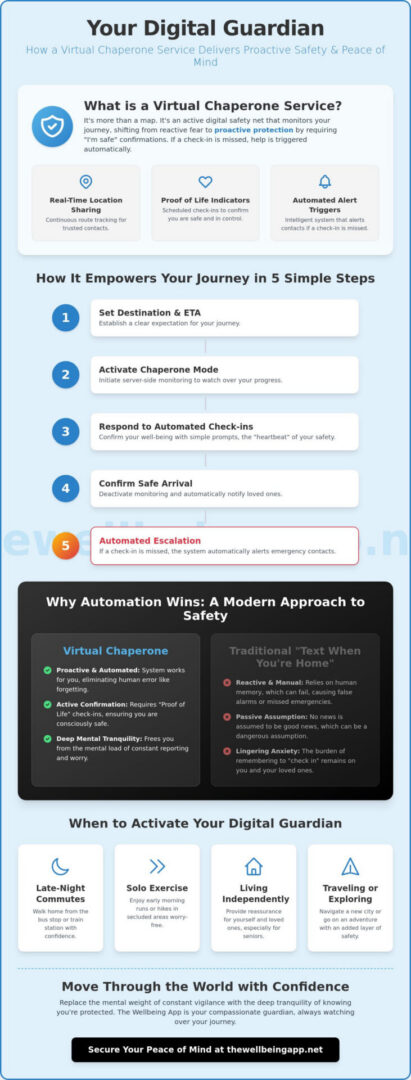
A virtual chaperone service isn’t just a map on a screen; it’s a commitment to your well-being. While many people think of security as a reactive response to a crisis, this technology shifts the focus toward proactive care. It functions as a digital safety net that monitors your journey as you move from one point to another. Unlike a standard personal safety app that might sit dormant on your phone, a chaperone service is an active participant in your commute. It bridges the gap between walking alone and having a physical escort by providing a constant, watchful presence that prioritizes your mental tranquility.
The most critical difference lies in the nature of the monitoring. Passive GPS apps simply show where you are. A true virtual chaperone service requires active “safe” confirmations. If you don’t check in at a pre-set time or location, the system recognizes the anomaly immediately. This prevents the “I forgot to text” anxiety and ensures that help is triggered automatically if you’re unable to reach for your phone. It’s a sophisticated way to maintain personal agency without the burden of constant manual reporting.
The Evolution from Physical to Digital Chaperones
In the past, personal safety often relied on physical escorts, such as campus security or a friend walking you to your car. While effective, these methods are often impractical for daily life or spontaneous trips. Mobile technology has democratized this level of high-level security, making professional-grade monitoring available to every individual with a smartphone. We’ve moved away from the era of “reactive” emergency calls, where help is only summoned after a problem occurs, to a “proactive” model. In this new landscape, your safety is managed through consistent status monitoring that identifies risks before they escalate.
Core Components of a Reliable Virtual Escort
A robust system relies on several technical pillars to ensure your safety is never compromised. These include:
- Real-time location sharing: Continuous route tracking that allows your trusted contacts or a monitoring server to see your progress.
- Proof of Life indicators: Scheduled check-ins that serve as a heartbeat for the service, confirming you’re conscious and in control of your situation.
- Automated alert triggers: Intelligent systems that notify designated emergency contacts if a check-in is missed or if you deviate significantly from your intended path.
These features transform your device into an instrument of personal agency. It’s about more than just technology; it’s about the harmony between digital robustness and human connection. By automating the “I’m safe” confirmation, you can focus on your surroundings rather than your screen.
How Virtual Monitoring Technology Empowers Your Daily Freedom
The true power of a virtual chaperone service lies in its ability to transform a passive journey into a supervised experience. It’s not just about knowing your coordinates; it’s about ensuring your well-being through an active, rhythmic dialogue between you and the technology. This process replaces the heavy burden of constant vigilance with a structured system of support. When you’re empowered by these tools, you don’t just move through the world; you move with a sense of mental tranquility that comes from knowing you’re never truly alone.
Activating this digital guardian is a straightforward process designed to fit seamlessly into your existing routine. It typically follows five essential steps:
- Step 1: You start by setting your destination and an estimated time of arrival (ETA), giving the system a clear expectation of your journey.
- Step 2: You activate the Chaperone mode, which initiates server-side monitoring to watch over your progress.
- Step 3: Throughout your walk or commute, you’ll respond to periodic automated check-in prompts, which serve as a heartbeat for your safety.
- Step 4: Once you reach your destination, you confirm your arrival to deactivate the watch and automatically notify your loved ones.
- Step 5: If a check-in is missed and you don’t respond, the system triggers an automated escalation, alerting your emergency contacts immediately.
This structured approach is gaining significant traction, particularly as more people look for reliable ways to manage solo commutes. For instance, the rise of the personal safety app for women highlights a growing demand for tools that prioritize personal agency and proactive care over reactive emergency calls.
The Science of Server-Side Monitoring
Many people worry about what happens if their phone battery dies or they lose cellular signal in a dead zone. This is where server-side logic becomes vital. Unlike apps that only run on your local device, a server-side system keeps the timer running even if your phone goes dark. If the server doesn’t receive your “safe” confirmation by the expected time, it knows something is wrong regardless of your phone’s status. Server-side monitoring is the ultimate safety fail-safe.
Customizing Your Safety Perimeter
Safety isn’t a one-size-fits-all solution; it should adapt to your environment and your personal comfort levels. You can adjust the frequency of check-in prompts based on the perceived risk of your route, choosing shorter intervals for unfamiliar areas and longer ones for your daily neighborhood walk. You also have the power to select specific “watchers” from your trusted community network to receive alerts. For those who want protection that extends into the home, the Night Watch feature provides overnight monitoring, ensuring that your safety net remains active while you sleep. Exploring proactive safety tools like these allows you to tailor your protection to your unique life, fostering a deep sense of harmony and security.
Virtual Chaperone vs. Traditional Safety Methods: Why Automation Wins
We’ve all relied on the “text me when you’re back” agreement at some point. It’s a gesture of love, but it’s also a deeply flawed safety strategy. If you forget to send that message because you’re distracted, tired, or your battery dies, your loved ones face hours of unnecessary worry. A virtual chaperone service eliminates this human error by automating the confirmation process. Instead of relying on your memory during a busy commute, the system assumes you need help unless you actively confirm you’re safe. This shift in logic provides a level of mental tranquility that manual methods simply can’t match.
Standard GPS tracking apps often provide a false sense of security. Seeing a dot on a map tells a friend where you are, but it doesn’t tell them if you’re safe, if you’ve been approached, or if you’ve dropped your phone. Similarly, panic buttons are only useful if you can actually reach them. In a high-stress moment, reaching for a phone and swiping a screen is often impossible. Automation changes the signal entirely. In this proactive model, silence becomes the alarm. If you don’t check in, the system speaks for you, ensuring that help is summoned even when you’re unable to make the call yourself.
The Burden of Manual Check-ins
Manual safety habits create a heavy cognitive load that can actually distract you from your surroundings. When you’re walking through a dimly lit parking garage, your focus should be on your environment, not on typing a message. Remembering to update others creates “false anxiety” for family members when a message is delayed by a bad signal. These automated systems remove the guilt of forgetting to check in. They allow you to prioritize your immediate safety while the technology handles the communication in the background, fostering a sense of harmony between your digital and physical worlds.
Proactive vs. Reactive Security
Most traditional tools, including 911 and physical panic buttons, are reactive. They require you to take the first step during a crisis. If you’re incapacitated or unable to reach your device, these systems remain silent and useless. A virtual chaperone service is proactive because it takes action when you cannot. By monitoring your journey through server-side indicators, the system initiates an alert the moment a scheduled check-in is missed. Proactive alerts save critical minutes in an emergency by removing the requirement for a victim to initiate the call for help. This transition from reactive to proactive monitoring is the cornerstone of modern personal agency.
Everyday Scenarios: When to Activate Your Digital Guardian
Integrating a virtual chaperone service into your life isn’t about living in fear. It’s about reclaiming your freedom to move through the world with a quiet, steady confidence. Whether you’re navigating a busy city or a quiet trail, these tools act as a compassionate guardian that stays in the background until needed. You don’t have to change your lifestyle to stay safe; you simply add a layer of protective reassurance that respects your personal agency.
Think about the walk from the subway station to your apartment after a late shift. It’s a short distance, yet the silence of a parking garage can feel heavy. By activating your digital guardian, you turn that solitary walk into a supervised journey. You’re no longer just a person alone on a street; you’re an individual with an active safety net that expects you to arrive home safely. The system monitors your progress, allowing you to keep your head up and your eyes on your surroundings rather than your screen.
For those who find solace in early morning runs or evening bike rides, the risk of an unnoticed accident is a valid concern. If you’re exploring a new city on a solo vacation, you might feel vulnerable as an outsider. Using location sharing and automated check-ins provides an “invisible” friend who watches your back. This allows you to focus on the scenery or your fitness goals, knowing that if you stop moving or miss a check-in, your trusted community will be notified immediately.
Empowering Student Safety on Campus
Late nights at the library are a hallmark of student life, but walking across a large, dark campus at 2:00 AM shouldn’t feel like a gauntlet. For parents, knowing their child has a reliable way to signal safety provides immense relief. This technology integrates into the modern student lifestyle, offering a layer of protection that respects their independence while fulfilling a family’s duty of care. It’s about fostering social cohesion and making sure every student feels empowered to pursue their education without anxiety.
Support for Seniors and Vulnerable Adults
Maintaining independence is a priority for many seniors who value their privacy. They often don’t want the intrusiveness of a 24/7 live-in carer or constant check-in calls that feel like prying. A virtual chaperone service provides this safety net without compromising dignity. Our Proof of Life indicators ensure daily wellness through subtle, automated checks that confirm the user is active and well. This reduces the “wellness check” anxiety for long-distance family members, creating a sense of harmony for everyone involved. Start protecting your independence today with our specialized safety and chaperone features.
Securing Your Peace of Mind with The Wellbeing App
The Wellbeing App is built on a simple promise: your safety is our priority, and your mental tranquility is our mission. We recognize that true security isn’t found in a panic button you might never reach. It’s found in the quiet confidence of knowing a watchful protector is always active in the background. Our virtual chaperone service is more than a technical tool; it’s a compassionate guardian that bridges the gap between digital robustness and human connection. By focusing on the preservation of your mental state, we empower you to move through life without the constant weight of anxiety.
We believe that safety is a shared effort. When you use our platform, you aren’t just installing an app; you’re joining a community of watchful protectors dedicated to collective well-being. This persona is disciplined and serious about your protection, yet it remains accessible and friendly. It’s like having a trusted community leader or a protective family member looking out for your best interests at every turn. This sense of harmony between technology and care is what allows our users to feel truly empowered rather than anxious.
The Chaperone and Proof of Life Synergy
Our system stands apart by integrating the Chaperone feature with our server-side Proof of Life indicators. This synergy creates a continuous “heartbeat” of safety that doesn’t rely on your phone’s battery or signal. While standard trackers are passive, our approach is empathetic and vigilant. The app monitors your status through subtle prompts that confirm you’re safe and in control. If a check-in is missed, the server-side logic takes over, ensuring that help is summoned even if your device is unreachable. It’s an automated safety net that never sleeps.
We’ve carefully designed our interface to be accessible during high-stress moments. There are no complex menus to navigate when you’re feeling vulnerable. We also offer flexible subscription plans that scale to meet your specific needs. You can choose individual coverage for your daily commute or extend full family protection to your loved ones, fulfilling your duty of care toward those who matter most. For overnight security, Night Watch extends this vigilance into your most vulnerable hours, providing uninterrupted monitoring while you rest.
Taking the First Step Toward Proactive Safety
Starting your journey with us is a straightforward process of empowerment. After downloading the app, you’ll set up your profile and designate your trusted safety circle. These are the people in your community who will receive automated alerts if the system detects a risk. This collective responsibility is a central pillar of our mission to foster social cohesion. In an unpredictable world, proactive safety management is an essential instrument for personal agency. It’s time to replace the burden of worry with the strength of a digital guardian.
Download The Wellbeing App and start your first safe walk today.
Reclaiming Your Freedom and Mental Tranquility
Safety is not merely the absence of a threat; it’s the presence of a reliable, compassionate guardian that allows you to move through the world without hesitation. We’ve explored how a virtual chaperone service transcends traditional tracking by providing proactive protection that works even when you cannot. By utilizing server-side monitoring, these tools ensure your safety net remains active if your phone loses power or signal. This technical robustness is matched by dedicated features like Night Watch and Proof of Life indicators, which transform your device into an instrument of personal agency.
Choosing to prioritize your well-being means embracing a safety model that values your mental state as much as your physical location. It’s about fulfilling a duty to yourself and your loved ones to stay connected through a system that understands the nuances of modern life. You deserve to walk home, exercise, or live independently with a sense of complete harmony and support. Our watchful protector persona is here to ensure that your journey is always supervised with care and precision.
Join The Wellbeing App and empower your personal safety with a virtual chaperone.
Take the first step toward a more secure and peaceful future today. You’re never alone when you have a dedicated guardian watching over your every step.
Frequently Asked Questions
Is a virtual chaperone service the same as a GPS tracker?
No, a virtual chaperone service is an active safety tool, whereas a standard GPS tracker is passive. While a tracker simply shows your location on a map, a chaperone monitors your progress against an expected arrival time and requires active check-ins. This proactive approach ensures that help is triggered automatically if you’re unable to confirm your safety, providing a level of mental tranquility that simple location sharing cannot offer.
What happens if my phone battery dies while the chaperone is active?
Our server-side monitoring acts as a vital fail-safe even if your phone loses power or signal. Because the safety timer runs on our secure servers rather than your local device, the system will still trigger an automated escalation if you miss a scheduled check-in. This ensures that your protective reassurance doesn’t depend on a battery charge, as help is summoned based on your last known data point and intended route.
Can I use a virtual chaperone for my elderly parents who live alone?
Yes, this technology is a compassionate guardian for seniors who value their independence but need a safety net. By using Proof of Life indicators, you can ensure your parents are active and well without the intrusiveness of constant phone calls or invasive cameras. It allows family members to fulfill their duty toward their loved ones while respecting their privacy, creating a sense of harmony and collective responsibility within the family.
How does the app know if I am in danger versus just being distracted?
The system uses a rhythmic check-in process to distinguish between a minor distraction and a potential crisis. If you miss a scheduled prompt, the app will attempt to get your attention with escalating notifications. If silence remains after these attempts, the system treats it as a signal of danger and initiates the alert protocol. This “silence as a signal” approach ensures that help is never delayed by your inability to reach your phone.
Is my location data private when using a virtual chaperone?
Privacy and personal agency are central pillars of our service. Your real-time location is only shared with the trusted “watchers” you have specifically designated in your safety circle. We prioritize transparent data handling and focus on the preservation of your mental state, ensuring that your information is used solely as an instrument of protection rather than for invasive tracking. You remain in control of who sees your journey at all times.
Do I need special hardware to use a virtual chaperone service?
No proprietary hardware or specialized devices are required to access this level of protection. It’s designed to work seamlessly on your existing smartphone, making professional-grade security accessible to everyone. This democratization of safety ensures that you can activate your digital guardian whenever you feel vulnerable, whether you’re on a late-night commute, a solo hike, or simply walking from a parking garage to your front door after a long shift.
How much does a virtual chaperone subscription typically cost?
Personal safety apps in 2026 generally follow a freemium model where basic tools are free and premium features require a subscription. Market data shows that most services offer monthly memberships ranging from a few dollars for basic access to higher tiers for full family protection. You should check the specific plans available within the app to find the level of supportive safety that best fits your lifestyle and your family’s unique needs.
Can a virtual chaperone alert the police automatically?
Most virtual chaperone service providers focus on alerting your trusted community network first to ensure a rapid, personalized response. These designated emergency contacts receive your last known location and status, allowing them to coordinate help or contact local authorities if the situation warrants it. This approach fosters social cohesion by involving those who care most about your well-being, ensuring that every alert is handled with sincere concern and immediate action.