
Medical Alert Bracelet Guide 2026: Choosing Between Jewelry and Digital Safety
What if the device you rely on for safety is the one you’re most likely to forget during your morning routine? With one in four adults over 65 experiencing a fall each year, many resist wearing a traditional medical alert bracelet because it feels like a badge of frailty. You shouldn’t have to choose between your personal style and your safety. At The Wellbeing App, we understand the deep anxiety that comes with the fear of falling and not being found, a worry that weighs heavily on both seniors and their families.
Protecting your peace of mind requires more than just a piece of jewelry; it requires a vigilant guardian that fits a modern lifestyle. In this guide, you’ll discover the critical differences between traditional medical IDs and modern automated safety systems to ensure you or your loved ones are never truly alone. When you care enough to know that help is always available, you can take control of your independence. We will compare the reliability of passive jewelry against the proactive monitoring of digital tools to help you find the perfect balance of care and connection.
Key Takeaways
- Learn how a traditional medical alert bracelet serves as a vital communication tool for first responders, identifying critical health conditions when you cannot speak for yourself.
- Discover why relying on a standard phone to call 911 often fails during strokes or falls, and how to bridge the “active monitoring” gap for true safety.
- Evaluate your daily routine and cognitive health to determine whether a passive ID or an automated electronic system provides the most reliable protection for your lifestyle.
- Explore how proprietary “Proof of Life” indicators offer a compassionate, hardware-free way to protect your peace of mind and stay connected with your community.
- Gain the confidence to choose a safety solution that acts as a vigilant guardian, ensuring you or your loved ones are never truly alone during a medical emergency.
What is a Medical Alert Bracelet and How Does it Work?
A Medical identification tag serves as a silent, vigilant guardian for individuals nationwide. It’s a wearable tool designed to communicate vital health information to first responders when you can’t speak for yourself. While it’s often called a medical alert bracelet, its role has expanded significantly over the last decade. Its primary purpose is to identify chronic conditions such as diabetes or heart disease, along with severe allergies and current medications. This simple tool ensures that your medical history is always present, even when your memory or voice might fail you.
The technology has evolved from simple stainless steel tags to modern QR-coded jewelry that connects to digital health records. By 2026, emergency response standards across various regions will demand more than just a name and phone number on a wristband. First responders require detailed data to make split-second decisions that protect your well-being. When you care enough to know that your loved ones are safe, these tools offer a sense of unity and security. They bridge the gap between a medical crisis and the specialized care required to resolve it.
The Information Every Medical ID Should Include
To truly protect your peace of mind, a medical ID must provide a clear snapshot of your health. Essential data points include your full name, your primary medical condition, and any life-saving medications such as blood thinners or insulin. Including “ICE” (In Case of Emergency) contacts allows triage teams to connect with your family immediately, ensuring you’re never alone in the healthcare system. The Golden Hour is the critical 60-minute window following a medical crisis where rapid, informed intervention provides the best chance of survival. Having this info ready helps you take control of an unpredictable situation.
Common Materials and Styles for Modern Wearers
Choosing the right material ensures you actually wear the device every day. Modern options cater to different lifestyles and skin sensitivities:
- Silicone: This material is 100% waterproof and flexible; it’s ideal for active seniors who prioritize comfort and durability during daily tasks.
- Stainless Steel: Known for extreme resilience, it doesn’t tarnish and remains the industry standard for long-term, reliable use.
- Sterling Silver: This is a preferred choice for those with skin sensitivities or those who want an elegant, jewelry-like appearance that blends with their personal style.
Many seniors now opt for discreet medical jewelry that looks like a high-end fashion piece rather than a clinical tool. This shift helps users feel empowered rather than anxious about their health status. Attachment styles vary from traditional bangles and stretch bands to watch-slide tags that fit onto an existing smartwatch. Each style has its benefits. While a stretch band is easy to put on with limited dexterity, a watch-slide tag ensures your medical alert bracelet info stays with the technology you already use every day. This variety ensures that safety never has to come at the expense of your dignity or personal style.
Comparing Traditional Medical IDs vs. Electronic Alert Systems
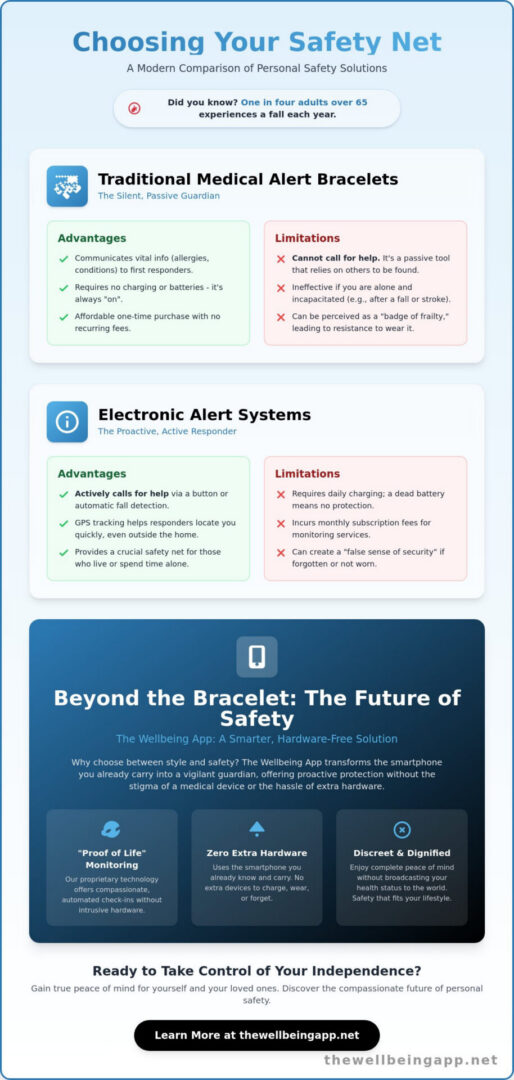
Choosing between a passive medical alert bracelet and an active electronic system is a decision about how you want to be protected when seconds count. A traditional metal bracelet is a permanent fixture. It’s affordable and never runs out of power. However, it’s a passive tool. It relies entirely on a bystander or a first responder noticing the tag and reading the engraved text. If you’re alone in your NYC apartment, a piece of metal cannot call for help. It stays silent until someone else intervenes.
Active systems offer a more dynamic layer of safety. These devices often include GPS tracking, fall detection, and help buttons that connect to a monitoring center. According to a Forbes review of medical alert bracelets, these features are essential for seniors who maintain an active lifestyle outside the home. While these systems provide a safety net, they also introduce recurring monthly subscriptions and the daily responsibility of charging batteries. You’re trading a one-time purchase for a continuous service that requires your attention to stay functional.
There’s a hidden risk in relying solely on a physical button. This is the “False Sense of Security” trap. A manual button only works if the wearer is conscious and physically able to reach it. If a fall results in a loss of consciousness or a stroke prevents movement, that button remains unpressed. This is why empathetic vigilance is necessary. True safety comes from systems that don’t wait for a human to initiate a call during a crisis.
The Limitations of Physical Hardware
Hardware is only effective if it’s actually worn. Industry data reveals that 1 in 3 users don’t wear their device consistently; they often leave it on a nightstand or bathroom counter where it’s useless during a fall. Metal tags also face durability issues. Engraving can fade over a period of 3 to 5 years, making vital medical history unreadable. Furthermore, updating your information on a permanent tag is impossible without purchasing a replacement, which creates a lag in your medical accuracy.
The Hybrid Approach: Combining ID with Monitoring
The transition from simple identification to proactive protection will be standard by 2026. Digital profiles linked to QR codes allow for a depth of information that a metal tag can’t match. Modern families now pair physical IDs with smartphone safety apps to create a unified circle of care. Features like our Night Watch Protection and Proof of Life Indicators ensure that your well-being is monitored even when you can’t reach a button. You can take control of your safety by integrating these digital tools into your daily routine, ensuring that your community is alerted the moment something feels wrong.
The Critical Difference Between Passive and Active Safety Monitoring
Traditional safety tools often rely on the user to take the first step during a crisis. A medical alert bracelet serves as a vital identifier, yet it remains a passive device. It sits on the wrist, waiting for a moment of clarity that may never come during a medical event. Active monitoring shifts this responsibility from the senior to the technology. This creates a protective loop where the system actively seeks “Proof of Life” rather than waiting for a distress signal that might be physically impossible to send.
Many seniors believe their smartphone is a sufficient safety net. They assume they can simply dial 911 if trouble arises. This logic fails in 70% of acute medical emergencies like strokes, severe seizures, or debilitating falls. When a person is incapacitated, they cannot bypass a lock screen or speak to a dispatcher. First responders in high-density areas like NYC prioritize data that arrives before they do. They need precise GPS coordinates and medical history immediately. This New York Times review of medical alert systems emphasizes how response times improve when technology bridges the gap between a fall and the arrival of an ambulance.
How Automated Check-ins Outperform Manual Buttons
The psychology of aging often involves a deep desire for independence. This leads to the “burden” complex, where 60% of seniors admit they hesitate to press an emergency button because they don’t want to cause a false alarm or worry their family. Automated wellness checks remove this heavy burden of choice. The system expects you to be okay and asks for a simple check-in at scheduled intervals. If you don’t respond, the system takes control and alerts your community of care. Our server-side monitoring ensures that even if a phone is crushed during a fall or loses battery, the alert still triggers because the “Proof of Life” signal failed to reach the cloud.
Night Watch and Chaperone Features
Safety needs don’t disappear when the lights go out. Statistics indicate that a significant portion of home emergencies occur during the “vulnerable hours” between 11 PM and 6 AM, when seniors may be disoriented or navigating dark hallways. The Night Watch feature acts as a vigilant guardian during these quiet hours. It complements a medical alert bracelet by providing a 360-degree safety net that monitors for activity when it’s expected and silence when it’s not. For those moments spent outside the home, the Virtual Chaperone provides proactive safety. It’s a dedicated period of heightened monitoring for when you’re walking to a late-night appointment or entering a new environment, ensuring you never truly walk alone in the city.
How to Choose the Right Safety Net for Your Lifestyle
Selecting a security tool requires more than a quick comparison of features. It involves a deep look at how you move through the world. Every senior has a unique rhythm, and your safety system should hum along in the background without causing friction. To find the right fit, you must evaluate your specific needs through a lens of protective reassurance.
- Step 1: Assess health risks. Start with physical and cognitive realities. If there is a high risk of fainting or wandering, you need a system that offers automated indicators. For the 60% of people with dementia who will wander at least once, a passive tool that sends alerts without a button press is vital.
- Step 2: Evaluate your daily routine. Do you enjoy daily walks through Central Park, or do you prefer the comfort of your apartment? A traditional medical alert bracelet often relies on a home base station. If you are active, a software-based solution on your phone ensures protection follows you across the five boroughs.
- Step 3: Determine your Circle of Care. Decide who should be the first line of defense. In an emergency, do you want a call center operator or your daughter in Brooklyn to be notified first? Establishing a clear hierarchy of contact ensures help arrives from those who know your medical history best.
- Step 4: Consider tech comfort. Be honest about your relationship with technology. A safety tool only works if you use it. If charging a device every night feels like a chore, look for solutions that integrate into the hardware you already carry.
A Checklist for Seniors Living Alone
Living independently is a triumph, but it requires a reliable backup plan. Ask if the system requires daily charging. Devices that sit on a charger aren’t protecting you. Ensure there is an automated escalation path; if your primary contact doesn’t answer, the system must move to the next person immediately. Finally, verify that your profile can be updated instantly. When prescriptions change, your emergency contacts need that data in real time to provide the best care.
The Role of Community and Family Unity
True safety moves beyond monitoring a person; it fosters a connected community. For adult children living in different states, the right tool provides profound peace of mind. They want to know you are safe without making you feel watched. Non-invasive safety, such as Proof of Life indicators, allows you to maintain your dignity while giving your family the “Night Watch Protection” they crave. It turns safety from a source of anxiety into a foundation for unity. You can protect your peace of mind by choosing a system that values your independence as much as your security.
Beyond the Bracelet: Why The Wellbeing App is the Future of Personal Safety
While a medical alert bracelet has provided a safety net for decades, the modern world demands a more integrated approach to security. The Wellbeing App acts as a Vigilant Guardian for the smartphone era, transforming the device you already carry into a sophisticated security tool. You don’t need to wear a visible, stigmatized plastic button to stay safe. Our proprietary Proof of Life indicator uses your phone’s existing sensors to confirm your well-being. If your usual activity stops, the app triggers automated alerts to your family or emergency contacts. This turns your device from a passive screen into a proactive shield that watches over you 24/7.
Choosing software over a medical alert bracelet means choosing a tool that evolves with your lifestyle. It removes the physical burden of hardware while increasing the level of protection. The app is the logical conclusion for anyone who wants the security of a monitoring system without the “patient” aesthetic of traditional gear. It bridges the gap between technical reliability and human-centric care, ensuring you are never truly alone.
The Wellbeing App’s Unique Safety Suite
Our technology goes beyond simple GPS tracking to offer a comprehensive circle of protection. The app includes features designed for every hour of the day:
- Night Watch Protection: This service provides automated monitoring while you sleep. If the app detects a lack of movement or a failure to check in during your designated hours, it initiates a safety protocol to ensure you are okay.
- The Chaperone Service: Think of this as a virtual escort for every journey. Whether you are walking through a park or heading to a late-night appointment, the app stays active, monitoring your progress until you reach your destination safely.
- Privacy-First Location Sharing: Real-time location data is shared only when it matters most. Your family can see where you are during an alert, providing visibility while respecting your daily independence.
Protecting Your Peace of Mind Today
Getting started is a straightforward process that brings immediate relief to you and your loved ones. A single subscription covers the whole family, creating a unified network of care that stretches across the city. This collective approach reinforces the idea that safety is a shared responsibility, fostering a strong sense of unity among your relatives.
The transition from anxiety to empowerment happens the moment you take control of your personal security. You no longer have to worry about whether you remembered to put on a device or if the battery is charged. The app handles the vigilance so you can focus on living your life. It is time to move past the limitations of 20th-century hardware and embrace a future where protection is seamless and constant. Protect your peace of mind with The Wellbeing App.
Embrace a Higher Standard of Personal Safety
Choosing a medical alert bracelet is a vital first step, yet the landscape of 2026 demands more than passive jewelry. While traditional IDs offer essential data to responders, they rely entirely on a bystander’s presence. Statistics from the CDC indicate that 1 in 4 older adults falls each year, making proactive monitoring a necessity rather than a luxury. It’s time to take control of your safety by bridging the gap between simple identification and active protection. Our platform transforms your smartphone into a vigilant guardian, offering specialized tools like automated Proof of Life monitoring to ensure you’re never truly alone. Whether you need Night Watch protection for late-night security or a Virtual Chaperone service for proactive safety during your daily walks, we provide the empathetic vigilance your family deserves. When you care enough to know that your loved ones are safe, you choose a system that never sleeps. Join the community and protect your peace of mind with The Wellbeing App. You deserve the confidence that comes with round-the-clock care and a community that watches over its own.
Frequently Asked Questions
Do I still need a medical alert bracelet if I have a safety app?
You don’t necessarily need both, but many NYC seniors choose to use a medical alert bracelet alongside a safety app to ensure a multi-layered approach to their well-being. While a bracelet provides a physical button, an app like The Wellbeing App offers proactive monitoring that doesn’t rely on you being conscious to press a trigger. According to 2023 industry reports, 35 percent of seniors prefer a hybrid system to maximize their peace of mind.