
Elderly Overnight Safety Monitoring Guide (2026)
It’s 3 AM, and you’re wide awake, staring at the ceiling and wondering if that “middle of the night” call is finally coming. Since the majority of unwitnessed falls and acute clinical events occur between 10 PM and 6 AM, your concern is rooted in a very real reality. You want to check in, but you don’t want to wake them up or intrude on the independence they’ve worked so hard to keep. We understand that the weight of caregiving doesn’t end when the sun goes down. That’s often when the anxiety and sleep deprivation truly set in for families living across the country.
Finding a reliable method for overnight safety monitoring for elderly parents is about more than just technology; it’s about reclaiming your mental tranquility. You deserve to know they’re safe without sacrificing their privacy or your own well-being. This guide reveals how to protect your aging loved ones during their most vulnerable hours by utilizing a silent, automated safety net that never sleeps.
We’ll explore how specialized Proof of Life indicators and Night Watch protections can provide you with a reliable way to verify wellness each morning. You’ll discover how to receive instant alerts if a routine is missed, ensuring you remain a compassionate guardian while your loved one maintains the freedom they deserve.
Key Takeaways
- Learn why effective overnight safety monitoring for elderly loved ones requires a shift from reactive fall detection to proactive Proof of Life verification during high-risk hours.
- Understand the “Nightstand Trap” and why traditional medical alert buttons often fail to provide protection when seniors are most vulnerable in bed.
- Discover how to evaluate monitoring systems to find a balance that preserves a senior’s privacy and dignity without the need for intrusive cameras.
- Get a practical plan for auditing physical home hazards and establishing a seamless digital check-in routine that fits your loved one’s natural habits.
- Explore how specialized tools like Night Watch act as a virtual guardian, providing families with mental tranquility through automated, server-side protection.
The Hidden Risks of Overnight Care for Seniors Living Alone
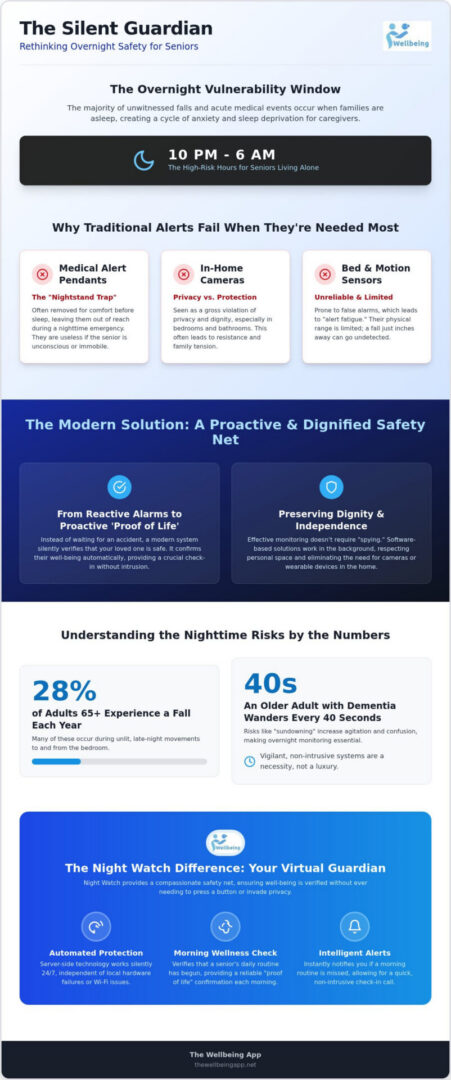
The hours between dusk and dawn are often the most precarious for seniors living independently. While many families focus on daytime fall risks, the reality is that the majority of unwitnessed medical events and falls occur between 10 PM and 6 AM. This window of vulnerability creates a specific need for overnight safety monitoring for elderly loved ones that goes beyond reactive emergency buttons. True safety in 2026 is defined by Proof of Life verification; a silent, automated confirmation that your parent is resting safely or moving through their home as expected.
Overnight safety monitoring is a proactive system for 24/7 peace of mind that ensures a senior’s well-being is verified without them ever having to press a button. For many family members, the absence of this system leads to “sleep-with-one-eye-open” syndrome. You stay tethered to your phone, jump at every notification, and endure a persistent low-level anxiety that only dissipates when you finally hear their voice the next morning. This psychological toll is heavy, but it’s often a direct result of relying on outdated, reactive tools that require the senior to be conscious and mobile to call for help.
Common Nighttime Hazards in the Home
Nighttime introduces a unique set of challenges that daytime care simply doesn’t face. Reduced visibility makes even familiar hallways dangerous, especially when combined with the disorientation caused by certain medications or the grogginess of waking from a deep sleep. Navigating to the bathroom for nightly Activities of Daily Living (ADLs) is a frequent trigger for incidents. According to data from August 2026, 28% of adults aged 65 and over experience at least one fall each year, with many of these occurring during unlit, late-night movements.
For those managing cognitive changes, the field of Gerontechnology has highlighted how “sundowning” can lead to increased agitation, confusion, or wandering. Since an older adult with dementia wanders away from a safe location approximately every 40 seconds, vigilant monitoring becomes a necessity rather than a luxury. Environmental factors like loose rugs or poor lighting only compound these risks during sleep-walking episodes or hurried trips to the kitchen.
The Caregiver’s Dilemma: Privacy vs. Protection
The struggle for families often centers on the balance between security and dignity. Many seniors resist the idea of “spying” and feel that cameras in the bedroom or bathroom are a gross violation of their privacy. This resistance is valid, yet it leaves a significant gap in protection. Families are often left choosing between their parent’s comfort and their own need for security, a choice that creates unnecessary guilt and tension.
Wearable hardware often fails because of the “Forgotten Pendant” phenomenon. Many seniors remove watches or pendants before bed for comfort, leaving them on a nightstand exactly when they are needed most. By choosing a software-based approach like Night Watch, you provide a virtual guardian that respects their personal space while ensuring you aren’t left in the dark. Effective overnight safety monitoring for elderly parents should empower their personal agency, providing a compassionate safety net that preserves their privacy and your mental tranquility.
Evaluating Senior Monitoring Systems: Sensors, Cameras, and Apps
Selecting the ideal system for overnight safety monitoring for elderly family members often feels like a trade-off between total surveillance and total silence. While hardware options like bed pads and cameras have historically filled this gap, 2026 has introduced a more balanced approach. Digital, server-side solutions now offer a way to verify wellness without the intrusive ‘eyes’ of a camera or the technical failures of local hardware.
Physical Sensors and Bed Alarms
Pressure-sensitive mats and bed alarms are traditional tools designed to trigger an alert when a senior stands up. They’re often used to catch wandering or bathroom trips before a fall occurs. However, these systems are limited by their physical footprint. If a loved one falls just outside the sensor’s range, or if the device shifts out of place, the safety net disappears. These devices are also prone to false alarms, which can lead to ‘alert fatigue’ for caregivers. Maintaining these setups involves managing battery life and ensuring the local base station stays connected, which can be a burden for aging users. These systems are inherently reactive; they don’t provide a continuous indicator of well-being, only an alert for a specific movement.
The Rise of the Safety App in 2026
Smartphones have become the most accessible tool for senior safety, replacing the need for specialized hardware that seniors often resist wearing. Safety apps leverage the technology already in their pockets to provide a middle ground of non-intrusive protection. Unlike cameras, which can feel like a violation of privacy, an app uses automated check-in logic to verify safety. This removes the ‘spy’ stigma while ensuring that a senior’s routine is being quietly monitored for any deviations.
The true innovation lies in Proof of Life indicators and specialized Night Watch features. Instead of a manual text that might be forgotten, the system performs a digital handshake at pre-set times. If the user doesn’t acknowledge the check-in, the server-side monitoring takes over. This is a critical fail-safe; because the monitoring happens on the server, an alert is sent even if the senior’s phone dies or loses its internet connection. This ensures that ‘no news’ isn’t just a technical error, but a signal that requires your attention. You can learn how automated check-ins provide security without the need for constant, intrusive watching, allowing both you and your loved one to rest easier.
Why Traditional Medical Alerts Fail During Sleep Hours
Many families rely on medical alert necklaces, believing they’ve secured their loved one’s safety. However, the “Nightstand Trap” is a widespread reality that leaves many seniors vulnerable. As they prepare for bed, these devices are frequently removed and placed on a dresser or nightstand for comfort. If an incident occurs in the middle of the night, the very tool meant to save them is out of reach. This creates a dangerous gap in overnight safety monitoring for elderly parents who might be unable to cross the room to call for help during a crisis.
Even when the device is worn, manual activation remains a significant hurdle. Waking up at 3 AM in a state of disorientation or physical distress makes finding and pressing a small button difficult, if not impossible. Automated alerts are more reliable than manual buttons during emergencies because they don’t depend on a person’s ability to react or remain conscious under duress. This shift from reactive to proactive protection is what allows families to move from a state of constant anxiety to one of mental tranquility.
The Comfort Factor in Senior Safety
Wearable technology often causes skin irritation or sleep disruption, leading many seniors to abandon them during their most vulnerable hours. Beyond physical discomfort, there’s a heavy psychological burden to consider. Wearing a pendant can make a senior feel like a patient in their own home, which can erode their sense of independence and agency. Passive monitoring through The Wellbeing App increases user compliance by removing these barriers. It doesn’t require any hardware to be worn, allowing your loved one to maintain their dignity while the system acts as a silent, watchful protector.
When the User Can’t Press the Button
Traditional alerts are fundamentally flawed because they’re useless if a senior is incapacitated or unconscious. This is where overnight safety monitoring for elderly needs to be smarter. By utilizing Proof of Life indicators, the system treats silence as a meaningful signal. If a scheduled check-in is missed, the server-side monitoring recognizes the absence of activity immediately. It doesn’t wait for a button press that might never come. Instead, it triggers a family-wide emergency response, ensuring help is dispatched even when your loved one cannot ask for it. This ensures that the responsibility for safety is a shared effort, managed by a reliable, always-on partner.
How to Implement a Non-Intrusive Safety Net
Implementing a reliable safety net is a structured process that combines physical awareness with digital vigilance. To establish effective overnight safety monitoring for elderly parents, you should follow a clear path that prioritizes their comfort while ensuring your own mental tranquility. By moving away from manual check-ins, which are prone to human error and forgetfulness, you create a system that is both dependable and respectful of their privacy.
- Step 1: Audit for Physical Hazards. Walk through the home at night to identify risks that aren’t obvious during the day. Ensure hallways and bathrooms have motion-activated lighting and that all loose rugs or clutter are removed. Since 28% of adults over 65 fall annually, addressing these physical trip hazards is your first line of defense.
- Step 2: Map the Digital Routine. Set up a check-in schedule that mirrors your loved one’s natural habits. Use automated Proof of Life indicators to confirm they’ve settled in for the night and have started their day safely without requiring a phone call.
- Step 3: Designate Emergency Contacts. Safety is a shared effort. Select a group of trusted family members or neighbors who are authorized to act if an alert is triggered. A family-wide response ensures that help is never delayed.
- Step 4: Test the Alert System. Verify that notifications reach all designated contacts. A system is only as good as its delivery; ensuring everyone receives the alert simultaneously provides a collective layer of security.
Creating a ‘Night Watch’ Schedule
A successful monitoring plan should feel like a natural extension of a senior’s day. By setting check-in windows that align with their typical bedtime and wake-up routines, you create a system that is consistent but non-intrusive. For those times when they might be up late or are expecting an unusual disruption, utilizing a Chaperone service provides an extra layer of empathetic vigilance. Consistency in automated monitoring is key; it builds a baseline of “normal” behavior that allows the system to detect even subtle deviations during the most vulnerable hours.
Communicating the Plan with Your Loved One
The most important part of implementing overnight safety monitoring for elderly family members is the conversation you have with your parent. Frame the technology as an instrument of empowerment and a tool for maintaining their independence. Explain that having a virtual guardian like Night Watch isn’t about watching their every move, but about giving the family the peace of mind to sleep better. When seniors understand that their personal agency is being protected, they’re more likely to embrace the system. You can start building your custom safety net today to ensure your loved one remains safe and independent.
Sleep Soundly with Night Watch: The Wellbeing App Difference
The Wellbeing App acts as a virtual guardian that never sleeps. It transforms the concept of overnight safety monitoring for elderly adults from a source of stress into a foundation for mental tranquility. By utilizing a subscription-based model, we provide a scalable solution that fits the needs of modern families, whether they live in the same house or across the country. Our mission goes beyond simple tracking; we aim to foster social cohesion by making safety a shared, effortless responsibility within the family circle.
The core of our service is Night Watch, a specialized layer of protection active during the most vulnerable hours between dusk and dawn. This isn’t just a passive tool. It’s a proactive system built on Proof of Life indicators. These automated check-ins replace the need for intrusive phone calls or manual texting, which are often forgotten. Because the monitoring is server-side, our system knows if a status update is missed even if the user’s phone dies. This ensures that a missed check-in triggers an immediate response, bridging the gap when your loved one cannot reach for help.
The Wellbeing App Feature Deep-Dive
Our interface is designed specifically for vulnerable adults, ensuring it remains accessible and friendly. Beyond the automated check-ins, the app offers real-time Location Sharing, providing the family with complete visibility of their loved one’s whereabouts. If a routine is broken, the Automated Emergency Alerts notify the entire family simultaneously. This collective response ensures that the burden of safety is shared, and help is never more than a notification away. It’s a technologically sophisticated approach that remains deeply caring at its heart.
Mental Tranquility for the Whole Family
Manual check-ins often lead to “check-in fatigue,” where the constant cycle of texting and calling becomes a chore for both the senior and the caregiver. This friction can strain relationships and lead to gaps in oversight. The Wellbeing App removes this burden, allowing families to build a community of care without the intrusion. It empowers seniors by protecting their personal agency while giving caregivers the reassurance they need to rest. When you know a virtual guardian is on duty, you can finally reclaim your sleep and your peace of mind. It’s time to move from anxiety to empowerment with a partner that is always on, always watching, and always ready to act.
Secure your family’s peace of mind with The Wellbeing App today
Reclaim Your Mental Tranquility Tonight
Protecting your loved one during their most vulnerable hours doesn’t have to mean sacrificing their privacy or your own sleep. You’ve learned that effective overnight safety monitoring for elderly parents requires moving beyond reactive hardware to a proactive, silent safety net. By addressing physical home hazards and implementing automated check-ins, you bridge the gap between independence and security.
Traditional alerts often fail when a senior is disoriented or incapacitated; however, a digital guardian provides a reliable way to verify wellness without intrusion. With Automated Proof of Life indicators and 24/7 server-side monitoring, you ensure that silence is always interpreted as a signal for care. This approach empowers your loved one’s independence while giving your family the reassurance it deserves. Restore your peace of mind with The Wellbeing App’s Night Watch protection and join a community dedicated to watchful, empathetic vigilance. You don’t have to carry the weight of caregiving alone. Let technology act as your partner in fostering safety and harmony for the people you cherish most.
Frequently Asked Questions
Is overnight safety monitoring for elderly people intrusive to their privacy?
Effective overnight safety monitoring for elderly adults doesn’t have to be intrusive. Unlike camera-based systems that can feel like a violation of dignity, The Wellbeing App uses automated check-ins to verify wellness. This approach respects your loved one’s personal agency while providing a silent safety net. It focuses on digital handshakes rather than constant surveillance, ensuring both privacy and protection are maintained throughout the night without the need for cameras.
Can an app really replace a physical medical alert pendant at night?
An app is often more reliable because it solves the common problem of seniors removing uncomfortable pendants before bed. Since many people keep their smartphones on their nightstand, the app remains accessible. More importantly, server-side monitoring doesn’t require the user to be conscious or mobile to trigger an alert. It provides a proactive layer of security that manual buttons simply cannot match during a middle-of-the-night emergency or health event.
What happens if my parent misses an automated check-in while I’m asleep?
If a scheduled check-in is missed, the system immediately sends automated Emergency Alerts to your entire designated contact list. Because the monitoring happens on our servers, these notifications go out even if the senior’s phone is powered off or loses its connection. We recommend designating multiple family members or neighbors as contacts to ensure that someone is always available to respond, even if you are currently unavailable or asleep.
Does The Wellbeing App require any special hardware or wearable devices?
No, there is no need for proprietary hardware or wearable devices. The Wellbeing App is a software-based solution designed to work on the smartphone your parent already owns. This makes implementation simple and avoids the resistance many seniors feel toward wearing medical equipment. By leveraging existing technology, we provide a sophisticated virtual guardian that is easy to use and requires no new hardware for your loved one to learn.
How does ‘Proof of Life’ monitoring differ from a standard wellness check?
Standard wellness checks are typically manual and reactive, often relying on a phone call that can be missed or forgotten. Proof of Life is a proactive, automated indicator that confirms a user is safe at pre-set intervals. It treats silence as a meaningful signal. If a handshake isn’t acknowledged, the system recognizes the deviation from the routine and alerts the family immediately, ensuring help is never delayed by human forgetfulness.
Can I monitor a parent who lives in a different state with this app?
Yes, you can monitor a parent from anywhere in the country. The Wellbeing App operates nationally across the United States, providing real-time location sharing and status updates regardless of the distance between you and your loved one. This makes it an essential tool for families living in different states who want to maintain a sense of protective reassurance and stay connected to their parent’s well-being without being physically present.
What should I do if my elderly parent refuses to use any monitoring technology?
It’s best to frame the conversation around your own mental tranquility and their continued independence. Explain that overnight safety monitoring for elderly parents is a way to ensure they can stay in their home longer without the need for intrusive cameras or physical guards. Emphasize that they remain in control of their status and that the system is a silent partner designed to protect them during their most vulnerable hours.
Is there a monthly fee for professional overnight safety monitoring services?
Yes, access to the full suite of safety features is provided through recurring monthly or annual subscription plans. These fees support the continuous server-side monitoring and automated alert dispatch systems that keep your family protected. By choosing a subscription model, you ensure that your loved one has a reliable, always-on partner that provides round-the-clock vigilance without the need for expensive upfront hardware costs or the presence of physical security personnel.