
Legal Implications of Monitoring Family Members: A 2026 Safety Guide
The moment you decide to use technology to protect a vulnerable parent or a growing teenager, you aren’t just acting as a caregiver; you’re stepping into a complex legal landscape that shifts with every state line. Understanding the legal implications of monitoring family members is no longer just for lawyers. It’s a fundamental part of being a responsible, watchful protector in 2026. You want to keep your loved ones safe without compromising their dignity or your own legal standing, yet the confusion over state-specific consent laws and updated COPPA regulations can create deep anxiety.
We believe that safety should bring harmony, not legal stress. This guide provides the clarity you need to find that essential balance between vigilance and privacy. You’ll gain a clear understanding of consent requirements and an ethical framework that turns monitoring into a consensual act of protection. We explore the latest 2026 legal updates, from two-party audio consent rules to the evolving rights of seniors in long-term care facilities. By the end of this guide, you’ll have the peace of mind that comes from knowing your family’s safety net is built on a foundation of lawful, respectful care.
Key Takeaways
- Understand the core legal tension between a family’s right to safety and individual privacy protections under 2026 standards.
- Learn why explicit, written consent is your most powerful defense against the complex legal implications of monitoring family members.
- Identify the distinct legal thresholds for monitoring minors versus the specific “capacity” requirements for protecting seniors with cognitive decline.
- Create a “Family Safety Covenant” to establish a framework of transparency that prioritizes user agency over constant surveillance.
- Discover how automated, server-side alerts like Night Watch provide 24/7 vigilance without the ethical or legal risks of invasive tracking.
The Legal Landscape of Family Monitoring in 2026
Family monitoring in 2026 is defined by the use of sophisticated technology to safeguard the location, health status, and physical safety of our relatives. It’s an act of deep care; a way to remain a compassionate guardian in a fast-paced world. However, the legal implications of monitoring family members are rooted in a delicate balance between the instinct to protect and the fundamental Right to privacy. While the Fourth Amendment primarily limits government intrusion, its principles heavily influence how domestic courts view digital boundaries. By 2026, regulations have evolved to prioritize user agency, shifting the focus from covert surveillance to transparent, consensual monitoring that honors the individual’s autonomy.
Federal vs. State Privacy Frameworks
The Electronic Communications Privacy Act (ECPA) serves as the federal baseline for digital safety, yet state laws often provide more specific hurdles. As of 2026, twenty states have enacted comprehensive privacy laws, with new statutes taking effect in states like Indiana, Kentucky, and Rhode Island. These frameworks are designed to ensure that safety tools don’t cross the line into stalking or harassment. For a watchful protector, this means choosing services that emphasize automated alerts rather than constant, manual tracking. Modern safety apps must now comply with stricter data privacy standards that require clear indicators when a device is being monitored. This regulatory environment encourages a shared responsibility where safety is a collaborative effort between the protector and the protected.
The ‘Expectation of Privacy’ Doctrine
Within a shared home, the “reasonable expectation of privacy” remains a cornerstone of legal standards. While you feel a duty to watch over a senior parent, installing hidden cameras in private dwellings can trigger severe legal repercussions under state-level wiretapping laws. This is where digital check-ins like Proof of Life provide a safer, more ethical path. Unlike invasive surveillance, these tools respect the individual’s space and agency. They only trigger an alert when a scheduled check-in is missed, preserving the user’s dignity while ensuring the caregiver’s mental tranquility. Legally, this shift from constant observation to “exception-based” reporting aligns perfectly with 2026 standards for personal agency and ethical safety management.
Understanding Consent: The Legal Foundation of Family Safety
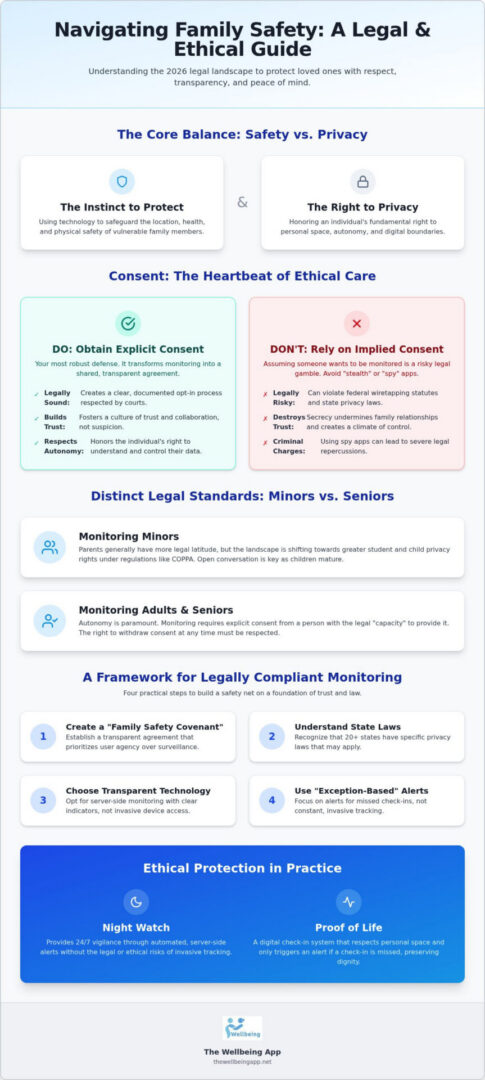
Consent is the heartbeat of ethical care. For the watchful protector, obtaining explicit, written consent is the most robust defense against the complex legal implications of monitoring family members. It transforms a technical action into a shared agreement. Relying on “implied consent,” the idea that a loved one wants to be tracked because it’s “for their own good,” is a risky legal assumption. In 2026, courts increasingly side with individual autonomy, making clear opt-in processes essential for any safety strategy. When everyone understands the “why” and “how” of monitoring, it fosters a culture of trust rather than a climate of suspicion.
Avoid “stealth” or “spy” apps at all costs. These tools often operate by intercepting communications without the user’s knowledge, which can violate federal wiretapping statutes and lead to criminal charges. True safety shouldn’t require secrecy. By choosing transparent platforms, you establish a legal relationship defined by the Terms of Service. This contract protects both the protector and the vulnerable person, ensuring that the boundaries of care are documented and legally sound. It’s about being a compassionate guardian who respects the digital rights of those they love.
Explicit vs. Implied Consent
When does care become an intrusion? Legally, the line is drawn at the moment of agreement. While parents have latitude with minors, the conversation shifts as children grow. For example, discussions around student privacy protections highlight how even school-age children are gaining more digital rights. In a family setting, an explicit opt-in mechanism ensures everyone is on the same page. It’s also vital to acknowledge that consent can be withdrawn. A legally compliant safety plan must respect a family member’s right to change their mind, fostering an environment of empowerment rather than control.
Monitoring and Data Security Standards
Legal protection also depends on how data is handled. Server-side monitoring offers a higher tier of security because it doesn’t rely on invasive, local device access that could be compromised. Using end-to-end encryption for location data ensures that your family’s private movements remain private. The Wellbeing App’s automated check-ins, such as Proof of Life, minimize data exposure by only alerting you when a scheduled check-in is missed. This “privacy by design” approach reduces the amount of personal information stored, providing a safer legal and ethical foundation for your family’s mental tranquility.
Adults, Seniors, and Minors: Distinct Legal Standards
The legal implications of monitoring family members vary significantly depending on the life stage of the person you’re protecting. As a watchful protector, your duty is to match your level of vigilance with the legal status of your loved one. While the instinct to safeguard a family member remains constant, the law views a toddler, a teenager, and an aging parent through very different lenses. Navigating these distinctions is essential for maintaining both your family’s harmony and your own legal standing. By understanding these boundaries, you can ensure your safety net provides mental tranquility without infringing on individual rights.
Parental Guardianship and Digital Safety
For children under the age of 18, parents generally hold broad legal authority to monitor movements and digital footprints. This right is rooted in the duty to protect minors from harm. However, 2026 brought critical updates to the Children’s Online Privacy Protection Act (COPPA). As of April 22, 2026, the updated COPPA Rule expanded the definition of personal information to include biometric data, requiring even more stringent parental consent for data sharing. While you have the right to use Location Sharing for your children, it’s vital to transition these tools as they reach the age of majority. Once a child turns 18, they are legally an adult, and your role must shift from a direct guardian to a consensual partner in safety.
Senior Care: Dignity vs. Protection
Monitoring seniors requires a delicate balance between dignity and physical protection. The “capacity” hurdle is the primary legal consideration here. If a senior is competent, they must provide explicit consent for any monitoring. However, when cognitive decline like Alzheimer’s or Dementia is involved, the situation shifts. Caregivers often need to establish Power of Attorney or legal guardianship to implement safety measures. In 2026, states like Illinois and Oregon enacted laws on July 7, 2026, that specifically permit electronic monitoring in long-term care facilities with the resident’s consent. Utilizing non-intrusive indicators like Proof of Life or Night Watch allows you to fulfill your duty of care while respecting their private dwelling space.
Monitoring Competent Adults
Monitoring a competent adult without their knowledge is a high-stakes legal risk that can lead to stalking or harassment charges. In domestic partnerships, the law is particularly strict about non-consensual tracking. Legality is found only through transparency and agency. Consensual tools like a Virtual Chaperone service are designed for high-risk activities, such as solo hiking or walking home late at night. These services empower the user to invite a protector into their journey. By establishing a “Safety Covenant” where location sharing is a choice, you transform technology into an instrument of empowerment rather than a tool of surveillance.
Practical Steps for Legally Compliant Family Monitoring
Taking the step from understanding the law to implementing a daily routine requires a shift in mindset. When you address the legal implications of monitoring family members through open dialogue, you transform a technical tool into a bond of trust. This isn’t about control; it’s about empowerment. You can move from theoretical legal knowledge to a daily practice that keeps everyone safe while honoring their individual rights. By following a structured approach, you ensure your safety net remains both legally sound and emotionally supportive for every member of your group.
Creating a Shared Safety Agreement
A Safety Covenant is a mutual agreement of protection that defines the boundaries of care between a protector and their loved ones. Unlike a corporate handbook, this agreement is rooted in empathy and shared responsibility. It serves as your primary documentation of consent, which is vital for legal compliance in 2026. Your covenant should clearly outline:
- Data Access: Specify exactly who can see location data and under what specific conditions, such as a missed check-in.
- Feature Boundaries: Determine which tools, like Night Watch or Location Sharing, are active for each person.
- Transparency: Ensure every member knows how the app works and what triggers an automated alert.
Establish your own agreement today by exploring the Location Sharing and automated alert features of the Wellbeing App.
Choosing Non-Invasive Technology
The tools you select determine your legal risk profile. In 2026, “privacy by design” is a legal expectation. Choosing non-invasive technology like Proof of Life check-ins is legally safer than constant audio or video streaming because it respects the user’s private dwelling. These automated systems reduce the “human” element of surveillance, meaning you aren’t constantly watching; you’re only alerted when your help is actually needed. When evaluating a safety app, look for a privacy policy that explicitly prioritizes user agency and server-side monitoring to ensure 24/7 vigilance without manual intrusion.
Don’t forget to conduct regular “Safety Audits.” Every few months, sit down as a family to discuss if the current monitoring level still feels right. As teenagers grow or seniors’ needs change, your legal and ethical framework must adapt. Educating everyone on how to trigger Emergency Alerts ensures that the technology remains a tool for their personal agency. This proactive management keeps the focus on mental tranquility and collective well-being, ensuring your role as a watchful protector is always welcomed and legally protected.
The Wellbeing App: Ethical Protection for the Modern Family
Choosing the right technology is the final piece in resolving the legal implications of monitoring family members. We designed the Wellbeing App to act as a compassionate guardian, ensuring that your duty of care never feels like an intrusion. Our philosophy centers on the idea that safety should enhance your family’s harmony, not disrupt it. By shifting from aggressive surveillance to a model of empathetic vigilance, we provide a framework where protection and privacy exist in perfect balance.
Our Proof of Life feature respects individual dignity by operating on an “exception-only” basis. It doesn’t watch every movement; instead, it triggers automated alerts only when a scheduled check-in is missed. This server-side monitoring ensures 24/7 vigilance without the need for manual texting or invasive tracking. For those times when a loved one is walking home alone, the Chaperone service offers a proactive, consensual tool. It empowers the user to invite a protector into their journey, providing a high-stakes safety net that respects personal agency at every turn.
Night Watch extends this peace of mind through the quiet hours, providing 24/7 server-side monitoring for seniors or those living alone. It removes the emotional weight of “are you okay?” check-ins, allowing the relationship to remain focused on connection rather than constant worry. Our subscription model is built to foster community unity, emphasizing collective responsibility over individual anxiety. It’s a sophisticated approach to safety that understands the legal implications of monitoring family members requires transparency and trust.
A Compassionate Guardian Approach
Empowerment is the core of our platform. We provide users with full agency over their safety settings, ensuring that monitoring is always a transparent, shared choice. This approach removes the “nagging” text from family dynamics, as automated server-side checks handle the vigilance for you. We remain committed to the highest national privacy standards, ensuring that your family’s data is treated with the same level of care that you provide to your loved ones.
Securing Your Family’s Mental Tranquility
The true value of our service is the emotional reward of mental tranquility. You gain the quiet confidence that help is automated if a check-in is ever missed. By joining our community, you’re becoming part of a movement dedicated to proactive safety and preventing missing person incidents. It’s about more than just software; it’s about the preservation of your family’s peace. Protect your family legally and ethically—Get started with The Wellbeing App
Embracing a Future of Transparent Protection
Navigating the legal implications of monitoring family members doesn’t have to be a source of anxiety. By prioritizing explicit consent and selecting non-invasive tools, you transform surveillance into a shared covenant of care. You’ve seen that the secret to legal compliance in 2026 lies in transparency and respecting the personal agency of every family member. Whether you’re protecting a teenager or a senior living independently, this balanced approach ensures your safety net remains a source of harmony rather than conflict.
We’re here to serve as your watchful protector, providing the technical robustness needed for 24/7 automated server-side monitoring while keeping human dignity at the forefront. Our privacy-first Proof of Life check-ins offer a path to safety that honors individual boundaries and fosters mental tranquility for the entire group. It’s time to replace worry with a reliable, empathetic safety strategy that works for everyone. Secure your family’s peace of mind with a proactive safety subscription and step into a future where protection is always an act of love.
Frequently Asked Questions
Is it legal to track my elderly parents’ location without their knowledge?
Tracking a competent adult without their knowledge is generally illegal and could violate anti-stalking or wiretapping statutes. For seniors, the law prioritizes their right to autonomy unless a court has determined they lack capacity. It’s always best to use consensual tools like Proof of Life. This ensures you’re acting as a guardian rather than an intruder, preserving both their dignity and your legal standing within the family unit.
Can I legally monitor my teenager’s phone if they are under 18?
Parents generally hold the legal right to monitor their minor children’s digital footprints and physical location to ensure their safety. However, the 2026 COPPA update requires stricter handling of a minor’s biometric and personal data. While it’s legally permitted, experts suggest using transparent Location Sharing to build a foundation of trust. This approach empowers your teen while fulfilling your duty to protect them from emerging digital risks like AI companion apps.
What is the difference between legal monitoring and illegal stalking?
The primary distinction lies in consent and the intent of the tracking. Illegal stalking involves covert, non-consensual surveillance that creates a reasonable fear of harm or distress. Legal monitoring is built on transparency and user agency. Understanding the legal implications of monitoring family members helps you choose tools that require an active opt-in. By establishing a shared safety agreement, you ensure that your vigilance is welcomed and legally protected.
Do I need a written agreement to use a family safety app with my spouse?
While a verbal agreement might suffice in some jurisdictions, a written Safety Covenant is the gold standard for legal protection. Monitoring a spouse without their explicit consent can inadvertently trigger harassment or stalking laws in many states. Documenting who has access to data and under what conditions creates a clear legal boundary. It turns location sharing into a mutual act of care rather than a point of domestic contention.
How do 2026 privacy laws affect my ability to monitor a relative with dementia?
As of 2026, privacy laws have become more specific regarding vulnerable adults. If a relative has dementia, you typically need to establish legal guardianship or Power of Attorney to monitor them legally. Recent laws enacted on July 7, 2026, in several states now permit electronic monitoring in care facilities provided there is resident or guardian consent. Using non-invasive Night Watch features helps maintain their dignity while providing the necessary oversight.
What happens legally if I miss a check-in and an alert is sent to my family?
Automated alerts are part of a consensual service agreement and carry different legal weight than active surveillance. When a Proof of Life check-in is missed, the system simply fulfills its contractual duty to notify your emergency contacts. This automated process minimizes the human element of monitoring, making it a safer legal choice. It ensures help is dispatched based on pre-set parameters without violating the user’s daily privacy or expectation of autonomy.
Are automated ‘Proof of Life’ apps more legally compliant than hidden cameras?
Automated check-ins are significantly more compliant because they don’t involve the constant recording of private activities. Hidden cameras in a private dwelling often violate Reasonable Expectation of Privacy doctrines and state wiretapping laws. In contrast, Proof of Life apps only share data when an emergency indicator is triggered. This privacy by design approach respects 2026 legal standards, providing a sophisticated safety net that doesn’t require invasive physical or digital presence.
Can my family monitoring data be used against me in court?
Any digital data can potentially be used as evidence in court proceedings, including location logs or check-in history. This reality makes it vital to use services that prioritize end-to-end encryption and have transparent data retention policies. When you understand the legal implications of monitoring family members, you realize that choosing a privacy-first platform is an act of protection for your future. It ensures that your safety records remain secure and used only for their intended purpose.