
Family Safety Alerts: 2026 Guide to Proactive Protection
What if the most effective way to protect your family isn’t by watching their every move, but by trusting a system that only speaks up when it truly matters? We’ve all felt that tightening in the chest when a phone call goes to voicemail for the third time or when an elderly parent doesn’t check in at their usual hour. It’s a heavy burden to carry the constant need for manual check-ins; this often leads to a sense of surveillance fatigue that drains the joy out of our daily connections. You deserve a way to manage personal safety alerts for family that doesn’t feel like a full-time job or an invasion of privacy.
Discover how automated safety alerts and proactive monitoring can provide your family with total peace of mind without the intrusiveness of traditional surveillance. By moving away from reactive texting and toward a digital safety net, you can achieve true mental tranquility for the whole group. This guide explores the 2026 landscape of proactive protection, including specialized tools like Proof of Life and Night Watch that ensure help is on the way even if a phone is out of reach. You’ll learn how to establish a reliable, always-on partnership that guards your loved ones’ independence while fulfilling your duty to keep them safe.
Key Takeaways
- Understand the critical shift from reactive SOS buttons to proactive monitoring that protects your loved ones even when they can’t call for help.
- Evaluate the advantages of subscription-based safety apps over traditional hardware, focusing on server-side reliability and lower upfront costs.
- Learn how to configure personal safety alerts for family to ensure a “set it and forget it” safety net that only activates when something is actually wrong.
- Discover the “gold standard” features for solo dwellers and commuters, including Proof of Life check-ins and the Virtual Chaperone for night-time security.
- Gain practical strategies for introducing safety technology to your family in a way that emphasizes their independence and your collective mental tranquility.
Beyond the SOS Button: The Shift to Proactive Family Safety
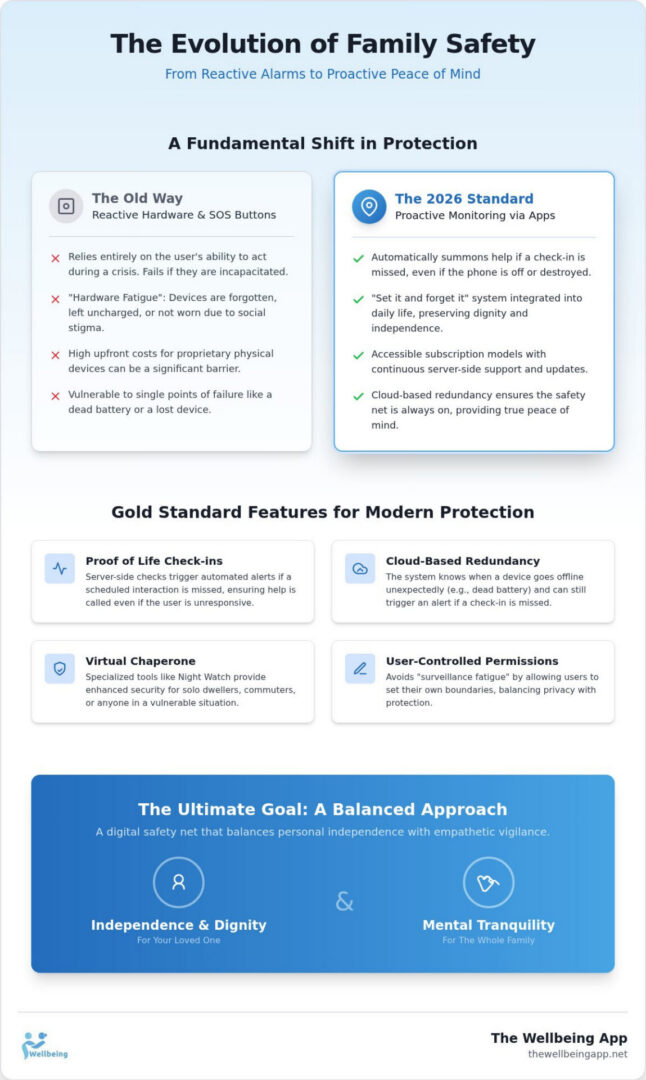
Safety used to be a button you pressed in an emergency. In 2026, that paradigm has shifted completely. We now view personal safety alerts for family as a spectrum that runs from reactive to proactive. On one end, you have traditional SOS buttons. These tools are helpful, but they rely entirely on a person’s ability to act during a crisis. If a loved one is incapacitated or unable to reach their device, a reactive system stays silent. The other end of the spectrum features proactive, automated systems that act as a watchful protector. This technology stays in the background, observing the rhythm of daily life and intervening only when that rhythm is broken. As we move away from bulky, specialized hardware, integrated mobile ecosystems are becoming the new standard for family protection.
The Limitations of Traditional Medical Alerts
Traditional medical alert necklaces often fail because of simple human nature. We call this hardware fatigue. Many seniors find the constant need to charge a separate device exhausting, or they simply forget to put it on after a shower. There is also a persistent social stigma attached to wearing a visible emergency button; it can make people feel vulnerable rather than empowered. Perhaps the most significant flaw is the unconscious user gap. If someone falls and loses consciousness, they cannot press a button. In these critical moments, a manual system offers no protection at all, leaving family members in the dark when they are needed most.
Defining Proactive Monitoring and Proof of Life
Proof of Life is a server-side check that triggers automated alerts to your circle if a scheduled interaction or check-in is missed. This mechanism ensures that help is summoned even if a phone is destroyed or the user is unable to move. Automated check-ins preserve a person’s dignity by allowing them to go about their day without the feeling of being watched or tracked in real time. The technology only steps in when an expected indicator of well-being is absent. For family members, this creates a state of mental tranquility. You don’t have to worry about unanswered phone calls or wonder if a lack of contact means trouble. By establishing these personal safety alerts for family, you create a digital safety net that balances personal independence with empathetic vigilance.
Comparing Family Safety Systems: Apps vs. Hardware
Choosing between a physical device and a digital application is about more than just convenience; it’s about the infrastructure that supports your loved ones during a crisis. Standalone GPS trackers or whistles might seem like a simple one-time purchase, but they often lack the sophisticated logic required for true protection. These devices usually require a direct connection to a working phone or a specific cellular network to function. If that connection breaks, the safety net disappears. In contrast, modern software solutions leverage the power of the cloud to ensure that your security doesn’t depend on a single piece of plastic.
The financial aspect also favors the move toward mobile ecosystems. High upfront costs for proprietary hardware can be a barrier for many families. Subscription-based models offer a more accessible entry point while funding the continuous server-side monitoring that hardware-only solutions can’t provide. This ongoing support is what transforms a simple app into a reliable guardian that stays vigilant even when life gets complicated.
Reliability and Redundancy in 2026
Cloud-based monitoring represents a massive leap forward from the simple Bluetooth trackers of the past. The most critical feature to look for is server-side logic. In a “Dead Battery” scenario, a standard tracker simply stops working. However, a server-side system knows when a device goes offline unexpectedly. If a scheduled check-in is missed because a phone died or was destroyed, the server triggers an alert anyway. This redundancy ensures that personal safety alerts for family are never silenced by a technical failure or a lost charger. By using real-time location sharing alongside these automated triggers, you create a layer of protection that physical hardware alone cannot match.
Privacy vs. Protection: Finding the Balance
Many people hesitate to adopt safety technology because they fear “surveillance fatigue” or the feeling of being stalked by their own relatives. There’s a vital distinction between 24/7 tracking and a proactive safety net. Effective systems prioritize user-controlled permissions, allowing the vulnerable to set their own boundaries. Instead of constant location monitoring, these tools focus on indicators of well-being and only share sensitive data when a specific safety threshold is crossed.
This approach empowers the user rather than making them feel watched. You aren’t monitoring their every move; you are simply waiting for a signal that everything is okay. By using empathetic vigilance, we can protect our family’s physical safety while honoring their need for autonomy and mental tranquility. This balance is what makes a digital safety net far more effective than a physical shackle, providing the “set it and forget it” security that modern families require.
Essential Features for Comprehensive Family Protection
Many families mistake constant location sharing for actual safety. While knowing a coordinate on a map is useful, it doesn’t confirm a person’s health or immediate well-being. True personal safety alerts for family require active indicators of activity rather than just passive tracking. The Proof of Life mechanism serves as the gold standard for this proactive approach, especially for solo dwellers. It’s a server-side system that monitors for a missed interaction rather than just a physical location. If a user fails to check in at a scheduled time, the system initiates an automated notification dispatch. This ensures that the specific hierarchy of emergency contacts is alerted through the cloud, even if the primary device is destroyed or out of range.
Virtual Chaperone: A Digital Guardian for Every Walk
The Virtual Chaperone feature is designed for those moments of transition where vulnerability naturally increases. Whether it’s a student walking across a college campus at night or a late-shift worker heading to their car after midnight, this tool acts as a silent, watchful partner. It provides a powerful deterrent effect because the user is actively engaged with a system that expects a safe arrival. If the user doesn’t reach their destination within the expected timeframe, the Chaperone triggers an immediate link to their chosen circle. It’s a practical solution for urban commuters and anyone meeting a new person, offering a layer of protection that passive location apps simply don’t have.
Night Watch and Vulnerable Adult Protection
Nighttime represents the highest-risk period for seniors and adults with specific health vulnerabilities. Emergencies that occur while the rest of the family is asleep are the most dangerous because they often go unnoticed for several hours. Night Watch solves this by providing a silent, non-intrusive “all is well” signal during these critical hours. This feature significantly reduces the burden on family members who often feel a sense of duty to perform manual wellness checks at odd times. Instead of losing sleep to send a text or check a tracking app, you can rely on the system’s empathetic vigilance. These personal safety alerts for family maintain the user’s independence while ensuring that help is summoned the moment an indicator of well-being is missing.
How to Implement a Family Safety Plan
Success in family protection starts with a clear strategy rather than just a set of tools. Begin by conducting a safety audit of your current communication habits. Are you relying on manual check-in calls that often go unanswered? Do you find yourself texting “Are you home yet?” multiple times a night? These habits often lead to checking-in fatigue, where the recipient feels monitored and the sender feels anxious. Transitioning to personal safety alerts for family allows you to replace these stressful interactions with a silent, reliable rhythm that respects everyone’s time and boundaries.
Effective implementation requires establishing a clear emergency contact hierarchy. This isn’t just a list of names; it’s a plan for who responds first based on proximity and availability. Perhaps a trusted neighbor is the first to check the house, while a family member handles the digital coordination. By defining these roles early, you ensure that help arrives quickly without overwhelming the system with redundant calls. It’s about creating a community of care that functions logically during a crisis.
Having the “Safety Talk” Without the Friction
When introducing a new safety tool, focus on wellbeing rather than security. Avoid language that suggests a loved one is incapable of looking after themselves. Instead, frame the app as a tool for your own peace of mind. You might say, “It helps me relax knowing that a system is looking out for you.” Mentioning features like Night Watch is particularly effective. It ensures that everyone in the family can enjoy uninterrupted sleep, knowing that the app will only wake them if something is actually wrong. This shifts the focus from surveillance to collective harmony and empowers the user to maintain their independence.
Configuring Your Automated Alert System
To make the system work, you must match the check-in rhythm to your loved one’s actual routine. Set Proof of Life intervals that align with Activities of Daily Living (ADLs), such as a morning coffee or an evening walk. This makes the interaction feel natural rather than forced. You can also customize alert messages for different scenarios; a missed morning check-in might require a different response than an active SOS. Finally, commit to a brief monthly safety drill. Testing the system ensures that everyone knows how to react when an alert actually arrives. It’s a simple way to maintain preparedness without creating unnecessary stress.
Ready to build your family’s digital safety net? You can start protecting your loved ones today by configuring your first proactive alert system and achieving true mental tranquility.
The Wellbeing App: Your Partner in Mental Tranquility
The Wellbeing App stands as a compassionate guardian in a world that often feels fragmented and uncertain. It doesn’t just offer features; it provides a unified interface where Proof of Life, Chaperone, and Night Watch work in harmony to protect your loved ones. This integration is rooted in the philosophy of empathetic vigilance, where technology cares as much as you do without becoming a burden. By choosing a software-driven approach, you’re investing in a system that prioritizes the user’s mental state and independence. It’s about moving away from the anxiety of the unknown and toward a shared sense of collective responsibility.
Our subscription model ensures that your family is backed by constant server-side monitoring. This is a critical distinction from standard apps that rely solely on the device’s local power. If a phone is destroyed or loses signal in a dead zone, our servers recognize the silence and initiate the priority alert dispatch. This level of technical robustness is what makes personal safety alerts for family truly reliable in 2026. You aren’t just buying an app; you’re joining a community dedicated to proactive protection and the prevention of missing person incidents.
Why Proactive Protection is the Future
The era of reactive gadgets is fading, replaced by proactive software guardians that stay one step ahead of potential crises. The Wellbeing App fosters social cohesion by removing the friction of manual check-ins and the stigma of wearable devices. It allows families to remain connected through a digital safety net that only intervenes when the rhythm of life is interrupted. The Wellbeing App is designed to act when the user cannot, bridging the gap left by traditional alerts that require a conscious manual trigger. This shift empowers the vulnerable to live fully while providing caregivers with the tranquility they deserve.
Getting Started with Your Family Safety Net
Building your safety net is a simple, purposeful process that takes only a few minutes. After downloading the app, you can choose between monthly or annual plans to ensure continuous, uninterrupted protection for your circle. The setup is intuitive, leading you from the initial download to your first Proof of Life check-in with logical ease. There are no complicated hardware configurations or proprietary devices to manage. You simply define your emergency hierarchy and set your preferred monitoring windows. Secure your family’s peace of mind today with The Wellbeing App and take the first step toward a future of empowered, proactive safety.
Embracing a Future of Empathetic Vigilance
True protection isn’t found in constant surveillance, but in a reliable system that understands the rhythm of your family’s life. Moving from reactive SOS buttons to proactive monitoring allows your loved ones to maintain their independence while ensuring help is always within reach. By implementing personal safety alerts for family, you replace the weight of “unanswered call” anxiety with the quiet confidence of a digital safety net. This shift toward automated server-side monitoring ensures that your safety infrastructure remains active even when a device is offline or unreachable.
The Wellbeing App bridges the gap left by traditional security tools through specialized features like automated Proof of Life monitoring, Virtual Chaperone walks, and Night Watch protection. These server-side alert dispatch systems provide the mental tranquility your family deserves. It’s time to trade surveillance fatigue for proactive peace of mind. Start Protecting Your Loved Ones with The Wellbeing App today and step into a more connected, secure future where safety is a shared, effortless effort. You don’t have to carry the burden of worry alone when a watchful protector is standing by.
Frequently Asked Questions
What is a Proof of Life check-in app and how does it work?
A Proof of Life check-in app is a proactive safety tool that monitors for missed interactions rather than just physical movement. It works through server-side monitoring; the system expects a signal from the user at scheduled intervals. If that signal doesn’t arrive, the app automatically triggers a notification dispatch to your designated circle. This ensures help is summoned even if the person is unconscious or unable to reach their device during a crisis.
Can a safety app replace a traditional medical alert bracelet?
A proactive safety app can effectively replace traditional hardware by closing the unconscious user gap. Unlike a medical alert bracelet that requires a physical button press, software like The Wellbeing App monitors for the absence of activity. This removes the social stigma of wearing a pendant and eliminates the risk of hardware fatigue. It’s a modern way to manage personal safety alerts for family without relying on a device that might be forgotten.
What happens if my family member misses a scheduled check-in?
The system immediately initiates an automated alert sequence if a scheduled check-in is missed. This process happens on the server, so it doesn’t depend on the family member’s phone being functional at that exact moment. Your pre-defined emergency contact hierarchy is notified via text or app alerts, allowing you to respond based on the specific scenario. This mechanism provides mental tranquility by removing the need for manual check-in texts that often go ignored.
Does the app work if the phone battery dies or there is no signal?
The app remains effective because it uses server-side logic to monitor user status. If a phone battery dies or the device loses its signal, the server notices the lack of communication. Instead of staying silent like a traditional tracker, the system treats the disconnection as a potential indicator of trouble. This redundancy ensures that your safety net remains intact even when the physical device is offline or destroyed, providing a more reliable layer of protection.
Is the “Virtual Chaperone” feature safe for teens and young adults?
The Virtual Chaperone is an empowering feature for students, commuters, and young adults. It acts as a digital guardian during vulnerable moments, such as walking across a campus at night or meeting someone new. By setting a destination and expected arrival time, the user establishes a watchful partnership with the system. If they don’t confirm their safety within the window, their circle is alerted instantly, providing a powerful deterrent and an immediate link to support.
How much do personal safety alerts for family typically cost per month?
Personal safety alerts for family are typically offered through recurring subscription plans that fund continuous 24/7 server monitoring. While costs vary across the industry, most families choose between monthly or annual billing cycles to maintain their digital safety net. These plans grant access to the full suite of monitoring tools, including automated notification dispatch and priority alerts. Investing in a subscription ensures that the infrastructure behind your family’s protection is always active and technically robust.
How do I explain the need for a safety app to an independent senior?
Focus on your own mental tranquility and the preservation of their independence. Explain that automated check-ins reduce the need for intrusive texts, which often lead to checking-in fatigue. Frame the technology as a compassionate guardian that only speaks up when it’s truly necessary. Mentioning features like Night Watch can also help, as it ensures you both get uninterrupted sleep knowing the system is watching over them and will act if they cannot.
Can I monitor multiple family members from a single account?
The Wellbeing App is built to support community unity, allowing you to monitor multiple loved ones from a single, intuitive interface. You can establish different check-in rhythms and alert hierarchies for each person, matching the protection to their specific daily routines. This centralized approach makes it easy to fulfill your duty to your family while managing their safety with logical ease. It creates a comprehensive safety net that covers everyone from solo dwellers to urban commuters.