
The Evolution of Personal Safety Software: A Guide to Proactive Protection in 2026
What if the most critical tool in your safety arsenal isn’t a button you press, but a system that notices when you can’t? In those high-stakes moments where every second counts, the most advanced personal safety software doesn’t wait for a cry for help; it proactively checks in on you. We all know the heavy, hollow feeling of sending a “text me when you’re home” message and watching the clock when the reply doesn’t arrive. It’s a burden of anxiety that many of us carry, whether we’re worrying about an aging parent living alone or a loved one walking home after a late shift. You deserve a solution that replaces that fear with genuine mental tranquility.
This guide explores how the landscape of protection has shifted from passive tracking to intelligent, automated guardianship. You’ll discover how modern personal safety software moves beyond simple GPS coordinates to provide a digital safety net that works in the background. We will examine the transition toward server-side monitoring and specialized tools like Proof of Life and Night Watch. These advancements offer true peace of mind and fast emergency response without the need for constant, invasive surveillance. It’s time to move toward a future where safety is a shared, proactive effort that empowers every member of your family.
Key Takeaways
- Learn why the next generation of personal safety software focuses on proactive “Proof of Life” checks rather than just reactive panic buttons.
- Understand how server-side monitoring ensures your emergency alerts are dispatched even if your device is lost, damaged, or out of battery.
- Discover how specialized features like Chaperone and Night Watch provide a discreet digital safety net during your most vulnerable moments.
- Explore how modern mobile apps offer a more flexible and cost-effective alternative to traditional, bulky medical alert hardware.
- Find out how to foster mental tranquility for your whole family by automating the “text me when you’re home” process.
Beyond the Panic Button: Why Personal Safety Software is Shifting to Proactive Care
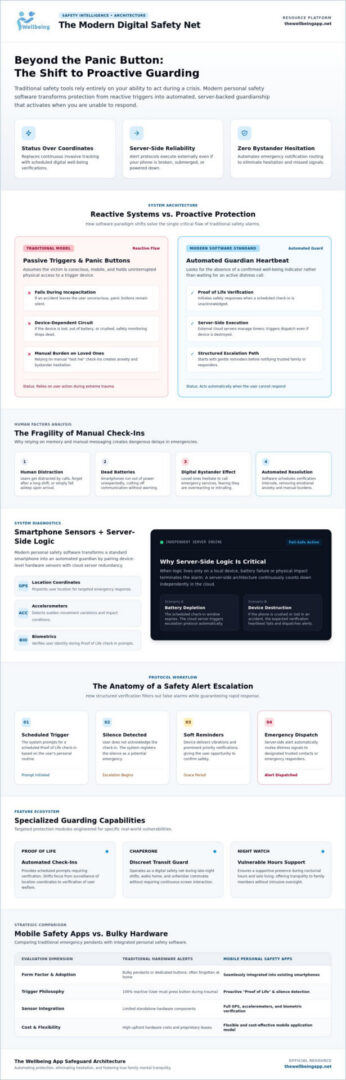
Traditional safety tools have always shared a single, critical flaw: they rely entirely on the user’s ability to act during a crisis. Whether it is a physical panic button or a mobile emergency slider, these reactive systems assume you are conscious, mobile, and able to reach your device. If a sudden medical emergency or an accident leaves you incapacitated, a reactive tool becomes silent. By 2026, the standard for personal protection has evolved to address this silence. Modern personal safety software no longer waits for a signal of distress. Instead, it looks for the absence of a “well-being” indicator, ensuring that help is summoned even when you are unable to ask for it.
This shift represents a significant psychological move from surveillance to supportive monitoring. While older tracking apps often felt like an invasion of privacy, proactive systems focus on your status rather than just your coordinates. This approach fosters a sense of mental tranquility for both the user and their loved ones. It transforms the technology from a passive tracker into a compassionate guardian that respects your independence while maintaining a watchful eye on your welfare.
The Limits of Manual Check-ins
The ritual of saying “text me when you get home” is a staple of modern life, but it is an inherently unreliable safety strategy. Human memory is fallible; we get distracted by phone calls, we forget to charge our batteries, or we simply fall asleep after a long day. When that expected text doesn’t arrive, it creates a painful dilemma for family and friends. They often fall victim to a digital bystander effect, where they hesitate to call emergency services because they don’t want to overreact or intrude on your evening. This hesitation can waste precious hours. Automated personal safety software removes this burden of memory. By scheduling automated checks, the system takes over the responsibility of verification, ensuring that a missed check-in is treated with the gravity it deserves without requiring constant manual effort from your circle of support.
Defining Proactive Protection
Proactive protection is built on the concept of a digital heartbeat. Rather than monitoring every movement, the software checks for a specific “Proof of Life” at intervals that make sense for your lifestyle. This moves the focus away from constant location tracking and toward consistent status monitoring. Proactive safety software is a system that acts when you cannot. If a user does not acknowledge a scheduled prompt, the system recognizes the silence as a potential emergency. It then initiates server-side protocols to alert designated contacts or emergency responders immediately. This ensures that your safety net remains intact even if your phone is destroyed or lost, providing a level of reliability that traditional manual methods simply cannot match.
What is Personal Safety Software and How Does it Work?
Personal safety software is more than just a map with a dot on it. At its core, it is a sophisticated mobile application designed to monitor your well-being through automated emergency protocols. Unlike simple tracking apps, this technology acts as a silent partner that remains vigilant even when you aren’t looking at your screen. It integrates seamlessly with your smartphone sensors, utilizing GPS for location, accelerometers to detect sudden movement, and biometrics to verify your identity. This combination creates a robust digital safety net that connects you to a designated circle of trusted contacts, such as family members or close friends.
One of the most critical components of this technology is server-side monitoring. This means the logic that triggers an alert lives on a secure, external server rather than just on your device. If your phone’s battery dies, or if the device is destroyed in an accident, the server still expects a check-in at the scheduled time. When that signal doesn’t arrive, the system knows something is wrong. This level of reliability is why many families now choose automated well-being monitoring to replace the uncertainty of manual check-ins.
The Anatomy of a Safety Alert
The process begins with a trigger, which is usually a missed scheduled check-in. The system doesn’t immediately jump to a full-scale emergency response. Instead, it follows a structured escalation path. It starts with soft reminders, such as a vibration or a notification, giving you a chance to confirm you’re okay. If there is no response within a set window, the personal safety software escalates the situation by sending emergency notifications to your pre-selected contacts. Data privacy is central to this journey; your location remains private and encrypted until an alert is actually triggered, ensuring you are protected without feeling watched.
Proof of Life Indicators
Modern software uses Proof of Life indicators to create a consistent timeline of safety. These indicators can be customized based on your daily routine and activity levels. If you’re out for a solo run, you might set a frequent check-in schedule, whereas a quiet evening at home might only require a single confirmation. You can choose between active indicators, where you manually tap the screen to confirm your status, and passive indicators that use sensor data to confirm you’re moving and safe. This flexibility allows the software to adapt to your life, providing protection that feels like a natural extension of your day.
Software vs. Hardware: Why Mobile Safety Apps are the Modern Choice
For decades, the “medical alert necklace” was the primary symbol of personal security for solo dwellers and seniors. While these physical buttons provided a basic level of protection, they often came with a heavy emotional cost. They were visible markers of vulnerability that many users felt embarrassed to wear. In 2026, the shift toward personal safety software has replaced these bulky devices with discreet, intelligent solutions that live on the device you already carry everywhere. This transition isn’t just about aesthetics; it is about moving from a rigid, single-purpose tool to a dynamic system that adapts to your life.
The cost-benefit analysis heavily favors software-based protection. Proprietary hardware often requires a significant upfront investment and expensive maintenance for devices that can quickly become obsolete. In contrast, subscription-based software provides access to advanced monitoring without the need for additional gear. Reliability has also seen a massive leap. While traditional hardware often relies on a single, aging cellular chip, a smartphone offers multi-network connectivity. By utilizing 5G, Wi-Fi, and Bluetooth simultaneously, modern apps ensure your digital safety net remains active even in areas where a standalone hardware device might lose its signal.
The “stigma factor” is perhaps the most significant driver of this change. Whether it’s a college student walking home late or a senior maintaining their independence, people want protection that feels like a natural part of their day. Software is invisible to the outside world, yet it provides a deep sense of mental tranquility. It empowers the user rather than labeling them, turning a smartphone into a compassionate guardian that watches over them without drawing unwanted attention.
The Versatility of Software
One of the greatest strengths of a software-driven approach is its ability to evolve. While hardware is limited by its physical components, personal safety software can be updated instantly through the cloud. This means you always have access to the latest security protocols and feature enhancements. Furthermore, software scales with your needs. You can easily expand a single subscription to cover an entire family, creating a unified circle of protection that hardware simply cannot match. It turns your existing technology into a powerful tool for collective well-being.
When Hardware Still Matters
This isn’t to say that hardware has no place in the modern safety ecosystem. Physical buttons and wearables, such as smartwatches, can serve as excellent secondary triggers. However, the software is now the primary engine for emergency response. A smartwatch might be the interface you use to tap a “Proof of Life” check-in, but the intelligent logic, the server-side monitoring, and the automated alert dispatch all happen within the app. In this hybrid model, hardware acts as a convenient extension of the software, which remains the true heart of your proactive protection strategy.
Essential Features of a Comprehensive Digital Safety Net
A digital safety net is only as strong as its most specialized features. While basic GPS tracking is a common tool, high-quality personal safety software provides layers of protection that address the nuances of daily life. It isn’t just about knowing where you are; it’s about ensuring you are safe during the specific moments when you feel most exposed. This includes everything from your evening commute to the quiet hours of the night. True protection requires a system that understands the difference between a routine delay and a genuine emergency.
Comprehensive protection must balance visibility with privacy. Real-time location sharing is enhanced by privacy-first geofencing, which keeps your coordinates secure and encrypted until an actual need for intervention arises. One of the most vital technical advancements in 2026 is the ability for automated emergency alerts to bypass “Do Not Disturb” settings on the devices of your designated contacts. This ensures that your circle of support is notified immediately, even if they are sleeping or in a meeting, removing the risk of a silent cry for help going unnoticed.
The Chaperone Service
Solo commutes can often feel isolating, especially late at night. The Chaperone feature provides a sense of presence by allowing a digital guardian to walk with you. You can set expected arrival times for high-risk activities, such as traveling through an unfamiliar area or meeting someone new. If you don’t arrive and confirm your safety by the scheduled time, the system initiates its protective protocols. Similarly, Night Watch offers automated protection during your most vulnerable sleeping hours. It acts as a silent sentry for those who live alone, providing the mental tranquility that comes from knowing a watchful protector is looking out for your interests while you rest.
Emergency Alert Protocols
When an alert is triggered, speed and information accuracy are paramount. Modern protocols allow you to customize exactly what information is shared with your contacts. This might include your precise location, your phone’s battery status, or even a brief status update. While one-touch SOS features are helpful for immediate threats, the automated triggers remain the primary engine for safety when you can’t reach your phone. This technology facilitates a community-based response, turning your family and friends into an empowered rescue team. To begin building your own circle of protection, you can explore the features of the Wellbeing App today.
Empowering Independence with The Wellbeing App
The Wellbeing App bridges the gap between sophisticated technology and the warmth of human connection. It isn’t enough to simply have a tool that tracks coordinates; true safety requires a system that understands the emotional bonds between family members. We take a “Compassionate Guardian” approach to protection, ensuring that our personal safety software respects your personal agency while providing a constant, invisible safety net. This philosophy allows you to maintain your independence without the anxiety that often accompanies solo living or travel. Our technology serves as a silent partner, rooted in the concept of mental tranquility.
Our mission goes beyond the technical robustness of our alerts. We’re building a community dedicated to preventing missing person incidents through the power of proactive checks. By offering flexible subscription plans for individuals and families nationwide, we ensure that this level of protection is accessible to everyone. This collective responsibility fosters social cohesion, as each circle of trust becomes a pillar of safety within the broader community. When you choose this personal safety software, you’re choosing a partner that is disciplined about your security and serious about your welfare.
A Mission of Mental Tranquility
Our vision is rooted in the preservation of your mental state. We believe that technology should serve as a means to a social and emotional end, creating an atmosphere of harmony rather than fear. While other services focus on the crisis itself, we focus on the tranquility that comes from knowing the crisis will be noticed. The Proof of Life feature serves as the ultimate tool for senior independence, allowing older adults to live on their own terms while their families remain confident in their safety. This altruistic focus ensures that our monitoring tools are always working toward your well-being, providing a watchful eye that supports rather than restricts.
Getting Started with Your Digital Safety Net
Setting up your proactive protection is designed to be a seamless experience. You can move from the initial download to your very first check-in within minutes. The process is purposeful and intuitive, guiding you through the creation of your specialized safety protocols. Building your circle of trust within the app allows you to choose exactly who should be notified in an emergency, ensuring that your most trusted allies are always in the loop. You don’t have to carry the burden of safety alone anymore. Take the first step toward proactive safety today and experience the peace of mind that comes from a digital guardian that never sleeps.
Embrace a Future of Proactive Peace of Mind
The landscape of protection has fundamentally changed. We’ve moved beyond the limitations of reactive hardware and manual check-ins toward a more intelligent, compassionate way of looking out for one another. By choosing advanced personal safety software, you’re investing in a digital safety net that understands the rhythm of your life. Whether it’s through server-side monitoring that ensures 100% alert reliability or specialized tools like Night Watch and Chaperone, you can now enjoy your independence with total confidence. This shift isn’t just about technology; it’s about reclaiming the mental tranquility you and your family deserve.
You don’t have to carry the weight of worry alone. With national US coverage and no proprietary hardware required, empathic protection is always within reach. It’s time to replace the “text me when you’re home” anxiety with a system that acts even when you can’t. Secure your peace of mind with The Wellbeing App and join a community dedicated to keeping every loved one safe. You have the agency to manage your safety proactively, and we’re here to stand as your watchful protector every step of the way.
Frequently Asked Questions
How does personal safety software know if I’m okay without tracking me 24/7?
Proactive systems focus on well-being status rather than constant surveillance. You set specific intervals for check-ins based on your routine or high-risk activities. The software looks for a “Proof of Life” indicator, which is a simple confirmation that you’re safe. This approach respects your privacy and personal agency while ensuring that a digital guardian is always ready to act if you stop responding.
What happens if my phone dies or I lose signal during a check-in?
Your security doesn’t depend on your phone’s battery or local connectivity. Because the system uses server-side monitoring, the logic that triggers an alert lives on a secure, external server. If your device goes offline and misses a scheduled check-in window, the server recognizes the silence as a potential emergency. It then initiates the automated alert protocol to notify your circle of trust immediately.
Is an app as reliable as a traditional medical alert button for seniors?
It’s often more reliable because it doesn’t require the user to be conscious to call for help. A traditional button is reactive; you must be able to reach it and press it. Personal safety software like The Wellbeing App is proactive. If a senior is incapacitated and cannot move, the system notices the missed check-in and summons help without any manual action required.
Can I use personal safety software for my children or teenagers?
This technology is an excellent tool for fostering independence in younger family members. Features like Chaperone allow you to monitor a teenager’s walk home from a late practice without being overbearing. It provides a digital safety net that works in the background. You receive an automated notification only if they fail to arrive at their destination or miss a scheduled status check.
How does the ‘Proof of Life’ feature differ from a standard GPS app?
Standard GPS apps only show your coordinates, which doesn’t tell your family if you’re actually okay. Proof of Life is a status indicator that requires an active or passive confirmation of well-being. It creates a consistent timeline of safety. While location is a component, this feature ensures that help is dispatched if you become unresponsive, even if your GPS coordinates haven’t changed.
Will this software drain my phone’s battery significantly?
Modern personal safety software is designed for maximum efficiency and minimal impact. It uses optimized background processes and smart sensor polling rather than constant, high-frequency data streaming. Since the app focuses on scheduled check-ins and specific monitoring windows, the battery usage is comparable to other standard utility apps. You get 24/7 protection and mental tranquility without sacrificing your phone’s daily performance or longevity.
What information is shared with my emergency contacts when an alert is triggered?
When an emergency protocol begins, the system shares critical data to facilitate a fast response. This typically includes your last known location, your device’s battery status, and the specific reason for the alert. This information is encrypted and remains private until a trigger occurs. Your designated contacts receive exactly what they need to coordinate a rescue, ensuring your privacy is balanced with your physical security.
Is there a monthly fee for personal safety software like The Wellbeing App?
The Wellbeing App operates on a subscription-based model with monthly or annual options. These recurring fees support the robust server-side monitoring and automated notification systems that ensure 100% alert reliability. This model allows the platform to remain a dedicated, always-on partner for your family’s safety. It ensures the software stays updated with the latest security protocols without requiring you to purchase expensive or bulky proprietary hardware.