
Lone Worker Check-In App Pricing: A Comprehensive 2026 Buyer’s Guide
What if the most expensive part of your safety strategy isn’t the monthly subscription, but the heavy silence that follows a missed check-in? You likely already know that keeping your team safe is a non-negotiable duty, yet the path to securing that peace of mind is often blocked by unpredictable per-user costs and overly complex setups. It’s difficult to feel like a compassionate guardian when you’re stuck wrestling with software that feels more like a surveillance tool than a digital safety net. Understanding lone worker check-in app pricing shouldn’t be a source of anxiety; it should be the first step toward a more harmonious and secure workplace for everyone involved.
We promise to help you cut through the technical jargon to find a monitoring solution that balances robust protection with genuine empathy. By the end of this guide, you’ll have a clear framework for predictable budgeting and a deep understanding of why a Proof of Life indicator is the heart of any reliable system. We’ll explore how to choose services like Night Watch and automated alerts that empower your staff, ensuring they feel supported rather than watched as they go about their essential work. This journey is about more than just numbers; it is about providing the mental tranquility your team deserves.
Key Takeaways
- Learn how the safety industry is moving away from expensive proprietary hardware toward flexible, app-based subscriptions that prioritize user comfort and high adoption rates.
- Discover the nuances of lone worker check-in app pricing; compare per-user monthly models with flat-fee household plans to find a predictable budget for your specific needs.
- Understand why automated Proof of Life indicators provide a more reliable safety net than manual texting, ensuring alerts are sent even if a device is lost or damaged.
- Evaluate the true return on investment by quantifying the mental tranquility and emotional security that comes from having a watchful protector for your team or family.
- Use a value-based framework to select the right features, such as Chaperone for active transitions or Night Watch for overnight monitoring, based on your unique risk profile.
Understanding the Lone Worker Monitoring Pricing Landscape
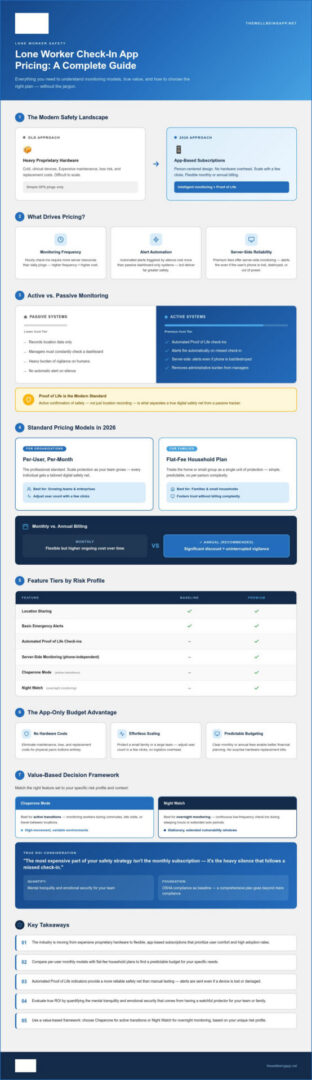
The landscape of safety has undergone a profound transformation. Historically, protecting individuals meant investing in heavy, proprietary hardware that often felt cold and clinical. Today, the focus has shifted toward compassionate vigilance. Modern lone worker safety monitoring centers on the person, not just the equipment. As you evaluate lone worker check-in app pricing, you’ll find that 2026 models prioritize intelligence over simple GPS pings. This means the value lies in how the system interprets a lack of movement or a missed signal, rather than just recording a location.
The core cost drivers in this new era are monitoring frequency, alert automation, and server-side reliability. A system that checks in every hour requires more resources than one that only pings once a day. However, the true worth of a subscription is found in its ability to act when the user cannot. When a solution is built with technical robustness, it provides the mental tranquility that comes from knowing silence will always be investigated.
Active vs. Passive Monitoring Costs
The primary distinction in pricing often comes down to how involved the system is in the user’s well-being. Passive systems, which merely record location data, typically sit at the lower end of the cost spectrum. These systems place a heavy burden of vigilance on managers or family members who must constantly check a dashboard. In contrast, active systems utilize automated check-ins to confirm safety.
Proof of Life is the modern standard for safety indicators.
By requiring this active confirmation, the software acts as a watchful protector. It removes the administrative weight of manual check-ins. Premium tiers usually justify their cost through server-side monitoring. This ensures that if a user’s phone is destroyed or loses power, the server recognizes the silence and triggers an alert regardless. This level of technical robustness provides a deep sense of harmony that passive tracking simply cannot match.
The ‘App-Only’ Advantage for Budgeting
Shifting to a digital-first approach offers a significant advantage for your annual budget. You no longer have to worry about the maintenance, loss, or replacement of physical panic buttons. Digital solutions scale effortlessly. Whether you’re protecting a small family or a large professional team, you can adjust your user count with a few clicks.
This flexibility improves your long-term ROI. You pay for the protection you need without the overhead of hardware logistics. When considering lone worker check-in app pricing, look for models that offer clear, predictable monthly or annual fees. This allows for better financial planning while ensuring your loved ones or employees are never left without a digital safety net. The goal is to foster a community of safety where everyone feels empowered and secure.
Standard Pricing Models for Safety Solutions in 2026
Selecting a safety solution is a deeply personal decision that balances fiscal responsibility with a sincere concern for the vulnerable. While safety itself is priceless, budgeting for it requires a clear understanding of the market. In 2026, lone worker check-in app pricing generally follows two distinct paths: professional scalability and personal simplicity. For organizations, the “Per-User, Per-Month” model remains the standard. It allows managers to scale their protection as their team grows, ensuring that every individual has a digital safety net tailored to their specific role.
Families and households are increasingly moving toward flat-fee monthly plans. These models treat the home or small group as a single unit of protection, fostering an atmosphere of trust without the complexity of individual billing. When you look at the long-term impact, annual billing often emerges as the most supportive option. It provides a significant discount over monthly renewals and, more importantly, ensures uninterrupted vigilance. Meeting OSHA workplace safety requirements is a foundational step for any organization, but choosing a comprehensive plan goes beyond mere compliance; it’s an act of collective responsibility.
Enterprise vs. Individual Subscription Tiers
Feature access is typically tiered to match the user’s risk profile. Baseline subscriptions often include Location Sharing and basic Emergency Alerts. However, premium tiers are where you find the most robust indicators of well-being. Specialized services like Night Watch offer heightened protection during vulnerable overnight hours, while Chaperone provides active support during transitions between locations. These advanced tools are designed for those who require a more sophisticated watchful protector to maintain their mental tranquility throughout the day. If you are exploring how these tiers fit your specific needs, you might consider how a comprehensive safety subscription can bridge the gap between technical features and real-world impact.
Hidden Costs to Watch Out For
Transparency is a central pillar of trust. When evaluating lone worker check-in app pricing, it’s essential to look past the sticker price. Poorly designed apps can become an “invisible” cost through excessive battery drain and high data usage, which can lead to hardware fatigue over time. In corporate environments, some providers may also include unexpected setup or implementation fees. To maintain personal agency and financial harmony, prioritize services that offer no-contract flexibility. This allows you to adjust your protection levels as your life or business evolves, ensuring that your safety solution remains a supportive partner rather than a restrictive burden.
Evaluating the Value of Automated Check-In Features
True safety isn’t found in a map filled with dots; it’s found in the certainty that someone is okay. While basic tracking might seem sufficient on paper, manual “I’m okay” texts often fail when they are needed most. In a high-stress encounter or a sudden medical emergency, the cognitive load required to send a manual message is simply too high. Relying on a person in distress to signal for help is a reactive strategy that leaves too much to chance. This is why understanding the nuances of lone worker check-in app pricing requires looking beyond the subscription fee to the functional value of automation.
The Proof of Life mechanism represents a fundamental shift from passive tracking to active, empathetic vigilance. By automating the check-in process, the system removes the constant burden of vigilance from the individual. It fosters an atmosphere of harmony where users can focus on their tasks or their journey, knowing their well-being is being quietly confirmed in the background. Proactive protection like this identifies potential issues before they escalate into full-scale emergencies. When comparing various employee monitoring software pricing benchmarks, it becomes clear that the most valuable solutions are those that prioritize the user’s mental state alongside their physical location.
The Reliability of Server-Side Alerts
A critical component of technical robustness is what happens when the connection breaks. If a phone is lost, dead, or destroyed, a standard app might simply go dark, leaving contacts in a state of anxious uncertainty. Server-side monitoring acts as a “Cloud Guardian,” ensuring that the safety net remains intact even when the hardware fails. Because the countdown happens on a secure server, the alert dispatch occurs the moment a check-in is missed. A safety app is only as good as its ability to act when the user cannot. This server-led approach ensures that designated contacts receive accurate information with life-saving speed, maintaining the integrity of the protective circle you’ve built around your team or family.
Night Watch: Specialized Protection for Vulnerable Hours
The quiet hours of the night bring unique risks that require a specialized approach to monitoring. During sleep or periods of low activity, the standard “active” check-in might be intrusive, yet the need for a watchful protector remains. Night Watch features are designed to integrate seamlessly into your standard subscription, providing a layer of security that respects the user’s rest while maintaining constant readiness. There is a profound psychological benefit to knowing that a dedicated system is standing guard 24/7. This constant presence helps preserve mental tranquility, allowing for a restful night based on the foundation of collective responsibility and professional-grade reliability. When you evaluate lone worker check-in app pricing, consider how these specialized tools contribute to a total sense of empowerment and safety.
Calculating ROI: The Cost of Safety vs. The Cost of Incident
When you evaluate lone worker check-in app pricing, it’s easy to focus solely on the line item in your monthly budget. However, the true return on investment isn’t found in a spreadsheet; it’s found in the preservation of mental tranquility. For a family member waiting at home or a manager overseeing a remote team, the “Watchful Protector” persona of a safety app provides a value that is difficult to quantify but impossible to ignore. A single unmonitored incident can lead to catastrophic social and emotional consequences that far outweigh the cost of a decade of subscriptions.
Preventing missing person incidents is the ultimate emotional “return” on safety. By utilizing smart, tiered escalation protocols, modern systems reduce the “false alarm” fatigue that often plagues manual monitoring. These protocols ensure that alerts are only escalated when a genuine risk is detected, maintaining a high level of trust and responsiveness within your protective circle. This disciplined approach to safety ensures that when an alert does sound, every designated contact is ready to act with purposeful urgency. To start building your digital safety net, you can explore our protective monitoring plans today.
Empowerment vs. Anxiety
The right pricing model does more than just grant access to software; it encourages a shift in the user’s mindset. When protection is built on a foundation of empathy, users feel empowered rather than surveilled. This distinction is vital for long-term adoption. If a system feels like a surveillance tool, users will find ways to bypass it. If it feels like a shared effort toward collective responsibility, it becomes a natural part of their daily routine. This community unity is what turns a technical tool into a proactive shield, ensuring that safety is something felt by everyone involved, not just something managed from afar.
Long-term Savings Through Proactive Monitoring
Early detection is the most effective way to reduce the complexity of an emergency response. When a missed check-in is identified within minutes via a server-side alert, the window for a successful recovery is significantly wider. Location Sharing also provides long-term savings in non-emergency scenarios, such as helping a lost hiker or a disoriented senior find their way home before a situation escalates. By positioning safety as a core pillar of personal well-being, you’re investing in a more harmonious future. The cost of a lone worker check-in app is a small, predictable investment in the ongoing harmony and security of your most valuable assets: the people you care for.
Choosing Your Plan: A Value-Based Decision Framework
Selecting a safety plan is a deeply personal process that begins with a clear assessment of your unique risk profile. A professional working in remote environments requires a different level of vigilance than a vulnerable senior living independently. When you evaluate lone worker check-in app pricing, the goal is to find a solution that mirrors your specific needs for mental tranquility. You don’t need a complex B2B procurement process; you need a watchful partner that fits seamlessly into your daily life. This framework ensures you prioritize features that provide the most significant emotional and practical return.
If your days involve active transitions, such as walking between sites or returning home after dark, the Chaperone feature provides a vital layer of support. For those who require constant, quiet confirmation of well-being, the 24/7 Proof of Life indicator becomes the heart of your safety strategy. By choosing a solution that doesn’t require extra hardware, you eliminate the friction of maintaining physical devices. This digital-first approach empowers you to maintain your personal agency while staying connected to a protective community of care.
The Wellbeing App Difference
The Wellbeing App stands apart by blending technical robustness with a voice that is both calm and supportive. We believe that technology should serve as a compassionate guardian rather than a cold surveillance tool. Our monthly and annual plans are designed to provide continuous monitoring without the burden of hardware logistics or complex setups. This simplicity is intentional. It fosters social cohesion by making safety a shared effort between the individual and their designated contacts.
Our server-side monitoring ensures that your safety net remains intact even in the most challenging scenarios. Because the alert system lives on our secure servers, your contacts are notified even if your phone is destroyed or the battery dies. This level of proactive protection is a central pillar of our mission to preserve the user’s mental state. We are dedicated to fostering a world where safety is accessible, friendly, and deeply rooted in the concept of well-being for everyone.
Next Steps: Securing Your Peace of Mind
Safety doesn’t have to be complicated or expensive. You can begin your journey toward a more secure future with a simple app download. Setting up your first Proof of Life indicator takes only minutes, allowing you to establish a digital safety net immediately. This quick implementation ensures that you and your loved ones can move through the world with a renewed sense of harmony and empowerment. It is your duty to protect those you care about, and we are here to help you fulfill that promise with ease. Discover the right safety plan for your needs at The Wellbeing App and take the first step toward lasting tranquility today.
Embracing a Future of Shared Safety and Tranquility
Choosing the right lone worker check-in app pricing model is about more than just managing a monthly budget; it is about honoring your duty to those you care for. We’ve seen how the shift toward digital safety nets has redefined protection by prioritizing empathy over surveillance. By focusing on technical robustness and server-side reliability, you ensure that your safety strategy remains intact even when hardware fails. This transition to modern, app-based monitoring allows you to provide a watchful protector for your team or family without the friction of physical devices.
The Wellbeing App offers a seamless path to this peace of mind. It requires no proprietary hardware and works directly on your smartphone, providing automated Proof of Life monitoring and virtual Chaperone services for active transitions. You don’t have to navigate these complex safety decisions alone. Secure your peace of mind with The Wellbeing App’s 24/7 monitoring and begin building a more harmonious, empowered community today. Your commitment to safety is the greatest gift you can offer your loved ones.
Frequently Asked Questions
What is the average monthly cost of a lone worker monitoring app?
Lone worker check-in app pricing typically follows a per-user monthly subscription model for professional teams or flat-fee plans for households. While specific rates vary based on the level of technical robustness and features like Night Watch, most industry standard plans focus on recurring fees to maintain 24/7 server-side monitoring. These subscriptions ensure that your digital safety net is always active, providing a level of empathetic vigilance that manual texting cannot match.
Is a subscription really better than a one-time hardware purchase?
A subscription is generally superior because it eliminates the hidden costs of maintaining, losing, or replacing physical hardware. App-based solutions scale effortlessly and receive continuous updates to improve alert accuracy. By removing proprietary hardware from the equation, you empower users to use their existing smartphones. This creates a more harmonious experience where the technology acts as a watchful protector without the friction of carrying an extra, often stigmatizing, device.
Can I use a lone worker check-in app for my elderly family members?
You can certainly use these tools to protect elderly family members who live independently. Features like Proof of Life indicators are specifically designed to provide a gentle, non-intrusive way to confirm their well-being throughout the day. This proactive protection fosters community unity and preserves the user’s mental state. It allows seniors to maintain their personal agency while giving their loved ones the tranquility that comes from knowing silence will always be investigated.
What happens if I miss a check-in and my phone is dead?
If your phone dies or is destroyed, the server-side monitoring system recognizes the lack of a check-in and triggers an alert anyway. Because the countdown happens on a secure server rather than just on your device, the safety net remains intact. This technical robustness is a central pillar of reliable monitoring. Automated alerts are dispatched to your designated contacts immediately, ensuring that help is coordinated even when your hardware is no longer functional.
Are there free lone worker apps, and are they safe?
While free apps exist, they often lack the technical robustness and server-side reliability required for true safety. Many free versions only offer passive tracking, which places the burden of vigilance back on your family or managers. A professional subscription ensures 24/7 monitoring and automated alert dispatch. Investing in a dedicated service reflects a sincere concern for the vulnerable and provides the consistent, uninterrupted protection necessary to maintain genuine mental tranquility.
Do these apps require special hardware or a smartwatch?
Most modern safety solutions, including The Wellbeing App, don’t require any proprietary hardware or specialized smartwatches. They’re designed to work seamlessly on the smartphone you already carry every day. This approach reduces implementation friction and ensures that safety is accessible to everyone. By using standard devices, the system feels less like a surveillance tool and more like a supportive partner that empowers you to move through the world confidently.
How do automated alerts work if I’m in an area with poor signal?
Automated alerts rely on the server to act as a Cloud Guardian when a signal is lost. If you enter a dead zone and miss a scheduled check-in, the server recognizes the silence and notifies your contacts. This proactive approach is essential for lone worker check-in app pricing value. It ensures that a lack of communication is treated as a priority, allowing your protective circle to respond with speed and accuracy regardless of your current connectivity.
Can I cancel my safety monitoring subscription at any time?
Most app-based safety services offer the flexibility to cancel or adjust your subscription as your needs evolve. Prioritizing a no-contract model allows you to maintain personal agency over your safety strategy. Whether you need temporary protection during a specific project or long-term vigilance for a family member, this flexibility ensures the service remains a supportive resource. It allows you to focus on well-being and harmony without being locked into restrictive, long-term technical burdens.