
How Does an Automated Wellness Check Work? The Complete 2026 Guide
What if the most effective way to protect a vulnerable relative wasn’t a camera in their living room, but a silent, digital guardian that respects their privacy? It’s a question many families face as they search for a balance between vigilance and independence. You likely feel that familiar pang of anxiety when a daily text goes unreturned, yet you dread the idea of installing intrusive tracking hardware. You want your loved ones to feel empowered in their own homes, not managed. Understanding how does an automated wellness check work is the first step toward reclaiming your mental tranquility. This guide pulls back the curtain on the server-side logic that powers modern safety. We’ll explore the inner workings of proactive check-ins, like Proof of Life alerts, and show you how they provide seamless protection without the friction of manual monitoring. You’ll discover how these systems transition from reactive emergency buttons to a compassionate, always-on partnership that keeps families connected. By the end, you’ll see why a sophisticated digital chaperone is the most respectful instrument of personal safety available in 2026.
Key Takeaways
- Understand exactly how does an automated wellness check work through a secure, three-step server-side cycle that eliminates the friction of constant manual texting.
- Discover how software-driven monitoring provides continuous protection independent of local device crashes, allowing you to completely avoid invasive tracking hardware.
- Learn how modern safety platforms protect personal privacy through user-controlled permissions, ensuring your loved ones maintain their independence and dignity.
- Explore how proactive features like Proof of Life deliver true mental tranquility, acting as a compassionate guardian for your family’s daily routine.
What Is an Automated Wellness Check and Why Is It Necessary?
An automated wellness check is a software-driven schedule designed to verify a person’s safety at predetermined times throughout the day. Instead of waiting for a crisis to occur, this technology shifts the paradigm from reactive emergency response to proactive safety monitoring. It establishes a non-intrusive digital safety net that supports independent living while preserving personal dignity. Historically, families relied on broader frameworks of Telecare to manage vulnerability, but modern applications refine this into a seamless, cloud-based experience.
When exploring how does an automated wellness check work, it helps to understand the profound emotional relief it provides. Constant manual checking places a heavy toll on family dynamics, often making relationships feel transactional or burdened by worry. By automating these routine touchpoints, technology steps in as a compassionate guardian, protecting the mental state of everyone involved and fostering an atmosphere of safety and trust.
The Problem with Traditional Check-In Methods
Relying on manual text messages or daily phone calls often creates unintended friction. Busy schedules or simple forgetfulness cause missed check-ins, which instantly triggers an intense anxiety spiral for waiting family members. A single unreturned text can turn a quiet afternoon into a panic-filled ordeal. Forcing a vulnerable relative to answer a phone call at the same time every day can also feel intrusive, disruptive, and patronizing. It interrupts daily routines and subtly erodes a person’s sense of self-reliance, making manual oversight unsustainable over time.
Who Benefits Most from Automated Monitoring?
This proactive approach offers immense value across various lifestyles, creating a shared circle of protection without the need for clinical tracking tools. It doesn’t require constant coordination, making it ideal for several groups:
- Seniors living alone: Older adults who wish to preserve their personal autonomy can do so securely without the burden of constant surveillance.
- Solo travelers and night commuters: Individuals walking home alone during late hours or traveling alone benefit from a temporary digital partner.
- Anxious families: Relatives achieve true mental tranquility by establishing a reliable safety loop that functions seamlessly in the background.
Ultimately, automated systems ensure that safety is maintained silently, effectively, and with total respect for individual privacy.
How Does an Automated Wellness Check Work Behind the Scenes?
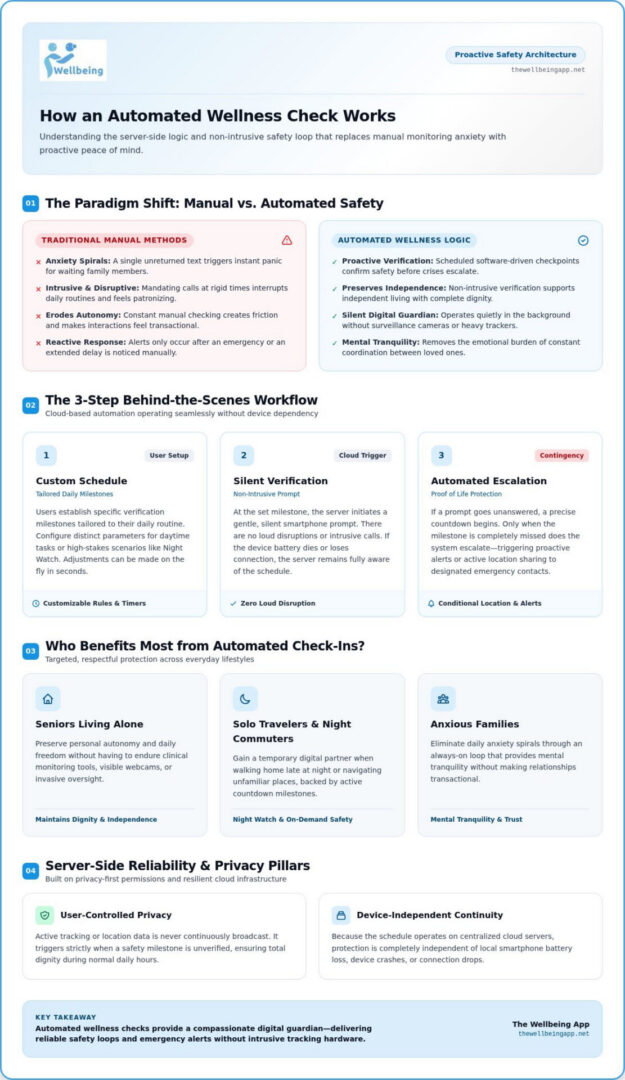
Demystifying the technology behind modern safety reveals a system built on server-side logic rather than constant surveillance. You might worry that these tools are complex, but they actually function through a streamlined three-step cycle. This entire process runs securely via cloud-based servers, ensuring that your data is protected while maintaining a vigilant watch. It’s a system designed to stay in the background until it’s actually needed. Active tracking or location sharing only triggers when a specific safety milestone is missed, preserving the user’s privacy during every other moment of the day. Understanding how does an automated wellness check work helps families transition from constant worry to true mental tranquility.
Step 1: Setting the Custom Schedule
The process begins with empowerment. Users establish specific check-in milestones that align perfectly with their unique daily habits. You can configure different rules for daytime activities versus high-stakes scenarios like Night Watch protection. If a plan changes, modifying the schedule on the fly within the app takes seconds. This flexibility ensures the service remains a helpful tool rather than a rigid chore. It’s similar in concept to a state-run automated daily check-in program, but with the added benefit of modern smartphone integration and real-time customization.
Step 2: The Silent Verification Window
At the scheduled time, the server initiates a silent verification window. A non-intrusive notification prompt appears on the smartphone, asking the user to confirm they’re safe. There are no loud alarms or disruptive calls during this phase. It’s a gentle touchpoint that respects the user’s current environment. Because the monitoring happens on the server, the system remains fully aware of the schedule even if the smartphone battery dies or the device loses its internet connection.
Step 3: Automated Escalation and Emergency Alerts
If the prompt goes unanswered, a precise countdown mechanism begins. This is the heart of the safety loop. Once the timer expires, the system automatically dispatches Emergency Alerts to the user’s chosen contacts via SMS or app notifications. At this specific moment, real-time location sharing activates to guide family members or friends to the user’s exact position. This resolution loop ensures that help is directed precisely where it’s needed, removing the guesswork from family security. You can explore how these features fit into your family’s routine at thewellbeingapp.net.
Automated Check-Ins vs. Legacy Hardware: A Reliability Analysis
Choosing the right protection for a family member involves looking at the structural differences between modern software and physical equipment. While legacy hardware was once the standard for senior safety, software-based subscriptions now offer a new level of empathetic vigilance. You don’t need to purchase bulky, specialized devices to feel secure. Instead, the focus shifts to how does an automated wellness check work through the smartphones we already carry every day. This transition removes the technical barriers that often make safety feel like a burden rather than a benefit.
The Stigma and Constraints of Physical Hardware
Many individuals refuse to wear conspicuous medical alert pendants because they feel like a public badge of frailty. This stigma often leads to a dangerous compromise where the device is left on a nightstand or a charger rather than on the person. Beyond the social cost, physical hardware often has geographic limitations. Many systems are tethered to a home base station, meaning protection stops at the front door. There is also the constant burden of device maintenance. If you forget to charge a proprietary battery or if the hardware fails, the safety net disappears entirely. It’s a reactive model that places the responsibility on the user to remember their equipment.
The Versatility of Software-Based Safety Nets
When people ask how does an automated wellness check work in terms of reliability, the answer lies in the cloud. Software-based protection leverages the sophisticated GPS and notification systems already built into smartphones. This provides superior accuracy without requiring a single piece of extra equipment. Because updates are deployed through the cloud, your safety features evolve seamlessly without you ever needing to buy a new model. A digital safety net acts as a compassionate guardian that travels with you, whether you’re at home or out in the community.
- Cost Efficiency: You can completely avoid expensive equipment setup fees and recurring hardware maintenance costs.
- Proactive Logic: Server-side monitoring ensures safety doesn’t rely on a single physical button press during a crisis.
- Dignified Experience: The service respects personal style and autonomy, blending into daily life rather than defining it.
By removing the physical barrier of a medical pendant, we restore a sense of agency to the user. This approach fosters social cohesion within the family, as the technology handles the routine monitoring while you focus on the quality of your relationships. It’s about achieving true mental tranquility through a system that is technologically sophisticated yet deeply caring.
Overcoming Common Privacy and False Alarm Concerns
Accepting a new form of safety monitoring often comes with a valid fear of constant surveillance. You might worry that inviting technology into your home means sacrificing the very independence you’re trying to protect. It’s a common concern that “monitoring” implies invasive cameras or constant, clinical tracking. However, understanding how does an automated wellness check work reveals a system built on privacy by design. These platforms act as a compassionate guardian, staying silent and invisible until a genuine need arises. By prioritizing user-controlled permissions, modern safety tools ensure that your personal life remains your own.
Preserving Personal Autonomy and Privacy
Automated check-ins are fundamentally different from indoor security cameras or wearable trackers that broadcast your every move. While a camera is always watching, a digital safety net only looks for a specific confirmation at a time you choose. Location sharing remains strictly inactive during your normal routine. It only becomes visible to your inner circle if a safety milestone is missed and the escalation window expires. You maintain absolute control over who receives your status updates, ensuring that your data is shared only with those you trust most. This approach respects your personal agency while providing the mental tranquility your family needs.
Smart Mechanisms to Eliminate False Alarms
The fear of “crying wolf” often prevents people from using safety services. To address this, sophisticated systems use a multi-tiered warning logic. Before any family members are contacted, the app sends several private prompts to your device. You can customize the grace period duration to fit your specific lifestyle, whether you need five minutes or an hour to respond. If you simply forgot to check in, a quick-cancel feature allows you to reset your status instantly with a single tap. This prevents accidental emergency escalations and ensures that alerts are only sent when they truly matter.
Integrating these checks into your daily life is simple and stress-free. Many users find success by aligning their check-in with a morning coffee or a favorite evening television show. By making the confirmation a part of an existing habit, it becomes a seamless, five-second task rather than a chore. You can start building your own circle of protection today by visiting thewellbeingapp.net to see how these safeguards work in practice.
Securing Peace of Mind with The Wellbeing App
Choosing a safety partner is a deeply personal decision rooted in the preservation of your family’s mental state. The Wellbeing App acts as a compassionate guardian, providing a sophisticated layer of protection that respects individual agency. By focusing on the core logic of how does an automated wellness check work, the platform transforms your smartphone into a reliable instrument of proactive safety management. At the heart of this service is the Proof of Life feature, which serves as the emotional anchor for your daily routine. It ensures that your loved ones are safe without the need for intrusive hardware or constant, anxious surveillance.
A Comprehensive Suite of Proactive Safety Tools
The platform offers specialized indicators tailored to specific moments of vulnerability. While Proof of Life handles the daily rhythm, the Chaperone service provides empathetic vigilance for those walking home alone at night or entering unfamiliar environments. It establishes a temporary, high-stakes safety loop that only shares your position if you fail to reach your destination. For those concerned about the quiet hours, Night Watch protection guards individuals during their most vulnerable sleeping periods. This subscription model ensures continuous, reliable server-side safety monitoring. Because the logic lives in the cloud, your protection remains active even if your device encounters local crashes or connectivity issues.
- Proof of Life: The primary automated check-in verifying well-being at scheduled intervals.
- Chaperone: A proactive partner for solo journeys and late-night commutes.
- Night Watch: Specialized monitoring that provides harmony and security during rest.
- Location Sharing: Real-time data that only activates during a confirmed Emergency Alert.
Empowering Families and Cultivating Community Unity
Safety is a shared effort. The Wellbeing App appeals to your sense of duty toward your loved ones by making collective responsibility simple and dignified. You don’t need to be a tech expert to manage the system; the ease of onboarding family members onto a shared protection plan makes it accessible for every generation. By understanding how does an automated wellness check work in a real-world context, you can replace fear with a sense of empowerment. It’s time to move past the friction of manual texting and embrace a watchful protector that never sleeps. Ready to secure your digital safety net? Download The Wellbeing App today.
Embracing a Future of Proactive Peace of Mind
Transitioning from the anxiety of manual check-ins to a sophisticated digital guardian is a vital step toward reclaiming your family’s harmony. You’ve seen how does an automated wellness check work by replacing invasive surveillance with server-side vigilance that respects individual dignity. This technology ensures that protection isn’t tethered to a specific piece of hardware or a single button press. Instead, it relies on continuous server-side monitoring that stays active regardless of your local device state, providing a reliable safety net that never sleeps.
The Wellbeing App provides a comprehensive safety suite, featuring Proof of Life and Chaperone modes designed to foster personal agency while cultivating community unity. It’s a compassionate partner that appeals to your sense of duty, offering a watchful eye that moves with you through every part of your day. By choosing a proactive approach, you’re not just installing an app; you’re investing in a lifestyle of empowerment and collective responsibility. Protect your family’s peace of mind with The Wellbeing App today. You deserve the mental tranquility that comes from knowing your loved ones are always watched over with care and respect.
Frequently Asked Questions
What happens if my phone battery dies during a scheduled wellness check?
If your phone loses power, the server-side monitoring system continues to track your safety status independently. Since the schedule lives in the cloud rather than just on your local device, the platform recognizes a missed milestone even if the phone is off. This ensures that protection isn’t broken by a dead battery or a lost connection. It allows your designated contacts to be notified through the standard escalation process without delay.
Can I customize the check-in times for different days of the week?
You have complete control over your safety schedule, allowing you to tailor check-in milestones to your unique daily habits. Whether you need a morning Proof of Life confirmation or a specialized Night Watch protocol, you can set different rules for every day of the week. This flexibility ensures the service remains a respectful instrument of empowerment that fits seamlessly into your life rather than forcing you to change your routine.
Does an automated wellness check track my location constantly?
Privacy is a central pillar of the service, so constant location tracking is never active during your normal day. The system only initiates real-time location sharing if a scheduled safety milestone is missed and the grace period expires. This design preserves your personal autonomy and dignity, ensuring that your movements remain private until a genuine emergency alert is triggered. It’s a compassionate guardian that stays in the background until it’s needed.
How does the app alert my emergency contacts if I miss a check-in?
If you miss a scheduled prompt, the system follows a precise resolution loop to ensure your safety. Once the automated countdown mechanism concludes, the platform dispatches high-stakes emergency alerts to your chosen circle via SMS or app notifications. These alerts include your last known coordinates to guide your family or friends directly to you. Understanding how does an automated wellness check work helps families realize that help is always just a missed milestone away.
Is an automated wellness check suitable for seniors living alone?
Proactive monitoring is ideal for seniors who wish to preserve their personal autonomy while providing their families with true mental tranquility. It removes the friction of manual texting and the unreliability of constant phone calls, replacing them with a silent, digital safety net. By focusing on community unity and collective responsibility, the platform allows older adults to feel empowered and secure in their own homes without the need for intrusive hardware or cameras.
What is the difference between a wellness check app and a traditional medical alert bracelet?
Traditional medical alert bracelets are reactive, meaning they require the user to manually press a button during a crisis. In contrast, an app-based service like Proof of Life is proactive, reaching out to you at scheduled times to verify your well-being. Additionally, the app functions through your existing smartphone, so you don’t need to purchase or maintain proprietary hardware devices. It’s a more dignified, technologically sophisticated approach to maintaining family security.