
Mastering Stability: The Ultimate Guide to Balance Exercises for Seniors in 2026
Last October, 76-year-old Arthur realized he had stopped visiting his backyard bird feeder because the slight slope of the grass felt like a threat to his independence. This quiet withdrawal from daily joys is a reality for the 1 in 4 older adults who experience a fall each year, according to 2025 health reports. You likely believe that your home should be a sanctuary of comfort rather than a landscape of potential hazards. It is natural to worry about the “long lie” or losing the ability to move freely through your own hallways, but you don’t have to face these fears with anxiety.
This guide empowers you to take control of your physical health by mastering balance exercises for seniors that are specifically designed for safety and stability in 2026. You will learn how to strengthen your physical foundation and implement proactive monitoring tools that act as a vigilant guardian for your safety. We will walk through gentle, effective routines to improve your coordination and explore the “Proof of Life” indicators that help you protect your peace of mind while living life on your own terms.
Key Takeaways
- Understand the science behind stability to learn how your inner ear and muscle strength work together to preserve your independence.
- Master a progressive routine of balance exercises for seniors that emphasizes safety-first techniques for absolute beginners.
- Overcome the psychological fear of falling by learning how to manage the anxiety that can physically compromise your stability.
- Build a sustainable safety net by integrating daily physical activity with proactive digital monitoring to ensure you are never truly alone.
- Protect your peace of mind with advanced features that offer a more compassionate and vigilant alternative to traditional panic buttons.
Understanding the Science of Stability: Why Balance Matters for Seniors
Balance is a silent partner in every move you make. It isn’t just about standing on one leg; it’s a sophisticated dialogue between your brain and your body. This interaction relies on three critical inputs: the vestibular system in your inner ear, your visual focus, and your muscular strength. When these systems work in harmony, you move with confidence. When they drift, your peace of mind can drift with them.
Physical stability naturally changes as we age. By age 70, many adults experience a 25 percent reduction in the hair cells within the inner ear that manage equilibrium. This decline directly impacts Activities of Daily Living (ADLs). Simple tasks like reaching for a high shelf or stepping out of the shower become sources of stress rather than routine habits. In 2026, wellness is no longer about reacting to a stumble. It’s about proactive prevention. Engaging in consistent balance exercises for seniors allows you to maintain your independence and stay connected to the people you love.
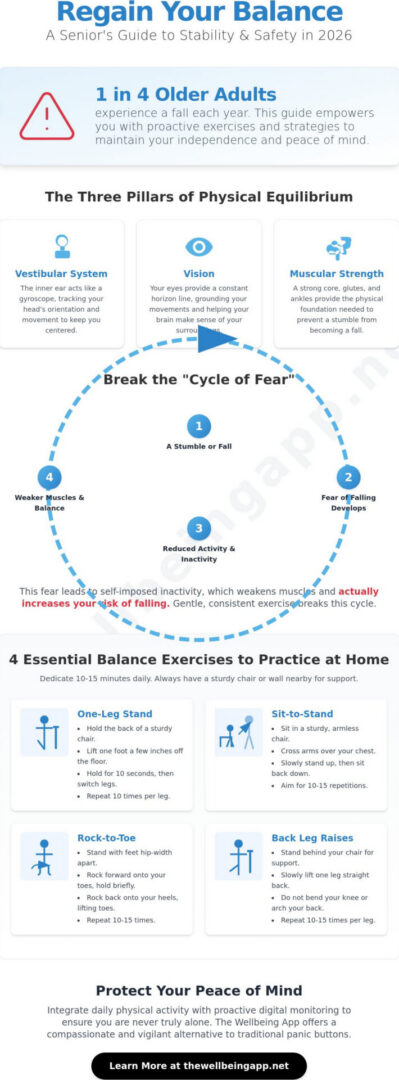
The “Cycle of Fear” is a psychological hurdle that often follows an initial trip or near-miss. This fear leads to self-imposed inactivity. You might stop walking to the park or visiting neighbors because the ground feels unreliable. This inactivity causes muscles to atrophy, which actually increases your risk of falling. We want to help you break that cycle. When you care enough to know the state of your own stability, you can take control of your future health.
The Three Pillars of Physical Equilibrium
Your body maintains its upright position through three distinct channels. The Vestibular System uses the fluid-filled canals of your inner ear to track your head’s orientation and movement. Your vision provides a constant horizon line to ground your movements. Finally, your core and lower body strength act as the physical foundation. Without strong glutes and ankles, even the best sensory data cannot stop a fall. Training these pillars through balance exercises for seniors ensures your body can recover from a sudden trip before it becomes an emergency.
Recognizing Early Warning Signs of Imbalance
Instability often whispers before it shouts. You might notice “furniture walking,” where you subconsciously touch tables or walls for support as you move through a room. Dizziness when standing up too quickly is another indicator that your systems need attention. Proprioception is the body’s sixth sense for spatial awareness. When this sense dulls, you may feel clumsy or unsure of your footing in the dark. This is why “Night Watch” safety is so vital; balance is most compromised during late-night movements when your visual pillar is removed. Recognizing these subtle shifts early allows you to intervene with targeted training and protect your peace of mind.
7 Essential Balance Exercises for Seniors to Practice at Home
Building a foundation for your physical security starts with small, daily commitments. You don’t need a professional gym to protect your independence; a dedicated 10 to 15 minute routine in your living room creates a powerful protective layer against falls. According to 2023 data from the CDC, one in four Americans aged 65 and older falls each year. Taking control of your stability is the best way to ensure you don’t become part of that statistic. Safety is our absolute priority. Always perform these movements with a sturdy chair or a clear section of wall within arm’s reach for support. Ensure your environment is well-lit and clear of clutter. Wear supportive, non-slip shoes to maintain a firm connection with the floor.
Stationary Stability Movements
These exercises focus on your foundation while you remain in one spot. They’re designed to help you feel grounded and secure in your own skin. When you care enough to know your physical limits, you can work to expand them safely.
- The One-Leg Stand: This is a classic test of balance. Stand behind a chair and hold the back for support. Lift one foot and hold for 10 seconds. This strengthens your ankles and engages your core. Repeat 10 times per leg.
- The Rock-to-Toe: Stand with feet hip-width apart. Slowly rock forward onto your toes, then back onto your heels. This improves calf strength and your ability to shift weight without losing your center of gravity.
- The Sit-to-Stand: Sit in a sturdy chair. Without using your hands, stand up slowly and sit back down. This builds the functional leg strength required for daily independence.
- Back Leg Raises: Stand behind your chair. Slowly lift one leg straight back without bending your knee. Hold for a second and lower it. This targets the glutes and lower back, which are essential for upright posture.
Dynamic Balance and Gait Training
Movement is where most falls occur, so practicing balance exercises for seniors while in motion is vital for long-term well-being. These drills help your brain and body stay connected during daily activities. By mastering these patterns, you protect your peace of mind and stay active within your community.
- Heel-to-Toe Walk: Place the heel of one foot directly in front of the toes of the other, as if walking a tightrope. Take 10 to 15 steps. This sharpens your coordination and focus.
- Sideways Walking: Step to the right with your right foot, then bring your left foot to meet it. Perform 10 steps in each direction. This engages the hip abductors, which provide lateral stability during sudden movements.
- The Simple Grapevine: This advanced move involves crossing one foot over the other while walking sideways. It improves footwork and prevents trips when you need to change direction quickly in a crowded environment.
Consistency is more important than intensity. By practicing these balance exercises for seniors every day, you create a reliable internal monitoring system for your body. This proactive approach ensures you remain a vibrant, mobile member of your family circle for years to come.
Overcoming the Psychological Barrier: Exercising Safely While Alone
The most common reason seniors hesitate to begin a new routine is the fear that an exercise session could lead to an unmonitored fall. This hesitation is a natural response to the reality of living independently. However, anxiety does more than just hold you back mentally; it physically alters your stability. When you feel anxious, your body responds with muscle tension and shallow, rapid breathing. These physiological shifts stiffen your joints and center of gravity, which paradoxically increases the risk of the very stumble you’re trying to avoid. By addressing this fear, you can perform balance exercises for seniors with the fluid, relaxed movements required for true stability.
It’s time to shift the narrative from “I am vulnerable” to “I am taking control of my safety.” You aren’t just exercising alone; you’re operating within a system designed to protect your peace of mind. Modern technology acts as a “Virtual Chaperone” that stands watch while you move. This proactive approach allows you to focus entirely on your physical progress rather than scanning the floor for potential disasters. When you feel secure, your body moves with more confidence, making your balance exercises for seniors significantly more effective.
Creating a Controlled Environment
Before you start your first set of movements, perform a home safety audit to transform your space into a professional-grade training zone. A 2023 report from the National Safety Council found that 60% of fall-related injuries occur within the home, often due to preventable hazards. Start by replacing dim bulbs with high-output LEDs to ensure every corner is visible. Remove “trip triggers” like decorative throw rugs or loose extension cords that can catch a heel. It’s vital to remember that the fear of falling is often as debilitating as the fall itself. By clearing your path, you clear your mind to focus on strength.
The Role of Automated Safety Indicators
Relying on manual check-ins is often unreliable during physical activity. You might forget to send a text to a family member when you’re focused on a difficult stance, or your phone might be out of reach. This is where “Proof of Life” technology changes the equation. Instead of you having to remember to call for help, a silent guardian watches over your activity. The Wellbeing App uses automated safety indicators to monitor your status throughout the day.
When you care enough to know that help is always a heartbeat away, you can push your boundaries safely. If a scheduled check-in is missed during your workout, the system automatically triggers a notification to your circle of care. This automated response ensures that you’re never truly alone, providing the security tool you need to take control of your fitness journey and enjoy lasting peace of mind.
Designing Your 2026 Senior Safety Net: A Comprehensive Checklist
True stability involves more than just physical strength. It requires a 360-degree approach to safety that blends physical movement with digital vigilance. By 2026, the concept of a “safety net” has evolved from simple handrails to integrated systems that protect your peace of mind. This checklist helps you build a sustainable rhythm where you feel empowered and connected to your loved ones every day.
Step 1: Consult and Assess
Before beginning any new regimen of balance exercises for seniors, you must speak with a physical therapist or doctor. A 2024 report from the National Council on Aging found that personalized exercise plans reduce fall-related injuries by 31 percent compared to generic routines. During your consultation, set realistic and measurable goals for 30, 60, and 90-day intervals. You might aim to stand on one leg for 20 seconds by month one or walk 1,000 steps without assistance by month three. This phase also involves identifying your “Proof of Life” indicators. These are specific daily actions, such as opening the medicine cabinet by 9:00 AM or using the kitchen kettle, that signal to your support network that you’re active and well.
Step 2: Implement the “Guardian Protocol”
Safety is a collective responsibility that relies on smart monitoring. When you prepare for a solo session of balance exercises for seniors, activate automated alerts to inform your family that you’re starting your routine. Real-time location sharing allows your circle of care to know exactly where you are in the home, providing a layer of empathetic vigilance without being intrusive. You should also establish a “Night Watch Protection” routine for high-risk hours. Statistics from a 2025 home safety study indicate that 65 percent of senior falls occur during midnight trips to the bathroom. Setting up automated security tools that monitor movement during these windows ensures help is always standing by. When you care enough to know, you take control of your environment and your future.
Transitioning from mere physical movement to a broader state of well-being fosters a strong sense of unity within the family. By integrating these habits, you transform your home into a sanctuary of care and security. This holistic approach ensures that your journey toward better balance is supported by both your own physical efforts and a dedicated community of guardians.
Ready to secure your daily routine and stay connected with those who matter most? Protect your peace of mind with The Wellbeing App today.
Protect Your Peace of Mind with The Wellbeing App
You have taken the first step toward a safer lifestyle by mastering balance exercises for seniors. Physical stability is the foundation of longevity, but true security requires a partner that remains vigilant when you’re alone. The Wellbeing App is that partner. It transitions your safety strategy from reactive to proactive, ensuring that you’re never truly isolated. This platform is built on the principle of empathetic vigilance, serving as a compassionate guardian that monitors your status without infringing on your dignity.
Beyond Fall Detection: The Power of Proof of Life
Traditional “panic buttons” are often left on chargers or avoided because they feel like a badge of frailty. Research in the field of gerontology suggests that nearly 80% of users fail to wear their medical alert pendants at the time of a fall. The Wellbeing App removes this barrier by utilizing the smartphone you already use every day. Through proprietary Proof of Life check-ins, the app confirms your safety at regular intervals. This automated system is designed to prevent the “long lie,” a dangerous period where a person remains on the floor for over an hour after a fall, which can increase mortality rates by up to 50%.
The Chaperone service acts as your virtual companion during daily routines. Whether you’re heading out for a stroll or practicing your balance exercises for seniors at home, the app monitors your movement. If the system detects a lack of activity or a missed check-in, it immediately alerts your designated contacts. This approach is more reliable than hardware that can be forgotten; it provides a seamless safety net that integrates into your existing habits.
Joining a Community of Care
The Wellbeing App creates a circle of unity between you, your family, and your neighbors. It’s built for those who believe that safety is a collective effort. The Night Watch feature provides 24/7 server-side monitoring, acting as a silent protector while your loved ones rest. This feature ensures that even if your phone battery dies or you lose signal, the system recognizes the lapse and initiates a protocol to verify your well-being. It’s a disciplined, serious approach to safety that provides total reassurance to everyone involved.
Choosing this platform is an act of empowerment. It allows you to manage your own safety while giving your family the peace of mind they deserve. When you care enough to know, you choose a tool that values your life as much as they do. Take control of your independence today with The Wellbeing App and walk into your future with confidence.
Take Control of Your Independence Today
Mastering balance exercises for seniors is about more than just physical strength; it’s about reclaiming the freedom to move through your home without hesitation. Research from the Cochrane Library indicates that structured exercise programs can reduce the rate of falls by 21 percent. By committing to the 7 essential movements we’ve discussed and following your 2026 safety checklist, you’re building a foundation of resilience. You don’t have to face the challenge of solo living alone. We’ve designed a digital safety net to ensure you’re always connected to those who care. Our system provides 24/7 Night Watch server-side monitoring and a Virtual Chaperone for your solo activities, so help is always standing by. With automated Proof of Life check-ins, your family stays informed without feeling intrusive. It’s time to replace anxiety with confidence. When you care enough to know that you’re safe, you can focus on enjoying every moment of your active lifestyle.
Protect your peace of mind and your independence, download The Wellbeing App today.
Your journey toward better stability starts with a single step, and we’re here to watch over you every inch of the way.
Frequently Asked Questions
Is it ever too late to start balance exercises for seniors?
No, it’s never too late to begin a routine. A 2022 study in the Journal of Frailty & Aging found that participants aged 85 to 97 improved their gait speed by 15% after an 8-week program. Your body keeps its ability to build neural pathways well into your tenth decade. Starting today allows you to take control of your physical independence and protect your peace of mind.
What is the most effective balance exercise for someone over 70?
Single-leg stands are the gold standard for balance exercises for seniors over 70. Research from the Mayo Clinic indicates that the ability to stand on one leg for 30 seconds is a primary predictor of longevity and fall prevention. To perform this safely, stand behind a sturdy chair and lift one foot while keeping your gaze fixed on a stationary point. This simple movement builds the foundational strength you need.
How often should a senior perform balance routines for best results?
You should perform balance routines at least 3 days per week according to the CDC’s 2023 physical activity guidelines. Each session should last approximately 15 to 20 minutes to achieve optimal neuromuscular benefits. Consistency is the key to building a strong sense of unity between your mind and body. This routine ensures you remain steady and confident throughout your daily activities in the community.
Can I improve my balance if I already use a walker or cane?
Yes, you can significantly improve your stability even if you currently rely on assistive devices. A 2024 clinical trial demonstrated that seniors using walkers who engaged in seated core strengthening and standing weight shifts reduced their fall risk by 22%. These targeted movements help you regain confidence and maintain your well-being. It’s about making progress at your own pace while staying safe.
What should I do if I feel dizzy while performing these exercises?
Stop the exercise immediately, sit down, and focus your eyes on a single unmoving object. Dizziness can stem from various factors, but a 2025 report from the Vestibular Disorders Association notes that 35% of adults over 40 experience vestibular dysfunction. If the sensation lasts more than 60 seconds, consult your physician. We want to ensure your safety and provide you with total peace of mind.
How does a “Proof of Life” app help if I fall during exercise?
A Proof of Life app acts as a vigilant guardian by detecting a lack of movement through automated indicators. If a fall occurs during your balance exercises for seniors and you’re unable to reach your phone, the app sends an automated alert to your family. This system ensures that care arrives quickly. It provides a compassionate safety net for those who value their independence and live alone.
Do I need special equipment to start balance training at home?
You don’t need expensive equipment to begin your training at home. Most effective routines utilize everyday items like a sturdy kitchen chair for support or a rolled-up towel to create an uneven surface. The American Council on Exercise states that 90% of basic stability training can be performed using only your body weight. You can start today with what you already have in your living room.
How can I convince my elderly parent to use a safety monitoring app?
Focus the conversation on empowerment and peace of mind rather than fear or loss of independence. Explain that the app is a security tool that allows them to live life on their own terms while keeping the family connected. Remind them that when you care enough to know they’re safe, it reduces your anxiety. This approach frames the technology as a way to take control together.