
The Best Apps to Ensure You Get Home Safe: 2026 Safety Tech Roundup
The traditional “text me when you get home” ritual is a well-meaning gesture that offers almost no actual protection when things go wrong. We’ve all felt that low-level hum of anxiety when a loved one’s message is late or when we’re walking alone at night, hoping the person on the other end is still awake. You want to feel connected without feeling watched, and you certainly don’t want to rely on a system that fails if you fall asleep or become incapacitated. Choosing a dedicated app to ensure someone gets home safe is no longer about constant surveillance; it’s about establishing a compassionate guardian that acts when you cannot. It’s time to move past the privacy fatigue of 24/7 tracking and embrace a more intentional form of empathetic vigilance.
In this 2026 safety tech roundup, we explore how modern safety monitoring provides a reliable digital safety net that goes far beyond simple GPS coordinates. You’ll discover how automated check-ins and a virtual chaperone can offer genuine mental tranquility for both the traveler and those waiting at home. We will preview the top-rated tools of the year, including those that leverage AI to detect anomalies and those that meet the strict standards of the new App Store Accountability Acts in states like Texas and California. By the end, you’ll know how to turn your smartphone into a sophisticated instrument of proactive safety management that preserves your well-being and protects your peace of mind.
Key Takeaways
- Understand why manual check-ins often fail and how to close the incapacitation gap with technology that acts automatically when you can’t.
- Discover how a specialized app to ensure someone gets home safe uses automated check-in timers to replace the unreliable “text me when you’re home” system.
- Learn to utilize virtual Chaperone and Night Watch services for real-time monitoring during high-risk windows or solo journeys.
- Get expert guidance on choosing your Safety Circle and setting up Proof of Life schedules that align perfectly with your daily routine.
- Explore how empathetic vigilance through Proof of Life indicators provides constant mental tranquility without the intrusion of 24/7 tracking.
Why ‘Text Me When You Get Home’ is a Broken Safety System
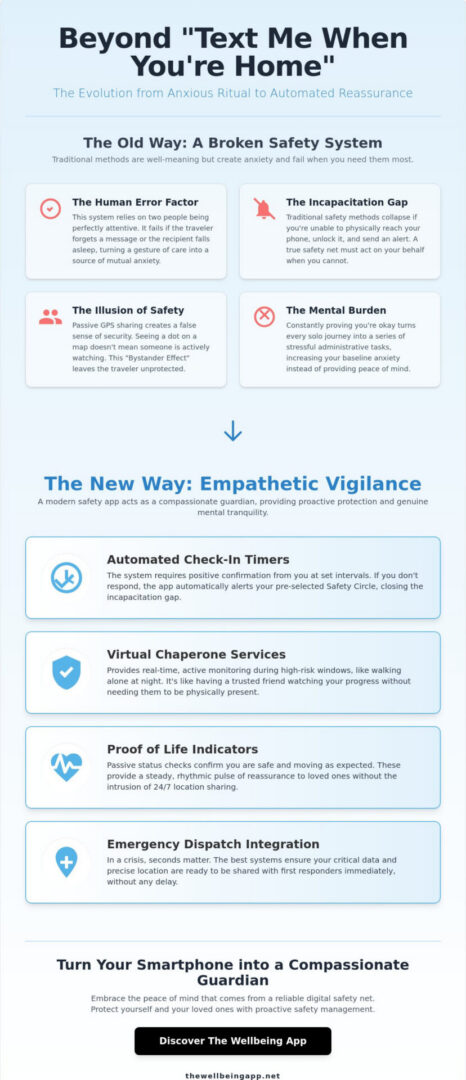
We’ve all said it before. “Text me when you’re through the door.” It’s a phrase born of genuine love, yet as a security strategy, it’s fundamentally flawed. This ritual relies entirely on two people being perfectly attentive at the exact same moment. If the traveler forgets to send that final message, the recipient’s heart sinks with worry. If the recipient falls asleep before the phone pings, the traveler is left without a safety net. We call this the “Human Error” factor, a gap in our collective responsibility that technology is finally beginning to close. It transforms a gesture of care into a source of mutual anxiety rather than actual protection.
More critically, there’s the “Incapacitation Gap.” Traditional safety relies on your ability to physically reach your phone, unlock it, and send a signal. If you’re unable to do that, the entire system collapses. A truly effective personal safety app must bridge this gap by acting on your behalf when you’re unable to act for yourself. Choosing a sophisticated app to ensure someone gets home safe means moving away from reactive panic and toward a model of proactive, empathetic vigilance. It’s about ensuring that help is already on the way before a crisis even has the chance to escalate.
The Illusion of Safety in GPS Sharing
Passive location sharing often creates a false sense of security. Seeing a dot on a map doesn’t mean your contact is actually watching your journey or ready to intervene. Digital safety circles frequently suffer from the “Bystander Effect,” where every contact assumes someone else is keeping an eye on the screen. Active safety monitoring is different. It doesn’t just show where you are; it understands the intent of your journey. It recognizes when you’ve stopped moving in a high-risk area or when you’ve failed to reach your destination on time, providing a level of specialized authority that a simple map cannot match.
The Mental Burden of Personal Security
Relying on manual check-ins places a heavy psychological weight on the traveler. Every solo journey becomes a series of administrative tasks to prove you’re okay, which can actually increase your baseline anxiety. True mental tranquility comes from knowing you have a “watchful protector” in your pocket that doesn’t require constant attention. Using an app to ensure someone gets home safe shouldn’t feel like an extra chore on your to-do list. It should feel like a silent, supportive presence that allows you to focus on your surroundings, not your screen. Automation is the key to sustainable personal safety that empowers the individual while fostering social cohesion within our communities.
4 Critical Features of an App to Ensure You Get Home Safe
Identifying the right app to ensure someone gets home safe requires looking beyond simple location icons. You need a system that acts as a compassionate guardian, standing ready to intervene when silence becomes a cause for concern. For technology to provide true mental tranquility, it must move from being a passive observer to an active participant in your journey. This shift is defined by four essential pillars of digital protection that every traveler should look for in 2026.
- Automated Check-In Timers: The system must require a positive confirmation from you at set intervals. If you don’t respond, the app takes the initiative to alert your contacts.
- Virtual Chaperone Services: This provides real-time monitoring during high-risk windows. It’s like having a trusted friend watching your progress without needing them to be physically present.
- Proof of Life Indicators: These are passive status checks that confirm you are safe and moving as expected. They provide a steady, rhythmic pulse of reassurance to those waiting for you.
- Emergency Dispatch Integration: In a crisis, seconds matter. The best systems ensure that your critical data and location are ready to be shared with the right responders immediately.
By focusing on these features, you move away from the anxiety of “what if” and toward the empowerment of “I am protected.” It’s about building a digital safety net that respects your independence while maintaining empathetic vigilance.
Active vs. Passive Monitoring Systems
Most legacy systems rely on active monitoring, where you must physically press a button to call for help. However, innovation in the space, such as Guardial, a personal-safety app, highlights the move toward more proactive deterrents. A hybrid approach is the gold standard for 2026. It combines the immediacy of an SOS alert with the reliability of passive monitoring, where the system triggers an alert if a scheduled check-in is missed. This ensures that even if you are incapacitated, your safety net remains intact.
Privacy-First Safety Design
Privacy fatigue is a real barrier to safety adoption. You don’t have to choose between your data and your security. A privacy-first app to ensure someone gets home safe utilizes session-based monitoring. This means your location is only shared during a specific journey, such as a late-night walk or a solo commute. Once you reach your destination, the tracking ceases. This temporary visibility allows for collective responsibility without the weight of 24/7 surveillance. By setting up a personalized Night Watch schedule, you can ensure you are only visible when it truly matters for your protection.
Top Safety Apps for Safe Travels in 2026: A Comparative Review
Choosing the right app to ensure someone gets home safe depends on your specific lifestyle and the level of vulnerability you face. Not all digital tools are created equal; some focus on family logistics while others specialize in emergency response. According to recent research on personal safety apps, the most effective solutions are those that integrate seamlessly into a user’s daily habits rather than requiring constant manual input. We aren’t just looking for a dot on a map. We’re looking for a digital guardian that understands the rhythm of our lives and provides a steady pulse of reassurance.
Best for Automated Reliability: The Wellbeing App
The Wellbeing App stands out in 2026 as the specialist in automated guardianship. It’s designed for those who want mental tranquility without the burden of constant manual reporting. By utilizing proprietary features like Night Watch and Proof of Life, the app establishes a compassionate safety net. If you’re a commuter or a student, you can set a Chaperone session for your journey. If you don’t confirm your arrival, the system automatically triggers Emergency Alerts. This proactive approach eliminates the “Human Error” factor where a loved one might fall asleep and miss a late-night check-in. It’s an ideal choice for seniors and solo travelers who value both their independence and their security.
Best for General Logistics: Traditional Family Trackers
Many household names in the safety space focus on general coordination and location history. These systems are often excellent for keeping track of multiple people throughout the day, providing arrival notifications for frequent spots like school or work. However, they’re primarily passive trackers. While they show where everyone is, they don’t offer the same level of active intervention during a high-stakes solo journey. For a dedicated app to ensure someone gets home safe during a specific, risky window, the constant background tracking can sometimes lead to privacy fatigue without providing the automated response that a crisis requires.
Best for Manual SOS: Noonlight
Noonlight is a powerful tool for those who want a direct line to professional help. Its signature “Hold the Button” mechanic is designed for moments of acute danger. You hold the button when you feel unsafe and release it once you’re secure; failing to enter your 4-digit pin after releasing triggers a professional dispatch. It’s a robust system for immediate threats, but it still requires the user to be physically capable of manual action. It serves as a vital emergency tool, though it lacks the automated, rhythmic monitoring found in guardianship-focused platforms.
Best for Outdoor Timers: GetHomeSafe
GetHomeSafe is a functional option for outdoor enthusiasts and lone workers who prefer manual timers. It allows users to set a specific duration for an activity and will alert contacts if the timer isn’t stopped. It’s a practical, straightforward tool for those who don’t mind the administrative task of setting and clearing timers for every journey. While it doesn’t offer the integrated “Proof of Life” indicators that define a more holistic wellbeing approach, it provides a reliable basic alert system for those off the beaten path.
Building Your Digital Safety Net: Setup and Best Practices
Setting up an app to ensure someone gets home safe is a powerful declaration of care. It’s about moving from passive hope to proactive management of your personal security. Your first step is curating your “Safety Circle.” These shouldn’t just be random contacts from your phone book. Choose individuals who are reliable and understand their role as your digital guardians. They need to know that an alert from you is a call to action, not just another notification to be ignored. Educating your circle on what to do when they receive an alert is just as important as the technology itself.
Once your circle is established, align your Proof of Life schedules with your actual habits. If you usually arrive home by 6:00 PM, set your check-in for 6:15 PM. This provides a buffer for minor delays while ensuring that the system remains vigilant. You must also consider the technical health of your device. Ensure your battery optimization settings don’t put the app to sleep, and keep your data active. A safety net is only as strong as the connection it maintains. By taking these intentional steps, you transform a simple tool into a sophisticated instrument of empowerment.
Configuring the ‘Night Watch’ for Vulnerable Loved Ones
For those living alone, the Night Watch feature offers a rhythmic pulse of protection that respects their independence. It’s not about 24/7 surveillance, which can feel intrusive and lead to privacy fatigue. Instead, it’s about scheduled, automated checks that confirm well-being during vulnerable hours. This creates a non-intrusive safety rhythm that fosters social cohesion and provides mental tranquility for the entire family. It’s the perfect balance between staying connected and staying out of the way.
Using a Virtual Chaperone for Late-Night Commutes
When you’re facing a late-night walk or a solo commute, activate your Chaperone session before you leave. This virtual chaperone monitors your journey in real-time, focusing on your specific route and expected arrival time. If your plans change mid-journey, simply update your status within the app. This ensures your contacts are always aware of your intent. It’s a powerful way to exercise personal agency, knowing you’re never truly walking alone. Ready to protect your peace of mind? Download the Wellbeing App today and start building your personalized safety net.
The Wellbeing App: A Compassionate Guardian for Every Journey
True safety isn’t found in a dot on a map; it’s found in the knowledge that someone is always looking out for you. The Wellbeing App moves beyond the limitations of standard tracking to offer what we call “Empathetic Vigilance.” This philosophy recognizes that you deserve your privacy and independence, but you also deserve a safety net that never sleeps. As an app to ensure someone gets home safe, it prioritizes your mental tranquility by focusing on automated outcomes. Instead of forcing you to constantly report your status, the system maintains a silent, supportive presence that only steps in when it’s truly needed.
Our Proof of Life indicators provide a steady, rhythmic pulse of reassurance. Unlike 24/7 trackers that can feel like an intrusion, these indicators are session-based and purposeful. They confirm your well-being at critical intervals, ensuring that your contacts are only alerted if a check-in is missed. This proactive approach fosters social cohesion, as it allows your circle to remain connected without the burden of constant surveillance. It’s a specialized form of authority that empowers you to move through the world with confidence, knowing that your safety is a shared effort.
Mental Tranquility as a Service
The “anxiety loop” is a common experience for families waiting for a loved one to return. Every minute past an expected arrival time can feel like an eternity. The Wellbeing App breaks this loop by providing a reliable, automated system that handles the “what ifs” for you. Knowing that a sophisticated guardian is watching the journey provides an emotional reward that manual texting simply cannot match. Users often report a profound sense of harmony once they establish their safety routines. One regular commuter shared that having a virtual Chaperone changed her entire evening experience, turning a stressful walk into a peaceful transition home. This is the real-world impact of technology rooted in sincere concern.
Choosing Your Plan for Proactive Protection
We offer tailored solutions to meet the unique needs of every traveler. Our individual plans are perfect for solo adventurers and students, focusing on personal agency and immediate Emergency Alerts. For households, our family subscriptions enhance collective responsibility, allowing you to manage multiple Night Watch schedules from a single interface. Every plan is backed by professional server-side monitoring, ensuring that your alerts are processed even if your phone loses connection or power. This level of technical robustness is what sets us apart as a leader in the safety tech space. Secure your peace of mind with The Wellbeing App today.
Embracing a Future of Proactive Peace of Mind
The days of relying on a fragile “text me when you’re home” system are behind us. True security in 2026 is defined by technology that acts on your behalf, bridging the gap between intent and action. By choosing a dedicated app to ensure someone gets home safe, you move from a state of passive hope to one of empowered personal agency. We’ve explored how automated check-ins and session-based monitoring provide a digital safety net that respects your privacy while maintaining empathetic vigilance. It’s time to replace the anxiety of the unknown with the certainty of a system that watches over you.
Whether it’s protecting a vulnerable loved one through specialized Night Watch protection or securing your own late-night commute, the goal is always mental tranquility. The Wellbeing App serves as a compassionate guardian, offering automated server-side monitoring that ensures help is triggered even if your phone fails. It’s about fostering social cohesion and knowing that you’re never truly walking alone. Your safety is a shared responsibility, and the right tools make that burden light for everyone involved. You deserve to move through the world with confidence and peace.
Start your journey toward mental tranquility with The Wellbeing App and experience the harmony of a life lived with proactive protection.
Common Questions About Personal Safety Technology
How does a safety app differ from standard GPS location sharing?
A safety app provides active monitoring and automated alerts, whereas standard GPS sharing is a passive display of coordinates. While a map tells your contacts where you are, an app to ensure someone gets home safe understands your intent. It recognizes when you’ve missed a deadline or stopped moving unexpectedly, triggering a response even if no one is watching the screen. This proactive approach moves beyond mere tracking to offer true empathetic vigilance.
What happens if my phone dies while I’m using a virtual chaperone app?
The system is designed to handle hardware failure through server-side monitoring. If your device goes offline during an active Chaperone session, the server recognizes the loss of signal as a potential indicator of trouble. Because the timer is managed remotely, your Emergency Alerts will still be triggered once the scheduled check-in window expires. This ensures your safety net remains intact even when your technology fails, providing uninterrupted mental tranquility.
Can these apps contact emergency services directly for me?
Many advanced systems facilitate direct communication with professional dispatchers or provide your precise data to emergency responders. When a critical alert is triggered, the platform can share your live location and personal safety profile with the appropriate authorities. This ensures help is directed accurately and swiftly, bridging the gap between a peer-to-peer notification and professional intervention. It’s a vital feature for those who may be incapacitated and unable to call for help themselves.
Is my location tracked all the time, or only when I’m walking home?
You have complete personal agency over when and how you are monitored. Most modern platforms offer session-based Location Sharing, meaning your coordinates are only visible during a specific journey or a scheduled Night Watch window. This prevents privacy fatigue by ensuring you’re only “seen” when you’ve intentionally requested a watchful protector to accompany you. You can move through your day with independence, activating your safety net only when it’s truly needed.
What is a ‘Proof of Life’ check-in and how does it work?
A Proof of Life check-in is an automated status request that requires a simple interaction from you to confirm your well-being. It’s a rhythmic pulse of reassurance that doesn’t require you to send a manual text or call. If you don’t respond to the prompt within a set timeframe, the system recognizes the silence as a potential emergency and notifies your circle. This feature is the cornerstone of a system that acts when you cannot.
Do I need to pay for a subscription for a safety app to be effective?
While basic features are often available for free, premium subscriptions typically unlock more robust automated guardianship tools. Paid plans frequently include advanced server-side monitoring and specialized features like Night Watch. You should evaluate your specific safety needs and the level of protection you require before choosing a plan. Investing in a specialized app to ensure someone gets home safe often provides the technical robustness needed for genuine peace of mind.
How do I choose the best emergency contacts for my safety app?
Select individuals who are reliable, technologically accessible, and understand their role in your collective responsibility. Your contacts should be people who will act immediately upon receiving an alert rather than assuming someone else will handle it. It’s best to choose those who are familiar with your daily routines and who you trust to manage high-stakes situations. Clear communication with your circle ensures everyone knows how to respond when the system triggers an alert.
Can I use these apps for elderly neighbors or seniors living alone?
These tools are highly effective for fostering social cohesion and protecting vulnerable seniors. By setting up a recurring Proof of Life schedule, you can ensure they’re safe without intruding on their daily lives or dignity. It’s a compassionate way to provide a safety net for those who value their independence but benefit from a guardian’s watchful eye. This proactive monitoring ensures that silence is never mistaken for safety during their most vulnerable hours.