
Location Sharing for Personal Safety: A Complete Guide to Protecting Your Peace of Mind
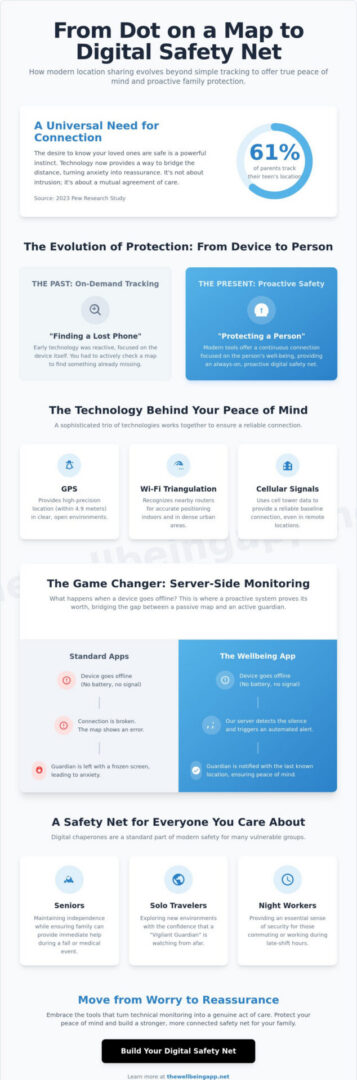
At 10:24 PM on a cold Thursday, a father watches a small icon on his screen move steadily toward home. For the 45 minutes his daughter is on the road, that simple digital connection is the only thing standing between him and a night of restless anxiety. We’ve all experienced that hollow feeling when a text goes unanswered or a loved one is late. A 2023 Pew Research study found that 61% of parents use their phones to track their teen’s whereabouts, proving that the desire for connection is a universal priority. It’s natural to want to look out for those we care about, yet nobody wants to feel intrusive. You need a way to stay connected that feels like a supportive presence rather than a constant watch.
This guide will show you how to take control of your family’s safety. When you care enough to know they are safe, you deserve tools that offer more than just a dot on a map. Discover how to protect your peace of mind by transforming basic location sharing into a sophisticated, proactive digital safety net. We’ll explore how to set up automated alerts, manage emergency protocols for low batteries, and build a sense of community unity through shared protection.
Key Takeaways
- Learn how to evolve from basic tracking to a proactive safety strategy that protects your most vulnerable loved ones.
- Understand the vital role of server-side monitoring in ensuring your digital connection remains unbroken even when a device goes offline.
- Discover how to frame location sharing as a mutual agreement of care, transforming privacy concerns into a shared foundation of trust.
- Establish essential “Night Watch” protocols and safety routines to maintain constant vigilance during high-risk scenarios.
- Explore how moving beyond mere coordinates to “Proof of Life” indicators provides the ultimate reassurance for your family’s well-being.
Understanding Location Sharing: From Simple Tracking to Proactive Safety
Location sharing has matured far beyond the early days of simple digital maps. It is now a continuous digital connection between trusted individuals who prioritize collective well-being. This technology represents a fundamental shift in how we approach personal security. We have moved from the era of “finding a lost phone” to a more compassionate era of “protecting a vulnerable person.” The focus is no longer on the device itself; it’s on the human being carrying it. This shift is led by the concept of the Vigilant Guardian. This persona represents a person who values the emotional reward of peace of mind over the cold acquisition of raw data. They don’t monitor to control; they monitor to care. Location sharing is a vital tool for community unity and proactive protection that ensures no one has to face an unpredictable world alone.
The Evolution of GPS and Real-Time Monitoring
The journey of consumer GPS began in the year 2000 when the US government stopped the intentional degradation of satellite signals for civilian use. By 2011, roughly 50% of smartphone users in the United States were regularly engaging with some form of location-based service to navigate their surroundings. However, early versions of this technology were largely on-demand. You had to actively open an app to see a pin on a map. Today, modern safety tools utilize always-on background monitoring. This creates a seamless flow of real-time data that acts as the foundation for sophisticated safety features. Real-time monitoring allows for automated alerts and specialized indicators that can recognize a deviation from a normal routine. It’s the difference between looking for someone after they’re missing and knowing they’re safe every step of the way.
Why Location Sharing Matters in 2026
As we move through 2026, the world feels increasingly complex and decentralized. The need for digital chaperones has become a standard part of a modern safety plan. High-quality location data provides a necessary safety net for various vulnerable groups:
- Seniors: Maintaining independence while ensuring family members can provide help during a medical event.
- Solo Travelers: Exploring new environments with the confidence that a “Vigilant Guardian” is watching from afar.
- Night Workers: Providing a sense of security for those commuting or working during late-shift hours.
When you care enough to know, the emotional reward is profound. You can move from a state of constant, nagging worry to a state of empathetic vigilance. This transition allows families to take control of their anxiety. Instead of wondering “what if,” they can rely on Proof of Life indicators and automated check-ins. By fostering this strong sense of unity, technology becomes a bridge to a more connected and secure society. Protect your peace of mind by embracing tools that turn technical monitoring into a genuine act of care.
How Location Sharing Works: The Technology Behind the Peace of Mind
Understanding how your device communicates is the first step toward true security. Modern location sharing relies on a sophisticated trio of technologies: Global Positioning System (GPS), Wi-Fi triangulation, and cellular signals. GPS satellites provide incredible precision, often locating a device within a 4.9-meter radius in clear conditions. When you step indoors or move through a dense city, Wi-Fi triangulation takes over by recognizing the unique signatures of nearby routers. This seamless handoff ensures that your loved ones aren’t just looking at a frozen screen. You can find more details on how these systems interact in the eSafety Commissioner’s guide to location sharing, which highlights the balance between connectivity and personal privacy.
Reliability doesn’t stop at the device level. The most effective safety tools utilize server-side monitoring. If a phone’s battery dies or the signal is cut, the server recognizes the silence immediately. Instead of waiting for a manual check, the system identifies the last known location and can trigger automated alerts to your inner circle. This proactive approach bridges the gap between a passive map and an active guardian. While some worry about battery drain, 2024 optimization protocols allow apps to use low-power motion sensors. These sensors only wake the GPS when movement is detected, preserving your phone’s life for when you need it most. This ensures you can stay protected without constantly searching for a charger.
Geofencing and Safe Zones
Geofencing creates a virtual perimeter around specific physical locations. By setting up Safe Zones for your home, office, or school, you automate the check-in process. You don’t have to remember to send a text when you arrive; the system does it for you. This passive monitoring provides a quiet sense of unity, letting family members know you’re safe without interrupting your day. It’s a simple way to take control of your family’s daily security routines through effortless automation.
Signal Reliability and Emergency Indicators
Dead zones and concrete buildings can occasionally swallow a signal. This is where Proof of Life indicators become vital. Unlike standard apps that simply show you as offline, safety-focused platforms track the trajectory and signal strength leading up to the loss of connection. If a device remains unresponsive for a set period, server-side notification dispatch kicks in. This ensures help is mobilized based on data rather than guesswork, providing a safety net that never sleeps. By relying on automated server checks, you remove the risk of human error during a critical moment.
Navigating the Privacy vs. Protection Debate
The decision to implement location sharing often brings up a tension between the desire for privacy and the need for security. Many users hesitate because they fear being “tracked” or “stalked,” viewing the technology through the lens of control rather than care. It’s vital to reframe this conversation. Location sharing is a mutual agreement of care, a digital hand-hold that ensures no one has to face a crisis alone. When you approach safety from this perspective, you aren’t losing your autonomy; you’re gaining a safety net. This is the core of the principle “When You Care Enough to Know.” It’s about being there for the people who matter most without intruding on their daily lives.
Modern safety tools rely on end-to-end encryption and permission-based protocols to keep your information private. Unlike broad social media check-ins, these tools ensure that only your designated “Vigilant Guardians” can see your status. This technical robustness protects your data from third-party exploitation, allowing you to protect your peace of mind with confidence. By setting clear parameters, you take control of how and when your information is used, ensuring that your digital footprint remains secure and purposeful.
Establishing Boundaries with Loved Ones
Success begins with a transparent “safety talk.” When discussing safety with teens or elderly parents, emphasize that these tools are meant to support their independence, not limit it. You can use “Proof of Life” indicators, which provide simple, non-intrusive signals that a loved one is safe and active. This approach respects their privacy while removing the need for constant, “just checking in” phone calls. For specific situations, “Night Watch” protection offers a middle ground. This feature limits active location sharing to specific high-risk times, such as a walk to the car after a late shift or a solo trip. It ensures help is ready exactly when it’s needed.
Data Security and Ethical Monitoring
Choosing the right platform is a critical step in maintaining your privacy. A 2023 study by the Pew Research Center found that 81% of adults feel they have very little control over the data companies collect. This is why it’s essential to look for a “no data selling” clause in any safety app’s privacy policy. There is a fundamental difference between big-tech tracking, which often monetizes your movement for ads, and specialized safety tools built for protection. A subscription-based model is typically more ethical because the developer’s loyalty lies with the user, not an advertiser. This alignment ensures that your well-being remains the primary focus, creating a secure environment for your entire community.
Maximizing Safety: Best Practices for Location Sharing
Safety isn’t a passive state; it’s a practice built on consistency and care. By integrating location sharing into your daily rhythm, you transform a simple tool into a shield of protection. Establish a baseline by scheduling regular check-ins through “Proof of Life Indicators” at set intervals, such as every four hours. This creates a predictable pattern that allows your circle to recognize immediately when something is wrong. When you maintain a consistent digital heartbeat, you remove the guesswork from your well-being.
For scenarios requiring extra vigilance, such as late-shift commutes or evening runs, you should activate “Night Watch Protection.” This heightened state of monitoring ensures your community is alert when you’re most vulnerable. Every designated contact must understand their specific role; they aren’t just observers, but active participants in your safety plan. Before you head out, ensure your group knows the protocol. For instance, if a check-in is missed, they should attempt to call you twice within a five-minute grace period before escalating the situation to local authorities.
The “Chaperone” concept is vital for high-risk activities like walking through an unfamiliar neighborhood or meeting a new person from a marketplace app. By sharing your live path, you invite your trusted circle to walk beside you metaphorically. This unity fosters a sense of security that empowers you to explore while staying connected to those who care. It’s about moving from a place of isolation to a state of collective protection.
The Virtual Chaperone: Safety for Solo Travelers
Using real-time location sharing acts as a virtual walk-home service for those traveling alone. You can set a specific timer for your journey; if you don’t reach your destination within the 20-minute window you’ve allocated, your circle receives a notification. This provides a profound psychological benefit. Knowing a vigilant guardian is watching your progress allows you to move through the world with confidence rather than anxiety. It’s the difference between feeling watched and feeling watched over.
Automated Alerts: The End of “Text Me When You Get There”
Manual texting is unreliable in a true emergency because adrenaline or physical constraints often prevent you from reaching your device. By setting up automated triggers for missed check-ins or unexpected route changes, you take control of your environment. Automated alerts provide a 24/7 safety net that operates without the risk of human error, ensuring help is summoned even if you’re unable to send a message yourself. This system replaces the fragile “text me” promise with a robust, automated security tool that never forgets.
When you care enough to know that your loved ones are safe, proactive tools make all the difference. You can protect your peace of mind by turning passive monitoring into an active shield of community care.
The Wellbeing App: Beyond Location to “Proof of Life”
While standard apps stop at showing a dot on a map, The Wellbeing App represents the logical conclusion of personal safety technology. It moves beyond basic location sharing to focus on the person, not just the device. Through proprietary Proof of Life indicators, the app monitors your actual status rather than just your GPS coordinates. This distinction is vital; a phone sitting in a park doesn’t tell your family if you’re safe. It only tells them where your phone is. By focusing on status, we provide a deeper level of protective reassurance that traditional tracking simply cannot match.
The app introduces specialized authority tools like Night Watch and Chaperone. These services act as a vigilant guardian during your most vulnerable moments. Night Watch Protection is specifically designed for the hours between 10:00 PM and 6:00 AM, providing a digital escort for those who work late shifts or travel during the night. The Chaperone service offers a similar layer of security for social outings or exercise routines. These features position the app as a compassionate partner for families, ensuring that no one ever has to feel truly alone when they are out in the world.
Automated Status Monitoring and Emergency Dispatch
The Wellbeing App server acts as an always-on partner, monitoring your status 24/7 without fail. Unlike standard location sharing tools that require a loved one to constantly refresh a map, our system uses automated logic to detect irregularities. The process is precise and disciplined:
- Continuous Monitoring: The server checks your Proof of Life indicators every 60 seconds to ensure you are active and safe.
- Automated Dispatch: If the system detects a lapse in your status, it immediately initiates an automated notification dispatch to your emergency contacts.
- Reliable Connection: This server-side monitoring ensures that even if your phone battery dies or the device is destroyed, the last known status remains secure in our system.
This “always-on” approach is more reliable than standard GPS apps because it removes the human element of error. You don’t have to worry if your spouse is looking at their phone; the app is already looking out for you. It’s a technological bridge between a potential problem and a rapid solution.
Protect Your Peace of Mind Today
Moving from passive tracking to proactive protection is the most significant step you can take for your family’s safety. It’s a shift from constant anxiety to a state of calm unity. When you care enough to know, you choose tools that act when you can’t. The Wellbeing App is more than a software provider; it’s an instrument of personal empowerment that allows you to take control of your environment.
We invite you to join a community that prioritizes care and collective responsibility. Don’t wait for a reason to be concerned. Protect your peace of mind today by choosing a guardian that never sleeps. Your family deserves the security that comes from knowing you are always connected and always protected. Take the first step toward a safer future for everyone you love.
Empower Your Community Through Proactive Protection
Choosing to embrace personal safety means moving beyond simple tracking to a system that truly cares for your well-being. A 2023 study by the Pew Research Center found that approximately 32% of Americans now rely on digital tools to stay connected with loved ones. Effective location sharing isn’t just about viewing dots on a map; it’s about the deep security that comes from knowing a compassionate guardian is always watching over your circle. You’ve explored how to balance privacy with protection and why proactive habits are the foundation of a secure lifestyle.
The Wellbeing App transforms these concepts into a reliable reality. By utilizing round-the-clock server-side monitoring and proprietary “Proof of Life” indicators, the platform ensures you’re never truly alone. If a scheduled check-in is missed, the system triggers automated alerts to your designated contacts immediately. This specialized authority allows you to take control of your environment while fostering a strong sense of unity among those you care about most. It’s a supportive way to stay connected without the constant weight of worry. Protect your peace of mind with The Wellbeing App; start your safety monitoring today. Your journey toward a more secure and confident life starts with a single, protective step.
Frequently Asked Questions
Is location sharing safe to use with my family?
Yes, location sharing is a safe and effective way to foster unity and ensure the well-being of your inner circle. A 2023 study by the Pew Research Center found that 62% of parents use location tracking to keep their children secure. When you limit access to trusted family members, you create a digital safety net that protects your peace of mind while maintaining personal privacy through encrypted data channels.
Does location sharing drain my phone battery?
Modern location sharing technology uses low-power sensors and cellular triangulation to minimize battery consumption, typically using less than 5% of your total daily charge. Our app optimizes these background processes so your device stays powered throughout the day. By adjusting the frequency of updates based on movement, we ensure you stay connected to your community without the anxiety of a dying phone when you need it most.
What is the difference between location sharing and a “Proof of Life” check-in?
Location sharing provides a continuous map of your physical coordinates, but a “Proof of Life” check-in acts as a proactive security tool that requires a manual response. While a GPS signal shows where you are, our specialized indicators confirm that you’re safe and responsive. This dual layer of monitoring ensures that if a family member doesn’t check in at a scheduled time, you can take control and respond immediately.
Can I share my location only during certain times of the day?
You can easily set specific schedules to activate sharing only during vulnerable moments, such as a 20 minute walk home at night. Features like Night Watch Protection allow you to take control of your privacy by limiting visibility to certain hours or locations. This flexibility ensures you feel supported during high-risk times while maintaining your independence and personal space during the rest of your daily routine.
What happens if my phone dies while I am sharing my location?
If your battery drops below a 10% threshold or your phone shuts down, the app automatically logs your last known location for your family to see. This final data point serves as a critical indicator for your community, providing a starting point for any necessary assistance. Because we prioritize your well-being, our system ensures that your loved ones aren’t left in the dark when a device loses power unexpectedly.
How do I talk to an elderly parent about using a safety monitoring app?
Approach the conversation with empathy by explaining that this tool is about unity and staying connected rather than surveillance. You might mention that 1 in 3 seniors falls each year according to CDC data from 2022, making quick communication vital. Frame the app as a way for them to protect your peace of mind, allowing you to be a vigilant guardian who can help them maintain their independence longer.
Is my location data encrypted and private?
We protect your data using AES-256 encryption, the same standard used by global financial institutions to secure sensitive information. This means your movements remain private and are only visible to the specific individuals you’ve invited into your trusted circle. We believe that true security requires both technical robustness and a commitment to privacy, ensuring your personal information never falls into the wrong hands or third-party databases.
What should I do if I receive an automated alert from a family member?
When an automated alert arrives, stay calm and check the app for the person’s most recent status indicators. Try calling or texting them immediately to verify their safety, as 85% of alerts are resolved through direct communication. If you cannot reach them and their location seems unusual, use the data to take control of the situation by contacting local authorities or designated community members to provide assistance.