
7 Compassionate Alternatives to Calling Parents Every Day in 2026
You are in the middle of a busy workday when you realize you haven’t checked on your father yet. A familiar knot of anxiety tightens in your chest, but you know that a quick call might lead to a guilt-trip or a rushed conversation that leaves you both feeling empty. Finding sustainable alternatives to calling parents every day is not about caring less; it’s about caring smarter. We understand the heavy mental load of being a watchful protector, especially when the silence on the other end of a phone line feels like a crisis in the making.
You deserve a sense of mental tranquility that doesn’t depend on a daily dial tone. This guide will show you how to ensure your parents’ safety and maintain a deep connection without the constant pressure of a check-in. If you can establish a baseline of safety through automated alerts like Proof of Life or Night Watch, then the time you spend together becomes a source of rejuvenation rather than a checklist of fears. We will explore seven compassionate strategies to verify their well-being passively, ensuring that when you do pick up the phone, it’s because you want to talk, not because you are afraid.
Key Takeaways
- Distinguish between functional safety checks and emotional social calls to ensure your time together is focused on genuine bonding rather than a checklist of fears.
- Utilize low-pressure digital touchpoints to maintain a “passive presence,” allowing you to stay connected through shared moments without the friction of a scheduled call.
- Implement alternatives to calling parents every day that use automated indicators to bridge the dangerous safety gaps often left by once-a-day manual check-ins.
- Discover how server-side monitoring and virtual Chaperone features can provide a sense of empathetic vigilance, protecting your loved ones during their daily routines and errands.
- Reclaim your mental tranquility by shifting the burden of safety monitoring to a reliable, always-on partner, freeing you to enjoy a more harmonious and empowered family relationship.
The Daily Check-in Dilemma: Why Manual Calls Often Fail
By 2026, the “sandwich generation” is feeling the squeeze more than ever before. Many adults are balancing the needs of their own children while simultaneously acting as the primary safety net for their aging parents. This dual responsibility creates a heavy mental load that often manifests as a rigid schedule of manual phone calls. While these calls are born from love, they often transform into a source of significant stress. You find yourself watching the clock, waiting for that window of time when you can verify they are safe, yet the call itself often feels like a transaction rather than an interaction.
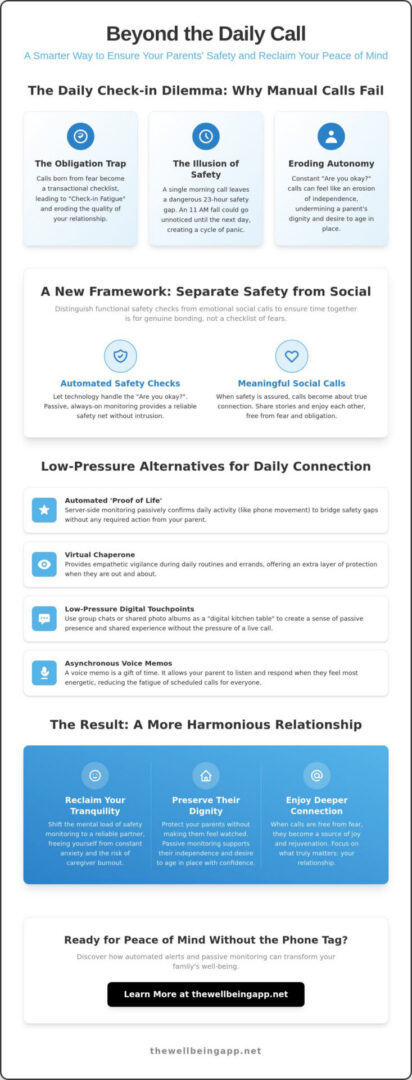
When you rely solely on manual calls, you often fall into the “Obligation vs. Connection” trap. The conversation stops being about how they are feeling and starts being a checklist of vitals. This is why exploring alternatives to calling parents every day is so vital for long-term family harmony. When a call is mandated by fear, it loses its emotional value. Both the adult child and the parent begin to experience “Check-in Fatigue,” where the phone ringing feels like a demand rather than a delight. It’s a cycle that can actually erode the quality of the relationship you’re trying to protect.
The Illusion of Safety in a Single Daily Call
Many families believe that a morning check-in secures the entire day. However, a 24-hour gap between contacts is actually a dangerous safety window. If you speak to your mother at 10:00 AM and she suffers a fall at 11:00 AM, she could remain without help until your next scheduled call the following day. This “single point of failure” creates immense anxiety for everyone involved. If they don’t answer immediately because they are in the garden or napping, your mind instantly jumps to the worst-case scenario. This cycle of panic and relief is exhausting for your nervous system. Over time, frequent false alarms can lead to a “Boy Who Cried Wolf” effect, where you might dismiss a genuine lack of response as just another missed call.
Preserving the Dignity of Aging Parents
For a parent, the constant “Are you okay?” call can feel like a subtle erosion of their autonomy. Most seniors prioritize aging in place because they value their independence and the comfort of their own environment. When every conversation begins with a safety interrogation, it reinforces the idea that they are no longer capable of self-management. Shifting your mindset from “monitoring” to “connecting” allows the relationship to flourish. By using passive safety indicators, you can protect them without making them feel watched. Caregiver Burnout is a systemic risk to family health that occurs when the emotional and physical demands of care outweigh the available support and resources. By finding smarter ways to stay informed, you preserve your own mental state and your parent’s dignity.
Low-Pressure Digital Touchpoints for Daily Connection
Shifting away from the high-stakes manual call doesn’t mean distancing yourself from your loved ones. It actually creates space for a more authentic “passive presence” in each other’s lives. By utilizing alternatives to calling parents every day, you can weave a thread of connection through the day that feels like a warm embrace rather than a mandatory check-in. This approach respects their schedule and yours, fostering a sense of mental tranquility that manual monitoring simply cannot provide. We want to move from a state of constant interrogation to a state of shared experience.
Group chats serve as a digital kitchen table for many families in 2026. Sharing a quick photo of a blooming flower or a funny observation allows your parent to feel included in your world without the pressure to sustain a long conversation. Voice memos are another powerful tool. Unlike a live call that demands immediate attention, a voice memo is a gift of time. Your parent can listen and respond when they feel most energetic, perhaps after their morning walk or evening tea. This asynchronous communication reduces the “check-in fatigue” for everyone involved. You might even consider smart home “heartbeat” signals, such as a smart bulb that changes to a warm amber color when you tap a button on your phone, silently letting them know they are in your thoughts.
The ‘Good Morning’ Emoji System
Establishing a simple emoji system is one of the most effective ways to verify safety with zero friction. A single sun or coffee cup emoji sent each morning serves as a binary indicator that all is well. For this to work, you must establish a “no-reply-needed” rule for busy workdays. This removes the guilt your parent might feel for “bothering” you while still providing the safety signal you need. Setting clear expectations for response times is crucial to avoid unnecessary panic. If you know they usually send their signal by 9:00 AM, you only need to lean into your empathetic vigilance if that window passes without a word. For those seeking a more robust way to manage these daily signals, automated safety indicators can provide that extra layer of server-side protection.
Shared Digital Spaces
Creating shared digital environments allows for non-verbal connection that persists throughout the day. Cloud-based photo frames act as a window into your life, updating in real-time with snapshots of your children or pets. This visual connection often sparks more meaningful conversations during your weekly social calls because your parent is already “up to speed” on your daily happenings. Shared calendars also provide visibility into appointments and social events, reducing the need for “what are you doing today?” questions. You can even collaborate on music or audiobook lists to foster shared interests, ensuring that your connection remains rooted in joy rather than just safety management.
Social Calls vs. Safety Checks: Developing a New Framework
To reclaim your mental tranquility, you must first distinguish between the two types of communication you have with your parents. A “Safety Check” is a purely functional verification that your loved one is active, mobile, and well. In contrast, a “Social Call” is a quality interaction designed for emotional bonding, laughter, and shared stories. When these two distinct needs are blurred, every conversation begins to feel like a medical intake form. You find yourself asking about medication or meal times before you’ve even had a chance to say “I love you,” which turns your relationship into something transactional and hollow.
By 2026, the most effective alternatives to calling parents every day involve automating the safety check so you can liberate the social call. When you know that a background system is monitoring their well-being, the pressure to “check in” evaporates. You no longer have to call out of a sense of fearful duty. Instead, you pick up the phone because you genuinely want to hear their voice. This shift moves you from being a vigilant monitor to being a supportive family member, fostering a much healthier atmosphere of trust and empowerment for everyone involved.
Scheduling Quality over Quantity
Transitioning to a “Sunday Deep Dive” can be a transformative step for your family’s emotional health. Rather than seven short, rushed calls that leave you both feeling unsatisfied, dedicate one afternoon a week to a long, meaningful conversation. To explain this shift to your parents without hurting their feelings, focus on the value of the interaction. You might say, “I want our talks to be the highlight of my week where we can really catch up, rather than a quick check-in while I’m stuck in traffic.” This allows the conversation to center on storytelling and legacy, asking about their childhood or their perspective on current events, rather than “did you take your pills?”
Identifying Real Safety Indicators
To feel truly safe, you don’t need a play-by-play of their day; you need to know their Activities of Daily Living (ADLs) are being met. This includes knowing they are moving through the house, accessing the kitchen, and maintaining their usual routine. While many people rely on a quick morning text, manual texting is an unreliable safety indicator compared to automated systems because a sent message doesn’t account for the critical hours of silence that often follow a sudden health event. True peace of mind comes from knowing that if their normal patterns of life were to stop, a system like Proof of Life would alert you immediately, providing a far more robust safety net than a simple “I’m okay” text ever could.
Implementing Automated ‘Proof of Life’ Systems
Implementing automated systems is the most reliable way to secure alternatives to calling parents every day while maintaining high safety standards. We often treat safety as something that only matters during a fall or a medical event, but true security is found in the quiet hours of a normal day. By moving from reactive “panic buttons” to proactive status indicators, you create a continuous loop of verification. This digital presence acts as a watchful protector, ensuring that silence is a sign of peace rather than a cause for alarm. It effectively removes the memory burden of manual tracking, allowing you to focus on your own daily tasks with a clear mind.
The shift toward modern safety requires a move away from hardware that feels like a burden. Traditional pendants only work if a person is conscious and able to reach them, which leaves a significant gap in protection. Establishing a consistent, automated check-in establishes a baseline of health that doesn’t require a single phone call. This gives you the mental tranquility to go about your day, knowing that if the rhythm of your parent’s life were to change, you would be the first to know. It’s about being a compassionate guardian without being an intrusive presence.
How Automated Check-ins Work
The core of a sophisticated app-based system is simplicity for the user. A daily Proof of Life notification appears on the parent’s smartphone, requiring only a five-second interaction to confirm they are well. This small action provides the server-side monitoring necessary to keep a family informed. Behind the scenes, the Night Watch protection protocol ensures that if a signal isn’t received, a calm and disciplined escalation process begins. This path leads from a gentle nudge to the parent to a priority alert for family members, ensuring that no one is left alone in a moment of vulnerability. It’s a rhythmic, uninterrupted service that mirrors the constant care you want for your family.
The Advantage of App-Based Safety
Traditional hardware devices often fail because they are forgotten, uncharged, or viewed as a loss of dignity. By using the technology your parents already carry, you integrate safety into their existing lifestyle. Research from 2026 shows that 90% of adults aged 50 and over own a smartphone, making app-based solutions the most accessible choice. These systems are highly scalable, allowing siblings or local friends to share the collective responsibility of being a guardian.
The Chaperone feature is particularly vital for parents who enjoy an active lifestyle. It allows them to set a timer for a specific activity, like a 30-minute walk in the park. If they don’t check back in when the timer expires, the system automatically alerts their circle of trust. This isn’t about tracking their every move; it’s about providing a safety net that only activates when something deviates from the plan. It empowers the parent to explore their community with confidence while giving the adult child the peace of mind they deserve. You can implement an automated check-in system to replace the anxiety of manual calls with the certainty of modern technology.
The Wellbeing App: Peace of Mind Without the Phone Tag
The Wellbeing App acts as a compassionate guardian for your family, bridging the gap between your busy life and your parent’s desire for autonomy. It offers the most reliable alternatives to calling parents every day by providing a continuous, silent safety net that only speaks up when it truly matters. Our Proof of Life feature is designed to replace the friction and anxiety of the manual check-in call with a simple, daily status indicator. This shift empowers your parents to maintain their independence, knowing they aren’t being “monitored” in a restrictive sense, but rather protected by a system that values their dignity.
True safety goes beyond knowing where someone is at a single moment. While standard location sharing provides a snapshot, our Night Watch and Chaperone features offer a more sophisticated level of empathetic vigilance. Night Watch monitors the hours when you are asleep and most vulnerable to missing an emergency, while Chaperone provides virtual protection during errands, walks, or social outings. This proactive safety management ensures that your parent is never truly alone, even when they are exploring their community or resting at home. It is about creating an environment of safety and trust that encourages everyone to feel empowered rather than anxious.
Features Designed for Modern Families
We understand that your life doesn’t stop, which is why our digital safety net works even when you’re in high-stakes meetings or fast asleep. The system is built on a foundation of harmony and collective responsibility. You can expect:
- Automated Alerts: Our indicators trigger only when something is actually wrong, preventing the “check-in fatigue” that often leads to ignored notifications.
- Privacy-First Location Sharing: We respect your parent’s privacy by keeping location data discreet until an alert is triggered, ensuring help finds them exactly where they are.
- Always-On Monitoring: Whether you are across the street or across the country, the server-side monitoring remains constant and uninterrupted.
Taking the First Step Toward Tranquility
Setting up your first family safety circle takes only minutes, but the emotional reward lasts a lifetime. By moving the burden of safety from your daily to-do list to an automated partner, you can finally transition from a state of constant vigilance to true mental tranquility. This shift allows you to reclaim your relationship, turning your interactions back into sources of joy and connection. You’ve fulfilled your duty as a protective family member; now, it’s time to enjoy the peace that comes with professional-grade protection. Secure your family’s peace of mind with The Wellbeing App today.
Reclaiming Harmony Through Empathetic Vigilance
The journey toward a more balanced relationship with your aging parents begins with a simple realization: you can be a devoted guardian without being a constant caller. By distinguishing between functional safety checks and emotional social interactions, you liberate yourself from the cycle of check-in fatigue. We’ve explored how alternatives to calling parents every day, such as automated indicators and digital touchpoints, provide a more reliable safety net than a single manual call could ever offer. This shift doesn’t just protect them; it preserves your mental state and restores the joy of your time together.
Choosing a path of proactive safety management means leaning into technology that respects their autonomy. With automated ‘Proof of Life’ indicators and 24/7 server-side monitoring, you ensure that silence is never a cause for panic. Because there is no proprietary hardware required, you can implement this protective shield using the devices they already trust and carry. It’s time to move from a place of anxious vigilance to one of deep, lasting tranquility.
Start your 7-day free trial of The Wellbeing App and reclaim your peace of mind.
You have a duty to protect your loved ones, and now you have the tools to do so with both sophistication and soul. You’re not just choosing an app; you’re choosing a more harmonious future for your entire family.
Frequently Asked Questions
Is it normal to feel guilty about not calling my parents every day?
Yes, it’s completely normal to feel this weight, but it’s important to realize that daily calls are often driven by anxiety rather than genuine connection. When you shift your focus to alternatives to calling parents every day, you’re choosing to prioritize the quality of your interactions. This change allows you to move from a state of constant vigilance to one of mental tranquility, where your love isn’t measured by the frequency of a dial tone.
How can I tell if my parents are safe without talking to them?
You can verify their well-being by monitoring their “Activities of Daily Living” through passive digital signals. Automated systems provide a status indicator that confirms they are moving and active without requiring a conversation. This approach offers a reliable way to ensure safety while respecting their autonomy. By establishing a baseline of health through technology, you can feel confident in their safety even during the quiet hours between your social visits.
What is a ‘Proof of Life’ app and how does it work?
A Proof of Life app is a proactive safety tool that requires a simple, five-second interaction from the user once a day. If the parent doesn’t respond to the scheduled notification, the system triggers an escalation path to notify family members. This server-side monitoring ensures that a lapse in activity is caught immediately, preventing the dangerous 24-hour gaps that often occur with manual check-in calls or simple texting.
Can automated check-ins replace a medical alert necklace?
These tools are designed to work together rather than act as a total replacement. While a medical alert necklace is a reactive tool for use during an emergency, automated check-ins are proactive status indicators. If a parent is unable to press a button after a fall, the check-in system serves as the ultimate safety net. Using both ensures you have a comprehensive shield that covers both immediate crises and long-term well-being.
How do I suggest a safety app to my parents without offending them?
Frame the conversation around your own need for peace of mind and their desire to stay independent. You might say, “I want to make sure you’re safe without being a nuisance, and this helps me feel calm while I’m at work.” Position the app as a tool of empowerment that allows them to live life on their terms. Most parents are happy to help reduce their children’s stress once they understand the emotional reward.
What should I do if my parent misses an automated check-in?
If a notification is missed, the system typically initiates the Night Watch or Chaperone protocol. You should first attempt a direct phone call to see if they simply forgot their device. If there is no answer, you then move to your secondary circle of trust, such as a nearby neighbor or a local friend. Having a pre-defined escalation path ensures you act with disciplined urgency rather than unmanaged panic.
Are safety monitoring apps expensive compared to traditional systems?
Software-based safety monitoring is typically more affordable than traditional hardware-heavy systems. Because there is no proprietary hardware to purchase, maintain, or replace, the primary investment is the service itself. This shift toward app-based protection allows families to access sophisticated features like Emergency Alerts and Chaperone without the high entry costs or long-term contracts often associated with older security industry models.
Does location sharing drain my parent’s phone battery?
Modern safety apps are designed with battery preservation as a central priority. While Location Sharing does use some power, 2026 technology is highly optimized to minimize the impact on a smartphone’s daily life. You can often customize these settings so that high-precision tracking only activates during specific events, such as when a Chaperone timer is set. This ensures the device remains a reliable tool for both communication and protection throughout the day.