I’ve Fallen and I Can’t Get Up: Modern Safety Solutions for 2026
What if the most effective way to handle a fall isn’t a button you press, but a system that already knows you need help? Most of us dread the thought of being trapped for hours after a tumble, wondering if anyone will notice we’re missing. It’s a valid fear that often leads to a reluctant acceptance of bulky hardware pendants that feel like a badge of lost independence. We’ve all seen the commercials where someone cries, “i’ve fallen and i can’t get up,” but in 2026, that reactive approach is becoming a relic of the past. As the global fall detection market reaches $8,379 million this year, technology is shifting toward a more compassionate, invisible guardian.
You shouldn’t have to choose between your dignity and your safety. When you care enough to know that help is always available, you can finally let go of the anxiety that shadows your daily routine. This article will show you exactly how to handle a fall when you’re alone and explain why proactive monitoring is the modern standard for aging in place. We’ll explore how new regulations like the CTA-2142 standard are making devices more reliable and how you can use Proof of Life indicators to protect your peace of mind while you take control of your freedom.
Key Takeaways
- Learn the critical “Freeze and Breathe” recovery technique to prevent secondary injuries and avoid the medical complications associated with being stranded for hours.
- Understand why nearly 20% of users don’t wear traditional pendants during a crisis and how modern smartwatch integration provides a more reliable, dignified alternative.
- Discover how the reactive fear of saying “i’ve fallen and i can’t get up” is being replaced by proactive check-ins that alert your circle before a situation escalates.
- Explore how automated “Proof of Life” indicators create a round-the-clock safety net, allowing you to maintain your independence while staying connected to your community.
- Take control of your safety by moving beyond simple panic buttons toward a vigilant guardian system that protects your peace of mind every single day.
The Reality Behind ‘I’ve Fallen and I Can’t Get Up’
Most people recognize the phrase from a 1987 television commercial that quickly turned into a cultural punchline. While the internet treats it as a vintage meme, the fear it describes is a visceral reality for millions of seniors and their families. It represents the moment independence feels most fragile. For a person living alone, that specific cry for help isn’t a joke; it’s the sound of a life changing in an instant. Validating this fear is the first step toward finding a solution that offers true security without sacrificing dignity.
The Cultural Legacy of the Panic Button
The 1980s commercials did more than sell devices; they fundamentally changed how we perceive senior independence. They introduced the world to the Medical alarm, a technology designed to bridge the gap between solitude and safety. However, these early systems also created a lasting stigma. Many people still associate traditional hardware pendants with a loss of autonomy or a public admission of frailty. This resistance often leads to the very situations we try to avoid. By April 2026, the focus has shifted away from these “old person” pendants toward integrated, discreet technology that protects your peace of mind without making you feel like a patient in your own home.
Why Immediate Response is Non-Negotiable
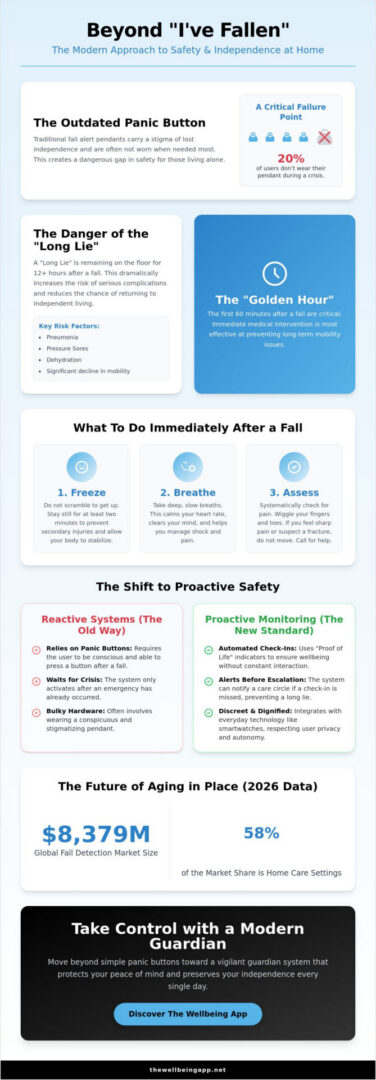
Medical professionals often speak about the “Golden Hour” in emergency care. This is the sixty minute window following a fall where medical intervention is most effective at preventing long term mobility issues. If a hip fracture or head injury occurs, reaching a wall mounted phone or even a cell phone on a nightstand can be physically impossible. The stakes are incredibly high. The “Long Lie” is a primary risk factor for post-fall complications, defined as remaining on the floor for 12 hours or more after a fall. This extended period of immobility can lead to pneumonia, pressure sores, and a significant decline in the likelihood of returning to independent living.
The data from February 2026 shows why we must take this seriously:
- Market Growth: The global fall detection market is valued at $8,379 million in 2026, reflecting an urgent need for better response systems.
- Home Care Dominance: Home care settings represent 58% of the market share, proving that more people are choosing to age in place.
- Response Gap: Despite the availability of technology, many falls still go undetected for hours because the user wasn’t wearing their device.
Transitioning from a reactive “i’ve fallen and i can’t get up” mindset to a proactive safety strategy is essential. It’s about moving beyond the panic button to a system that watches over you with empathetic vigilance. When you care enough to know that help is always a heartbeat away, you can truly take control of your future.
Immediate Steps: What to Do if You Fall While Alone
When the floor suddenly meets you, your first instinct is likely to scramble back up as quickly as possible. This surge of adrenaline is natural, but it can be dangerous. Scrambling often leads to secondary injuries or fainting from a rapid change in blood pressure. Instead of reacting with haste, adopt the “Freeze and Breathe” technique. Stay exactly where you are for at least two minutes. Take deep, slow breaths to calm your heart rate and clear your mind. This moment of stillness is your most important tool for fall prevention and recovery because it allows you to assess your body objectively.
Once you’ve found your breath, begin a systematic check for pain. Gently move your fingers, toes, and limbs. If you feel sharp pain, see significant swelling, or suspect a broken bone, do not attempt to get up. Moving a fractured limb can cause further internal damage. If you feel capable of moving, use the “Plan Your Path” strategy. Scan the room for the sturdiest piece of furniture nearby, such as a heavy armchair or a sofa. Avoid using towel racks, rolling walkers, or light coffee tables, as these will likely tip under your weight. If you are on a hard floor, try to slide toward a rug or carpeted area to protect your joints during the transition.
The Safe Self-Lift Technique
If you’ve determined it is safe to move, follow these steps to rise with control. First, roll onto your side and slowly move onto all fours. Crawl toward your chosen piece of furniture and place both hands firmly on the seat. Bring your strongest leg forward, placing your foot flat on the floor. From this kneeling position, use your arms and leg to push yourself up, then slowly turn and sit on the chair. If you find that a self-lift is physically impossible, your priority shifts to conservation. Stay warm by pulling nearby rugs or clothing over your body and use whatever is at hand to signal for help. The phrase “i’ve fallen and i can’t get up” is a call for assistance, not a reason to panic.
Essential ‘Fall-Proof’ Habits for the Home
Preparation is the foundation of peace of mind. While the “phone in pocket” rule is a good start, phones often slide out of reach during a tumble. Consider placing “emergency stations” in high-risk areas like the bathroom or kitchen, stocked with a spare charger and a loud whistle. However, the most reliable safety net is a system that doesn’t rely on you reaching for anything at all. Establishing a routine that includes a connected safety tool ensures that your community is alerted even if you cannot speak. Automated check-ins provide a layer of empathetic vigilance that bridges the gap between independence and isolation, allowing you to take control of your daily life with confidence.
Hardware vs. Software: Comparing Modern Emergency Response Systems
Choosing between a physical button and a digital application is about more than just technical specs; it’s about how you want to live your life. While traditional hardware once defined the industry, April 2026 has seen a massive shift toward software based solutions. Research indicates that approximately 20% of users don’t have their medical alert device on them during a fall. Whether the pendant is left on the nightstand or charging in another room, a device that isn’t worn is a safety net with a hole in it. This is why the classic “i’ve fallen and i can’t get up” scenario remains a threat; the help is often just out of reach because of human habit.
When you’re evaluating the Best Medical Alert Systems, you’ll notice a clear divide in cost and commitment. Traditional providers like Medical Guardian often require upfront equipment fees ranging from $149.95 to $199.95, plus monthly monitoring costs. Most of these brands, including MobileHelp and Bay Alarm Medical, charge an additional $10 per month just for fall detection. In contrast, software based systems turn the smartphone you already carry into a sophisticated security tool. By 2026, mobile phone based systems are projected to capture 35% of the market share because they offer a more flexible, integrated approach to well being.
Why Seniors are Moving Away from Pendants
The stigma of aging is a powerful deterrent. Many seniors feel that wearing a visible plastic pendant is an admission of frailty, leading them to hide the device under clothing or leave it off entirely. There’s also a significant maintenance burden. Keeping a separate device charged and testing its range regularly feels like another chore. Software provides “invisible protection.” It lives on a smartphone or a stylish smartwatch, allowing you to maintain your dignity while staying connected to a vigilant guardian. This transition to software removes the “patient” label and replaces it with a sense of personal empowerment.
The Rise of the Safety App Ecosystem
Modern safety apps leverage the advanced sensors already built into your phone, such as accelerometers and GPS. These tools allow for real time location sharing and automated alerts that go beyond a simple call center. Instead of talking to a stranger, an app can notify your entire community of family and friends instantly. This creates a circle of care that feels personal rather than clinical. Software is also easier to update. While hardware becomes obsolete, an app can receive new features like “Proof of Life” indicators through a simple download, ensuring your safety system evolves as quickly as the technology around it.
The Power of Proactive Monitoring: Moving Beyond the Panic Button
Traditional safety systems rely entirely on your ability to act during a crisis. If you’re unconscious or disoriented, the classic phrase “i’ve fallen and i can’t get up” becomes a silent reality that no one hears. Proactive monitoring flips this dynamic by focusing on activity rather than just emergency. By April 2026, automated detection systems lead the market with a 62% share, reflecting a global shift toward technology that checks on the user. Instead of waiting for a button press, these systems look for “Proof of Life” indicators throughout the day. This transition moves the primary communication from a cry for help to a reassuring confirmation that you’re safe and well.
The check-in revolution is built on the philosophy of empathetic vigilance. Automated prompts verify your safety at scheduled intervals, turning your device into a reliable partner. If a check-in is missed, a structured protocol is triggered to alert your community of family and friends. This ensures that help arrives even if you’re unable to call for it yourself. It’s a way to ensure that “i’ve fallen and i can’t get up” is a phrase you never have to say alone. When you care enough to know that your loved ones are secure, this proactive approach offers a level of protection that a simple pendant can’t match.
Proof of Life: The Guardian in the Machine
Digital check-ins act as a virtual tap on the shoulder, occurring at times that make sense for your life. You can customize the frequency of these indicators based on your daily Activities of Daily Living, such as morning coffee or evening rest. Because the monitoring occurs on a secure remote server, the system will automatically trigger an emergency alert to your contacts even if your smartphone is crushed or powered down during a fall. This specialized authority ensures that your safety net remains intact regardless of the condition of your hardware.
Night Watch and Chaperone Features
Late hours often carry the highest risk for falls and confusion. Night Watch protection monitors your well-being during these vulnerable times, providing a silent guardian while you sleep. For those who enjoy active independence, the Virtual Chaperone feature offers real-time monitoring during walks or transit. This reduces family anxiety by providing transparent, non-intrusive status updates. You can take control of your personal safety today by embracing a system that values your independence as much as your security.
Take Control with The Wellbeing App: A Modern Guardian
The Wellbeing App represents the logical evolution of senior safety, moving away from the reactive fear of the past toward a future of empathetic vigilance. In a world where home care settings represent 58% of the fall detection market as of 2026, the need for a non-intrusive, reliable solution has never been greater. We’ve designed this platform to act as a Vigilant Guardian, a technologically sophisticated partner that’s always on and always caring. You can take control of your safety in less time than it takes to make a cup of tea. Setting up your first Proof of Life indicator takes under five minutes, immediately bridging the gap between independence and security.
When you care enough to know that help is available, you shouldn’t have to carry a device that makes you feel fragile. The Wellbeing App replaces the dated “i’ve fallen and i can’t get up” panic with a steady, comforting rhythm of safety. It’s a system built for those who value their dignity as much as their well-being, providing a safety net that remains invisible until the moment it’s needed most. Our latest update on April 21, 2026, ensures that you’re using the most advanced monitoring technology available today.
Protect Your Peace of Mind with Automated Alerts
Modern safety shouldn’t come with a heavy hardware burden or activation fees. While some smartwatch systems in April 2026 require a $159 upfront device cost, our software integrates seamlessly into the smartphone you already carry. This hardware-free approach ensures that your safety tool is always with you, not left on a charger or a nightstand. Our “No-Fail” dispatch system is a core feature of our professional monitoring, ensuring your emergency contacts receive automated alerts the moment a check-in is missed. This server-side vigilance provides 24/7 protection that continues even if your physical device is damaged or loses power, giving you true peace of mind.
Joining a Community of Care
The strength of our system lies in its ability to foster unity among your loved ones. By connecting family, neighbors, and friends into a single, proactive safety net, we transform the solitary experience of aging into a collective journey of care. This community-focused model empowers you to maintain your independence while staying connected to a circle of trusted guardians. It’s a disciplined, serious approach to safety that remains accessible and friendly, much like a trusted community leader looking out for everyone’s best interests. When you choose this modern path, you aren’t just downloading an app; you’re joining a movement dedicated to social responsibility and mutual protection. Protect your peace of mind—get started with The Wellbeing App today.
Embrace a New Era of Proactive Protection
You’ve seen how the “Freeze and Breathe” technique can prevent secondary injuries and why the 2026 market is moving toward automated detection systems. The era of the clunky plastic pendant is fading, replaced by sophisticated software that offers invisible protection and empathetic vigilance. By choosing a system that monitors for activity rather than just crisis, you ensure that help is never out of reach. No one should ever have to experience the silent fear of thinking “i’ve fallen and i can’t get up” without knowing a community of care is already alerted. It’s about moving from a reactive panic to a proactive state of well-being.
The Wellbeing App provides this security through server-side monitoring that triggers alerts even if your phone is powered down or destroyed. You get access to Night Watch and Chaperone features without any bulky hardware to maintain or activation fees. It’s time to take control and protect your peace of mind with a system that truly cares enough to know you’re safe. Your independence is a gift; let’s help you keep it secure for years to come.
Start your proactive safety journey with The Wellbeing App
Frequently Asked Questions
What should I do if I fall and can’t get up?
Practice the “Freeze and Breathe” technique by staying exactly where you are for at least two minutes. This allows your heart rate to stabilize while you assess your limbs for sharp pain or fractures. If you realize that “i’ve fallen and i can’t get up”, stay warm by pulling a rug over yourself and use your phone or a whistle to signal your community for help.
Is an app better than a Life Alert pendant for seniors?
An app is often a more reliable choice because it eliminates the stigma and maintenance of a physical pendant. Research shows that 20% of seniors don’t have their medical alert hardware on them when a fall actually occurs. A software solution provides invisible protection through a device you already carry, ensuring you’re always connected to your circle of care without extra equipment.
How do automated check-ins work for someone living alone?
Automated check-ins work by sending a digital prompt to your phone at specific times you choose. You simply tap the notification to confirm you’re safe and well. These indicators are typically scheduled around your daily activities of living, ensuring your family knows you’re okay without needing to call and interrupt your day. It’s a simple way to maintain independence while staying connected.
What happens if I miss a check-in on The Wellbeing App?
If you miss a scheduled check-in, the system initiates a missed alert protocol to notify your emergency contacts immediately. This automated process ensures that your family or friends are alerted even if you’re unable to reach your phone. It provides a consistent safety net that doesn’t rely on your ability to press a button during a crisis, offering true peace of mind for everyone.
Can an app detect if I’ve fallen automatically?
Modern apps utilize the accelerometers and gyroscopes already inside your smartphone to detect sudden impact and orientation changes. By April 2026, these mobile based systems are projected to hold a 35% market share because they’re highly effective. They use advanced algorithms to reduce false alarms while ensuring help is dispatched to your location during a real emergency, even if you can’t speak.
Do I need special hardware to use a safety monitoring app?
You don’t need any specialized hardware to use a modern safety monitoring app. It turns your existing smartphone into a powerful security tool by leveraging its built-in sensors and technical robustness. This helps you avoid the equipment fees of traditional systems, which can cost up to $199.95, while providing a more discreet and integrated way to stay protected throughout your daily routine.
How can I monitor my elderly neighbor without being intrusive?
You can monitor a neighbor effectively by joining their digital circle of care to receive automated status updates. These systems use non-intrusive indicators that only alert you if a scheduled check-in is missed. This approach builds a strong sense of unity in the community, allowing you to be a vigilant guardian without infringing on their daily privacy or personal independence.
What is a ‘Proof of Life’ indicator?
A “Proof of Life” indicator is a proactive safety feature that confirms a user’s well-being through scheduled activity prompts. Instead of waiting for a crisis where you might say “i’ve fallen and i can’t get up”, this system verifies you’re safe at regular intervals. It’s a specialized authority feature that keeps the community informed and ensures that help is always just a heartbeat away.