
Best Way to Monitor Elderly Parents Remotely: 2026 Safety Guide
What if the most effective way to protect your aging mom or dad didn’t involve a single camera or a wearable device they’ll likely forget to charge? It’s a question many caregivers face as they seek the best way to monitor elderly parents remotely without triggering resistance or feeling like an intruder. You likely worry about a fall going unnoticed for hours, yet you also want to honor the independence they’ve earned. It’s a delicate balance between your need for mental tranquility and their right to privacy. We understand that protective instinct; safety should feel like a warm, supportive embrace rather than a constant interrogation.
In this 2026 safety guide, you’ll discover how to build a compassionate guardian system using automated indicators rather than invasive surveillance. We’ll explore how modern Proof of Life technology and smart home ecosystems allow you to stay connected to their daily rhythms. You’ll learn how to implement features like Night Watch and Emergency Alerts that provide a proactive safety net. This article provides a clear path toward ensuring your parents’ safety while fostering the social harmony and peace of mind your family deserves.
Key Takeaways
- Shift your focus from intrusive visual surveillance to a digital safety net that verifies well-being without compromising your parents’ dignity or privacy.
- Understand why software-driven automation is the best way to monitor elderly parents remotely, as it removes the burden of charging wearables or maintaining complex hardware.
- Discover how the “Proof of Life” framework establishes a predictable safety rhythm; this replaces the anxiety of constant calling with automated, proactive status checks.
- Learn to navigate the “Safety Conversation” using a 5-step approach that prioritizes your loved one’s personal agency and independence.
- Explore how dedicated features like Night Watch and Chaperone act as a compassionate guardian, offering you mental tranquility through consistent, quiet vigilance.
Beyond Cameras: Understanding Remote Monitoring for Seniors
Remote monitoring in 2026 has transformed from a series of intrusive lenses into a silent, digital safety net. It’s no longer about “Big Brother” style surveillance that records every private moment in a living room. Instead, modern well-being verification focuses on the presence of life and the continuity of daily rhythms. This shift is essential for families who want to support Aging in Place without turning a home into a high-security facility. Many caregivers are realizing that this non-visual approach is the best way to monitor elderly parents remotely. The goal is simple: mental tranquility for the adult child and complete autonomy for the parent. We believe that true safety shouldn’t come at the cost of one’s personal identity or comfort.
Traditional visual monitoring often creates deep-seated resentment. Seniors frequently view “nanny cams” as a vote of no confidence in their abilities, leading to privacy friction that can strain even the closest relationships. When you choose a software-based approach, you aren’t watching them; you’re watching out for them. This distinction is why many experts agree that an automated, non-visual system is the best way to monitor elderly parents remotely. It provides the reassurance you need without the “always-on” discomfort of a camera lens. It allows your family to maintain its natural bond, free from the clinical feeling of constant observation.
The Evolution of the Safety Net
Our approach to safety has moved far beyond the daily “check-in” phone call. While well-intentioned, manual calls often fail during the chaos of a busy workday or when an emergency prevents a parent from reaching the phone. The modern safety net utilizes server-side indicators that function with technical robustness. These automated systems verify status through activity rather than interrogation. If a morning routine doesn’t occur, the system notices and sends an alert. This transition to proactive monitoring ensures that a potential crisis doesn’t go unnoticed for hours, even if you’re stuck in a meeting or asleep. It’s about creating a reliable, automated safety net that works when you can’t.
Why Privacy is the #1 Factor in Success
Privacy isn’t just a preference; it’s a requirement for successful adoption. Research from senior advocacy groups suggests that older adults often resist help because they don’t want to be a “burden” or lose their sense of self. Non-intrusive monitoring preserves the parent-child relationship by removing the constant friction of surveillance. You gain the psychological benefit of knowing they’re safe through indicators like Proof of Life. It’s the feeling of a compassionate guardian standing watch in the background. Your parents keep their dignity, and you keep your peace of mind. This creates a lasting harmony that benefits the whole family, ensuring that safety is a shared effort rather than a point of contention.
Comparing Monitoring Methods: Hardware vs. Software Solutions
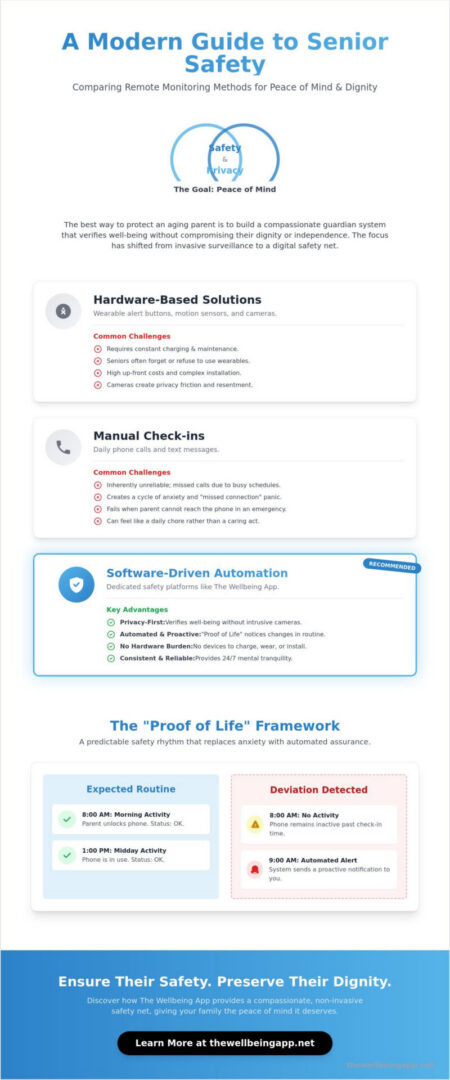
Choosing the right tool for your family’s safety shouldn’t feel like a technical chore. While many families initially look toward physical gadgets, the best way to monitor elderly parents remotely often involves less equipment rather than more. Traditional hardware solutions, such as wearable medical alert buttons or motion sensors, come with a specific set of burdens. Wearables require consistent charging and, more importantly, the senior’s willingness to wear them. Statistics show that many adults own these devices, yet a significant portion leave them on a nightstand when they are needed most. Physical sensors also present installation hurdles, often requiring hubs, wiring, or high upfront equipment fees that can reach hundreds of dollars before the service even begins.
Manual check-ins, such as daily texting or calling, are frequently used as a makeshift safety net. However, this method is inherently unreliable. Life gets busy. You might miss a scheduled call due to a meeting, or your parent might leave their phone in another room. This creates a cycle of unnecessary anxiety and “missed connection” panic. Transitioning to a software-based routine provides a more consistent, automated alternative. By utilizing a dedicated safety platform, you can establish a predictable rhythm of well-being without the friction of hardware maintenance or the stress of manual oversight. If you are looking for a more seamless experience, you might consider how automated safety tools can bridge this gap.
The Limitations of Wearables and Cameras
Cameras are often marketed as the ultimate solution, but they trap caregivers in a state of constant, active monitoring. You cannot watch a video feed 24/7, and cameras inevitably have blind spots that hide the very incidents you fear. Maintenance issues like battery depletion, WiFi signal drops, and frequent false alarms further erode the sense of security these devices are supposed to provide. This “active monitoring trap” often leads to more stress rather than the mental tranquility you seek.
The Rise of Automated Safety Apps
The best way to monitor elderly parents remotely in 2026 is through server-side automation. Software-based Proof of Life check-ins work by sending a gentle prompt to the senior’s smartphone at a set time. This creates a reliable indicator of safety without requiring them to wear a clunky plastic pendant. Because the monitoring happens on the server side, the safety net never sleeps. It doesn’t rely on you being awake or available to verify that everything is okay. These automated alerts ensure that if a check-in is missed, you are notified immediately, allowing for a proactive response that preserves both safety and independence.
The “Proof of Life” Framework: A Better Way to Verify Safety
True safety isn’t just about reacting to a crisis; it’s about confirming well-being before a problem ever starts. Many families find that the best way to monitor elderly parents remotely is through a proactive status verification system. Unlike passive sensors that wait for a movement that might never happen, a “Proof of Life” framework creates a predictable safety rhythm. It replaces the nagging “what if” with a scheduled “I’m okay.” This approach empowers the senior to take an active role in their own safety management, turning a passive tool into an instrument of personal agency. It’s a shift from being watched to being heard.
Establishing this rhythm provides an emotional reward that cameras simply cannot offer. When a parent confirms their status, a notification is sent to your device, providing an immediate sense of mental tranquility. You no longer have to wonder if they woke up on time or if they’re settling in safely for the evening. This structured flow of information builds trust. It ensures that safety is a shared effort within the family community rather than a source of friction. By using clear, automated indicators, you can maintain a watchful presence without being overbearing.
Scheduled Check-ins vs. Passive Tracking
Passive motion sensing often falls short because it relies on the absence of activity to trigger an alert. If a parent is resting or simply out of range of a physical sensor, the system might stay silent when it should be speaking up. Many caregivers believe that active verification is the best way to monitor elderly parents remotely because it removes the ambiguity of silence. You can customize the check-in frequency to match your parent’s unique activity level. Whether it’s a single morning check-in or a series of indicators throughout the day, this method ensures the safety net is always engaged. It eliminates the guesswork and technical robustness issues associated with physical hardware that can be bypassed or fail due to battery depletion.
Managing Emergency Escalations
What happens when a check-in is missed? This is where the framework truly shines as a compassionate guardian. If a response isn’t received within the designated window, the system initiates a missed check-in protocol. Automated Emergency Alerts are dispatched immediately to a pre-defined group of guardians. By notifying multiple family members, neighbors, or siblings simultaneously, you reduce response time during those critical moments when every minute counts. This collective responsibility ensures that no one person carries the full weight of vigilance. Help is always just a notification away. It transforms a solitary concern into a coordinated safety response, providing a reliable layer of protection that never sleeps.
Setting Up Your Remote Monitoring Routine: A 5-Step Guide
Implementing a new safety routine doesn’t require a professional care assessment or complex installations. Instead, it starts with a series of thoughtful, human-centered decisions. When you move beyond hardware, the best way to monitor elderly parents remotely becomes a structured habit that integrates into your family’s daily life. Follow these five steps to establish a reliable safety net that respects autonomy while providing the technical robustness you need for peace of mind.
- Step 1: Have the “Safety Conversation.” Sit down together to establish mutual goals. Frame the discussion around preserving their independence and your mental tranquility rather than highlighting their vulnerabilities.
- Step 2: Choose a Platform. Select a service that prioritizes privacy and ease of use. A software-based approach is often the best way to monitor elderly parents remotely because it ensures there are no intrusive cameras or clunky wearables to manage.
- Step 3: Define Monitoring Windows. Establish specific times for status verification. This includes setting up your Night Watch periods and daytime safety windows that align with their natural routine.
- Step 4: Designate Your Emergency Circle. Choose a group of trusted individuals, such as siblings or close neighbors, to receive automated Emergency Alerts. Collective responsibility ensures a faster response during a crisis.
- Step 5: Test the System Together. Run a few practice check-ins to build trust. When your parent sees how simple and non-intrusive the process is, their resistance typically fades.
Defining the Night Watch Protection
Nighttime is often the most vulnerable period for seniors living alone. It is the time when falls are most likely to occur and when caregivers are least available because they are asleep. Traditional cameras are often least effective in the dark and feel like a gross violation of sleep privacy. By utilizing automated Night Watch logic, you ensure that the Proof of Life system covers the full 24-hour cycle. If a parent doesn’t settle in or wake up as expected, the system notices even when you’re dreaming. This provides a constant, quiet vigilance that protects your loved ones through the loneliest hours of the day.
The Virtual Chaperone: Safety Beyond the Front Door
Safety shouldn’t stop at the threshold of the home. Many families worry about walks, grocery trips, or doctor appointments where a senior might become disoriented or have a medical emergency. The Virtual Chaperone concept extends your protective reach during these transitions. By using temporary Location Sharing, you can stay connected while they are in transit without being overbearing. This tool provides security during outings, ensuring that if they don’t return home as planned, your emergency circle is notified immediately. To start building your family’s safety routine today, you can get started with the Wellbeing App here.
Empowering Independence with The Wellbeing App
The Wellbeing App functions as a sophisticated, compassionate guardian that bridges the gap between senior autonomy and caregiver peace of mind. By moving away from the clinical feel of traditional surveillance, our platform provides a warm, supportive presence that integrates into your family’s daily life. It is the best way to monitor elderly parents remotely because it prioritizes the user’s mental state, ensuring that safety never feels like an interrogation. This software-driven approach fosters unburdened living for the parent while delivering deep mental tranquility to the adult child. We believe that true protection should empower the vulnerable rather than restrict them.
At the center of our service is the Proof of Life feature, which serves as our core differentiator. While other systems rely on passive sensors that can easily be bypassed or fail to trigger, our Proof of Life framework utilizes proactive status verification. This simple, scheduled interaction confirms well-being and provides a predictable safety rhythm for the entire family. It transforms the concept of monitoring from a passive tool into an instrument of personal agency. By focusing on these clear indicators of safety, we ensure that your parents stay connected to their community without the discomfort of a camera lens.
Our specialized features, Night Watch and Chaperone, offer total peace of mind across the full 24-hour cycle. Night Watch provides empathetic vigilance during the vulnerable hours when you are asleep, while the Chaperone service extends protection beyond the front door. Whether your parent is taking a walk or attending a doctor’s appointment, temporary Location Sharing ensures they are never truly alone. These high-stakes features are designed to handle the most critical moments with technical robustness, allowing for a proactive response before a situation turns into a crisis.
A Subscription to Peace of Mind
Our server-side monitoring replaces the need for expensive hardware or proprietary devices that often clutter a home and cause technical frustration. You don’t have to worry about battery life, complex WiFi setups, or high upfront equipment fees. The simplicity of the interface ensures that both seniors and caregivers can navigate the platform with ease. When you join our community, you are participating in a shared effort of collective responsibility. It is a commitment to well-being that values the social and emotional health of the senior as much as their physical safety.
Start Your Protective Journey Today
Setting up your new safety routine is a seamless process with no wires, no cameras, and no intrusion into your parent’s private life. Our automated alerts are the most reliable wellness check available because they don’t rely on your availability or memory to function. The system acts as an always-on partner, dedicated to the welfare of those you love most. It is time to replace the fear of “the fall” with a structured, supportive safety net. Protect your loved ones with The Wellbeing App today and reclaim the harmony your family deserves.
Restoring Harmony to Your Caregiving Journey
You’ve discovered that modern safety doesn’t require intrusive cameras or plastic buttons that seniors often refuse to wear. It’s about establishing a digital safety net that works behind the scenes to verify well-being through daily rhythms. By focusing on the “Proof of Life” framework, you shift from reactive fear to proactive protection. This approach ensures your parents remain independent while you maintain a sense of empathetic vigilance. Choosing a software-based platform is the best way to monitor elderly parents remotely because it removes the technical burdens of hardware and the emotional friction of surveillance.
The Wellbeing App offers a reliable partnership rooted in your mental tranquility. With 24/7 server-side monitoring and automated Proof of Life indicators, you can rest easy knowing a compassionate guardian is standing watch. There’s no invasive hardware required; just a simple, supportive routine that respects your parent’s autonomy. It’s time to fulfill your sense of duty with a tool that empowers everyone involved. Secure your parents peace of mind with The Wellbeing App. You deserve the quiet confidence that comes from knowing they’re safe, and they deserve the freedom to live unburdened and secure.
Frequently Asked Questions
What is the best way to monitor an elderly parent without being intrusive?
Software-based status verification is the most respectful approach because it eliminates the need for visual surveillance. By using automated prompts, you can confirm their well-being without making them feel watched. This preserves their personal identity while giving you the mental tranquility you need. It’s about watching out for them rather than watching them, creating a supportive environment that respects their boundaries and independence.
Do I need to install cameras to keep my parents safe at home?
You don’t need cameras to ensure your parents are safe at home. In 2026, many families prefer non-visual indicators like Proof of Life check-ins. Cameras often create privacy friction and resentment, which can strain your relationship. Our approach relies on technical robustness and automated alerts to provide a reliable safety net that doesn’t turn their private living space into a high-security facility.
What happens if my parent misses a scheduled check-in on the app?
If a parent doesn’t respond to a prompt, the system initiates a missed check-in protocol immediately. Automated Emergency Alerts are dispatched to your pre-defined circle of guardians, including family and neighbors. This collective responsibility ensures that help is on the way even if you’re unavailable. It transforms a moment of silence into a coordinated, proactive safety response that prioritizes their welfare above all else.
Is an app better than a medical alert button for seniors?
Many experts believe a software solution is the best way to monitor elderly parents remotely because it removes the burden of physical hardware. Seniors frequently leave medical alert buttons on nightstands or forget to charge them. An app-based system is integrated into a device they already use, making it a more consistent and reliable way to verify their safety throughout the day.
How can I monitor my parent if they refuse to wear a GPS tracker?
Smartphone features like Location Sharing offer a seamless alternative to specialized GPS trackers. This Virtual Chaperone concept provides security during grocery trips or walks without the stigma of a wearable device. It allows you to stay connected to their location temporarily when they are in transit, ensuring they are protected beyond the front door while maintaining their sense of personal agency and dignity.
Can multiple family members monitor the same elderly parent?
Yes, our platform is designed to empower an entire community of guardians. You can invite siblings, close friends, or neighbors to join your emergency contact circle. When an alert is triggered, everyone is notified simultaneously. This ensures that safety is a shared effort and reduces the response time during a crisis, providing a stronger, multi-layered safety net for your loved one.
What is a “Proof of Life” check-in and how does it work?
A Proof of Life check-in is a proactive prompt that verifies a senior’s status at scheduled times. Instead of waiting for a fall to happen, the system asks for a simple confirmation of well-being. This creates a predictable safety rhythm that replaces the anxiety of “what if” with a clear indicator of safety. It is an instrument of empowerment that lets seniors manage their own security.
Is there a way to monitor my parent at night without waking them up?
The Night Watch feature provides quiet, server-side vigilance during the hours when you are asleep. It monitors for activity indicators and follows a specific logic to detect if something is wrong without requiring cameras or waking them up with a phone call. This ensures the safety net is active during their most vulnerable period, offering you peace of mind while they rest undisturbed.