
How to Know if a Loved One is Safe Without Calling: A Guide to Empowered Vigilance
It’s 3:00 AM, and you’re staring at a silent phone, wondering if your aging father made it back from his walk or if your daughter arrived home safely. You want to check in, but you hesitate to wake them or appear overbearing. This internal tug-of-war is the “checking trap,” a cycle of hyper-vigilance that creates friction in your relationships and drains your mental energy. You’re likely searching for how to know if a loved one is safe without calling because you need a way to bridge the gap between caring and hovering. The mental load of constant “what-if” scenarios shouldn’t be your default state of being.
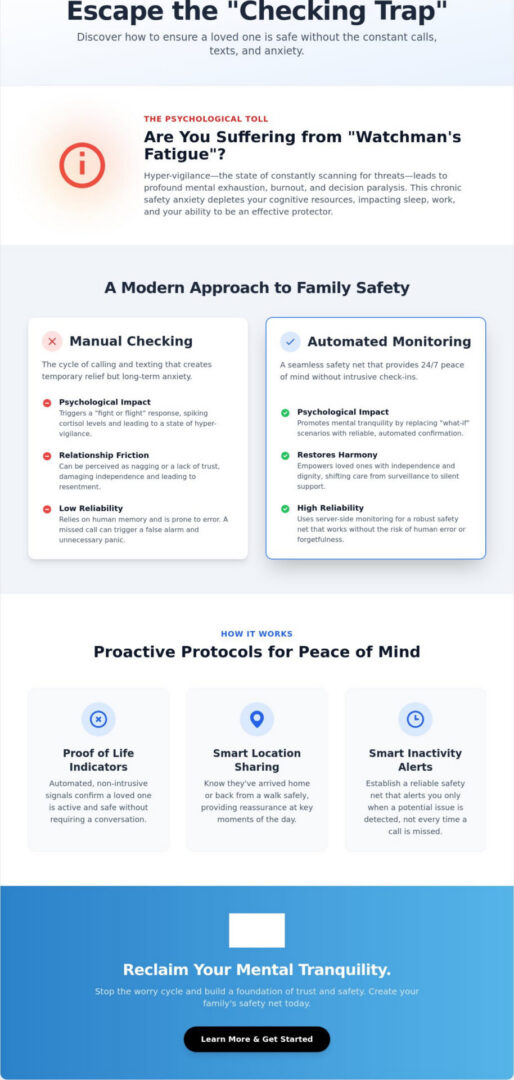
We believe that safety is a shared responsibility that should foster harmony, not anxiety. You deserve to feel like a compassionate guardian rather than a stressed monitor. This guide will show you how to replace the friction of manual checking with proactive, automated protocols that provide 24/7 peace of mind. We’ll explore how sophisticated tools like Proof of Life indicators, location sharing, and smart inactivity alerts create a reliable safety net that works without human error. By the end, you’ll have a clear path to achieving mental tranquility while empowering your loved ones to live with independence and dignity.
Key Takeaways
- Identify the psychological signs of “Watchman’s Fatigue” to prevent the mental exhaustion and burnout often associated with constant caregiving.
- Discover how to know if a loved one is safe without calling by shifting from intrusive manual checks to seamless, automated monitoring protocols.
- Compare the reliability of human memory against server-side monitoring to understand why automated indicators provide a more robust safety net.
- Establish a “Tiered Response” plan to manage your internal panic and maintain mental clarity when communication is naturally delayed.
- Learn how Proof of Life features can restore harmony to your relationships by automating the check-in process and preserving your tranquility.
The Checking Trap: Why We Worry About Those We Love
Safety anxiety isn’t a personality flaw; it’s a protective instinct that has become hyper-active in our hyper-connected world. In previous generations, “no news is good news” was a functional mantra. Today, the expectation of instant availability has rewired our brains to view silence as a signal of distress. This shift has turned healthy concern into a constant background hum of worry. You aren’t being overprotective because you want to control someone; you’re reacting to a biological drive to ensure the people you love are out of harm’s way. However, when this drive requires manual confirmation every few hours, it becomes a heavy mental burden for everyone involved.
The Biological Basis of Safety Anxiety
Your amygdala operates as a 24/7 alarm system. When a text goes unread or a call goes to voicemail, this part of the brain often processes that “silence” as a potential threat. It triggers a mild “fight or flight” response, flooding your system with cortisol. You might notice your heart rate increase or a tightening in your chest. When they finally reply, you get a rush of dopamine. It’s a temporary relief that feels like peace, but it doesn’t last. Because this relief is tied to a manual action, your brain quickly resets the clock, and the cycle begins again. This is why learning how to know if a loved one is safe without calling is essential for your long-term mental tranquility. It moves the burden of proof from a person to a system.
There is a fine line between being a caring family member and experiencing The Psychological Toll of Hyper-Vigilance. Healthy concern allows you to go about your day while keeping a loved one in mind. Hyper-vigilance, however, is a state of increased sensory sensitivity and high arousal that makes it impossible to focus on work or sleep. It transforms caregiving into a series of high-stakes checks that eventually lead to emotional exhaustion.
How Constant Checking Affects Relationships
The “Checking Trap” doesn’t just affect the person worrying; it creates significant friction in the relationship. To a senior trying to maintain their independence or a teenager finding their way, your frequent check-ins can feel like “nagging” or surveillance. It creates a dynamic where your care is perceived as a lack of trust. When a loved one feels their agency is being stripped away, they might stop answering altogether just to reclaim a sense of control. This creates a dangerous paradox. By checking in too often, you might actually make it harder to get a response during a real emergency.
Manual check-ins create a “friction-filled” environment. Every call requires the other person to stop what they’re doing, find their phone, and engage in a conversation they might not be ready for. By shifting to automated indicators, you remove this social tax. You gain the certainty your brain craves without requiring your loved one to perform for your peace of mind. It’s about moving from a culture of “asking” to a culture of “knowing.”
The Psychological Toll of Hyper-Vigilance on Caregivers
Hyper-vigilance is a state of sensory sensitivity where you are constantly scanning for potential threats. While this instinct is designed to keep those we love out of harm’s way, living in this state permanently is unsustainable. Many caregivers suffer from what we call “Watchman’s Fatigue.” This is the profound mental exhaustion that comes from always being “on call” for another person’s safety. When your brain is stuck in a loop of scanning for danger, it never enters a state of true rest. This chronic safety anxiety eventually leads to decision paralysis, where even simple daily choices feel overwhelming because your cognitive resources are entirely depleted by worry.
The impact ripples through every facet of your life. Interrupted sleep cycles, caused by late-night checking or the fear of a midnight emergency, leave you physically drained. At work, your productivity suffers as you constantly glance at your phone. You aren’t just losing time; you’re losing the mental clarity required to be an effective protector. To truly show up for others, you must first preserve your own mental tranquility. Finding a reliable way for how to know if a loved one is safe without calling isn’t just a convenience. It’s a necessary step in preventing caregiver burnout and maintaining the harmony of your household.
Cognitive Load and Caregiver Burnout
Think about the mental energy spent on “just checking” throughout a standard workday. Each time you send a text or check a location, your brain switches tasks. This cognitive switching cost adds up, leading to a significant decrease in both professional and personal performance. Research into caregiver stress often highlights that the anticipation of a problem is frequently more taxing than the problem itself. By automating this process, you can reclaim those mental cycles. Using a tool like The Wellbeing App allows you to shift from active scanning to passive assurance, ensuring your energy is preserved for meaningful connection rather than constant surveillance.
The Illusion of Control through Manual Monitoring
We often rely on protocols like “Text me when you get there,” but these are fundamentally flawed. Manual monitoring relies entirely on human memory and active participation.
- Human Error: Your loved one might simply forget to text, triggering a panic response in you that is entirely unnecessary.
- Manual Gaps: What happens when you are in a meeting or driving and can’t check in at the critical moment?
- Dependency: Manual checks create a cycle where the loved one feels they cannot move safely without your direct involvement.
Moving from a mindset of “I must know” to “I am notified immediately if something is wrong” changes everything. It replaces the illusion of control with the reality of automated safety. This transition allows you to step back from the role of an anxious watchman and step into the role of a supportive partner, confident that a 24/7 safety net is always active in the background.
Manual vs. Automated Safety: A Comparison for 2026
In the landscape of 2026, relying on a “Text me when you’re home” protocol is like using a paper map in the age of GPS. It’s outdated and prone to failure. Human memory is naturally fallible. Your loved one might get distracted by a neighbor, leave their phone in the car, or simply fall asleep before sending that vital confirmation. When this happens, your anxiety doesn’t just simmer; it boils. Understanding how to know if a loved one is safe without calling requires a fundamental shift from active questioning to passive data monitoring. Automated server-side checks don’t “forget” to check in. They provide a constant stream of certainty that human memory cannot match.
We can measure this difference through a “Friction Score.” A manual check-in has a high friction score because it requires two people to stop their lives, find their devices, and engage in a social transaction. In contrast, automated Proof of Life indicators have a friction score of zero. They work in the background, preserving the user’s mental state by providing a steady “green light” of safety. This constant data flow prevents the “Anxiety Spike” that occurs during the silent gaps of manual monitoring. Automation isn’t about a lack of trust. It’s a tool for empowerment that allows your loved one to maintain their independence without the weight of your worry.
Why Manual Check-ins Fail in Real Emergencies
The most dangerous limitation of manual checking is the “Phone-Out-of-Reach” problem. If a loved one suffers a fall or a medical event, their phone might be on a charger in the other room. Simple location sharing will tell you they are at home, but it won’t tell you if they are conscious or in distress. Manual methods fail exactly when they are needed most. Automated server-side monitoring acts as a digital Night Watch. It looks for activity indicators and triggers Emergency Alerts if a scheduled check-in is missed. This system doesn’t rely on the person being able to reach their phone during a crisis; it assumes silence is a signal that requires attention.
The Mental Tranquility of “No News is Good News”
For decades, we’ve tried to convince ourselves that no news is good news, but our brains rarely believe it. By shifting the burden of proof from your loved one to a reliable technology platform, you can finally “detach with love.” This doesn’t mean you stop caring. It means you stop hovering. When you know a 24/7 safety net is active, you can focus on your own daily life with a sense of harmony. For solo dwellers, Proof of Life indicators are the modern safety standard. They provide the reassurance of a community-integrated safety net while respecting the personal agency of the individual. You aren’t just monitoring a person; you are protecting a relationship from the erosion of constant, anxious checking.
Practical Strategies for Managing Safety-Related Stress
Managing the mental load of caregiving requires more than just good intentions. It requires a structured system that prevents your protective instincts from spiraling into panic. One of the most effective ways to lower your heart rate is to implement a Tiered Response plan. The Tiered Response protocol is a pre-agreed set of actions that escalate only when specific safety triggers are met. Instead of jumping straight to a frantic phone call when a text goes unanswered, you first check your automated dashboard. If the status is green, you stay at Level 1, maintaining your mental tranquility without interrupting their day.
Another powerful cognitive tool is the “worry window.” Schedule ten minutes twice a day to specifically process your safety concerns. Outside of these windows, if your automated system hasn’t sent an alert, you give yourself permission to focus entirely on your own work or rest. This practice helps you “detach with love,” ensuring that your identity isn’t consumed by the role of a watchman. By learning how to know if a loved one is safe without calling, you can reduce the frequency of manual check-ins by 50% within the first week, creating immediate breathing room for both parties.
Setting Healthier Safety Boundaries
The “Safety Talk” is often the hardest part of this transition. When discussing new protocols with a senior or a teenager, avoid framing it as a lack of trust. Instead, focus on your own needs for peace of mind. You might say, “I want to worry less so that when we do talk, we can focus on our lives rather than just safety checks.” Agree on “Safety Windows,” which are specific times when monitoring is active, such as during a solo commute or late at night. This respects their personal agency while providing you with a reliable safety net during high-risk periods.
Tools for Proactive Protection
Effective protection is about data, not intrusion. Location sharing is a helpful baseline, but it can quickly feel like stalking if you are constantly staring at a moving dot on a map. A more sophisticated approach involves utilizing a “Virtual Chaperone” protocol for activities like night walks or solo travel. This system monitors the journey and only alerts you if progress stops or a destination isn’t reached.
For those evening hours when you are apart, “Night Watch” features act as a silent guardian. These tools monitor for activity indicators in the home, ensuring that solo dwellers are safe and sound without a single intrusive ringtone. This proactive management allows you to sleep through the night, confident that you will be notified immediately if something is wrong. To begin replacing your anxiety with automated certainty, explore how our proactive safety protocols can restore your mental tranquility.
Reclaiming Your Mental Tranquility with The Wellbeing App
The Wellbeing App acts as a digital compass for families who value both safety and independence. We understand that your sense of duty toward your loved ones is driven by deep affection, yet it shouldn’t cost you your mental health. By utilizing our specialized features, you move past the constant friction of manual checking. This is the definitive answer for how to know if a loved one is safe without calling. You transition from a state of anxious hyper-vigilance to being an empowered, watchful protector who operates from a place of calm certainty. It’s about replacing the “Checking Trap” with a system that honors your need for peace and their need for autonomy.
The “Proof of Life” feature is the anchor of our platform. It automates the check-in process, effectively ending the cycle of dependency and stress that characterizes manual monitoring. Complementing this are our “Chaperone” and “Night Watch” services. These provide a layer of empathetic vigilance that stays active even when you are asleep or focused on your professional life. They act as a silent partner, ensuring that your family’s safety net is never compromised by human forgetfulness or busy schedules. You can finally step back and breathe, knowing our technology is standing guard.
Automated Peace of Mind: How It Works
Our system relies on robust server-side monitoring to ensure no one is ever truly alone. Unlike simple apps that wait for a user to open them, our platform proactively looks for indicators of well-being based on your agreed schedule. If a check-in is missed, the system doesn’t just wait; it initiates a structured alert process. You can customize these alerts to fit your family’s unique rhythm. Whether it’s a daily wellness check for a parent or night-time safety protocols for a solo dweller, the technology adapts to your life. This reliability is why thousands of families trust our automated safety net to preserve their collective mental well-being every single day.
Your Duty of Care, Simplified
Safety is a shared effort that should strengthen family bonds, not strain them. By choosing non-intrusive, proactive technology, you foster social cohesion and trust within your home. You’re providing a reliable safety net that respects personal agency while fulfilling your protective role. A small monthly subscription is a modest investment when compared to a lifetime of mental tranquility and the assurance of reactive protection. You don’t have to carry the burden of worry by yourself. Start your journey toward proactive protection today with The Wellbeing App and reclaim the harmony your family deserves.
Embrace the Certainty of Automated Protection
You don’t have to choose between constant anxiety and being an intrusive presence in the lives of those you love. By shifting from manual check-ins to a system of automated indicators, you break the cycle of hyper-vigilance that leads to caregiver burnout. We’ve explored how a Tiered Response plan and server-side monitoring provide a robust safety net that human memory simply can’t sustain. Discovering how to know if a loved one is safe without calling is the first step toward restoring harmony in your household and reclaiming your own mental clarity.
The Wellbeing App provides the empathetic vigilance you need through 24/7 server-side monitoring and automated Proof of Life indicators. This reliable, always-on partner is already trusted by thousands of families nationwide to preserve their collective tranquility. You have a duty of care, but you also have a right to peace of mind. Protect your loved ones and your peace of mind; download The Wellbeing App now.
Step forward today as an empowered protector. Your journey toward a more secure, connected, and peaceful family life begins with a single proactive choice.
Frequently Asked Questions
How can I stop worrying about my elderly parent living alone without calling every hour?
The most effective way to reduce this anxiety is to transition from manual checking to automated server-side monitoring. By using Proof of Life indicators, you can confirm their well-being through a silent data dashboard rather than an intrusive phone call. This shift allows you to maintain your mental tranquility while respecting their daily rhythm and privacy.
Is it normal to feel constant anxiety about a loved one’s safety when they don’t answer the phone?
Yes, this is a natural biological response where your brain processes silence as a potential threat. While common, this state of hyper-vigilance is emotionally draining and often leads to caregiver burnout. Implementing a structured safety protocol helps reframe silence as a sign of security rather than a cause for alarm.
What is a Proof of Life check-in app and how does it help caregivers?
A Proof of Life app is an automated system that requires the user to acknowledge a periodic prompt or monitors specific activity indicators. If a scheduled check-in is missed, the system immediately triggers Emergency Alerts to designated contacts. It provides a 24/7 safety net that functions reliably without requiring the caregiver to remember to check in manually.
How do I talk to my loved one about using a safety monitoring app without offending them?
Focus the conversation on your own need for peace of mind rather than their perceived frailty. Explain that learning how to know if a loved one is safe without calling will actually reduce the frequency of “nagging” texts and calls. Frame the technology as a tool that preserves their personal agency by removing the need for constant, direct supervision.
Can automated alerts really replace manual wellness checks for seniors?
Automated alerts provide a more consistent and technically robust layer of security than sporadic manual checks. While they don’t replace the emotional warmth of a social visit, they ensure that a missed status update is caught instantly. Servers don’t get distracted or forget to check in, providing a level of reliability that human memory cannot sustain.
What should I do if my anxiety about a loved one’s safety is affecting my job performance?
You should delegate the monitoring task to a reliable digital partner to reclaim your cognitive focus. Utilizing a Night Watch or automated alert system removes the mental load of “just checking” your phone throughout the day. When you know you’ll be proactively notified of any issues, you can dedicate your full attention to your professional responsibilities.
How does a virtual chaperone service work for someone walking home alone at night?
A Chaperone feature monitors a person’s journey in real-time through their smartphone’s sensors. It tracks their progress along a designated route and alerts emergency contacts if the user stops moving or deviates significantly from their path. This provides a protective, empathetic presence that secures the individual without the friction of a live phone call.
Will using a safety app make my loved one feel like they have lost their independence?
Actually, these tools often enhance independence by replacing active hovering with passive assurance. Automated monitoring allows seniors and teenagers to move through the world without being interrupted by frequent “where are you” messages. It fosters a sense of freedom because the safety net only becomes visible if a genuine emergency occurs.