
Activities of Daily Living (ADLs): The 2026 Guide to Maintaining Independence
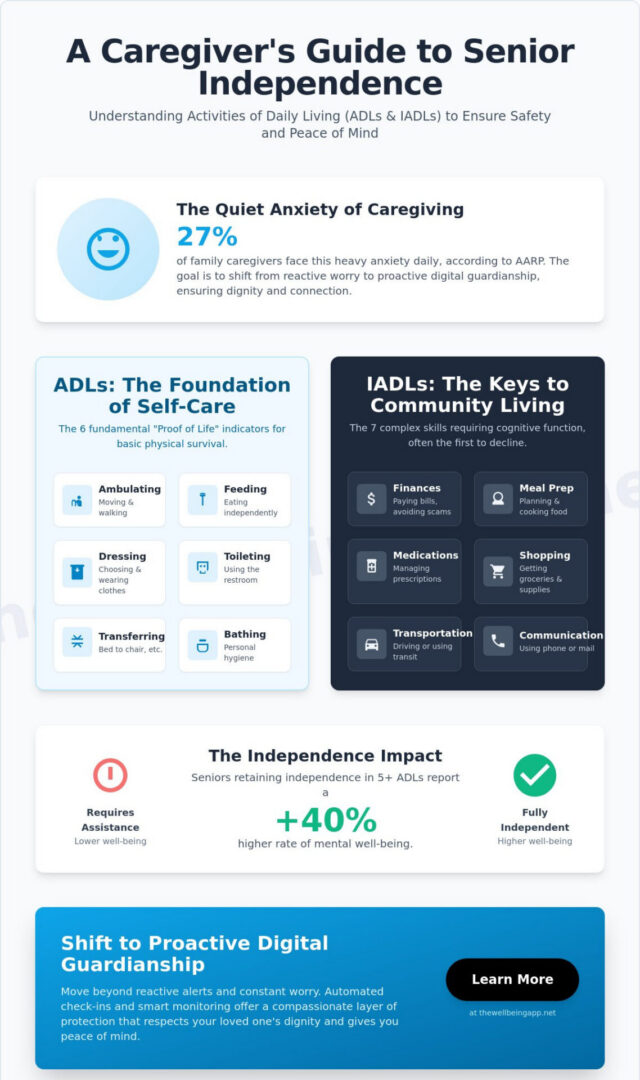
Last Tuesday at 2:15 PM, Sarah stared at her silent phone, wondering if her father had managed to navigate the kitchen stairs or if he was sitting alone after a missed meal. It is a quiet, heavy anxiety that 27 percent of family caregivers face every single day according to recent AARP data. You want to honor their desire for independence, yet the clinical complexity of monitoring adls often feels like learning a foreign language while under immense pressure. When you care enough to know they are safe, the gap between medical jargon and your daily reality can feel overwhelming and lonely.
We agree that your peace of mind shouldn’t come at the cost of your loved one’s dignity or your own mental health. This guide empowers you to master both the clinical and practical aspects of daily life to ensure your family remains safe and connected. You will gain a clear checklist for assessing safety and discover the latest tools to extend independent living through 2026. We will show you how to take control of the situation using reliable indicators so you can replace constant worry with a renewed sense of unity and protection.
Key Takeaways
- Learn why adls are the fundamental “Proof of Life” indicators used by clinicians to assess a senior’s safety and foundational independence.
- Understand the distinction between basic survival tasks and the complex community skills required to accurately evaluate long-term cognitive health.
- Recognize the subtle “slow slide” of behavioral changes that signal a struggle with daily self-care before it escalates into a health crisis.
- Discover how to shift from reactive alerts to proactive digital guardianship to reduce family friction and protect your peace of mind.
- Master the use of automated check-ins as a compassionate tool to ensure your loved ones remain safely connected without sacrificing their dignity.
Understanding ADLs: The Foundation of Senior Independence
Independence is not a vague concept; it’s a daily practice rooted in the ability to manage oneself. When we discuss Activities of Daily Living (ADLs), we’re identifying the essential self-care tasks that define a person’s functional status. Clinicians rely on these metrics as the primary “Proof of Life” safety indicators. These scores tell a story of whether a senior can thrive at home or if they require a higher level of empathetic vigilance from a caregiver.
In 2026, the monitoring of these tasks has evolved from intrusive manual check-ins to a more sophisticated digital vigilance. We don’t have to wonder if a loved one is managing; automated alerts and smart sensors provide a silent, supportive layer of protection. This technological shift allows families to stay connected without stripping away a senior’s dignity. Maintaining adls directly correlates to longevity. A 2024 study by the Journal of Aging Research found that seniors who retain independence in five or more ADLs report a 40% higher rate of mental well-being compared to those who require daily assistance. Proactive monitoring helps you take control before a minor decline becomes a major crisis.
ADLs are the fundamental building blocks of personal autonomy.
The 6 Basic Activities of Daily Living
- Ambulating: This is the physical capacity to move from one position to another. It includes the ability to walk independently or transition from a bed to a chair without falling.
- Feeding: This focuses on the capacity to get nourishment from a plate into the mouth. It doesn’t include meal preparation, but rather the physical act of eating.
- Dressing and Grooming: This involves selecting appropriate clothing for the weather and maintaining personal appearance. It requires the fine motor skills to manage buttons, zippers, and hairbrushes.
- Toileting and Continence: This includes the physical ability to use the restroom and the mental control over bowel and bladder functions.
- Transferring: The ability to move the body from a seated to a standing position, or getting in and out of bed safely.
- Bathing: The capacity to clean oneself and maintain personal hygiene within a shower or tub environment.
Why Clinical Definitions Matter for Caregivers
When you care enough to know the technical language of caregiving, you empower yourself to advocate for your family. Using clinical adls terminology allows you to communicate effectively with doctors and insurance providers. It removes the guesswork from the conversation. These scores are the specific metrics that insurance companies use to determine eligibility for home care services or long-term care benefits. By tracking these indicators through a security tool or a dedicated app, you provide a clear, data-driven picture of a loved one’s needs. This clarity protects your peace of mind and ensures that the care plan is based on reality rather than assumptions. It fosters a sense of unity between the family and the medical team, keeping everyone on the same page for the sake of the senior’s safety.
ADLs vs. IADLs: Mapping the Complexity of Daily Life
Understanding the difference between basic survival and true independence is vital for any family caregiver. While adls represent the foundational physical tasks like eating or dressing, Instrumental Activities of Daily Living (IADLs) focus on the cognitive and organizational skills required to live safely within a community. Experts emphasize that Identifying Early Warning Signs in these complex tasks often provides the first window into a loved one’s changing needs. Because IADLs require higher level executive function, they typically decline years before a person loses the ability to perform basic physical adls. Monitoring both categories creates a holistic safety net that honors a senior’s desire for autonomy while providing the protective reassurance their family needs.
The 7 Essential IADLs for Independent Living
IADLs are the “scaffolding” of a self-sufficient life. If these tasks begin to slip, the risk of isolation or injury increases significantly. Key areas include:
- Managing finances: This involves paying bills on time and spotting potential scams. A 2023 study found that roughly 5.6 percent of older adults experience financial exploitation annually, making this a critical indicator of cognitive health.
- Communication: Using a phone or computer isn’t just about tech skills; it’s about staying connected to the community and being able to call for help.
- Meal preparation: This measures the ability to plan a menu, use appliances safely, and follow the multi-step process of cooking without leaving the stove unattended.
- Shopping and Transportation: Navigating the world outside the front door requires spatial awareness and the ability to manage a budget in real-time.
Other essential IADLs include medication management, house cleaning, and laundry. When a person struggles with these, it’s rarely a matter of “laziness.” Instead, it’s often an early signal of cognitive shifts that require a compassionate, watchful eye.
The “Vigilant Guardian” Approach to Monitoring
Focusing only on basic tasks like bathing or walking creates a false sense of security. A person might look perfectly fine during a brief Sunday visit, yet their refrigerator is empty or their mail is piling up. These subtle shifts in IADLs act as early indicators of health changes that, if caught early, can be managed without a crisis. We believe in a philosophy of empathetic vigilance. This means balancing the need to know with the desire for a loved one’s privacy. You don’t need to hover to be helpful. Instead, look for patterns of change over time. When you care enough to know, choosing a supportive tool to protect your peace of mind ensures that no one faces these transitions alone. Taking control of the situation early allows for a transition that is dignified rather than desperate.
Identifying Early Warning Signs: When ADLs Begin to Falter
Independence doesn’t usually vanish in an instant. Instead, it often follows a “slow slide,” a gradual erosion of the ability to manage daily life without assistance. While a sudden health crisis like a stroke or a broken hip provides a clear signal for intervention, the subtle decline in adls is much harder to detect. According to a 2023 report from the National Institute on Aging, functional limitations often manifest months before a major medical event occurs. Recognizing these early shifts allows families to take control and provide support before a crisis forces their hand.
The psychological impact on seniors during this transition is profound. Many individuals experience a quiet sense of panic as tasks that were once automatic, like buttoning a shirt or standing up from a low sofa, become strenuous. This often leads to “masking,” where a senior exerts an exhausting amount of energy to appear perfectly capable during a short visit from family. They fear that admitting a struggle will lead to a loss of autonomy or a forced move into a facility. When you care enough to know the truth, you must look past the “I’m fine” responses to see the reality of their daily environment.
Initiating the “safety talk” requires a tone of protective reassurance rather than one of authority. Avoid framing the conversation around what they can no longer do. Instead, focus on how specific tools or minor lifestyle adjustments can help them maintain their residence for a longer period. Frame the discussion as a partnership designed to protect your peace of mind and ensure their continued comfort. This approach reduces defensiveness and fosters a sense of unity within the family.
Physical and Environmental Red Flags
Physical indicators are often the most visible signs that adls are becoming difficult to manage. Unexplained bruising on the arms or hips often suggests “furniture walking,” a behavior where a senior relies on walls and tables for stability because they’re losing confidence in their balance. You might also notice a decline in household standards. A refrigerator that remains empty or contains only expired items from three weeks ago suggests that grocery shopping and meal preparation have become overwhelming. Poor personal hygiene, such as unwashed hair or wearing the same clothes for four consecutive days, is a clear signal that the complex motor skills required for bathing and laundry are failing.
Cognitive and Social Indicators
Social withdrawal is frequently a defense mechanism used to hide cognitive struggles. If a loved one suddenly stops attending a long standing weekly bridge club or begins avoiding phone calls, they may be struggling with the cognitive load of social interaction. Forgetfulness regarding medication is another critical indicator; data from 2024 suggests that nearly 50% of seniors with chronic conditions fail to follow their prescribed regimens correctly. Missed check-ins are often the first measurable sign of ADL decline. These gaps in communication act as vital indicators that the daily routine is fracturing, requiring a vigilant guardian to step in and offer support.
Proactive Safety: Bridging the Gap with Technology
Technology has evolved far beyond the plastic pendants of the past. While traditional emergency buttons once served a vital purpose, they were inherently reactive; they required a crisis to occur before providing any help. In 2026, the focus has shifted toward proactive monitoring that supports your adls without waiting for a fall to happen. This transition moves us away from the anxiety of older “Life Alert” models and into the era of continuous, server-side monitoring that acts as a silent partner in care.
Manual check-ins often create a cycle of “nagging” that strains family relationships. When a daughter calls her father three times a morning just to see if he’s awake, it can feel like a loss of autonomy rather than an act of love. Automated systems eliminate this friction. By relying on 24/7 server-side logic rather than manual texting, the burden of proof is removed from the senior. If a phone battery dies or a person forgets to send a “good morning” message, the server notices the absence of activity immediately. This level of empathetic vigilance ensures that help is dispatched even when the user cannot ask for it. It’s about maintaining dignity while ensuring no one is ever truly alone during their daily adls.
Automated Alerts and Proof of Life Indicators
Modern safety tools track the pulse of daily life through non-intrusive digital breadcrumbs. Unlike invasive cameras that compromise privacy, Proof of Life indicators monitor basic device interactions to confirm well-being. This is vital for Night Watch protection, specifically designed for those living alone who may face risks during the late hours. By customizing alert thresholds to match a unique routine, families ensure that a notification only triggers when something is truly out of the ordinary. A 2023 report from the Journal of Aging and Health found that 60% of seniors felt more confident living independently when they knew a silent guardian was watching over their routine without interfering in it.
Virtual Chaperones for the Modern Senior
Maintaining independence means staying active outside the home. GPS-enabled chaperone services extend the safe zone to the grocery store, the park, or a friend’s house. These virtual chaperones provide real-time location sharing that empowers seniors to take control of their mobility. Instead of staying home out of fear, users can explore their community with the knowledge that their location is visible to their circle of care. It’s about unity and connection, ensuring that when you care enough to know, the information is available at a glance through a simple app interface. This technology turns a smartphone into a security tool that fosters freedom rather than restriction.
Protect your peace of mind and ensure your loved ones are never truly alone. Take control of your family’s safety with the Wellbeing App.
The Wellbeing App: Your Partner in ADL Protection
Maintaining independence while managing adls requires more than just physical effort; it demands a safety net that works silently in the background. The Wellbeing App acts as a compassionate, digital guardian for those living alone. It bridges the gap between total autonomy and necessary oversight. By integrating sophisticated monitoring with a human touch, the platform ensures that help is always a heartbeat away without infringing on a person’s dignity. It’s a tool built for the 2026 landscape, where technology and empathy must coexist to protect our most vulnerable community members.
Protect your peace of mind with the Wellbeing App. This platform doesn’t just track data; it fosters a sense of unity by connecting family, friends, and neighbors into a cohesive safety network. When a loved one lives independently, the distance can create a constant undercurrent of worry. This app replaces that anxiety with reliable, round-the-clock automated monitoring. It creates a digital bridge that keeps everyone connected, ensuring that no one is truly alone even when they’re physically by themselves.
Features Designed for Empathetic Vigilance
The core of the system is the Proof of Life indicator. This is a specialized safety tool that confirms a loved one is active and well throughout the day. It’s not about intrusive surveillance; it’s about establishing a consistent rhythm of safety. If the system detects a lapse in activity, it triggers Automated Safety Alerts. These notifications are dispatched instantly to the chosen circle of care, providing the specific information needed to take action when it matters most. For the most vulnerable hours, the Night Watch feature provides specialized protection. Between 11:00 PM and 6:00 AM, the app increases its sensitivity to ensure that nighttime emergencies don’t go unnoticed.
Getting Started with Proactive Care
Setting up a family safety net is a simple process that takes less than 10 minutes. Users can invite neighbors and relatives to join a “unit,” creating a multi-layered response team. The benefit of this subscription-based safety model is the continuous server-side vigilance it provides. Because the monitoring happens on secure, remote servers, the protection stays active even if a local Wi-Fi network goes down or a phone battery dies. This ensures that the support system is robust enough to handle real-world technical failures.
Taking control of the future starts with a choice to be proactive. When you care enough to know, you provide your family with more than just a security app; you give them the freedom to age in place with confidence. By addressing the challenges of adls through technology, we can ensure that independence never feels like isolation. It’s time to embrace a higher standard of care that values both safety and self-reliance.
Empower Your Independence for the Years Ahead
Maintaining a self-sufficient lifestyle in 2026 requires a proactive strategy that prioritizes early detection and smart support. Research from AARP reveals that 77% of adults aged 50 and older want to remain in their homes as they age, yet success often hinges on how effectively we manage adls. Recognizing when daily routines begin to shift allows you to implement solutions before a crisis occurs. Modern independence isn’t about doing everything alone; it’s about using the right tools to stay safe while keeping your dignity intact.
The Wellbeing App acts as a vigilant guardian, offering compassionate, non-intrusive safety technology that respects your privacy. You’ll benefit from 24/7 Automated Proof of Life Monitoring and Specialized Night Watch Protection, ensuring you’re never truly on your own. This system provides the reassurance your family needs without the discomfort of invasive cameras. It’s time to take control of your future and ensure your home remains your sanctuary for years to come. You deserve the confidence that comes with being protected day and night.
Protect Your Peace of Mind with The Wellbeing App
Frequently Asked Questions
What is the difference between ADLs and IADLs?
ADLs focus on fundamental self-care while IADLs involve complex skills needed for independent community living. According to the Katz Index of 1963, ADLs include basic survival tasks like feeding oneself and bathing. IADLs, defined by Lawton and Brody in 1969, cover activities like using a telephone or managing a monthly budget. Understanding these levels helps you provide the right layer of care for your loved one’s well-being.
How do I know if my parent can no longer perform ADLs safely?
You’ll notice physical indicators like unkempt hair, stained clothing, or significant weight loss. A 2023 study in the Journal of Aging and Health shows that losing 5 percent of body weight in six months is a critical warning sign. If they can’t manage these basic adls, it’s time to step in as a compassionate guardian. Monitoring these shifts allows you to take control before a minor struggle becomes a crisis.
Can an app really help monitor Activities of Daily Living?
Specialized software provides a non-intrusive way to track daily routines and ensure your family remains connected. The Wellbeing App uses Proof of Life Indicators to confirm a loved one is active and safe without needing constant phone calls. By establishing a digital safety net, you gain peace of mind knowing that automated alerts will trigger if a routine is disrupted. It’s a modern security tool built for sincere concern.
What are the 6 basic ADLs for senior care?
The six basic adls include walking, feeding, dressing, personal hygiene, continence, and toileting. These fundamental markers, established by the Katz Index in 1963, determine if a senior can live without daily assistance. When a parent struggles with even one of these, like bathing or dressing, it signals a need for protective intervention. Recognizing these needs early ensures your loved one stays safe and supported in their own home.
Is ADL monitoring considered an invasion of privacy?
Modern monitoring is designed to respect dignity while providing essential security for the vulnerable. Unlike invasive cameras, tools like our Night Watch Protection focus on activity patterns rather than visual surveillance. This approach fosters a sense of unity and trust within the family. It’s about being a vigilant guardian, not a spy, ensuring your loved one’s well-being is always protected.
What happens if a loved one misses a scheduled check-in?
An automated alert is immediately sent to the designated community of caregivers when a check-in window closes. This rapid response system ensures that you’re informed within minutes of a potential issue. Instead of worrying in silence, you receive a clear notification that allows you to take control and investigate. This proactive safety management is why we say you should use the app when you care enough to know.
How can technology prevent missing person incidents in seniors?
Technology prevents incidents by providing real-time location data and activity alerts that act as a digital safety net. Data from the Alzheimer’s Association shows that 60 percent of people with dementia will wander at least once. By using Proof of Life Indicators and GPS tracking, you can intervene the moment a loved one leaves a safe zone. This protective reassurance helps families stay connected and prevents tragic outcomes through constant, empathetic vigilance.