
Automated Personal Safety Monitoring: The Complete 2026 Guide
What if silence wasn’t a source of panic, but a signal that your safety net is already at work? We’ve all felt that familiar tightening in the chest when a loved one forgets to send the “I’m home” text, or the quiet anxiety of walking to your car after dark. It’s a heavy burden to carry the responsibility of manual check-ins, which is why automated personal safety monitoring has become such a vital tool for modern living. You deserve a solution that watches over you without demanding your constant attention or memory.
In this guide, you’ll discover how these proactive systems provide a fail-safe layer of protection for seniors, solo travelers, and families. We will explore how technology acts as a compassionate guardian, moving beyond simple tracking to offer real-time verification and emergency alerts that trigger automatically. From discreet smartphone tools like Night Watch to the restorative peace of mind provided by Proof of Life systems, we’ll show you how to foster deep mental tranquility for yourself and those you love most. By the end, you’ll understand how to reclaim your personal agency through a system that is as sophisticated as it is caring.
Key Takeaways
- Learn how automated personal safety monitoring replaces the stress of manual check-ins with a proactive system that treats your silence as a signal for assistance.
- Discover how features like Proof of Life and Night Watch provide a discreet safety net during sleep or high-risk activities without requiring specialized hardware.
- Understand the “Watchful Protector” philosophy and how it solves the common problem of forgotten “I’m home” texts through automated verification.
- Get a step-by-step guide to configuring your virtual safety schedule and choosing designated contacts to ensure help is always within reach.
- Explore how to maintain your personal agency and mental tranquility by turning your smartphone into a reliable tool for continuous, compassionate guardianship.
What is Automated Personal Safety Monitoring?
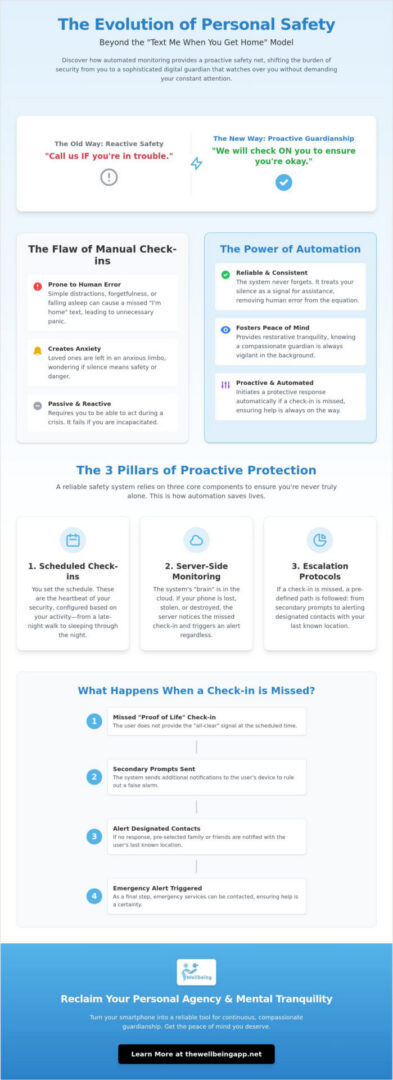
At its core, automated personal safety monitoring is a proactive safety net that shifts the burden of security from the individual to a sophisticated, digital guardian. Most traditional safety tools are reactive; they require you to press a button or scream for help in the middle of a crisis. This system is different. It functions on the principle of missed actions. Instead of waiting for you to trigger an SOS, the software monitors for your “all-clear” signal. If that signal doesn’t arrive at the scheduled time, the system initiates a protective response automatically. It’s a fundamental shift from “call us if you’re in trouble” to “we will check on you to ensure you’re okay.”
This approach is built on the “Watchful Protector” philosophy. We believe technology should be an empathetic companion that remains vigilant in the background, preserving your mental tranquility without being intrusive. It waits for your interaction and only acts when you cannot. While traditional tracking apps merely show a static location on a map, they fail to provide context regarding your well-being. A dot on a screen doesn’t tell your family if you’ve had a fall or if you’re unable to reach your phone. Automated monitoring bridge this gap by focusing on your status, not just your coordinates.
The gold standard for this verification is Proof of Life. This isn’t just a technical term; it’s a promise of presence. It involves a simple, discreet interaction with your smartphone that confirms you are safe, conscious, and in control of your situation. By establishing this digital pulse, you ensure that silence is never misinterpreted as safety.
The Evolution from Passive to Proactive Safety
For years, the “text me when you get home” message has been the standard for personal security. However, it’s also the weakest link. We forget to send it because we’re distracted by groceries, phone calls, or simply the relief of being home. When that text doesn’t arrive, loved ones are left in a state of anxious limbo, wondering if you forgot or if something went wrong. The shift toward “Check on Me” automation removes this human error. By 2026, the necessity for clunky, specialized hardware has vanished. Your smartphone now possesses the processing power to run complex safety protocols like Chaperone or Night Watch, providing professional-grade security through an interface you already use every day.
Key Components of an Automated Safety Net
A truly reliable safety system relies on three pillars to ensure you’re never truly alone:
- Scheduled Check-ins: These are the heartbeat of your security. You set the intervals based on your activity, whether it’s a solo hike or a late-night walk to your car.
- Server-Side Monitoring: The “brain” of the system lives in the cloud. If your phone is destroyed, loses battery, or is stolen, the external server notices the missed check-in and triggers the alert regardless of the device’s status.
- Escalation Protocols: When a Proof of Life indicator is missed, the system follows a clear, pre-defined path. This might involve secondary prompts, sharing your last known location with Designated Contacts, or triggering Emergency Alerts.
By integrating these components, you create a virtual environment where safety is managed proactively, allowing you to move through the world with a renewed sense of personal agency and peace.
The Mechanics of Proactive Protection: How Automation Saves Lives
The transition from passive safety to a proactive system relies on a set of intelligent, interlocking mechanics. Unlike a traditional alarm that sits dormant until triggered, automated personal safety monitoring creates a continuous loop of communication between the user and the secure server. This loop ensures that help isn’t just a possibility; it’s a certainty if you become incapacitated. By utilizing automated personal safety monitoring, you shift the responsibility of vigilance to a system that never tires and never forgets. When you initiate a monitoring session, the system begins a countdown. If you don’t provide a signal of well-being by the end of that interval, the escalation protocol begins.
During this critical alert phase, the role of GPS and real-time Location Sharing becomes paramount. To protect your privacy, the system doesn’t broadcast your every move to family or friends during normal operation. Instead, it holds that data securely. It only releases your precise coordinates to your Designated Contacts once a check-in is missed. This privacy-first architecture ensures you feel empowered and independent, knowing your data is only used when your safety truly requires it. It’s a sophisticated balance between technical robustness and human-centric respect for personal boundaries.
Proof of Life: The Core of Mental Tranquility
The Proof of Life interaction is designed to be as gentle and non-intrusive as possible. It usually appears as a soft notification on your smartphone, asking for a simple tap to confirm you’re okay. This user-friendly interface is a far cry from the high-stress environment of a panic button. To distinguish between a forgotten phone and a genuine emergency, the system uses a tiered approach. It might send multiple vibrations or audible prompts over several minutes before escalating. This nuance provides a profound psychological benefit. You no longer have to worry about being the person who forgets to text, because you know a compassionate guardian is always watching the clock for you. To experience this sense of relief firsthand, you can explore how these features integrate into your daily routine at thewellbeingapp.net.
Night Watch: Security While You Sleep
The hours between dusk and dawn often bring a specific type of vulnerability, especially for those living alone or managing health conditions. Night Watch addresses the fear of medical emergencies or intruders that can occur while you’re asleep and unable to reach for a device. It acts as a virtual chaperone that remains active while you are stationary and silent. Night Watch is a persistent, server-side monitoring state that ensures help is dispatched if a morning check-in is missed. This automated oversight means that even if you can’t make a call, the system already has the information needed to protect you. It’s a quiet, steadfast presence that guards your rest.
Manual vs. Automated Monitoring: Why the Check-in Text Fails
Relying on a manual “I’m home” text creates a fragile security chain that breaks the moment life gets busy. We’ve all experienced the distraction of a phone call, a hungry pet, or simply the relief of reaching our front door. When these moments cause us to forget our check-in, we inadvertently trigger a cycle of worry for our loved ones. This is the “Human Error” factor. It transforms a simple oversight into a stressful event for the very people we want to protect. Automated personal safety monitoring removes this burden by shifting the responsibility from your memory to a persistent digital guardian.
The “Incapacity” problem is even more critical. If you suffer a fall or a medical emergency, you might be physically unable to reach your device. In these high-stakes moments, a manual SOS button or a tracking app is effectively useless. You need a system that treats your silence as a signal for help. By using server-side automation, the safety net exists in the cloud, independent of your phone’s battery life or signal strength. If the server doesn’t receive your Proof of Life confirmation, it acts immediately. This ensures help is on the way even when you can’t call for it yourself.
Privacy remains a top concern for many, and it’s natural to feel hesitant about constant surveillance. It’s common to think, “I don’t want to be tracked every minute of the day.” However, true automated personal safety monitoring isn’t about surveillance. It’s about a “privacy-first” architecture where your data remains locked and invisible during normal activities. Your location is only shared with Designated Contacts during an active alert phase. This ensures you maintain your personal agency while having a fail-safe system ready to deploy only when it’s truly needed.
The Limitations of Traditional PERS (Medical Alert Buttons)
Traditional medical alert buttons often fail because they aren’t where they’re needed. Many users leave these clunky hardware devices on a nightstand or in a drawer to avoid the perceived stigma of “the button.” Beyond the social discomfort, hardware requires constant maintenance, such as charging and staying within a specific base-station range. An app-based solution lives on the smartphone you already carry, offering a discreet, modern alternative that empowers you rather than labeling you as vulnerable.
Why “Find My” Apps Are Not Safety Systems
There’s a dangerous difference between knowing where someone is and knowing if they are okay. Passive “Find My” apps show a dot on a map, but they offer no context. A stationary dot could mean someone is sleeping safely, or it could mean they are in distress and unable to move. Automated check-ins provide the “Why” and “When” that location data alone misses. Without an active verification of well-being, passive monitoring provides a false sense of security that can lead to hours of missed response time during a genuine crisis.
Implementing a Virtual Safety Net for Seniors and Solo Travelers
Building your own virtual safety net is a straightforward process that returns a sense of control to your daily life. By embracing automated personal safety monitoring, you move beyond the anxiety of “what if” and step into a structured environment of protection. The first step involves setting up a personal safety schedule that mirrors your actual habits. This isn’t a rigid itinerary; it’s a flexible series of check-in prompts that you define based on when you feel most vulnerable or when you simply want the comfort of a watchful protector. You can begin building your own protective circle today by visiting thewellbeingapp.net.
Selecting your Designated Contacts is central to any automated personal safety monitoring plan. These individuals are the people you trust most, such as family members, close friends, or neighbors. When the system detects a missed interaction, these are the people who will receive the automated alert. You can customize the escalation, choosing who is notified first and what information they receive. Many users also establish “Safe Zones” using geofencing technology. This allows the system to adjust check-in frequencies automatically based on your location, such as requiring more frequent pulses when you’re away from home and relaxing the schedule when you’re in a familiar, secure environment.
Protecting Seniors Living Alone
For seniors, the goal of automation is to preserve independence while providing a compassionate safety net. Setting up a daily Proof of Life rhythm allows a senior to go about their day without feeling hovered over by concerned relatives. If a morning check-in is missed, the family is notified immediately, reducing the “anxiety of the unknown” for adult children who may live hundreds of miles away. This community-based approach ensures that safety is a shared responsibility, fostering a sense of harmony and trust within the family unit.
The Virtual Chaperone for Solo Urban Life
Solo travelers and urban commuters face unique risks that require a more intensive level of oversight. When you’re walking home alone or meeting someone new, you can activate a Chaperone session. This feature pairs a countdown timer with real-time Location Sharing. The Virtual Chaperone is a temporary, high-intensity monitoring state that automatically alerts contacts if the user does not confirm their arrival. If you don’t tap the “I’m safe” button when you reach your destination, the system triggers Emergency Alerts to your contacts, providing them with your exact coordinates and the context they need to help you quickly.
The Wellbeing App: Your Partner in Continuous Personal Security
The Wellbeing App represents the logical conclusion for anyone seeking true mental tranquility. It’s more than just software; it’s a dedicated partner in your continuous personal security. By integrating the core features we’ve discussed, such as Proof of Life, Chaperone, and Night Watch, it creates a seamless environment of protection that adapts to your life. There’s no expensive hardware to buy and no need to hire physical security personnel. Your safety lives on the device you already carry, powered by a system that values your personal agency above all else. Embracing automated personal safety monitoring through this platform means choosing a life where you’re never truly alone.
The app’s architecture is built on the concept of community unity. It recognizes that safety is a shared effort between technology, the individual, and their loved ones. Whether you’re a solo traveler exploring a new city or a senior enjoying the comfort of your own home, the system provides a persistent, caring presence. It’s about fostering social cohesion and ensuring that every member of your family can breathe a little easier. When you use this technology, you’re making a powerful statement about your commitment to those you love.
Subscription-Based Peace of Mind
A recurring safety service provides a level of 24/7 oversight that manual methods simply can’t match. The Wellbeing App serves as a compassionate guardian, monitoring your status even when your family is asleep or at work. It’s designed for immediate impact. You can move from the initial download to your first Proof of Life interaction in just a few minutes. This ease of setup ensures that protection is accessible to everyone, regardless of their technical expertise. It’s a small commitment that yields a massive return in well-being and interpersonal connection. You can explore the full suite of features at thewellbeingapp.net.
Join a Community of Vigilant Care
The mission behind this technology is deeply altruistic. We’re dedicated to preventing missing persons incidents by ensuring that silence is addressed before it becomes a tragedy. Empowerment is the ultimate goal. When you use automated personal safety monitoring, you aren’t just installing an app; you’re joining a movement of proactive care. You’re taking a stand for your own safety and fulfilling a duty toward those who care about you. This persona is disciplined and serious about safety, yet it remains accessible and friendly. Secure your mental state and protect your loved ones today by choosing a partner that is as technologically sophisticated as it is deeply caring.
Reclaiming Your Personal Agency and Peace of Mind
True safety isn’t found in a tracker that follows your every move; it’s found in a system that knows when to act when you cannot. By choosing automated personal safety monitoring, you replace the anxiety of forgotten check-ins with a reliable digital pulse. This shift from reactive hardware to proactive server-side software ensures that your well-being is always the priority. You’ve learned how technology can act as a compassionate guardian, preserving your privacy while maintaining a constant, watchful eye on your status. It’s a fundamental change that turns your smartphone into a powerful tool for empowerment.
The Wellbeing App brings this vision to life through proprietary features like Chaperone and Night Watch. With server-side Proof of Life indicators, the system treats your silence as a signal for help, triggering an automated alert dispatch to your designated family contacts. You don’t have to carry the burden of vigilance alone anymore. Start your journey toward mental tranquility with The Wellbeing App and give your loved ones the gift of certainty. You deserve to move through the world with confidence, knowing a watchful protector is always standing by.
Frequently Asked Questions
How does automated personal safety monitoring differ from a standard GPS tracker?
Automated personal safety monitoring focuses on verifying your actual well-being rather than just displaying your location on a map. While a standard GPS tracker shows where you are, it cannot tell if you have had a fall or are in distress. This proactive system monitors for your specific confirmation and treats silence as a signal for help, providing context that passive tracking simply misses.
What happens if my phone battery dies or I lose signal?
The system utilizes server-side monitoring to ensure you are never left without a safety net during an active session. Because the “brain” of the system lives in the cloud, it notices if your device goes offline or fails to check in. If the server-side timer expires without a signal from you, the escalation protocol begins and your designated contacts are notified immediately regardless of your phone’s status.
Is automated safety monitoring better for seniors than a medical alert necklace?
Many seniors find this approach superior because it doesn’t require them to physically reach for a button during a crisis. Medical alert necklaces are often left on nightstands or forgotten, but an app-based system lives on the smartphone they already carry. It empowers seniors to maintain their independence while ensuring that if they become incapacitated, the system will automatically notify their family.
Can I customize who receives my alerts and when they are sent?
You have complete control over your safety circle and the timing of your check-in prompts. You can select your own designated contacts, such as family members, neighbors, or friends, and determine the order in which they are notified. The system allows you to set custom frequencies based on your specific activity, ensuring that the right people are alerted at the exact moment you need assistance.
Is my location data being tracked even when I am not in an active safety session?
Your privacy is a core pillar of the service, so the system is designed with a privacy-first architecture that avoids continuous tracking. Location Sharing is only activated during an alert phase when a Proof of Life interaction has been missed. This ensures that you maintain your personal agency and your data remains secure and invisible until it is actually needed to facilitate a rescue.
What is a “Proof of Life” check-in and how often should I use it?
A Proof of Life check-in is a simple, discreet interaction with your smartphone that confirms you are safe and conscious. You should use it as often as your environment or activity dictates to maintain your mental tranquility. For daily routines, a morning and evening check-in might suffice, but for more vulnerable situations, you can set the intervals to be more frequent to ensure a tighter safety net.
How does the Chaperone feature work when walking home alone?
The Chaperone feature provides a temporary, high-intensity monitoring state for your most vulnerable moments, such as a late-night commute. When you start a session, the system begins a countdown based on your estimated arrival time. If you don’t confirm that you have reached your destination safely, the system automatically triggers emergency alerts to your contacts, providing them with your last known coordinates.
Are there monthly fees for automated safety monitoring services?
Most professional automated personal safety monitoring services utilize a subscription model to support their robust, 24/7 server-side infrastructure. This recurring fee ensures that the system is always ready to monitor for missed signals and manage alert dispatches. While some basic tools may be free, a dedicated subscription provides the reliable, always-on partnership required to foster true social cohesion and family peace of mind.