
Child Safety App: Non-Custodial Visit Security Guide
The silence in the house after your child leaves for a weekend visit isn’t peaceful; it’s often filled with a heavy, persistent anxiety that follows you into every room. You find yourself staring at your phone, caught between the desperate need to check in and the fear that a single text will ignite another high-conflict argument with your ex-partner. Finding a reliable child safety app for non-custodial visits can transform this period of separation from a source of dread into a time of quiet confidence. It’s about moving beyond simple location tracking and establishing a foundation of objective, verifiable safety that protects both your child’s well-being and your own mental tranquility.
We understand that your sense of duty to protect your little ones doesn’t pause just because they’re in someone else’s care. You deserve to know they’re safe without having to navigate a minefield of stressful communication. This guide will show you how to utilize proactive monitoring tools like automated check-ins and virtual chaperones to ensure continuous protection. We’ll explore how features such as Proof of Life indicators and Night Watch alerts provide the objective proof you need to breathe easier while your child is away. By the end of this article, you’ll have a clear roadmap for using technology as an instrument of empowerment, allowing you to maintain a watchful eye while preserving the harmony of your co-parenting relationship.
Key Takeaways
- Shift your focus from reactive GPS tracking to proactive physical security monitoring. It’s about knowing your child is truly safe, not just knowing where their phone is located.
- Discover how a child safety app for non-custodial visits uses automated check-ins to reduce the need for high-conflict communication with an ex-partner.
- Learn to implement a virtual chaperone strategy that provides continuous protection during home transitions and overnight stays in unfamiliar environments.
- Understand the value of server-side indicators that keep working even if a mobile device is turned off or loses connection.
- Follow a structured approach to assessing visitation risks, allowing you to replace separation anxiety with a sense of empowered mental tranquility.
The Challenge of Ensuring Child Safety During Non-Custodial Visits
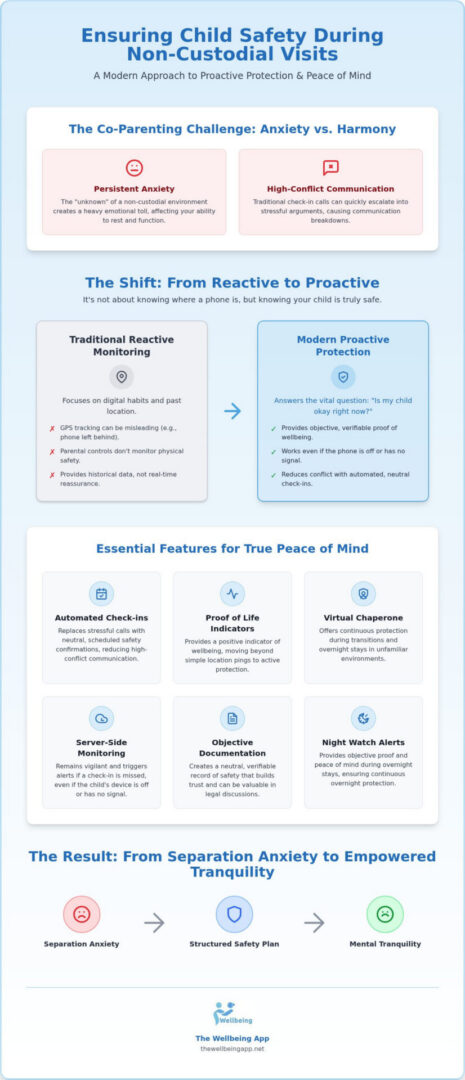
Visitation safety is much more than a legal checkbox; it is the fundamental physical security of your child during the periods they spend away from your home. For many custodial parents, the transition to a non-custodial environment brings an immense emotional toll. This “unknown” space often breeds anxiety, as you lose the ability to personally verify your child’s surroundings, routines, or immediate safety. It is a weight that doesn’t just sit on your shoulders; it affects your ability to rest and function while your child is away.
In many co-parenting relationships, especially those with a history of tension, traditional check-ins often fail. A phone call meant to hear a child’s voice can quickly escalate into a high-stakes argument between adults. These interactions often feel like interrogations rather than safety checks, leading to communication breakdowns that leave everyone more stressed. A child safety app for non-custodial visits provides a needed alternative. It acts as a digital safety net, monitoring physical wellbeing through automated indicators rather than intrusive human interaction. This proactive approach allows you to maintain your duty of care without triggering the conflict that often accompanies direct contact.
Why Traditional Parental Controls Aren’t Enough
Many parents mistake digital monitoring for physical security. Standard parental control apps are designed to manage screen time or filter out inappropriate websites, which are important for a child’s digital health but do nothing to ensure their physical safety. A web filter won’t tell you if your child arrived safely at a park, and a screen time limit won’t alert you if a check-in was missed. While virtual visitation can offer a brief window into your child’s world through video calls, it is a point-in-time solution. True peace of mind requires a system that monitors physical presence and wellbeing continuously, bridging the gap between digital habits and real-world security.
The Need for Objective Safety Documentation
When trust is thin, objective proof is the only way to find harmony. Automated safety platforms create a neutral record of a child’s status, removing the subjective “he-said, she-said” that often plagues custody disputes. By establishing a consistent history of successful check-ins, using a child safety app for non-custodial visits provides verifiable evidence of safety that can be invaluable in legal discussions. More importantly, this documentation helps build long-term trust between co-parents. When safety is handled by a reliable, automated system, it removes the burden of proof from the individuals and places it on a transparent, third-party indicator. This shift empowers you to focus on your child’s emotional needs, knowing their physical security is being watched over by a compassionate guardian.
Digital Monitoring vs. Physical Security: Which Does Your Family Need?
Most co-parenting tools focus on reactive monitoring. They show you where your child was or what they did online hours after the fact. While this is helpful for digital hygiene, it doesn’t provide the immediate reassurance needed during a non-custodial visit. Proactive monitoring focuses on the present. It answers the vital question: “Is my child okay right now?” This shift in perspective is essential for maintaining your mental tranquility while your child is away.
This is where the concept of Proof of Life becomes the emotional anchor of your safety plan. Instead of just watching a dot on a map, you receive a positive indicator of wellbeing. By using a child safety app for non-custodial visits, you move from passive observation to active protection. Server-side monitoring is the backbone of this system. It ensures that even if a child’s phone is powered off or loses signal, the system remains vigilant. If a scheduled check-in doesn’t occur, the server triggers an alert, providing a layer of security that local-only apps simply cannot match.
The Limitations of Standard GPS Tracking
Location pings can be misleading. A dot at a park doesn’t tell you if your child is safely with their co-parent or if the phone was left on a bench. GPS also struggles in dead zones or inside large buildings. If a battery dies, the data becomes stale instantly. Automated check-ins act as a secondary layer of verification. They require a specific action that confirms the child is physically present and safe, removing the ambiguity of a static GPS coordinate. This ensures that your duty of care is met with reliable, real-time data.
Choosing Between Hardware and App-Based Solutions
Dedicated GPS watches are popular, but they often require separate data plans and can be easily forgotten or removed. Smartphone apps are usually more sophisticated. They leverage the device’s existing logic to provide a seamless experience. Solutions like The Wellbeing App offer more than just tracking; they provide a comprehensive suite of protective features that integrate into a child’s daily routine. This approach turns a standard device into a powerful instrument of empowerment. It ensures that your child’s physical security is always a priority without the need for additional hardware, fostering a sense of harmony and safety for the entire family.
Essential Features for a Visitation Safety App
To effectively manage visitation anxiety, you need tools that prioritize physical presence over digital habits. Unlike general parental controls that focus on screen time, a dedicated child safety app for non-custodial visits provides features that act as a compassionate guardian. These tools are designed to maintain harmony between co-parents by automating the verification process. By shifting the responsibility from human interaction to automated systems, you can preserve your mental tranquility while ensuring your child’s wellbeing.
Automated Check-ins are the cornerstone of this approach. They remove the heavy burden of manual “I’m okay” texts that often feel like a chore for the child or an intrusion for the non-custodial parent. By scheduling these check-ins at specific intervals, you establish a reliable rhythm of safety. If a check-in is missed, Emergency Alerts are sent instantly to designated contacts. This ensures that help is mobilized immediately without the need for constant, stressful monitoring on your part. It is a disciplined, serious approach to safety that remains accessible and friendly for the child.
Location Sharing adds another layer of empathetic vigilance. It provides real-time visibility during travel and transitions between homes. Knowing exactly when a child arrives at a destination allows you to release the tension of the unknown. This feature isn’t about surveillance; it’s about the shared effort of keeping a family secure during periods of separation.
Automated Proof of Life Indicators
Scheduled check-ins provide a constant pulse on your child’s status. This is particularly vital during overnight stays in unfamiliar environments. The Night Watch feature is designed for these high-stakes periods, offering protection while the rest of the world sleeps. These indicators confirm wellbeing silently and effectively. They allow you to maintain your duty of care without the need for intrusive phone calls that might disrupt the child’s time or escalate co-parenting conflict. It’s a way to stay connected to your child’s safety while respecting the boundaries of the non-custodial environment.
Virtual Chaperone Services for Travel
Transitions are often the most stressful part of a visitation schedule. Whether a child is moving between homes or meeting at a public spot, the Chaperone feature acts as a protective layer within a child safety app for non-custodial visits. It monitors the child during unaccompanied travel or hand-offs, ensuring they stay on the intended path. If the system detects unexpected route deviations, it triggers real-time alerts. This proactive safety management empowers you to feel secure, knowing that a sophisticated, always-on partner is looking out for your child’s best interests during every mile of their journey.
How to Implement a Safety Plan for Non-Custodial Visits
Creating a structured safety plan is the most effective way to replace separation anxiety with mental tranquility. It turns a vague sense of dread into a manageable, disciplined process that protects your child while they’re away. Implementing a child safety app for non-custodial visits is not just about installing software; it’s about building a framework of trust and empowerment. By following a clear set of steps, you can ensure that your duty of care is met without constant, high-conflict communication.
- Step 1: Assess the specific risks. Identify the exact moments when your anxiety peaks. Is it during the Friday evening hand-off, or when they’re staying overnight in an unfamiliar neighborhood?
- Step 2: Choose your platform. Select a child safety app for non-custodial visits that focuses on physical presence and automated monitoring rather than just digital habits.
- Step 3: Establish check-in windows. Set specific times for Proof of Life indicators that align with the child’s existing routine, such as after breakfast or before bed.
- Step 4: Designate emergency contacts. Empower a small circle of trusted individuals who are prepared to act immediately if an automated alert is triggered.
- Step 5: Review safety data regularly. As your child grows and their schedule changes, adjust the monitoring logic to ensure it remains a helpful tool rather than a burden.
Start building your family’s digital safety net by exploring the features of The Wellbeing App today.
Communicating with the Co-Parent
When introducing a safety tool to your co-parent, frame it as a benefit for the child’s wellbeing rather than a surveillance tool on the adult. Explain that automated systems actually reduce the need for direct, stressful check-in texts, allowing both parents to enjoy their time with the child more fully. For long-term harmony, consider including specific safety app requirements in your legal parenting plans or custody agreements. This establishes the app as a neutral, third-party guardian that both parties have agreed to respect for the sake of the child’s physical security.
Preparing the Child for Safety Monitoring
Talk to your child about the app in an age-appropriate, empowering way. Present it as a “Virtual Chaperone” that is always there to help them if they need it, much like a protective family member. Teach them how to use the check-in features and what to do if they ever need to trigger an emergency alert. The goal is to make the child feel protected and supported, not “watched” or micro-managed. When a child understands that these tools are an instrument of their own personal agency and safety, they can transition between homes with greater confidence and peace of mind.
Empowering Peace of Mind with The Wellbeing App
The Wellbeing App stands as a compassionate guardian for families navigating the complexities of co-parenting. It is more than a technical tool; it’s a dedicated partner in preserving your mental tranquility. Choosing a child safety app for non-custodial visits should feel like adding a supportive layer to your family’s life, not like installing a surveillance system. This app focuses on the profound value of harmony and the preservation of your mental state during periods of separation. It empowers you to step back from the stress of the unknown and step into a space of informed, quiet confidence.
At the heart of this service is the Proof of Life feature, which serves as the emotional anchor for visitation safety. It provides the objective reassurance you need without the friction of high-conflict text exchanges or intrusive phone calls. Combined with Night Watch protection for overnights and Virtual Chaperone services for transitions, the app offers 24/7 empathetic vigilance. These features ensure that your child is physically secure while allowing you to fulfill your duty of care with calm assurance. Because the monitoring is server-side, the protection remains constant even if a device loses power, ensuring the safety net never breaks.
A Compassionate Approach to Security
Many security platforms rely on fear-based messaging to drive engagement. We take a different path, opting for a voice that is calm, supportive, and deeply rooted in the concept of collective responsibility. Our mission is to foster social cohesion and protect the vulnerable through technologically sophisticated care. Within this framework, we define Proof of Life as a specialized security indicator that confirms user status through scheduled interaction. This approach transforms safety from a source of anxiety into a shared effort for the well-being of the entire community. It positions the technology as an instrument of empowerment, helping parents feel like capable guardians even from a distance.
Getting Started with Your Family Safety Net
Building your proactive safety management plan is a straightforward process designed to reduce stress rather than add to it. You can choose between individual or family subscription plans based on your household’s unique needs. Once active, the app allows you to customize alerts to match your specific visitation schedule perfectly. You can set check-in windows that respect the child’s routine and designate the emergency contacts who will be empowered to act if an indicator is missed. This level of personal agency ensures the technology serves your family’s best interests. By automating the most stressful parts of visitation, you can focus on building a positive relationship with your child.
Protect your peace of mind and your child’s safety with The Wellbeing App today.
Restoring Harmony to Your Visitation Schedule
Protecting your child’s physical security during periods of separation is one of your most sacred duties. By shifting from reactive GPS tracking to proactive monitoring, you replace the weight of the unknown with a foundation of objective truth. You’ve learned how automated indicators and virtual chaperones can bridge the gap between homes without the need for high-conflict communication. Implementing a child safety app for non-custodial visits isn’t just about software; it’s about reclaiming your mental tranquility while your little ones are away.
Our commitment to your family includes 24/7 server-side monitoring that remains vigilant even if a phone loses power. With specialized features like Night Watch and automated Proof of Life alerts, you can rest assured that a compassionate guardian is always looking out for your child’s best interests. This shared effort in safety fosters a more peaceful environment for everyone involved, allowing you to focus on the joy of parenting rather than the stress of the schedule.
Start your family safety journey with The Wellbeing App and embrace a future where your child’s security is guaranteed and your peace of mind is preserved. You’re doing a wonderful job looking out for your family, and we’re here to help you every step of the way.
Frequently Asked Questions
Is a child safety app legal to use during non-custodial visits?
It is generally legal to use a child safety app for non-custodial visits because parents have a fundamental duty of care to ensure their child’s physical security. You should always review your specific custody agreement or parenting plan to ensure there are no prohibitions against electronic monitoring. In many cases, courts actually encourage the use of safety tools to reduce conflict and provide objective proof of a child’s wellbeing during transitions between homes.
How does “Proof of Life” differ from standard GPS tracking?
Standard GPS tracking only shows a device’s location, which can be misleading if the phone is left behind or the data is stale. Proof of Life is a specialized security indicator that confirms the child’s actual status through a scheduled, active interaction. It moves beyond passive location sharing to provide verifiable proof that the child is safe and responsive. This proactive approach offers a much higher level of mental tranquility than simply watching a dot on a map.
Can I use The Wellbeing App if my child is traveling across state lines?
Yes, The Wellbeing App provides comprehensive national coverage across the entire United States. Whether your child is visiting a relative in a neighboring state or traveling for a vacation, our server-side monitoring remains active. The Virtual Chaperone and Night Watch features continue to function seamlessly across state lines, ensuring your family safety net stays intact. This allows you to maintain your protective vigilance regardless of where the visitation schedule takes your child.
What happens if my child misses a scheduled check-in?
If a scheduled check-in is missed, the system immediately triggers automated Emergency Alerts to your designated contacts. Because we use server-side monitoring, the alert is dispatched by our system even if the child’s phone is unreachable or powered off. This ensures that a missed indicator is never ignored. You and your trusted circle will receive instant notification, allowing you to take immediate, empowered action to verify your child’s safety without waiting for a manual text.
Does the other parent need to have the app installed on their phone?
No, the non-custodial parent does not need to install the app on their personal device for the system to function. A child safety app for non-custodial visits is designed to run on the child’s smartphone, where it monitors indicators like Proof of Life and provides Chaperone services. This setup respects the co-parent’s privacy while prioritizing the child’s physical security. It reduces the need for high-conflict communication because safety data is handled by an objective, automated platform.
Is The Wellbeing App COPPA compliant for children?
Protecting the privacy of vulnerable users is a central pillar of our mission as a compassionate guardian. The Wellbeing App is designed with strict adherence to safety and privacy standards, including COPPA compliance requirements for child safety apps. We prioritize data security and ensure that all monitoring, from location sharing to automated alerts, is handled with the highest level of care. Our persona as a watchful protector means we are as disciplined about data privacy as we are about physical security.
Can the app monitor safety even if the child’s phone battery dies?
Yes, our server-side monitoring logic is specifically built to handle scenarios where a battery dies or a connection is lost. If the child’s device goes offline and misses a scheduled Proof of Life check-in, the server recognizes the absence of the indicator and triggers an alert. Unlike standard apps that stop working when the phone is off, our system remains a reliable, always-on partner. This ensures your mental tranquility isn’t shattered just because a battery ran low.
How much does a family safety subscription cost?
The Wellbeing App offers flexible recurring subscription plans designed to fit your family’s specific needs. You can choose between monthly or annual billing options for individual or family access to our full suite of safety monitoring tools. These fees grant you continuous access to premium features like Night Watch, Virtual Chaperone, and automated Emergency Alerts. By investing in a subscription, you are securing a professional digital safety net that provides round-the-clock protection and proactive safety management.