
Driver Safety Solutions: 2026 Guide for Couriers & Fleets
The most vulnerable moment of a delivery route rarely happens behind the wheel; it happens the second a driver steps onto an unlit porch. While commercial tracking has historically prioritized vehicle assets, modern delivery driver safety solutions must protect the person carrying the parcel. If you manage a dispersed team or complete solo runs late at night, you already know the quiet anxiety that comes with isolated drop-offs and the constant worry of an incident where reaching for a phone simply isn’t possible.
You deserve the peace of mind that comes from knowing every courier is guarded on foot, not just tracked on an asphalt map. In this guide, you will discover how to evaluate modern delivery driver safety solutions, comparing app-based personal protection with vehicle telematics to safeguard every shift. We will examine how automated check-ins, dedicated oversight, and reliable virtual monitoring ensure your team stays secure from initial dispatch to the final doorstep.
Key Takeaways
- Understand why modern delivery driver safety solutions must bridge the gap between vehicle telematics and the critical minutes spent on foot at unfamiliar doorsteps.
- Discover how automated verification protocols eliminate the friction of manual check-ins, keeping solo drivers focused while ensuring immediate escalation if an unexpected delay occurs.
- Compare the protective coverage and operational flexibility of app-based personal safety tools against traditional, vehicle-bound hardware systems.
- Learn a clear framework to audit route risks and implement dedicated virtual monitoring tools that bring genuine peace of mind to late-night and isolated delivery shifts.
Evaluating Modern Delivery Driver Safety Solutions: Key Risks and Industry Shifts
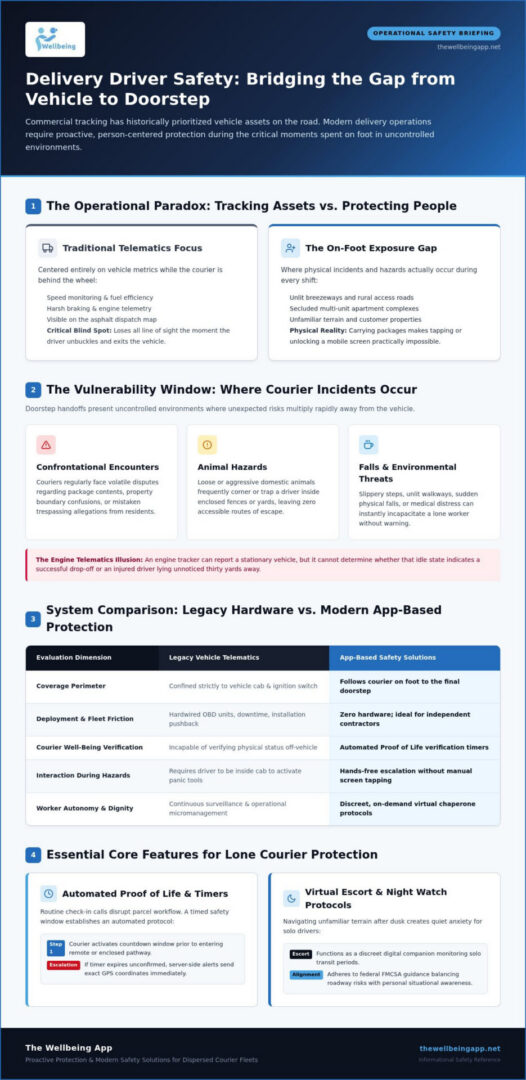
Every delivery route involves a profound operational paradox. A business might invest heavily in vehicular protection, yet the driver remains entirely exposed the moment they unbuckle their seatbelt. Comprehensive delivery driver safety solutions must protect couriers across the entire operational continuum, shielding them during vehicular transit and throughout high-risk doorstep drop-offs. The modern logistics sector is waking up to this reality. Fleets are shifting attention toward guarding lone couriers as they navigate dim breezeways, rural access roads, and unfamiliar terrain on foot.
Traditional operations relied solely on an in-cab fleet telematics system to monitor speed, fuel efficiency, and harsh braking. While valuable for vehicle health, these platforms treat worker protection as synonymous with vehicular tracking. They leave drivers on their own once they step onto a customer’s property. True peace of mind requires a dual imperative: pairing road precautions with dedicated, human-centered personal security that travels directly with the worker.
The Vulnerability Window: Where Courier Incidents Actually Occur
The greatest physical exposure happens during the brief window away from the vehicle. Doorstep handoffs, secluded apartment complexes, and unlit driveways present uncontrolled environments where unexpected risks multiply rapidly.
- Confrontational encounters: Couriers frequently face disputes over package contents, property boundaries, or mistaken trespassing.
- Animal hazards: Loose or aggressive dogs can trap a driver in an enclosed yard with zero escape routes.
- Disorientation and environmental threats: Slippery walkways, sudden falls, or sudden health emergencies can incapacitate a worker without warning.
During these moments, expecting a driver to manipulate a phone screen is unrealistic. Carrying boxes makes tapping an emergency button practically impossible, meaning delivery driver safety solutions must function without requiring active, manual phone interaction.
Limitations of Legacy Hardware and Vehicle-Only Telematics
Legacy telematics hardware cannot solve off-vehicle vulnerability. Dashcams and hardwired onboard diagnostic units lose all line-of-sight the instant an employee rounds a corner or enters a multi-unit complex. The vehicle remains visible on a dispatch map, but the human being carrying the cargo is completely unaccounted for.
Beyond visibility blind spots, proprietary hardware creates massive friction across modern independent contractor fleets. Installing custom black boxes or wired cameras into personal vehicles involves prohibitive installation downtime, maintenance burdens, and driver pushback. Most critically, an engine tracker cannot verify physical well-being. A stationary vehicle might indicate a successful drop-off, or it could mean an injured driver is lying unnoticed thirty yards away.
Essential Safety Features Every Delivery Driver System Must Include
Protecting couriers requires shifting the focus from vehicle surveillance to active, lone-worker support. While traditional platforms monitor hard braking, robust delivery driver safety solutions must address what happens when an individual walks into an isolated courtyard alone. Effective systems empower workers by removing operational friction, providing reassuring layers of protection that function smoothly alongside primary navigation apps.
According to federal guidance outlined in official FMCSA driver safety resources, commercial operators thrive when personal health, situational awareness, and roadway risks are managed together. Achieving that balance requires software tools engineered specifically for vulnerable solo scenarios.
Automated Proof of Life and Timed Safety Windows
Relying on couriers to make routine phone calls disrupts parcel workflows. Instead, modern systems utilize automated Proof of Life countdown timers. A driver activates a set window before walking up a winding path. If the timer expires without confirmation, server-side escalation immediately alerts trusted contacts with their exact coordinates. This approach protects worker dignity, establishing a resilient safety net without subjecting drivers to invasive, continuous operational micromanagement.
Virtual Escort Support and Specialized Night Watch Protocols
Navigating unfamiliar neighborhoods after dusk introduces severe anxiety. Virtual Chaperone support acts as a discreet digital companion, monitoring transit periods without demanding direct interaction. For extended nocturnal shifts, Night Watch protocols maintain quiet, battery-efficient background vigilance. Drivers focus entirely on handling deliveries safely, comforted by the knowledge that dedicated monitoring is tracking their route progression.
Emergency Alert Automation and Dynamic Location Sharing
When unexpected danger arises, manual panic buttons often fail because reaching into a pocket can provoke an aggressor. Next-generation systems bypass this dilemma through automated safeguards:
- Precision Location Sharing: Pinpoints delivery personnel inside dense multi-family complexes, where standard street addresses fall short.
- Automated Emergency Alerts: Triggers notifications to designated family networks or dispatchers the moment an unexpected delay or safety window lapses.
- Unobtrusive Operation: Runs seamlessly behind courier platforms to preserve device battery throughout grueling shifts.
Equipping couriers with proactive mobile safety technology bridges the gap between vehicle transit and personal protection, restoring genuine confidence to every solo route.
Comparing Delivery Driver Safety Solutions: App-Based Software vs. Hardware Telematics
Choosing the right safety infrastructure requires balancing logistical oversight with personal protection. Historically, commercial fleet managers leaned toward heavy vehicular telematics to ensure route accountability. Yet as modern logistics relies increasingly on independent contractors and agile courier networks nationwide, the operational shortcomings of vehicle-tethered machinery become apparent. Evaluating delivery driver safety solutions through a practical operational lens reveals clear distinctions between mobile software platforms and hardwired telematics devices.
Hardware systems excel at mechanical diagnostics. They measure fuel burn, tire pressure, and engine faults while the vehicle is running. However, these tools demand high capital outlays, professional installation downtime, and recurring maintenance fees for proprietary gear. When managing dispersed contractors who use their own passenger vehicles, mandating physical hardware installs is virtually impossible. App-based tools eliminate this entire barrier, delivering immediate coverage without logistical headaches.
Deployment Velocity and Zero-Hardware Accessibility
Speed of implementation often determines whether safety policies actually get adopted. While hardwired fleet hardware requires physical shipping schedules, vehicle wiring appointments, and specialized mechanics, app-based platforms activate in minutes. Couriers simply download the application directly onto their smartphones via standard app stores. This immediate deployment model removes supply chain delays, avoids device obsolescence, and allows scaling fleets across the country to onboard dozens of new contractors without mechanical audits.
Coverage Continuity: In-Transit vs. Beyond the Driver’s Seat
The core structural advantage of mobile software lies in unbroken physical coverage. Telematics coverage ends abruptly the moment the courier turns off the engine and shuts the cab door.
- Hallway and elevator transit: Mobile software accompanies couriers inside high-rise corridors and subterranean parking decks where dashcams cannot see.
- Doorstep interaction: Dedicated apps stay in the worker’s pocket, safeguarding the vital minutes spent confirming package delivery or navigating darkened pathways.
- Dynamic incident escalation: Should an emergency occur away from the vehicle, mobile-first delivery driver safety solutions activate automated alerts that broadcast the courier’s precise mobile coordinates rather than a parked van’s location.
Software-driven architectures create uninterrupted continuity from the vehicle cab all the way to the customer’s front door. That ongoing connection provides frontline drivers with the genuine mental tranquility they need to complete every shift safely.
Implementation Guide for Solo Drivers & Growing Fleets
Putting safety theory into practice shouldn’t require weeks of administrative planning or complex vehicle wiring. Whether you manage a nationwide delivery service or run evening routes as an independent contractor, rolling out effective delivery driver safety solutions involves establishing dependable routines before turning the ignition key. Protecting yourself or your team comes down to building a reliable, four-step protective workflow.
- Audit shift risk profiles: Review route terrain, lighting conditions, and specific drop-off density before dispatch.
- Select automated technology: Choose app-based platforms that rely on background monitoring rather than demanding manual, distracting inputs while handling parcels.
- Configure response networks: Connect your personal circle or dispatch contacts into your alert hierarchy with confirmed notification permissions.
- Establish timing habits: Define realistic countdown windows before stepping out into unlit breezeways or unfamiliar properties.
Establishing Escalation Protocols and Trusted Contact Networks
An emergency notification is only as effective as the person receiving it. When setting up your alert network, pick contacts who keep their phones accessible and know your typical delivery schedule. Next, calibrate your countdown buffers realistically. A single-family home with a flat path might require a two-minute window, whereas a sprawling three-story apartment complex with security gates needs four or five minutes.
Before leaving the dispatch hub or parking area, run a quick system check. Confirm that your device maintains active GPS permissions and that your background Location Sharing updates accurately. Catching a location permission glitch while parked prevents critical gaps later in the evening.
Developing Safe Habit Loops During Late-Night Deliveries
Safety tools only protect workers if activating them becomes second nature. Turn the moments right before stepping out of the cab into an automatic security ritual.
Before putting the vehicle in park, evaluate the surrounding drop-off zone. If streetlights are out or the property seems secluded, engage a virtual Chaperone session immediately. Once set, tuck the phone securely into your pocket and complete the delivery without looking down at the screen. If an uncomfortable interaction begins, simply avoid escalating the situation and retreat to your vehicle. Knowing that your safety window is running silently in the background removes the urge to reach for a phone during a confrontation.
By establishing regular, automated check-ins throughout each shift, you preserve your focus and mental tranquility. If you are ready to implement seamless lone-worker protection today, explore The Wellbeing App to equip your routes with dependable digital safety nets.
Proactive Protection with The Wellbeing App: The Modern Safety Net for Couriers
True protection isn’t about tracking engine diagnostic codes or managing driver metrics from a distant corporate dashboard. It’s about preserving human well-being and ensuring workers return home safely to the people who depend on them. Built as a watchful, compassionate guardian, The Wellbeing App redefines delivery driver safety solutions through accessible software empowerment. By replacing expensive, fixed equipment with an intuitive mobile subscription, it puts dynamic personal security directly into the pockets of couriers nationwide. Zero proprietary hardware is required, and zero vehicle modifications are needed to activate complete peace of mind.
Automated Vigilance Through Proof of Life Monitoring
The foundation of this digital safety net is Proof of Life check-in monitoring. Before stepping toward an isolated door or traversing a dimly lit parking deck, a driver activates a scheduled countdown window. If the stop finishes smoothly, a single tap confirms their safety. If an unexpected crisis occurs and the timer lapses without confirmation, server-side escalation takes over instantly.
The system immediately triggers automated Emergency Alerts alongside precise coordinates to designated contacts. This automated sequence removes the dangerous burden of having to unlock a phone during an active altercation. Couriers remain empowered rather than anxious, confident that an infallible digital safety net is watching over them throughout demanding shifts.
Empowering Couriers with Night Watch and Chaperone Support
Late-night and early-morning routes present distinct psychological and physical challenges. Through Night Watch, solo couriers working graveyard shifts gain continuous background oversight that safeguards their hours on the road without draining battery life or disrupting standard dispatch tools. For especially uncertain stops, virtual Chaperone support acts as a discreet companion, actively monitoring the worker’s transit until they are safely back inside their vehicle.
Paired with precision Location Sharing, these specialized features link frontline workers directly to their trusted family circle or support team. When evaluating modern delivery driver safety solutions, the ultimate priority must always be human life. By fostering mental tranquility and shared security, The Wellbeing App ensures no driver ever has to walk an unfamiliar path alone.
Securing the Route Ahead for Every Lone Courier
Every delivery driver deserves to finish their shift with complete confidence and peace of mind. As logistics networks evolve, effective delivery driver safety solutions must expand beyond vehicle telemetry to protect couriers during the vulnerable minutes spent away from the driver’s seat. Software-first tools eliminate the barriers of expensive hardware installations, giving solo operators and growing fleets immediate, reliable protection that travels with them up every stairway and across every threshold.
The Wellbeing App transforms your smartphone into a compassionate, watchful guardian. With automated server-side escalation through Proof of Life monitoring, scheduled safety windows trigger emergency support even if you cannot reach your phone. Combined with dedicated Night Watch monitoring and virtual Chaperone support, you stay seamlessly connected to the people who care about you most. Protect yourself and your team on every solo stop. Protect your delivery shifts with The Wellbeing App today and experience the lasting mental tranquility of a truly proactive digital safety net.
Frequently Asked Questions
What are the most important features in delivery driver safety solutions?
The most vital features in delivery driver safety solutions focus on off-vehicle personal security rather than basic vehicular tracking. Prioritize automated Proof of Life check-in timers, real-time Location Sharing, and instant Emergency Alerts that trigger without requiring manual phone interactions. Software tools featuring virtual Chaperone companion monitoring and overnight Night Watch protection ensure couriers have dependable oversight during vulnerable doorstep drop-offs, keeping drivers secure both on the road and on foot.
How do app-based safety solutions protect drivers once they exit the vehicle?
App-based tools protect couriers by traveling directly in their pockets, bridging the blind spot that vehicle dashcams leave behind. When a courier walks into an apartment breezeway or dim driveway, background monitoring remains active. If the driver activates a timed safety check-in before exiting the cab and encounters trouble, the system automatically detects the elapsed window and initiates escalation without needing the driver to unlock or touch their phone.
Can delivery driver safety apps function without expensive proprietary hardware?
Yes, modern delivery driver safety solutions operate entirely through software, requiring zero proprietary hardware or vehicle modifications. Couriers simply install the application on standard iOS or Android smartphones. This architecture eliminates upfront hardware expenses, professional installation appointments, and supply chain delays. Fleets and independent operators can deploy complete lone-worker protection in minutes, ensuring every contractor has immediate access to critical safety features on their existing mobile devices.
What happens if a driver misses a scheduled check-in during a delivery?
When a scheduled Proof of Life window expires without the courier tapping confirmation, server-side automation takes over immediately. The system generates automated Emergency Alerts sent directly to pre-configured contacts or dispatchers. These notifications include the worker’s precise, real-time coordinates. Because the escalation happens on secure remote servers, the safety alert triggers even if the driver’s phone is damaged, disconnected, or forcibly taken during an altercation.
How does automated location sharing work for solo couriers on foot?
Automated location sharing utilizes your smartphone’s internal GPS sensors to quietly transmit positional updates to designated family members or fleet contacts. Unlike vehicle telematics that show a parked vehicle at the curb, mobile sharing tracks foot movement through complex multi-unit complexes, courtyards, and stairwells. The software runs efficiently in the background, conserving battery life across extended shifts while maintaining precise visibility during high-risk drop-offs.
Why is server-side emergency monitoring safer than manual texting or phone calls?
Manual calls and texts fail during urgent emergencies because couriers often have their hands full of parcels or cannot reach their phones without provoking an aggressor. Server-side monitoring shifts the burden of action away from the vulnerable worker. If an expected check-in is missed, the cloud platform executes the emergency workflow automatically. This hands-free mechanism ensures assistance is requested rapidly, preserving critical minutes during unexpected safety incidents.
Are mobile personal safety solutions suitable for independent contractors and gig workers?
Mobile solutions are especially well suited for independent contractors and gig economy couriers who use personal passenger vehicles. Because no hardware installation or mechanical modifications are required, drivers can activate protection instantly on their personal phones. Flexible subscription models allow contractors to maintain personal safety across varying apps and shift schedules, delivering continuous mental tranquility whether they are delivering parcels during afternoon hours or handling solo food drop-offs late at night.