Fall Prevention for Seniors Living Alone: The 2026 Safety Guide
What if the greatest threat to your independence isn’t a loss of mobility, but the silent fear of what happens if you can’t reach the phone? You’ve worked hard to build a life of autonomy, and you deserve to enjoy your home without the nagging anxiety of the “long lie” after a fall. We understand that you want to stay safe without the stigma of bulky hardware or the intrusion of cameras in your private spaces. This is why a safety check in app for seniors living alone has become a vital tool for maintaining a secure, private lifestyle.
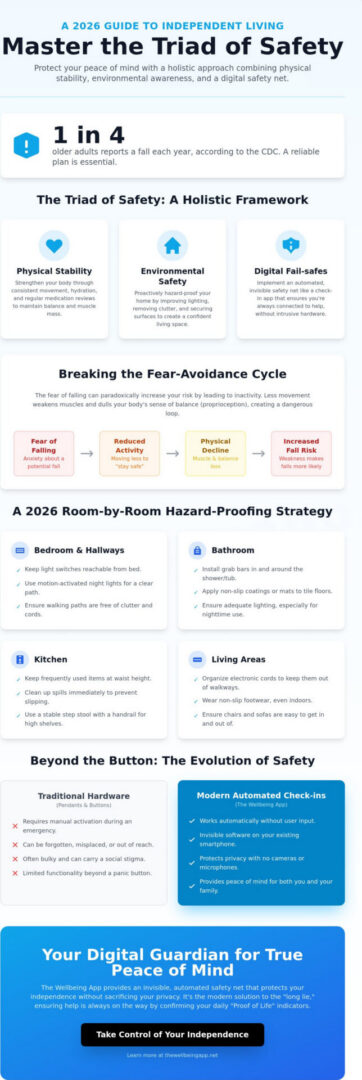
We’re here to help you protect your peace of mind. In this 2026 guide, you’ll master the “Triad of Safety,” a holistic approach combining physical stability, environmental changes, and digital fail-safes. With 1 in 4 older adults reporting a fall each year according to the CDC, having a reliable plan is essential. We’ll walk you through hazard-proofing your living space and establishing automated indicators that keep you connected to your community. You’ll learn how to create an invisible safety net that lets you take control of your environment while ensuring help is always ready when you care enough to know.
Key Takeaways
- Break the cycle of anxiety by mastering the “Triad of Safety,” a holistic approach that balances physical conditioning with environmental awareness.
- Implement a modern room-by-room hazard strategy that addresses often-overlooked risks like midnight lighting and bathroom floor textures.
- Learn why a safety check in app for seniors living alone provides a more reliable, invisible safety net than traditional hardware buttons or pendants.
- Identify internal risk factors by understanding how annual medication reviews and consistent hydration directly impact your balance and stability.
- Discover how to take control of your independence using scheduled “Proof of Life” indicators that protect your peace of mind without sacrificing privacy.
The Psychology of Falling: Why Living Alone Changes the Stakes
Living independently is a hard-won victory. It represents your strength and your desire to remain the architect of your own days. However, for those of us living solo, the stakes of a tumble are fundamentally different than they are for those in shared households. It isn’t just about the physical impact; it’s about the silence that follows. When there’s no one in the next room to hear a call for help, a simple trip can transform into a life-altering event. Understanding the psychology of falling helps us address these fears with logic rather than anxiety.
The most pressing concern for many is the “long lie.” This term describes the dangerous interval where a person remains on the floor for hours because they cannot reach a phone or alert system. It’s a scenario that creates deep-seated anxiety, often leading seniors to limit their activities. We believe safety technology shouldn’t be a reminder of vulnerability. Instead, a safety check in app for seniors living alone acts as an empowerment tool. It gives you the confidence to move freely, knowing that a silent guardian is always watching over your well-being.
The Fear-Avoidance Cycle
When fear takes root, the natural instinct is to move less to stay safe. Unfortunately, this creates a “fear-avoidance” cycle that actually increases your risk of injury. By reducing your daily activity, your body begins to experience sarcopenia, or the gradual loss of muscle mass. This weakness makes it harder to recover from a stumble. Movement is also essential for maintaining proprioception. Proprioception is the body’s ability to sense its movement and location. When you stop walking or reaching, your brain loses its fine-tuned connection to your limbs, making you feel less steady on your feet.
Peace of Mind as a Health Metric
We often view safety as a physical state, but it’s also a vital health metric for your mind. Chronic stress regarding your safety can lead to poor sleep patterns and reduced cognitive function. When you’re constantly on high alert, your brain doesn’t get the rest it needs to stay sharp. This is where the concept of empathetic vigilance becomes so powerful. It allows your family and community to remain connected to your status without hovering or being intrusive. By using a safety check in app for seniors living alone, you replace constant worry with a structured sense of unity. This mental clarity directly boosts your physical stability, allowing you to take control of your environment with a renewed sense of peace.
Hazard-Proofing Your Home: A 2026 Room-by-Room Strategy
Your home should be your sanctuary, a place where you feel most at ease. However, as we age, the environments we’ve lived in for decades can present new challenges. Hazard-Proofing Your Home isn’t about stripping away your personality; it’s about making subtle adjustments that allow you to move with confidence. By addressing risks room-by-room, you create a foundation for the “Triad of Safety” to work effectively. This proactive approach ensures that your physical environment supports your desire for independence.
In the bedroom, the primary risk occurs during the transition from sleep to movement. Ensure that light switches are reachable from your bed to avoid fumbling in the dark. Midnight wandering is a common cause of stumbles, so keeping a clear path to the bathroom is essential. In the bathroom, look beyond standard grab bars. Consider floor textures; applying non-slip coatings to tiles can prevent accidents when surfaces are wet. In the kitchen, reorganize your cabinets to keep frequently used items at waist height. Reaching for high shelves can cause dizziness or a loss of balance. We also recommend wearing non-slip footwear even when indoors, as socks on hardwood or tile are a significant slipping hazard. Living areas often suffer from modern electronic cord clutter. Use cable organizers to keep charging cables and lamp cords tucked away from walking paths. To ensure you’re never truly alone during these daily routines, using a safety check in app for seniors living alone provides a layer of digital protection that complements these physical changes.
Lighting as a Safety Feature
Modern smart lighting is a game-changer for 2026 safety. Motion-activated sensors can illuminate your path automatically as you step out of bed, eliminating the need to search for a switch. This is especially helpful for managing “sundowning,” where lower light levels in the evening can cause confusion or reduced depth perception. Maintaining consistent, bright lighting throughout the home helps your brain process your surroundings more accurately. For stairs, applying high-contrast tape to the edge of each step provides a critical visual cue, helping you identify exactly where to place your foot. This simple visual aid significantly reduces the risk of missteps on changes in elevation.
The Rug Debate: Secure or Remove?
Throw rugs are often the primary household hazard for solo seniors. While they add warmth, their edges are notorious for catching toes. The safest option is always to remove them entirely, but if you choose to keep them, they must be secured properly. Use industrial-grade double-sided tape or non-slip pads to ensure the edges don’t curl. We also suggest using transition strips between different flooring types, such as where carpet meets tile. These strips create a smooth slope, preventing the “toe-catching” that occurs at uneven thresholds. Taking these steps allows you to take control of your environment, ensuring your home remains a place of comfort rather than a source of worry.
Beyond the Button: Comparing Manual Alerts vs. Automated Check-ins
You have secured your rugs and upgraded your lighting, but the digital layer of your safety strategy is what ensures you are never truly alone. Traditional medical alert pendants have served a purpose for decades, yet they come with significant limitations that often lead to failure in real world scenarios. Many seniors find these devices stigmatizing or simply forget to wear them, leaving the button on a nightstand or in another room when a fall occurs. If you can’t physically reach or press that button, the device remains silent. A safety check in app for seniors living alone changes this dynamic by shifting the responsibility from the user to the technology.
When you use automated “Proof of Life” indicators, you create a silent safety net that doesn’t require you to wear a constant reminder of your vulnerability. This approach also removes the “burden of checking in” from your family. Instead of your children calling with an undertone of worry, the app handles the routine monitoring. This reduces family friction and allows your interactions to focus on connection rather than surveillance. Server side monitoring is also inherently more reliable than standard smartphone SOS features. If your phone breaks during a fall or the battery dies, a standard SOS button won’t work. An automated system knows you haven’t checked in and will trigger an alert regardless of your device’s status.
The Stigma of the Pendant
Privacy is a cornerstone of maintaining your dignity while living solo. Many people avoid traditional hardware because it feels like a loss of autonomy or an invitation for others to hover. We take a “Vigilant Guardian” approach that prioritizes your privacy; there are no invasive cameras or microphones. By using a discrete app, you take control of your safety without the visible label of a medical device. It’s about Strengthening Independence through technology that stays in the background until it’s actually needed.
Proactive vs. Reactive Safety
The fundamental difference between these two methods is when the help is summoned. Reactive safety requires you to be conscious and mobile enough to ask for assistance. Proactive safety assumes that if you haven’t checked in, something is wrong, and help is sent automatically. This distinction is what helps you protect your peace of mind and avoid the danger of a “long lie.”
| Feature | Manual Alert (Button) | Automated Check-in (App) |
|---|---|---|
| Activation | User must push a button | Automatic if check-in is missed |
| Reliability | Depends on battery and proximity | Server-side fail-safes |
| Privacy | Visible “medical” hardware | Discrete smartphone indicators |
| Response | Reactive (after the event) | Proactive (when you care enough to know) |
Strengthening Independence: Physical and Lifestyle Habits
While home modifications and digital tools are essential, your physical well-being is the core engine of your independence. A proactive lifestyle ensures your body stays responsive to your environment, allowing you to navigate your home with grace and power. By combining physical conditioning with a safety check in app for seniors living alone, you build a comprehensive defense against the risks of solo living. This internal strength is the first pillar of the Triad of Safety, ensuring that your body remains a reliable partner in your daily activities.
Dehydration is often a silent thief of balance. When your fluid levels are low, your blood pressure can become unstable, leading to sudden lightheadedness when you stand up from a chair or bed. Maintaining consistent hydration throughout the day is a simple yet powerful way to protect your stability. Similarly, your sensory health plays a massive role in how you move. Your eyes and ears are your primary sensors for foot placement; if your vision is blurred or your hearing is impaired, your brain receives incomplete data about your location in space. Regular check-ups for your vision and hearing are not just about health maintenance; they are critical safety checks that keep you oriented and secure.
Evidence-Based Movement
Tai Chi and seated core exercises are exceptional tools for improving your balance and coordination. These slow, deliberate movements train your nervous system to respond more effectively to changes in position. You can easily monitor your own progress at home using the 30-second sit-to-stand test. This involves counting how many times you can move from a seated to a standing position in half a minute. Leg strength is a primary predictor of fall recovery, as it provides the explosive power needed to catch yourself if you happen to stumble. Strengthening these muscles gives you the physical “brakes” necessary to prevent a trip from becoming a fall.
The Medication-Balance Link
Many common medications can inadvertently impact your equilibrium. Sedatives, certain antidepressants, and specific blood pressure treatments are known to increase fall risk by causing drowsiness or sudden drops in pressure. We recommend an annual medication review with your pharmacist to identify any dizziness-inducing side effects. If a medication causes lightheadedness, try to schedule your doses during times when you are less active or resting. To integrate these healthy habits into a broader security plan, take control of your daily safety here and ensure your family remains connected to your well-being.
Creating a daily safety routine is about unity between your physical actions and your digital safeguards. When you link your morning movement practice with your first digital check-in of the day, you establish a rhythm of safety that protects your peace of mind. This consistent habit ensures that your “Proof of Life” indicators are always active, providing a silent, empathetic vigilance that follows you through every room of your home.
The Digital Guardian: How The Wellbeing App Protects Your Peace of Mind
You have strengthened your body and secured your home. Now, it’s time to activate the final layer of the Triad of Safety. The Wellbeing App serves as the capstone of your independence, offering a level of empathetic vigilance that hardware alone cannot match. By utilizing a safety check in app for seniors living alone, you ensure that your autonomy is never compromised by the fear of being forgotten in a crisis. This is a sophisticated security tool designed to work in the background, allowing you to live your life without the constant intrusion of cameras or the physical weight of a pendant.
Our proprietary Proof of Life indicators act as a gentle, automated heartbeat for your daily routine. You simply set scheduled check-ins that align with your natural habits, such as waking up or finishing dinner. If a check-in is missed, our server-side monitoring system immediately recognizes the silence. It doesn’t rely on your phone being charged or within reach at that exact moment. Instead, the system proactively triggers automated alerts to your chosen circle of care. This ensures that if you can’t ask for help, the help comes to you automatically.
When You Care Enough to Know
This technology is built on the pillar of community unity. It fosters a sense of security for your family without the need for “nagging” phone calls or invasive check-ins that can cause friction between generations. For moments when you venture outside your sanctuary, the Chaperone feature provides added confidence during evening walks or social visits. Because the monitoring happens on our secure servers, there’s no extra hardware to charge or maintain. You simply use the smartphone you already own to stay connected to those who care about your well-being.
We also provide specialized Night Watch protection for the most vulnerable household hours. These are the times when help is hardest to reach and a fall can go unnoticed for the longest duration. By establishing a dedicated monitoring window during the night, we provide an extra layer of reassurance that someone is always looking out for your best interests while you rest.
Taking Control of Your Future
Investing in this digital guardian is about more than just fall prevention; it’s an investment in continued independence and family harmony. It allows your loved ones to rest easy, knowing you’re safe, while giving you the freedom to move through your day with total autonomy. Setting up your first check-in is a powerful way to take control of your environment and remove the anxiety of solo living. You deserve to feel empowered in your own home.
Don’t wait for a stumble to realize the value of a silent safety net. You have the power to define your own security on your own terms today. Protect your peace of mind with The Wellbeing App and embrace a future where you’re always connected, always cared for, and never truly alone.
Take Control of Your Independent Future
True independence is built on the foundation of the Triad of Safety: a stable body, a hazard-free home, and a reliable digital fail-safe. You’ve learned that preventing a fall is as much about your environment as it is about your physical strength. By addressing the psychological cycle of fear and implementing room-by-room modifications, you’ve already taken the first steps toward a more secure lifestyle. However, the final piece of the puzzle is ensuring that help is always within reach even when you can’t ask for it yourself.
A safety check in app for seniors living alone provides the ultimate layer of protection without the need for intrusive cameras or stigmatizing hardware. With Automated Proof of Life check-ins and Night Watch 24/7 server-side monitoring, you can trust that your well-being is being watched over by a compassionate guardian. This proactive approach ensures that your family stays connected to your status without hovering, fostering a sense of unity and care. It’s time to replace anxiety with confidence and move through your home with total freedom.
When you care enough to know that your safety is secure, you’re free to focus on what matters most. Protect your peace of mind with The Wellbeing App and start your journey toward a worry-free future today. You’ve worked hard for your autonomy; let us help you protect it.
Frequently Asked Questions
What is the “long lie” and why is it dangerous for seniors?
The “long lie” is the dangerous interval spent on the floor after a fall when you’re unable to get help. This period can lead to serious complications like hypothermia, dehydration, or muscle damage known as rhabdomyolysis. It’s a major concern for solo seniors because medical outcomes worsen significantly the longer a person remains unassisted. Rapid intervention is the key to maintaining your long-term health and independence.
Do I really need a safety app if I have a cell phone?
A cell phone is a reactive tool that only helps if you can reach it and remain conscious after a fall. A safety check in app for seniors living alone offers a proactive fail-safe that triggers help even if your phone is in another room. It ensures that your safety isn’t dependent on your physical ability to dial a number. This digital guardian works in the background to protect your peace of mind.
Are there fall prevention exercises I can do while sitting down?
Seated leg extensions and ankle circles are effective for building the muscle groups needed for stability. You can also perform seated marches to improve hip flexor strength while staying secure in your chair. These movements help maintain proprioception and core engagement without requiring you to stand. Consistent practice helps you take control of your physical health from the comfort of your living room.
What is a “Proof of Life” indicator and how does it work?
A Proof of Life indicator is an automated status check that confirms you are active and safe. It works by having you tap a button on your app at scheduled times throughout the day. If the server doesn’t receive this confirmation, it triggers an alert to your family or community contacts. This silent safety net ensures that help is summoned even if you’re unable to communicate.
How often should a senior living alone check in with family?
Most safety experts recommend at least two check-ins daily, typically once in the morning and once before bed. This rhythm ensures that help would arrive within twelve hours if an incident occurred. Using an automated tool allows you to maintain this routine without the friction of constant phone calls. It’s a way to show you care enough to know that everyone is safe and connected.
Can certain medications really make me more likely to fall?
Specific drugs like sedatives, antidepressants, and blood pressure medications can significantly increase your risk by causing dizziness or slow reaction times. These side effects can impair your balance, especially when you transition from sitting to standing. Always discuss these potential interactions with your healthcare provider. Understanding these risks is a vital part of protecting your well-being and maintaining your daily stability.
What should I do immediately after experiencing a fall at home?
Stay calm and remain still for a few moments to assess yourself for pain or injury before attempting to move. If you are hurt, don’t try to get up; instead, use your alert system or crawl toward a phone. If you aren’t injured, use a sturdy piece of furniture like a chair to slowly guide yourself back to a standing position. Taking these measured steps helps prevent further injury.
How does The Wellbeing App differ from a standard GPS tracker?
Standard trackers only provide coordinates, but our safety check in app for seniors living alone monitors your actual safety status through proactive indicators. Features like Night Watch and Proof of Life ensure that help is sent even if you aren’t moving or in a new location. Instead of just knowing where you are, your community knows that you are okay. This approach focuses on empathetic vigilance rather than just location data.