Home Healthcare Nurse Safety App: The Complete Guide to Personal Protection in 2026
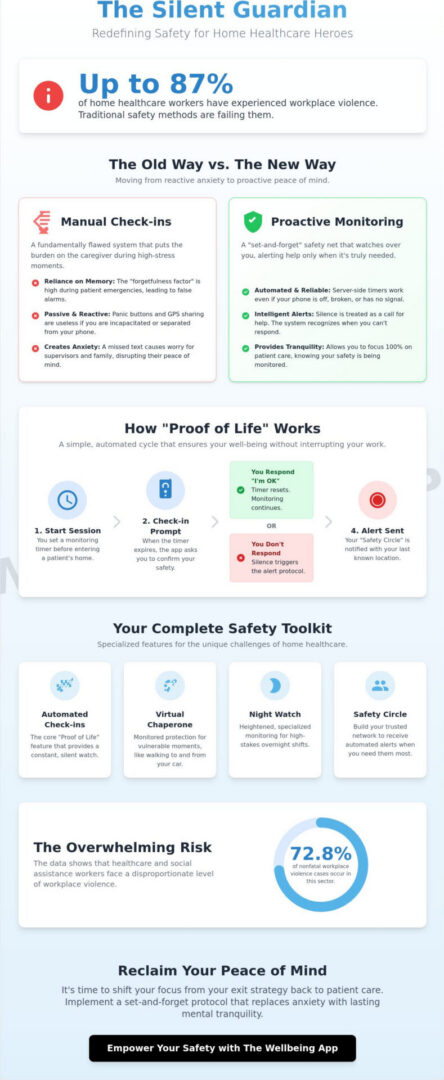
Did you know that up to 87% of home healthcare workers have experienced some form of workplace violence during their careers? It’s a staggering reality that makes every knock on an unfamiliar door feel like a calculated risk. You likely know the heavy burden of manually texting a supervisor “I am okay” every hour or the quiet anxiety that settles in when you enter an unpredictable residential environment. This constant state of high alert is exhausting, yet finding a reliable home healthcare nurse safety app shouldn’t be another source of stress. It should be your silent, watchful protector.
We understand that your focus belongs on your patients, not on your exit strategy. That’s why we’re exploring how proactive safety technology and automated Proof of Life monitoring are redefining personal security for professionals in 2026. This guide promises to show you how a set-and-forget safety net can provide true mental tranquility during high-stress shifts. We will preview the latest in automated alerts that trigger only when something is wrong, ensuring you have a compassionate guardian by your side without the need for constant manual check-ins. It’s time to reclaim your peace of mind while you provide essential care in the community.
Key Takeaways
- Understand why traditional manual check-ins are no longer enough and how proactive monitoring provides a superior safety net for lone healthcare workers.
- Learn how a modern home healthcare nurse safety app uses Proof of Life indicators to verify your well-being without interrupting your patient care.
- Discover the protective benefits of a virtual Chaperone during your walk to the car and specialized Night Watch monitoring for high-stakes overnight shifts.
- Master the steps to build your own Safety Circle, ensuring that the right people receive automated Emergency Alerts only when you truly need them.
- Shift your focus back to patient care by implementing a set-and-forget protocol that replaces anxiety with lasting mental tranquility.
The Rising Need for Home Healthcare Nurse Safety Apps
Entering a patient’s home is an act of profound trust. For many visiting nurses, that trust is often shadowed by a quiet, persistent concern for their own well-being. The US healthcare sector has seen a massive shift toward home-based care, yet the infrastructure for protecting those who deliver it hasn’t always kept pace. Relying on a robust home healthcare nurse safety app is no longer just a luxury. It’s a vital component of a professional’s toolkit. When you’re alone in a residential setting, the distance between you and help can feel immense. This isolation doesn’t just present physical risks; it creates a psychological weight that can lead to burnout and chronic stress. We believe that every caregiver deserves to feel as safe as the patients they serve.
The Statistics of Lone Worker Vulnerability
Recent data highlights the urgency of this issue. Research indicates that up to 87% of home healthcare workers have encountered workplace violence at some point in their careers. In 2022, the healthcare and social assistance sectors accounted for 72.8% of all nonfatal workplace violence cases in the private industry, totaling 41,960 reported incidents. These risks aren’t confined to specific zip codes. They happen during late-night shifts, in sprawling rural counties, and within unfamiliar urban neighborhoods. In 2026, a home health aide is officially classified as a lone worker whenever they perform duties without the direct, immediate presence of a colleague or supervisor. This lone worker safety status requires more than just a policy manual. It requires active, real-time protection that stays with you from the moment you leave your car.
Why Manual Safety Protocols Often Fail
For years, the standard protocol involved manual check-ins. A nurse might be expected to text a supervisor or call a family member after every visit. However, these systems are fundamentally flawed. In high-stress clinical environments, the “forgetfulness factor” is real. When a patient’s condition destabilizes, your first instinct is to provide care, not to check your phone. If you forget to text, it triggers a wave of unnecessary anxiety for your loved ones. They’re left wondering if you’re simply busy or if something is truly wrong. Standard smartphone GPS sharing also falls short because it’s a passive tool. It tells people where you are, but it doesn’t tell them if you’re safe. Without automated alerts or a dedicated home healthcare nurse safety app, a safety emergency could go unnoticed for hours. True empowerment comes from moving beyond simple compliance and adopting technology that acts as your silent, digital guardian.
What is a “Proof of Life” Safety App?
The term “Proof of Life” might sound like something from a high-stakes thriller, but in the context of a home healthcare nurse safety app, it represents the gold standard of proactive protection. While traditional safety tools wait for you to initiate a call for help, a Proof of Life system flips the script. It functions as a digital heartbeat, periodically asking you to confirm your well-being with a simple tap. If that confirmation doesn’t happen, the system recognizes the silence as a potential emergency. This shift from reactive to proactive monitoring is what provides true mental tranquility. You no longer have to worry about whether you can reach your phone in a crisis; the system is already looking out for you.
Proactive vs. Reactive Safety Technology
Most people are familiar with reactive safety, such as a panic button or a 911 shortcut. The fatal flaw of these systems is their reliance on your ability to act during a moment of peak stress or physical restriction. If you’re incapacitated or separated from your device, a panic button is useless. Proactive technology, however, utilizes server-side monitoring to ensure you’re never truly alone. This approach aligns with broader OSHA guidelines for home healthcare safety, which emphasize the importance of identifying and mitigating risks before they escalate. By using a system that monitors you from a remote server, your safety net remains intact even if your phone is destroyed or the battery dies. This significantly reduces the time-to-rescue, as help is dispatched the moment a check-in is missed, not hours later when a supervisor realizes you haven’t returned.
The Anatomy of an Automated Check-In
An effective home healthcare nurse safety app allows you to customize your protection based on the specific environment you’re entering. If you’re visiting a new patient in an isolated area, you might set a check-in interval for every thirty minutes. For routine visits in familiar settings, you might extend that time. When a check-in is due, you receive a discreet notification. If you don’t respond, the system initiates an automated escalation process, notifying your designated Safety Circle without escalating the situation on-site. Because the monitoring occurs on a secure remote server rather than solely on the user’s phone, an automated alert is triggered the moment a check-in is missed, ensuring help is dispatched even if the physical device is lost, broken, or powered down. This level of automation removes the burden of manual reporting, allowing you to focus entirely on clinical care. To see how this technology integrates into your daily routine, you can explore the features of The Wellbeing App and its specialized monitoring tools. Your privacy remains a priority throughout this process, as location sharing is only active during your scheduled visits, preserving your personal agency while you’re off the clock.
Key Features Every Nurse Safety App Should Have
A comprehensive safety net requires more than a simple check-in button. It needs to account for every phase of your shift, from the moment you leave your vehicle to the quiet hours of an overnight assignment. While the automated monitoring we discussed previously provides the foundation, a specialized home healthcare nurse safety app must offer tools that adapt to your specific environment. These features shouldn’t feel like a burden or an extra task on your already busy schedule. Instead, they should function as a silent, supportive partner that enhances your personal agency and grants you the mental tranquility needed to provide excellent clinical care.
The Virtual Chaperone: Safety in Transit
The transition between your car and a patient’s front door is often the moment of highest vulnerability. Dimly lit parking garages, narrow apartment hallways, and isolated rural driveways can create a sense of unease that lingers long after you’ve entered the home. A Chaperone feature addresses this specific anxiety by acting as a watchful protector during your transit. When you activate this mode, the system enters a high-frequency monitoring state, essentially walking with you until you confirm you’re safely inside. This creates a powerful deterrent effect. If someone intends to cause harm, seeing a professional who is actively engaged with a safety system often discourages the attempt. It transforms a high-risk walk into a managed, secure journey, ensuring that your loved ones are alerted the second your progress is interrupted.
Night Watch: Protection for After-Hours Care
Overnight shifts and 24-hour care assignments bring a different set of challenges. The isolation of the night can make the distance to help feel much greater, and the natural onset of fatigue can sometimes slow your reaction time in a crisis. Night Watch is a specialized protocol designed to protect you during these long, quiet hours. It integrates seamlessly into your professional routine, providing a consistent safety rhythm that doesn’t disrupt the patient’s rest. By setting longer, customized check-in intervals that match the pace of night care, you maintain a digital connection to your Safety Circle without needing to constantly check your phone. If you’re unable to respond to a scheduled indicator, the system initiates an immediate escalation, bridging the gap between isolation and assistance.
Beyond these specialized tools, your home healthcare nurse safety app must include foundational features like Location Sharing and Emergency Alerts. Location Sharing creates a digital breadcrumb trail that gives emergency services the precise coordinates they need, even in complex multi-unit buildings. Meanwhile, Emergency Alerts provide a one-touch or automated dispatch to your designated contacts, ensuring that help is never more than a heartbeat away. When these features work in harmony, they create an atmosphere of safety and trust. You aren’t just using a tool; you’re engaging a compassionate guardian that values your well-being as much as you value your patients’ health.
Implementing a Personal Safety Protocol for Home Visits
Safety is not merely a corporate policy; it is a personal practice that begins long before you arrive at a patient’s doorstep. While your organization may have its own requirements, true mental tranquility comes from taking ownership of your own security. This starts with a proactive risk assessment of every environment you enter. Before stepping out of your vehicle, take a moment to observe the surroundings. Check for adequate lighting, clear paths to exits, and any signs of potential instability in the area. By integrating a home healthcare nurse safety app into this initial assessment, you transform a moment of observation into an active layer of protection. You aren’t just looking for trouble; you’re ensuring that your silent guardian is ready to act if needed.
Building Your Emergency Contact Network
Your “Safety Circle” is the group of individuals who will receive your Emergency Alerts if an indicator is missed. When choosing these contacts, consider a mix of family members and professional colleagues. Family members provide a deep sense of duty and connection, while colleagues understand the specific clinical context of your work. Once you’ve selected your circle, briefing them is essential. They need to understand that an automated alert from your home healthcare nurse safety app is a high-stakes signal that requires immediate action. This creates a sense of community unity, reinforcing the idea that your safety is a shared responsibility. When your circle is well-prepared, you can walk into any home knowing that a reliable team is standing by, ready to support you at a moment’s notice.
Establishing Routine Check-In Habits
The most effective safety protocols are those that become second nature. Integrating app check-ins into your standard clinical workflow ensures that protection never feels like an interruption. For instance, make it a habit to activate the Chaperone feature every time you walk from your car to a residence and again when you depart. This consistent rhythm builds a protective barrier around your most vulnerable moments. Automating these routine safety habits ensures that your mental energy is reserved for complex patient care rather than constant security monitoring, which directly reduces cognitive load and professional burnout. When safety becomes a background process, you’re free to focus on the human connection that defines your profession.
Communicating these protocols to patients and their families can also be handled with professional grace. You might simply mention, “I use a professional safety system that checks in with my team periodically.” This transparency often builds respect and sets a tone of mutual safety and trust. It demonstrates that you are a disciplined professional who values both your well-being and the quality of care you provide. To begin personalizing your own protection strategy, you can start building your custom safety protocol today. By combining proactive habits with sophisticated technology, you ensure that every visit is defined by care, not by concern.
The Wellbeing App: Empowering Nurses with Proactive Protection
In a profession dedicated to the healing of others, your own safety should never be an afterthought. The Wellbeing App has emerged as the preferred home healthcare nurse safety app because it addresses the emotional and physical realities of lone clinical work. We don’t just provide software; we offer a commitment to your mental tranquility. By shifting the burden of security from your shoulders to our automated systems, we allow you to focus on what you do best: providing compassionate care. Our platform is built on the belief that a safe nurse is an empowered nurse, capable of fostering deep connections with patients without the shadow of anxiety. We are your compassionate guardian in the field.
At the heart of our service is the Proof of Life indicator. This is your silent, digital guardian that maintains a constant connection to our secure servers. Unlike reactive tools that require you to call for help, this proactive system monitors your status throughout your shift. If a scheduled check-in is missed, our 24/7 server-side monitoring immediately initiates an escalation protocol. This approach ensures that even if you’re unable to reach your phone, your Safety Circle is notified and help is on the way. It’s about creating a professional environment where no nurse is ever truly alone, regardless of their location or the time of day.
Specialized Tools for the Healthcare Hero
We recognize that nursing doesn’t follow a standard nine-to-five schedule. That’s why our specialized features are designed to adapt to your unique life. Whether you are navigating a dimly lit apartment complex or staying awake during a quiet overnight shift, our tools are ready to support you.
- Night Watch: Provides specialized protection for long overnight shifts where isolation feels most acute.
- Chaperone: Offers high-frequency monitoring during your walk to and from your vehicle, ensuring you’re never vulnerable in transit.
- Rapid Onboarding: You can set up your entire safety net and designate your Safety Circle in under five minutes.
Many home health nurses report that having these tools at their fingertips has completely transformed their professional confidence. We hear from clinicians who previously felt a sense of dread during late-night urban visits but now move with a renewed sense of calm. Families also benefit from this collective responsibility. Knowing that an automated system is watching over their loved one allows them to rest easier while you are out serving the community. This harmony between technology and human connection is the foundation of everything we do.
Taking Control of Your Personal Agency
You shouldn’t have to wait for an employer to prioritize your well-being. While many agencies are adopting better protocols, your safety is ultimately an expression of your own personal agency. An independent home healthcare nurse safety app provides a consistent safety net that moves with you. It stays by your side whether you’re working for a large hospital system, a small local agency, or taking on private duty assignments. It’s an investment in your career and your peace of mind. By taking proactive steps today, you ensure that you can continue serving your community with a clear heart and a focused mind. Ensure your safety with The Wellbeing App today and experience the freedom that comes with true professional security.
Empowering Your Professional Journey with Proactive Safety
Your role as a caregiver is one of the most vital in our society; however, it shouldn’t come at the cost of your own mental tranquility. We’ve explored how moving beyond reactive panic buttons to a proactive home healthcare nurse safety app fundamentally changes your daily experience. By utilizing automated Proof of Life indicators and 24/7 server-side safety monitoring, you ensure that a silent guardian is always watching over you. This technology works in the background, allowing you to focus entirely on the healing work that defines your career.
Whether you’re navigating a dark hallway with the Chaperone feature or managing a quiet shift under the protection of Night Watch, these tools are designed to honor your personal agency. You have a duty to your patients, but you also have a profound duty to return home safely to your loved ones. Don’t wait for an external mandate to prioritize your well-being. You can protect your peace of mind with The Wellbeing App’s Proof of Life monitoring today. Step into every home with the confidence that you are supported, valued, and never truly alone.
Frequently Asked Questions
Is a home healthcare nurse safety app better than a wearable panic button?
A home healthcare nurse safety app offers superior protection because it provides proactive monitoring rather than just a reactive response. While a wearable button requires you to physically reach and press it during a crisis, an app with Proof of Life indicators will trigger an alert automatically if you fail to check in. This ensures that help is dispatched even if you are unable to move or reach your device during an emergency.
How does “Proof of Life” monitoring protect me if I can’t reach my phone?
Proof of Life monitoring protects you by shifting the safety timer to a secure remote server rather than relying solely on your physical device. If you cannot reach your phone to confirm your well-being, the server recognizes the missed check-in and automatically initiates an escalation to your Safety Circle. This fail-safe mechanism ensures that a broken, lost, or unreachable phone never stands in the way of your rescue.
Will a safety app drain my battery during a long nursing shift?
Modern safety technology is designed to be energy-efficient, ensuring it won’t drain your battery during a standard 12-hour shift. The app primarily runs in the background and only uses significant power when high-frequency features like Chaperone or active Location Sharing are engaged. You can confidently maintain your safety net from your first morning patient visit until your final documentation of the day is complete.
Can I use a safety app for my commute as well as my patient visits?
You can absolutely use the app to protect your commute, especially when walking through parking structures or unfamiliar apartment complexes. The Chaperone feature is specifically designed for these transit moments, providing a watchful protector that stays active until you confirm you’ve safely reached your vehicle or home. It extends your professional security protocol into your personal travel, offering mental tranquility throughout your entire day.
Do I need my employer’s permission to use a personal safety monitoring app?
You generally don’t need employer permission to use a personal home healthcare nurse safety app, as it functions as a private tool for your own well-being. Many nurses choose to implement their own safety circle of family and trusted friends to ensure they have a dedicated support system that moves with them between different assignments. It’s an act of personal agency that demonstrates your commitment to professional longevity and safety.
How does the app handle privacy and location tracking when I am off the clock?
Your privacy is a fundamental priority, and location tracking is only active when you have explicitly started a safety session or check-in timer. When you are off the clock and the app is inactive, the system does not monitor your movements or share your location with your Safety Circle. This ensures a clear boundary between your professional protection and your private life, allowing you to enjoy your downtime without feeling monitored.
What happens if I miss a scheduled check-in by accident?
If you accidentally miss a check-in, the app will first send a series of high-priority audible and visual reminders to your phone before any alerts are sent to your contacts. This grace period allows you to quickly reset the timer if you were simply caught up in patient care or a clinical conversation. Only when these reminders go unacknowledged does the system escalate the situation, ensuring your Safety Circle is only contacted when it truly matters.