
How to Build a Safety Network with Friends and Family for Total Peace of Mind
What if you could guarantee that someone would always know you’re safe, even if you never had to send a single “I’m okay” text? Many of us live with the quiet fear of an accident occurring while we’re alone, yet we hesitate to bother our busy inner circle with constant check-ins. Learning how to build a safety network with friends and family is the key to silencing that anxiety. It’s about creating a system of collective responsibility where technology and human connection work in harmony. Research from Massachusetts General Hospital identifies social connection as the single strongest protective factor against depression, proving that a strong circle is vital for your mental tranquility.
We understand that maintaining your independence is just as important as your physical security. You’ll learn how to create a reliable, multi-layered safety network that protects your loved ones without compromising their freedom. We’ll show you how to move beyond confusing emergency contacts and toward a structured, fail-safe system. We will cover how to choose your safety team, organize notification levels, and integrate automated tools like Proof of Life indicators to act as your virtual guardian.
Key Takeaways
- Understand the vital distinction between a static emergency contact list and a proactive, multi-layered safety network designed for real-world scenarios.
- Learn how to build a safety network with friends and family by applying the “Rule of Five” to assign specific roles like Keyholders and Remote Monitors.
- Establish clear “Proof of Life” windows and a tiered response plan to ensure help arrives precisely when it is needed without unnecessary panic.
- Discover how to reframe your safety protocols as an act of collective responsibility that offers your loved ones the gift of mental tranquility.
- Explore how server-side monitoring acts as an always-on virtual guardian, providing a fail-safe layer of protection even if your device fails.
Defining the Modern Safety Network for Personal Security
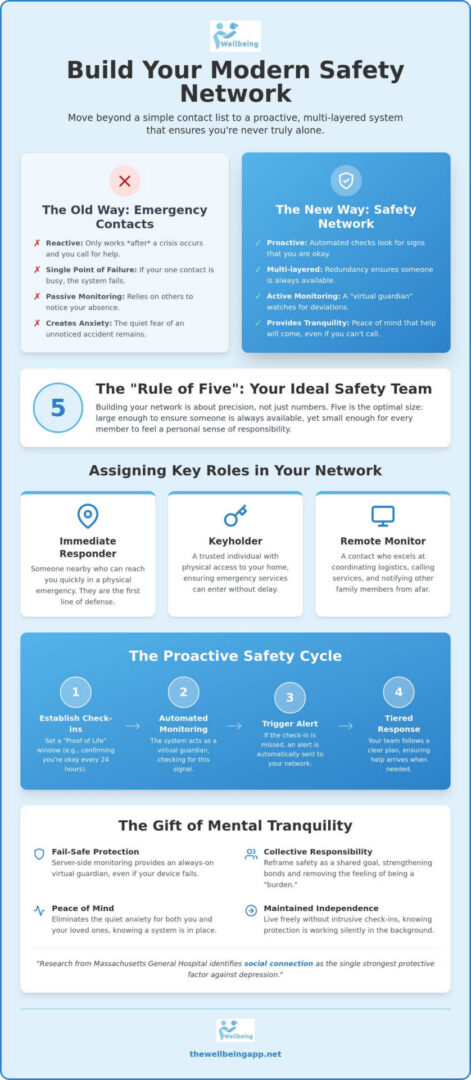
A safety network is often mistaken for a simple list of emergency contacts stored in a phone. In reality, a true network is a proactive, multi-layered system that combines human connection with intelligent tools to ensure you are never truly alone. When you consider how to build a safety network with friends and family, you are looking for more than just a list of people to call after a crisis. You are building a circle of empathetic vigilance. This means your loved ones remain watchful and ready to act, but they do so without intruding on your daily life or compromising your independence.
The traditional approach to personal security has always been reactive. You have a problem, you call for help, and someone responds. But what happens if you cannot reach your phone? In 2026, the shift toward proactive monitoring has changed the definition of safety. It’s no longer about waiting for a disaster to strike; it’s about establishing indicators that prove everything is fine. This shift moves the burden of discovery away from the victim and places it onto a structured, automated system that alerts your circle if something feels wrong. This approach ensures that help is dispatched even when you cannot ask for it yourself.
The Difference Between Support and Safety
It’s vital to distinguish between general social support and a dedicated safety network. While a support network helps with emotional needs or daily chores, a safety network is specifically designed to respond to crises. Relying on a single person for your safety creates a single point of failure. If your primary contact is busy, asleep, or out of range, the entire system collapses. A formalized network uses active monitoring, where check-ins are expected, rather than passive monitoring, where people simply wait for you to reach out first.
Why Vulnerable Adults Need Formalized Networks
For those living alone or aging in place, the risks of an unnoticed accident are a constant source of quiet anxiety. A formalized network replaces this fear with mental tranquility. By organizing a team, you ensure that someone is always available to step in. Research shows that community-based safety teams significantly reduce the time it takes for help to arrive during a medical emergency. This structured approach allows you to maintain your personal agency while enjoying the comfort of knowing a virtual guardian is always looking out for your best interests.
Identifying Your Safety Inner Circle and the Rule of Five
Building a network isn’t about collecting as many phone numbers as possible. It’s about precision and redundancy. When you consider how to build a safety network with friends and family, the “Rule of Five” provides the perfect balance. Five is the optimal number for a safety team because it’s large enough to avoid a single point of failure, yet small enough that every member feels a personal sense of responsibility. If you have too many people, everyone assumes someone else will take the lead. If you have too few, a single busy afternoon for one person leaves you vulnerable.
Your team needs specific roles to function effectively. The Immediate Responder is someone who can drop everything to help. The Keyholder is a trusted individual with physical access to your home, such as a neighbor or a nearby sibling. Finally, the Remote Monitor is often a family member who lives further away but excels at coordinating logistics or checking digital indicators. By assigning these roles, you ensure that everyone knows exactly what is expected of them when a notification arrives. Diversity in daily schedules is also vital. You don’t want a team where everyone works the same 9-to-5 shift or lives in the same time zone.
Choosing Proximal vs. Remote Contacts
A resilient network requires a blend of local and distant support. You need at least one person who can reach your front door within a 15-minute radius. This proximal contact is your first line of defense for physical emergencies. However, remote contacts are equally valuable. They can stay on the line with emergency services, notify other family members, or manage digital alerts while your local contact is in transit. To help organize these roles, you can use resources like the official guide to Make a Plan, which offers a framework for family communication.
Assessing Reliability and Availability
Reliability is more than just being a good friend. It’s about consistent availability and the willingness to act. When inviting people into your network, have a transparent “Safety Talk.” Ask them directly if they are usually near their phone during specific times of the day. A Reliable Contact is someone who understands the weight of a missed check-in and treats it with the appropriate gravity. If someone feels hesitant or too busy, thank them for their honesty and look for another candidate. It’s better to have a smaller, dedicated team than a large, unresponsive one. For those who want to simplify this process, using automated safety tools can help bridge the gap between your circle’s busy lives and your need for constant protection.
Establishing Reliable Communication Protocols and Check-ins
A safety network is only as strong as the protocols that govern it. When you are learning how to build a safety network with friends and family, the most critical step is defining exactly how and when communication happens. Without a structure, checking in becomes a vague suggestion rather than a reliable indicator of well-being. We recommend establishing Proof of Life windows. These are specific, agreed-upon times during the day when you provide a signal that you are safe. By standardizing these moments, you remove the guesswork for your circle and ensure that a missed window is immediately recognized as a potential issue.
A tiered response plan ensures that your network doesn’t overreact to a simple nap or a forgotten phone, while still maintaining a high level of vigilance. This structure moves through four logical stages:
- Level 1: The Text. A quick message to confirm status.
- Level 2: The Call. If no text response within 15 minutes, a direct phone call.
- Level 3: The Physical Check. If the call is unanswered, the Keyholder visits the home.
- Level 4: Emergency Services. Contacting authorities if the Keyholder cannot resolve the situation.
The “No-Response” Protocol is the backbone of this system. It dictates exactly how long your team should wait before escalating from one tier to the next. For most, a 30-minute window between a missed text and a physical check provides a balance between safety and privacy. This precision eliminates the paralyzing indecision that often occurs when a friend doesn’t reply. Your team won’t have to wonder if they are being annoying because they are simply following the plan you created together.
The Failure Points of Manual ‘Text Me’ Systems
Relying on a simple “text me when you get home” is a common point of failure. If both you and your friend are busy, it’s easy for a missed text to go unnoticed for hours. Group chats can also lead to the bystander effect, where every member assumes someone else has seen your check-in. This human error is not a lack of care; it’s a byproduct of modern life. Moving beyond manual texting reduces check-in fatigue and ensures that your safety doesn’t depend on your friend’s ability to keep their eyes on their screen at all times.
Setting Up a Daily Safety Routine
Deciding between morning or evening check-ins depends on your individual lifestyle. Morning check-ins are often best for those living alone, as they ensure you started your day safely after a night’s sleep. Evening check-ins are vital for those who have active days or commute late. Some families use shared digital calendars to signal their status, but the most effective routines incorporate automated technology. By using server-side monitoring, you can automate your “I am okay” signal, allowing your network to remain in a state of mental tranquility without the constant burden of manual messaging.
Overcoming the Fear of Being a Burden Through Reframing
The single greatest barrier to personal security isn’t a lack of technology or a lack of willing friends. It is the deep seated fear of being a burden. Many adults hesitate when considering how to build a safety network with friends and family because they don’t want to “annoy” their loved ones with daily check-ins. This hesitation often stems from a misunderstanding of what a safety network actually does. You aren’t asking for a favor; you are establishing a system of collective responsibility. By formalizing your safety, you actually remove the nagging uncertainty that your family members carry every day. You’re replacing their silent worry with a structured plan that only requires their attention when it truly matters.
A well organized system reduces the mental load on your circle. Without a protocol, your friends have to decide for themselves when to worry, when to call, and when to feel guilty for not checking in. This ambiguity is exhausting. When you provide a clear framework, you give them permission to stop worrying. They know that as long as the system is quiet, you are safe. This clarity preserves their mental tranquility and allows your interactions to remain focused on connection rather than constant wellness checks. It transforms safety from a series of intrusive questions into a background layer of empathetic vigilance.
Reframing Safety as Peace of Mind
Your family members likely worry about you more than they admit. They might stay silent because they don’t want to seem overprotective or infringe on your privacy. By introducing a safety network, you are giving them the gift of transparency. This openness fosters a deeper level of trust because it removes the guesswork from your relationship. When everyone understands the protocol, the anxiety of the unknown disappears. Safety is not a chore you impose on others, but a shared emotional end that preserves the well-being of the entire family unit.
Balancing Independence with Protection
Maintaining your personal agency is a vital part of knowing how to build a safety network with friends and family. Watchful protection is fundamentally different from surveillance. You don’t need to be tracked every second of the day to be safe. Instead, you can choose the right level of location sharing and check-ins that match your comfort level. For instance, you might only share your location during a high risk moment, such as walking home late at night, while keeping your daily movements private. This balance ensures you are protected without feeling watched. To start building this balance today, you can download The Wellbeing App and customize your own virtual guardian settings.
Strengthening Your Network with The Wellbeing App
The human protocols we’ve discussed are foundational, but even the most dedicated “Rule of Five” team is limited by the realities of busy schedules and human error. This is where technology transforms a social agreement into a fail-safe system. The Wellbeing App acts as the “Server-Side Guardian” for your circle, providing a technical layer of protection that never sleeps. When you are learning how to build a safety network with friends and family, integrating this type of automated monitoring ensures that your safety doesn’t depend on whether a friend happened to check their phone at the exact right minute. It bridges the gap between your loved ones’ busy lives and your own need for mental tranquility.
Automated Proof of Life for 24/7 Assurance
The app automates the “Proof of Life” indicators established in your communication plan. Instead of manual texts that can be forgotten, the app uses server-side logic to monitor your status. If you fail to check in during your agreed-upon window, the system automatically dispatches alerts to your team. This significantly reduces check-in fatigue because your loved ones only hear from the system when an actual intervention is required. Because the monitoring is server-side, it remains active even if your phone battery dies or you lose signal. It works when manual systems fail.
Virtual Chaperone and Location Sharing Features
For high-stakes moments, the Chaperone and Night Watch services provide focused, empathetic vigilance. If you’re walking home alone or entering an unfamiliar situation, the Chaperone feature alerts your network to stay on standby. Night Watch offers similar protection while you sleep, ensuring that your circle is notified if any indicators of concern are detected during the night. These tools empower you with proactive safety management, allowing you to maintain your personal agency while your network remains ready to act. Real-time Location Sharing further strengthens this bond, ensuring that if a crisis does occur, your Immediate Responders know exactly where to go without delay.
This integration creates a sense of harmony between your social life and your security needs. You’re no longer “bothering” people; you’re using a sophisticated instrument of empowerment. The app serves as a compassionate guardian that monitors the background so you can focus on living your life. By removing the friction of manual check-ins, you preserve the mental state of everyone involved. This allows your relationships to flourish without the weight of constant worry. You gain total peace of mind through a system that is both technologically sophisticated and deeply caring.
Secure Your Peace of Mind with a Virtual Guardian
True safety is found in the harmony between human connection and intelligent technology. Moving beyond a simple list of contacts and embracing a structured “Rule of Five” team ensures that someone is always ready to act. Establishing clear Proof of Life windows replaces the constant anxiety of the unknown with a reliable, predictable rhythm. Understanding how to build a safety network with friends and family allows you to respect your independence while providing a fail-safe layer of protection for those living alone.
The Wellbeing App serves as the final piece of this puzzle. It offers 24/7 server-side monitoring that stays active even when your phone battery fails. With automated Proof of Life check-ins and empathetic vigilance for solo dwellers, you can finally silence the quiet fears of “what if.” It’s time to transform your safety from a source of stress into a foundation for empowerment. Build your digital safety net today with The Wellbeing App and enjoy the mental tranquility you deserve. Your circle is ready to protect you, and we’re here to make sure they never miss a beat. Stay safe, stay connected, and live with total confidence.
Common Questions About Personal Safety Networks
What is a safety network and why do I need one?
A safety network is a proactive system that combines trusted people with automated tools to ensure you are never truly alone. Unlike a traditional emergency contact list that only helps after a crisis, a network provides a constant layer of empathetic vigilance. You need one to replace the quiet anxiety of solo living with mental tranquility, ensuring that help is dispatched even if you are unable to call for it yourself.
How many people should be in my safety network?
We recommend the “Rule of Five” as the optimal size for your inner circle. Five members provide enough redundancy to account for busy schedules and different time zones without diluting the personal sense of duty each person feels. This group size ensures that at least one person is always available to respond to an automated alert or a missed check-in window, maintaining the integrity of your virtual guardian system.
What should I do if a family member misses a scheduled check-in?
You should immediately initiate your tiered response plan rather than waiting or wondering if you are being intrusive. Start with a direct text message, followed by a phone call if there is no response within fifteen minutes. If the call goes unanswered, dispatch your local Keyholder for a physical check. Having this pre-set protocol removes the paralyzing indecision that often delays life-saving assistance during a real medical or safety emergency.
How can I build a safety network without feeling like a burden?
The best way to overcome this feeling is to reframe the network as a gift of peace of mind for your loved ones. Most family members worry about you in silence; by learning how to build a safety network with friends and family, you replace their vague anxiety with a structured, automated process. This system actually reduces their mental load because they only need to take action when the protocol signals a genuine concern.
Is a safety app better than a manual check-in system?
An automated app is significantly more reliable because it utilizes server-side monitoring that doesn’t rely on human memory. Manual “text me when you’re home” systems frequently fail when one person gets distracted or a phone battery dies. A dedicated app provides a fail-safe “Proof of Life” indicator that continues to watch over you even when your device is offline, ensuring your circle is alerted the moment a routine is broken.
Can a safety network help seniors living alone maintain independence?
A formalized network is one of the most effective ways for seniors to age in place with confidence. It provides a non-intrusive safety net that respects personal agency while offering the watchful protection necessary for solo living. Knowing that a team of trusted responders is linked through a virtual guardian allows seniors to maintain their daily routines without the constant fear that an accident might go unnoticed for days.
What information should I share with my safety team members?
Your team needs to know your daily check-in windows, the location of your spare keys, and any critical medical information that emergency responders might need. It’s also vital that every member knows who else is in the “Rule of Five” group. This transparency allows your proximal and remote contacts to coordinate their efforts seamlessly during a tiered response, ensuring that everyone understands their specific role in your protection.
How do I talk to my friends about being part of my safety team?
Start a transparent conversation about your desire for collective responsibility and mental tranquility. Explain that you are establishing a proactive system and would value their presence in your inner circle. Most friends feel a deep sense of duty toward those they care about and are relieved to have a clear plan. Discussing how to build a safety network with friends and family together ensures that everyone is comfortable with the expectations and the technology involved.