
Location Sharing for Personal Safety: Moving Beyond Passive Tracking in 2026
What if the glowing dot on your smartphone screen isn’t actually protecting your family, but is instead just fueling your own restlessness? We’ve all been there; staring at a map and waiting for a GPS refresh while a text remains unread. It’s time to look at alternatives to constant location sharing that do more than just show a coordinate. You deserve a system that understands the difference between a busy afternoon and a genuine emergency.
I understand the deep-seated desire for harmony and the quiet worry that comes with being a caregiver. It’s exhausting to be the one constantly checking a map for updates. This guide will show you how to move beyond passive tracking to create a reliable safety net for your community. You’ll discover how automated tools like Proof of Life and Night Watch can act as a digital chaperone, providing alerts only when something is actually wrong. We will explore how to build a system that offers true mental tranquility and ensures a response is triggered even when your loved one cannot call for help.
Key Takeaways
- Learn why a GPS coordinate alone cannot confirm a loved one’s well-being and how to move beyond basic map-watching.
- Identify how to choose Trusted Contacts based on proximity and availability to ensure a rapid response during critical moments.
- Explore effective alternatives to constant location sharing, including automated check-ins that provide peace of mind without compromising privacy.
- Discover how to build a Safety Circle for seniors and travelers that integrates community support with professional-grade monitoring.
- Master the transition from passive tracking to proactive safety management to achieve lasting mental tranquility for your entire family.
What is Location Sharing and Why Standard GPS Isn’t Enough?
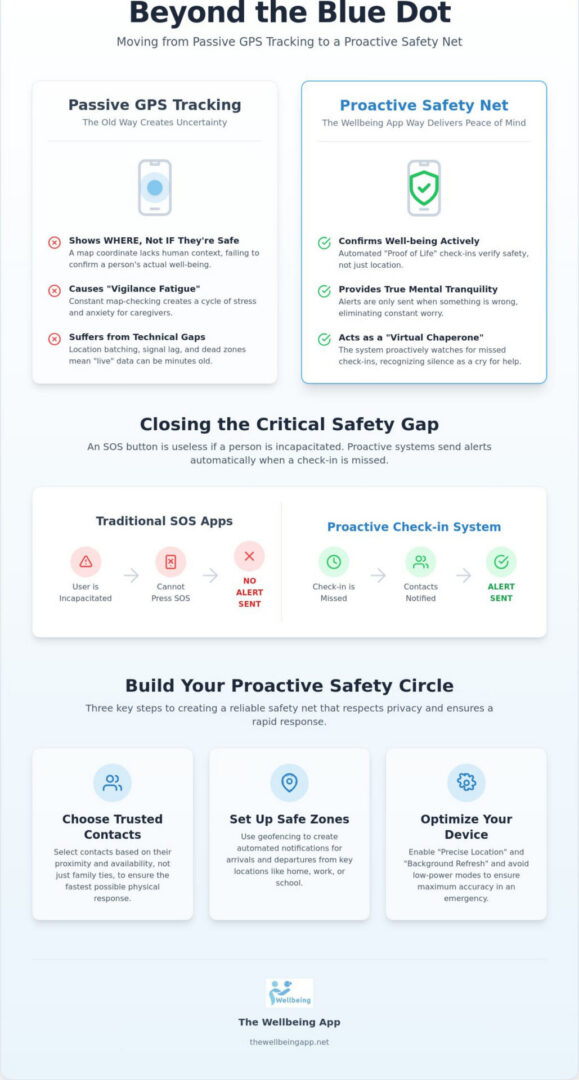
Location sharing is the real-time transmission of geographic coordinates. It’s powered by a GPS tracking unit or the sophisticated sensors inside your smartphone. While this technology is wonderful for meeting friends at a crowded festival, it has a serious flaw in safety scenarios. It tells you exactly where someone is, but it can’t tell you if they’re safe, conscious, or in distress. A blue dot on a map is just data; it lacks the human context of well-being.
Constantly checking a map app creates a unique kind of stress known as Vigilance Fatigue. You stare at a screen, hoping the dot moves, and your anxiety spikes the moment it stays still. This cycle of worry is why many families are now seeking alternatives to constant location sharing. We need to shift our focus away from passive social tracking. The goal should be proactive protection that guards the vulnerable while preserving everyone’s mental tranquility. By moving toward a digital safety net, we ensure that safety is a shared, automated responsibility rather than a source of constant individual dread.
The Mechanics of Modern GPS Tracking
Modern tracking is incredibly sophisticated. Your phone uses a combination of GNSS, Wi-Fi trilateration, and cell tower pings to pinpoint your spot. In the 2026 mobile landscape, operating systems have optimized battery life by batching location updates. This means your “Live Location” might actually be a few minutes old. Relying on a static pin during a crisis is risky. If the signal lags or the device enters a dead zone, you’re looking at where a loved one was, not where they are now. These technical limitations highlight why we must look beyond the map to find true security.
The Critical Gap: When the User Can’t Call for Help
There is a dangerous gap in traditional safety apps that most providers ignore. An SOS button is useless if the person is incapacitated or too intimidated to reach for their phone. If a senior falls in their home or a solo traveler is cornered, they can’t always trigger an alert manually. This creates a false sense of security. Passive map applications wait for you to notice something is wrong, which often happens too late.
Automated check-ins, such as our Proof of Life feature, serve as the missing link. These systems don’t wait for the user to act. Instead, they require a regular confirmation of well-being. If a check-in is missed, the system recognizes the silence as an indicator of trouble. This proactive approach ensures that Emergency Alerts are dispatched even when the user is unable to speak, acting as a Virtual Chaperone that never looks away.
Setting Up Location Sharing for Maximum Safety and Privacy
True safety begins with intentionality. Most of us have apps buried in our folders that have access to our coordinates without us even realizing it. A thorough audit of your OS-level permissions and third-party applications is the first step toward reclaiming your privacy. You should only share what is necessary for your well-being. By cleaning up these permissions, you reduce digital clutter and ensure that only the people you trust can see where you are.
When selecting your Trusted Contacts, look beyond family ties alone. Proximity and availability are the two most critical factors in a crisis. A sibling across the country is a wonderful emotional support, but a neighbor three doors down is the person who can physically reach you in minutes. Establishing these connections creates a community safety net that functions with harmony and speed. It turns a list of phone numbers into a proactive team of guardians.
Digital geofencing allows you to set Safe Zones around your home, office, or school. These parameters notify your circle when you arrive or depart, providing reassurance without the need for constant manual updates. It’s about creating a rhythm of safety that respects your daily routines. This automated transparency allows everyone to breathe a little easier, knowing the system is watching over the group’s best interests.
Optimizing Your Device for Emergency Accuracy
For your safety tools to function as a Virtual Chaperone, you must enable Precise Location and Background App Refresh. Without these, your device might only update your position every fifteen minutes to save battery. In an emergency, fifteen minutes is an eternity. Be mindful of low-power modes; they often disable the very tracking features you rely on for protection. Cross-platform compatibility is also vital. Ensure your Android and iOS devices can communicate seamlessly so no one is left out of the Safety Circle.
Privacy Protocols: Empowering Without Intruding
Safety should never feel like surveillance. Using time-limited sharing for specific events, such as a late-night walk home, ensures that your location is only visible when you are most vulnerable. Educating your circle on who has access to this data builds a culture of trust and shared responsibility. In 2026, with 20 U.S. states now enforcing comprehensive privacy laws, it’s more important than ever to understand your digital rights.
If the idea of a live map feels too invasive, consider alternatives to constant location sharing like Proof of Life indicators. These tools offer a less intrusive way to signal that you are okay without broadcasting every step you take. By choosing proactive safety tools, you preserve your mental tranquility while ensuring that help is always within reach if the silence becomes too long.
Passive vs. Proactive Sharing: The ‘Proof of Life’ Evolution
Standard location sharing is a passive experience. It requires a friend or family member to be actively looking at a map to recognize that something is wrong. If they are busy, sleeping, or away from their phone, the safety net effectively disappears. Proactive sharing transforms this dynamic by using automated alerts to monitor well-being on your behalf. These alternatives to constant location sharing prioritize your privacy while ensuring you are never truly alone.
We define Proof of Life as a recurring indicator of a user’s safety. It’s a simple, non-intrusive check-in that confirms you are conscious and capable of responding. This logic functions much like a “dead man’s switch” found in high-stakes industries. If the scheduled check-in doesn’t happen, the system recognizes the silence as a potential emergency and initiates a response. It moves the burden of vigilance from a human observer to a reliable, automated partner.
For the caregiver, this shift provides immense mental tranquility. You no longer need to spend your day refreshing a browser or staring at a GPS dot to feel secure. You can trust that you will be notified the moment a check-in is missed. It fosters a sense of harmony within the family, as the vulnerable individual feels empowered by their agency rather than restricted by constant surveillance.
Why Automated Alerts Beat Manual Texting
Manual texting is inherently fragile. It depends on a working device, a clear cellular signal, and a user who is physically able to type. Server-side monitoring is different. Because the monitoring happens on our secure servers, the safety protocol continues even if your phone battery dies or the device is destroyed. This creates a Digital Safety Net that remains independent of your hardware’s status at any given moment.
In a real-world medical emergency, this reliability is life-saving. Imagine a senior who suffers a sudden fall and cannot reach their phone to send a text or press an SOS button. Because they missed their scheduled 10:00 AM Proof of Life check-in, the system automatically dispatches an alert to their Safety Circle at 10:10 AM. Help arrives not because someone happened to check a map, but because the system was programmed to care when no one else was looking.
Understanding Night Watch and Virtual Chaperones
Our Chaperone service acts as a specialized guardian for specific journeys. Whether you are walking to your car after a late shift or taking transit in an unfamiliar city, the Chaperone monitors your progress from start to finish. If your movement stops unexpectedly or you deviate from your path, the system prompts a check-in to ensure you are still in control of your journey.
Night Watch protection extends this empathetic vigilance to your most vulnerable hours. It provides a structured safety protocol during the night, ensuring that solo dwellers have a Watchful Protector on duty while they sleep. Knowing that a sophisticated system is dedicated to your welfare allows for a deeper level of rest. It is a shared effort toward collective responsibility, where technology serves the ultimate goal of interpersonal connection and safety.
A Practical Safety Strategy for Seniors and Solo Travelers
Building a robust safety strategy requires more than just a smartphone app. It requires the creation of a Safety Circle. This circle should be a diverse group of people you trust, including local neighbors who can arrive quickly, family members who understand your history, and professional services that provide automated oversight. By diversifying your circle, you ensure that help is never more than a few minutes away. This collective responsibility is the foundation of true security and mental tranquility.
Effective safety plans integrate location sharing with Emergency Alerts that provide context, not just coordinates. Knowing that a loved one is at a specific street corner is helpful, but knowing they are there because they missed a scheduled check-in is critical. This distinction allows your Safety Circle to respond with the appropriate level of urgency. It transforms a simple data point into a powerful instrument of proactive safety management.
Supporting Senior Independence with Technology
For many seniors, the greatest fear is losing their independence. They don’t want to feel like a burden or have authorities performing intrusive wellness checks because a phone call went unanswered. Automated check-ins allow them to maintain their privacy while providing a digital safety net. By scheduling Proof of Life check-ins around morning and evening routines, seniors can prove they are safe without a single word. If a routine is missed, the system alerts the Safety Circle immediately, ensuring that help is dispatched only when it’s actually needed. This approach preserves the user’s mental state while fulfilling the family’s sense of duty.
The Solo Traveler’s Digital Toolkit
Solo travelers face unique risks, especially when navigating unfamiliar transit or walking through low-light areas. Using our Chaperone feature during these journeys provides a sense of empathetic vigilance. It monitors your movement from the moment you step into a rideshare until you are safely behind your door. If you are looking for alternatives to constant location sharing that don’t feel like surveillance, these event-based tools are the answer. They offer protection when you need it most without broadcasting your every move to the world.
Students and late-shift workers can also benefit from Night Watch protection. This service monitors your well-being during the hours when you are most vulnerable, such as during a late commute or while working alone. If an emergency occurs, the system provides your contacts with vital context, such as the last known safe location and the specific time the check-in was missed. This information is far more valuable to first responders than a simple coordinate on a map. It’s time to empower yourself with a system that cares as much as you do. Download The Wellbeing App today to start building your proactive safety net.
The Wellbeing App: Your Watchful Protector in an Uncertain World
The transition from passive map-watching to proactive safety represents a fundamental shift in how we care for one another. The Wellbeing App stands at the forefront of this evolution. It is more than just software; it’s a compassionate guardian designed to foster community unity and social responsibility. While other applications focus on social convenience, we focus on the preservation of your mental state. By offering sophisticated alternatives to constant location sharing, we empower you to live freely while knowing a digital safety net is always in place.
At the heart of our service is the Proof of Life feature. This is the embodiment of empathetic vigilance. It respects your privacy by not requiring a constant live feed of your every step. Instead, it relies on simple, scheduled indicators of well-being that confirm you are safe and conscious. This approach acknowledges that safety is a shared effort. It provides the harmony families need to function without the friction of constant, intrusive surveillance. It allows you to fulfill your duty toward your loved ones without causing them anxiety.
Our Chaperone and Night Watch services provide 24/7 proactive monitoring for those high-stakes moments. Whether you are walking home late from a shift or living alone in a new city, these tools act as your watchful protector. They don’t just record where you are; they analyze whether you are safe based on the parameters you set. If you deviate from your path or miss a check-in, the system acts immediately. This level of dedication ensures that help is always on the horizon, even if you cannot reach for your phone.
Automated Safety That Never Sleeps
Traditional apps fail when the device fails. If a phone is destroyed or a battery dies during an incident, a passive tracker simply stops updating, leaving you in the dark. Our server-side monitoring ensures that alerts are dispatched regardless of your device’s status. If a scheduled check-in is missed, the alert triggers from our secure servers. This commitment to proactive protection ensures that silence is never ignored during a crisis. The Wellbeing App is a comprehensive safety tool that bridges the gap between technical indicators and real-world human impact.
Join a Community of Proactive Protection
Choosing this service is an act of personal agency and social responsibility. It fosters social cohesion by creating a network where everyone looks out for the group’s best interests. By moving away from map-watching and toward alternatives to constant location sharing, you reclaim your time and your peace. Starting a monthly or annual subscription is a simple step toward total peace of mind for your entire Safety Circle. You aren’t just buying an app; you are investing in a system that values human life and interpersonal connection above all else. Secure your peace of mind with The Wellbeing App today and experience the mental tranquility you deserve.
Embracing a New Standard of Proactive Safety
True security is about more than just knowing where someone is; it’s about knowing they are okay. We’ve explored how standard GPS tracking often falls short when a user is unable to call for help. By shifting your focus toward automated systems, you can replace the stress of map-watching with genuine peace of mind. These alternatives to constant location sharing ensure that your privacy is respected while your safety is never compromised. You deserve a system that understands the difference between a busy day and a genuine emergency.
The Wellbeing App offers a sophisticated digital safety net through our server-side automated alert dispatch and proprietary Proof of Life indicators. Whether you are using our 24/7 Night Watch protection or setting up a Safety Circle for a loved one, you are taking a powerful step toward collective responsibility. You don’t have to carry the burden of vigilance alone. It’s time to empower your family with a system that acts even when you can’t. Start your journey toward mental tranquility with The Wellbeing App and discover the comfort of having a watchful protector by your side. Your safety is a shared journey, and we are honored to walk it with you.
Common Questions about Proactive Personal Safety
Is location sharing safe for my privacy?
Location sharing is safe when you use tools that prioritize your personal agency and data control. Many alternatives to constant location sharing allow you to set time limits or event-based triggers, ensuring your coordinates aren’t broadcast indefinitely. By auditing your permissions and choosing privacy-centric apps, you can enjoy the benefits of a safety net without feeling like you’re under constant surveillance.
How does Proof of Life differ from standard GPS tracking?
Standard GPS tracking is a passive tool that only shows your geographic coordinates on a map. Proof of Life is one of the most effective alternatives to constant location sharing because it confirms your actual well-being through recurring check-ins. While a GPS dot might stay still because you’re resting, Proof of Life ensures that if you are incapacitated, your Safety Circle is notified immediately. It moves the focus from where you are to how you are.
What happens if my phone dies or loses service?
Our server-side monitoring ensures that your safety protocol remains active even if your device is powered off or disconnected. Because the countdown for your next check-in happens on our secure servers, the system doesn’t need your phone to be online to recognize a missed prompt. If the server doesn’t receive your signal by the scheduled time, it automatically dispatches Emergency Alerts to your trusted contacts.
Can location sharing help seniors living alone?
It provides a vital digital safety net that supports senior independence while offering families mental tranquility. Instead of intrusive daily phone calls or physical wellness checks, seniors can use automated check-ins to signal they are safe. It allows them to maintain their privacy and dignity while ensuring that help is summoned the moment a routine is missed.
What is a Virtual Chaperone and when should I use it?
A Virtual Chaperone is a dedicated monitoring feature used for specific transit journeys from start to finish. You should use it whenever you are walking through low-light areas, taking a late-night rideshare, or navigating unfamiliar cities. It provides empathetic vigilance by tracking your progress and prompting a response if your movement stops or deviates from the expected path.
How much battery does a safety monitoring app typically use?
Modern safety apps are designed with battery-optimized location updates to minimize drain on your device. By utilizing Wi-Fi trilateration and cell tower pings alongside GNSS, these tools provide high accuracy without exhausting your power. In the 2026 mobile landscape, system-level optimizations ensure that your protective services can run in the background throughout the day without requiring frequent charging.
Can I set up automated alerts for when I arrive at a specific destination?
You can easily set up automated notifications through the use of Safe Zones and geofencing parameters. These features allow the system to recognize when you have safely arrived at home, work, or school and notify your circle accordingly. It’s an excellent way to provide reassurance to loved ones without needing to send a manual text message every time you reach your destination.
Who should I include in my Safety Circle for emergency alerts?
Your Safety Circle should include a mix of people chosen for their proximity and their availability to help. While family members provide emotional support, local neighbors or nearby friends are often the first who can physically reach you during a crisis. Including a professional monitoring service adds a layer of reliable, always-on protection that ensures no alert goes unnoticed.