
Medical Alert Alternatives: 2026 App-Based Safety Guide
What if the most effective way to protect your aging parent wasn’t a bulky plastic button around their neck, but the smartphone already sitting on their nightstand? It’s a question more families are asking as they look for alternatives to medical alert systems that don’t come with stigmatized hardware or expensive activation fees. You likely already feel the weight of caregiver burnout, spending your days sending manual check-in texts that often go unanswered for hours. This constant cycle of worry creates a burden for you and a sense of lost independence for your loved one.
We believe that safety should feel like a warm embrace rather than a technical intrusion. In this 2026 guide, you’ll discover how modern smartphone apps provide a discreet, proactive safety net that replaces reactive hardware with empathetic vigilance. We will explore how automated Proof of Life check-ins, Night Watch protection, and virtual Chaperone services offer a sophisticated way to stay connected without the high costs of traditional equipment. This overview will show you how to preserve senior dignity while ensuring that a reliable, always-on partner is looking out for your family’s best interests.
Key Takeaways
- Learn how software-first solutions eliminate the need for stigmatized wearables while providing more comprehensive, discreet protection for seniors.
- Understand why app-based alternatives to medical alert systems offer a lower total cost of ownership by utilizing the smartphone your loved one already owns.
- Discover the critical difference between reactive SOS buttons and proactive Proof of Life check-ins that work even if a senior is immobilized or unconscious.
- Explore how server-side monitoring ensures alerts are delivered even if a phone is lost or powered down, providing true mental tranquility for caregivers.
- Identify the essential 2026 safety features, including Night Watch and virtual Chaperone services, that foster community unity and preserve personal independence.
Beyond the Button: The Evolution of Medical Alert Apps for Seniors
The landscape of senior safety has undergone a profound transformation. We’ve moved away from the era of specialized, clunky hardware toward integrated, intelligent software. A modern medical alert app isn’t just a backup; it’s a comprehensive guardian that lives on the device seniors already carry. By 2026, the preference for software-first solutions is clear. Families are choosing alternatives to medical alert systems that prioritize human connection over clinical surveillance. This evolution replaces the cold feel of a panic button with the warmth of a digital safety net, ensuring that protection is always present but never intrusive.
The smartphone has become the ultimate all-in-one safety tool. It combines high-precision GPS, instant communication, and sophisticated monitoring into a single interface. Traditional pendants only do one thing: they wait for a disaster to happen. Modern apps take a different path. They provide proactive indicators of well-being, allowing families to maintain a state of mental tranquility without the constant need for manual check-in texts. This shift from reactive to proactive care is the hallmark of the modern safety era.
Addressing the Stigma of Senior Safety
There is a significant psychological barrier associated with wearing medical pendants or bracelets. Many seniors view these devices as “shame buttons” that broadcast their vulnerability to the world. Consequently, these expensive pieces of hardware often end up forgotten on a nightstand or hidden in a drawer. App-based safety preserves a user’s dignity by hiding protection in plain sight. It turns a tool of necessity into an instrument of personal agency. When safety is integrated into a familiar smartphone, it feels like a lifestyle choice rather than a medical requirement. This subtle shift fosters independence and reduces the resistance often felt toward traditional monitoring hardware.
Smartphone Adoption and Tech-Savviness in 2026
In 2026, the digital divide has largely vanished. Most seniors are now tech-savvy users who rely on mobile devices for social connection and information. This makes the smartphone the most reliable platform for modern alternatives to medical alert systems. Designing for accessibility has also improved significantly. Modern safety apps use high-contrast interfaces and intuitive layouts that are easy on aging eyes. This approach is incredibly cost-efficient. By leveraging the hardware your loved one already owns, you eliminate the burden of equipment fees and activation costs. It’s a smarter, more sustainable way to ensure nationwide protection while keeping families harmoniously connected.
Standalone Apps vs. Supplemental Hardware Systems
Choosing alternatives to medical alert systems shouldn’t mean sacrificing reliability for convenience. Traditional hardware providers often claim that a physical pendant is the only way to ensure professional grade monitoring. However, the true total cost of ownership tells a different story. When you factor in activation fees, shipping costs, and the price of replacing lost or damaged proprietary devices, a simple software subscription becomes the clear choice for family value in 2026. Beyond the finances, there is the “Always-With-You” factor. Most seniors have a deeply ingrained habit of keeping their smartphone charged and nearby for social connection. A pendant, conversely, is often viewed as a medical burden and is frequently left on the nightstand, precisely when it is needed most.
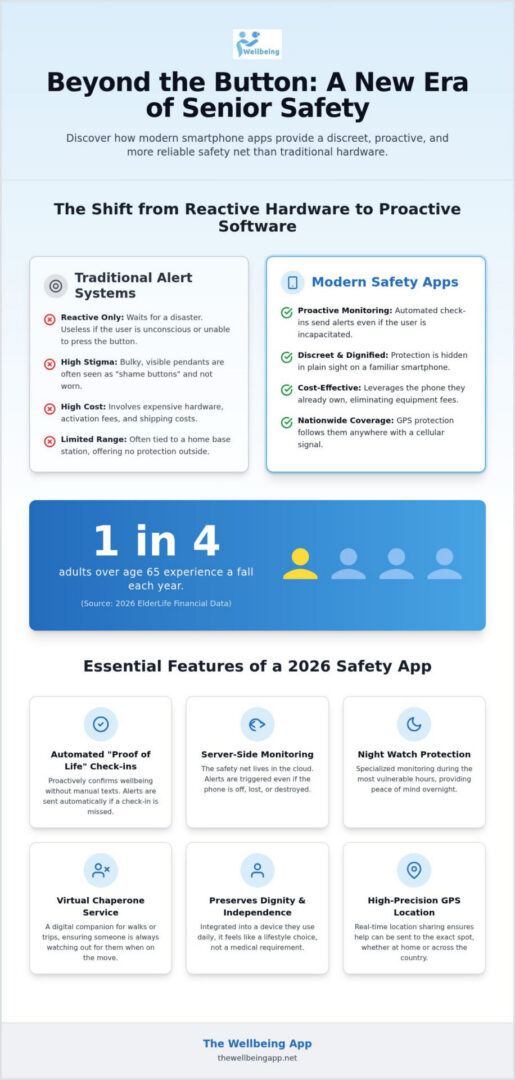
Roughly one in four adults over the age of 65 experience a fall each year, according to 2026 data from ElderLife Financial. This makes the portability of your safety tool a life-saving variable. Modern apps provide protection that moves with the user, extending far beyond the limited range of a home Wi-Fi base station. Whether your loved one is at the grocery store or walking in a local park, their safety net remains intact through the cellular network they already use every day.
Technical Reliability and GPS Precision
Modern app based solutions utilize server side monitoring to create a fail-safe environment. This means the safety net exists in the cloud, not just on the physical device. If a phone is powered off, lost, or destroyed, the system recognizes the lack of a check-in and triggers the alert hierarchy. This mirrors the logic of professional monitoring centers without the lag of a call center middleman. You get real-time location sharing and instant push notifications, which are significantly faster than the manual dispatch process used by older hardware systems. You can explore proactive safety features that offer this level of empathetic vigilance without the need for additional equipment.
The Hidden Costs of Traditional Medical Alerts
Traditional systems often lock users into long-term contracts that are difficult to cancel. These companies rely on a business model that requires selling proprietary plastic devices, which become obsolete the moment a new cellular standard is released. Software alternatives to medical alert systems improve over time through seamless updates, ensuring the technology stays current with the latest GPS and battery optimization standards. By leveraging the smartphone your loved one already owns, you eliminate hardware hurdles and focus your resources on the actual service of keeping them safe and sound. It’s a more transparent, flexible approach that prioritizes the user’s mental state and the family’s peace of mind.
The Power of Proactive Safety: Why Automated Check-ins are Essential
The biggest weakness of traditional safety hardware is its reactive nature. A panic button is only useful if the person wearing it is conscious, mobile, and able to reach it. If a senior experiences a stroke or a severe fall that leaves them immobilized, that plastic pendant becomes effectively useless. This is the “unreachable emergency,” a scenario that haunts many families. Modern alternatives to medical alert systems solve this by shifting the focus from reaction to prevention. By establishing a digital safety net through automated check-ins, we ensure that help is summoned even when the user cannot ask for it.
This proactive approach relies on Proof of Life indicators. These are scheduled, non-intrusive prompts that confirm a user is safe and sound. Safety experts emphasize that reducing the time spent immobilized after a fall is critical for long-term recovery. Proactive monitoring ensures that silence is treated as a signal for help, preventing the “long lie” that often leads to permanent loss of independence. It turns a passive tool into an active guardian, providing a level of protection that hardware alone cannot match.
How Automated Check-ins Function
The beauty of a software-based safety net lies in its customization. Families can set specific schedules for daily wellness checks that fit the senior’s routine perfectly. Whether it’s a morning “I’m awake” prompt or a nightly “I’m home” confirmation, these indicators provide consistent proof of well-being. The true technical robustness comes from server-side monitoring. Unlike a hardware device that might fail if its battery dies, these alerts are managed in the cloud. If the phone is powered off or lost, the server recognizes the missed check-in and triggers the alert hierarchy anyway. This fail-safe mechanism ensures that a loved one is never truly alone.
Mitigating Caregiver Burnout
Managing the safety of an aging parent often carries a heavy mental load. Caregivers frequently find themselves trapped in a cycle of manual texting, constantly asking “are you okay?” and waiting anxiously for a reply. This creates a sense of empathetic vigilance that can lead to significant burnout. Automated alternatives to medical alert systems remove this burden by handling the routine monitoring for you. It allows technology to watch over your family without being intrusive or overbearing. By building a community of care through automated notifications, every family member stays informed. This collective responsibility fosters social cohesion and preserves the mental state of everyone involved, turning safety into a shared, effortless effort.
Choosing the Best Medical Alert App: A 2026 Checklist
Selecting the right technology is a deeply personal decision that balances technical robustness with human dignity. When you explore alternatives to medical alert systems, your evaluation must go beyond basic SOS buttons. Real-time GPS precision is non-negotiable in 2026. You need to know exactly where a loved one is, not just their general vicinity from a cellular tower ping. This accuracy, paired with geofencing capabilities, allows the system to act as a watchful protector, notifying you the moment a senior leaves or enters a designated safe zone. It’s about creating an atmosphere of safety where the technology works silently in the background.
Cross-platform reliability is another critical pillar. Families are rarely uniform in their device choices, so the safety net must function seamlessly across both iOS and Android environments. This ensures that every member of your community of care stays connected regardless of their hardware. Privacy standards should also be a primary concern. Look for platforms that use end-to-end encryption to ensure that sensitive location and health data remain secure and private. Finally, the interface must be designed for aging eyes, featuring large buttons and intuitive navigation that empowers seniors rather than confusing them.
Essential Safety Features for Seniors
A comprehensive safety app should offer more than just an emergency alert; it should provide a sense of empathetic vigilance throughout the day. One-tap SOS functionality remains a core requirement for immediate access to help, but specialized features like virtual Chaperone services add a new dimension of safety. A Chaperone provides a watchful eye during walks or outings, ensuring that a loved one is never truly alone when they are away from home. For the most vulnerable hours, specialized Night Watch protection offers dedicated monitoring during the late evening and early morning. These features work together to preserve mental tranquility for both the senior and their family.
The Caregiver Dashboard Experience
The true power of modern safety software is revealed in the caregiver dashboard. This centralized hub allows you to manage multiple family members from a single secure interface, making it an ideal tool for the “sandwich generation” caring for both parents. You can customize alert thresholds to match individual health needs, ensuring that notifications are relevant and timely. Historical status logs are also vital, as they allow you to track long-term well-being patterns and identify subtle changes in activity before they become emergencies. To see how these features come together, you can explore the Wellbeing App checklist and start building your family’s digital safety net today.
The Wellbeing App: Your National Digital Safety Net
The Wellbeing App represents a fundamental shift in how we approach senior safety across the United States. It’s not just a tool; it’s a compassionate guardian designed to foster social cohesion and mental tranquility. While many other alternatives to medical alert systems focus solely on the moment of crisis, our platform prioritizes the hours of peace in between. We provide a digital safety net that leverages the technology your family already uses, eliminating the need for stigmatized hardware. This proactive senior safety model ensures that protection is constant, reliable, and deeply rooted in a sincere concern for the vulnerable.
At the heart of our service is the Proof of Life check-in. This feature transforms the smartphone into a proactive indicator of well-being. By automating daily wellness checks, we remove the burden of manual texting from caregivers while providing seniors with a sense of personal agency. It’s a system built on harmony and interpersonal connection, ensuring that silence is never a cause for panic but a signal for a coordinated, caring response. Our server-side monitoring acts as a fail-safe, ensuring that alerts are delivered even if a device is lost or powered down.
Specialized Protection for Every Scenario
The Chaperone feature provides protective reassurance during everyday errands or travel. Whether your loved one is heading to a doctor’s appointment or visiting a friend, this virtual companion stays with them, monitoring their progress in real-time. During the most vulnerable hours of the night, our Night Watch service takes over. It provides a constant vigil that monitors for missed check-ins even while the rest of the household sleeps. This comprehensive protection has a real-world impact by preventing missing person incidents through proactive alerts that trigger before a situation escalates. It’s about providing a watchful eye that respects boundaries while maintaining constant vigilance.
Fostering Community Unity and Safety
Safety is a shared effort, and our platform makes it easy to set up a circle of trust. You can invite family members, neighbors, and friends into a unified monitoring network, ensuring that collective responsibility is at the core of your safety strategy. Our mission goes beyond simple tracking; we aim for empowerment through proactive safety management. By providing transparent subscription plans for individuals and families, we ensure that nationwide protection is accessible to everyone. We believe that every senior deserves to age with dignity and every caregiver deserves a state of mental tranquility. Protect your loved ones today with The Wellbeing App and experience the peace of mind that comes from a truly proactive safety net.
Securing Independence Through Modern Connection
The transition from reactive hardware to proactive software marks a significant milestone in senior care. By choosing modern alternatives to medical alert systems, you’re trading clunky, stigmatized pendants for a sophisticated digital safety net that lives on the smartphone your loved one already carries. This shift ensures that protection is constant and empathetic, focusing on the preservation of a user’s mental state while providing families with true tranquility. We’ve explored how automated indicators of well-being can prevent the “long lie” and how lifestyle-integrated tech fosters community unity without the burden of expensive equipment fees.
True safety is a shared effort that relies on 24/7 server-side monitoring and automated Proof of Life check-ins to ensure help is always available, even if a phone is lost or powered down. Since there’s no proprietary hardware required, you can begin protecting your family immediately. It’s time to replace the worry of manual check-in texts with a system designed for empathetic vigilance and collective responsibility.
Start Your Proactive Safety Plan at The Wellbeing App today. You have the power to empower your loved ones, ensuring they remain safe, sound, and independent in the years to come.
Frequently Asked Questions
Can a medical alert app replace a traditional hardware-based system?
Modern apps serve as comprehensive replacements by shifting the safety paradigm from physical dispatch centers to immediate, digital notification hierarchies. While older systems rely on landline-tethered base stations, software-first alternatives to medical alert systems utilize the high-speed connectivity of the smartphone. This allows for a more responsive and intelligent safety net that integrates directly into your daily life, providing a level of empathetic vigilance that clunky, clinical hardware simply cannot match.
Do medical alert apps work if the senior is away from home Wi-Fi?
These solutions are designed for active lifestyles and function wherever cellular data is available. Unlike traditional units that often fail outside a specific radius of the home, app-based protection follows your loved one during interstate travel, grocery runs, or morning walks. By leveraging 5G and 4G networks, the safety net remains intact across the country, ensuring that the Proof of Life indicators and location sharing features continue to provide mental tranquility regardless of geography.
What happens if a senior misses an automated check-in?
When a scheduled wellness prompt is ignored, the system immediately triggers a multi-channel alert to the designated circle of trust. This notification chain typically includes push alerts, SMS, and automated calls to ensure the message is seen by all responders. Because the monitoring is managed on the server side, the alert is dispatched even if the senior’s phone is lost or the battery has died, ensuring that a missed check-in is never overlooked.
Are there medical alert apps that don’t require a monthly subscription?
While some basic timers exist, a true safety net requires a subscription to maintain the sophisticated server-side infrastructure. This investment covers the costs of secure data encryption, 24/7 server vigilance, and the fail-safe logic that sends alerts even when a device is offline. Subscription-based alternatives to medical alert systems provide better value by eliminating the predatory equipment fees and shipping costs that often inflate the price of traditional hardware contracts.
How does GPS tracking in a safety app compare to a hardware device?
Smartphone GPS is vastly superior to the basic tracking found in most pendants, offering real-time breadcrumb trails rather than occasional pings. The Wellbeing App utilizes the phone’s integrated location services to provide precise, live updates that are essential during active outings. This technical robustness allows families to see exactly where a loved one is located, providing much more reliable data than the outdated cellular triangulation used by many legacy hardware devices.
Can multiple family members receive emergency alerts simultaneously?
The system is specifically designed to foster community unity by notifying every member of the safety circle at once. This simultaneous broadcast ensures that the person closest to the senior can respond immediately, rather than waiting for a call center to work through a phone list. Role-based access allows the family to designate primary responders and secondary observers, creating a structured and efficient approach to collective responsibility and family safety.
Is fall detection included in standalone safety apps?
Many apps use the phone’s internal sensors to detect sudden impacts, but the real power lies in the proactive check-in model. Sensors often miss “silent” emergencies, such as fainting or medical episodes where no sudden fall occurs. By combining sensor data with automated wellness prompts, you ensure that help is summoned even if the technology doesn’t “feel” a fall. This dual-layered approach provides a more reliable safety net than impact-only hardware.
How do I talk to my parents about installing a safety app?
Approach the conversation as a way to preserve their personal agency and your family’s harmony. Focus on how the app is a shared tool for everyone’s peace of mind rather than a sign that they “need help.” By framing it as a way to stay connected and avoid the burden of constant manual check-in texts, you position the technology as a lifestyle enhancement. This encourages them to feel empowered and protected rather than monitored or restricted.