Modern Personal Safety Alerts: A Proactive 2026 Guide
What if the most reliable safety net was one you never had to touch? We’ve all felt that quiet flicker of anxiety when walking alone at night or wondering if a loved one is truly safe. For too long, the standard personal safety alert system has relied on a reactive model. It often requires you to press a button during a crisis or wear a stigmatized medical pendant that feels more like a burden than a benefit. You deserve to feel empowered, not anxious, as you move through your day.
True safety isn’t a siren you pull; it’s a silent, proactive digital safety net that watches when you can’t. This 2026 guide reveals how automated check-ins and server-side monitoring provide a superior level of protection compared to traditional alarms. We’ll explore how features like Proof of Life and Chaperone offer mental tranquility by ensuring help is dispatched even if you can’t reach your phone. You’ll learn how this modern approach works anywhere in the country, providing a compassionate guardian that preserves your independence while keeping you connected to those who care most.
Key Takeaways
- Learn how a modern personal safety alert system uses proactive digital monitoring to replace the limitations of traditional hardware sirens and reactive alarms.
- Discover how the Proof of Life feature automates scheduled check-ins, removing the constant burden of manual texting while ensuring you’re never truly alone.
- Understand the vital importance of server-side safety protocols that guarantee alerts are dispatched to your loved ones even if your device is damaged or lost.
- Explore practical tools like Chaperone and Night Watch that act as a compassionate guardian during solo commutes or vulnerable evening hours.
- Gain mental tranquility by investing in a reliable, community-centered safety net that empowers your independence without the stigma of traditional medical devices.
What is a Personal Safety Alert System in 2026?
In 2026, a personal safety alert system is no longer just a loud siren on a keychain or a plastic button worn around the neck. It has evolved into a sophisticated, invisible network of digital tools designed to monitor your well-being and alert help automatically when you can’t. While older devices focused on making noise to deter attackers, modern technology prioritizes mental tranquility. This shift means moving away from reactive hardware that relies on you being able to press a button during a crisis. Instead, we use proactive software and server-side monitoring. This ensures that if you miss a scheduled check-in, an alert is sent even if your phone is destroyed or the battery dies. It is a compassionate guardian that doesn’t sleep.
The Evolution from Whistles to Digital Safety Nets
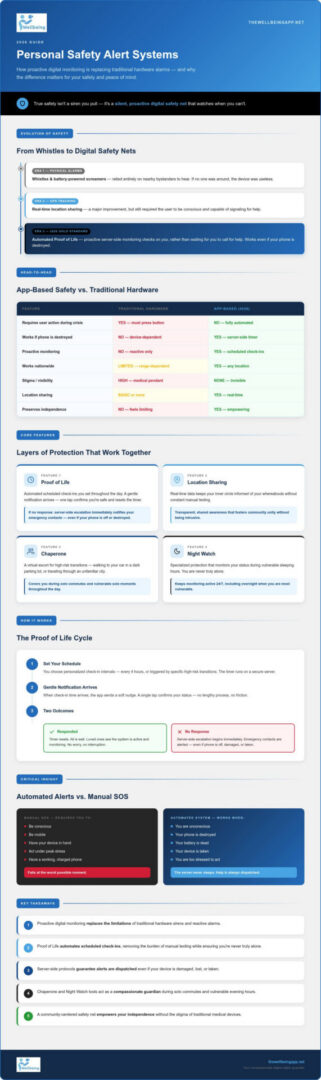
Early personal alarms were simple. A whistle or a battery-powered screamer relied entirely on the presence of immediate bystanders. If no one was around to hear, the device was effectively useless. The introduction of GPS changed the game by allowing for real-time location sharing, but it still required the user to be conscious and capable of signaling for help. Today, automated Proof of Life indicators are the gold standard. These systems check on you, rather than waiting for you to call for help. This creates a true safety net that functions even in your most vulnerable moments, providing a level of security that noise alone can never achieve.
Key Components of a Modern Safety System
A modern personal safety alert system is built on layers of protection that work together to provide a seamless, empowered experience. These components include:
- Proof of Life: Automated check-in schedules that you set throughout the day. If you don’t confirm you’re okay, the system begins an escalation process to notify your trusted contacts.
- Location Sharing: Real-time data that keeps your inner circle informed of your whereabouts without the need for constant, manual texting.
- Chaperone Services: A virtual escort for high-risk transitions, such as walking to your car in a dark parking lot or traveling through an unfamiliar city.
- Night Watch: Specialized protection that monitors your status during vulnerable sleeping hours, ensuring you’re never truly alone.
These features are managed server-side. This is a critical distinction because it means the safety net exists in the cloud, not just on your device. If your phone is taken or broken, the automated timer on the server continues to run. When that timer expires without your input, the system acts. This proactive stance transforms personal safety from a desperate cry for help into a disciplined, reliable partnership.
How Proactive Monitoring Works: The Power of Proof of Life
Traditional safety tools often fail because they require a human response in a moment of peak stress. A personal safety alert system in 2026 must be smarter than a simple siren. It needs to know you’re safe before something goes wrong. This shift from reactive to proactive monitoring is the foundation of true peace of mind. By establishing a rhythm of check-ins, you’re not just carrying a tool; you’re participating in a managed safety protocol that remains vigilant even when you’re distracted or unable to reach for help.
The ‘Proof of Life’ Mechanism Explained
The process begins with setting your personalized safety schedule. You might choose to check in every four hours or specifically during high-risk transitions. Proof of Life is a proactive status confirmation that prevents missing person incidents by ensuring help is dispatched even if a user is incapacitated. When a scheduled time arrives, the system sends a gentle notification. A single tap confirms your status and resets the timer. If that tap never happens, the server-side logic initiates an automated escalation. This is far more reliable than standard tracking apps because the countdown happens on a secure server. Even if your phone is turned off or destroyed, the server knows you missed your window and alerts your emergency contacts immediately.
This consistent loop of status indicators significantly reduces ‘wellness check’ anxiety for families. Instead of worrying when a text goes unanswered, loved ones can see that the system is active and monitoring. It turns safety into a shared, transparent effort that fosters community unity without being intrusive.
Automated Alerts vs. Manual SOS
High-stress incidents often lead to physical inability to act. Manual SOS buttons require you to be conscious, mobile, and in possession of your device. In contrast, automated alerts remove the burden of performance from the user. This is particularly vital for those who fear being alone during an emergency. Knowing that a silent guardian is waiting for your signal provides an immense psychological lift. If you are incapacitated, the system doesn’t wait for a scream; it waits for the absence of your all-clear signal.
This technology bridges the critical gap between an incident occurring and help arriving. In a medical crisis or a sudden accident, every minute counts. By removing the need for manual activation, the system ensures that the escalation process begins the moment a check-in is missed. You can find this same mental tranquility through proactive monitoring, allowing you to live your life with a renewed sense of agency and protection. It is a disciplined approach to safety that values your well-being as much as you do.
App-Based Safety vs. Traditional Hardware: A Comparison
Choosing between a physical device and a digital application is a pivotal decision when selecting a personal safety alert system. For years, the industry relied on plastic keychains and bulky pendants. These tools suffer from the “forgotten device” problem. If you leave your siren in another coat or forget to charge it, your safety net vanishes. Additionally, most hardware is one-way. It makes noise but cannot provide data back to your loved ones about your specific location or status. This lack of two-way communication leaves a significant gap in your protection during a crisis.
Why Your Smartphone is the Ultimate Safety Tool
Your smartphone is already a part of your daily life. It is rarely left behind and is consistently charged. By leveraging the device you already carry, you gain access to high-speed data and biometric security that a plastic button simply cannot match. Digital safety apps act as a discreet watchful protector within your personal safety alert system. They don’t announce your vulnerability to the world like a traditional medical pendant might. Instead, they provide a seamless experience through instant software updates. When new safety protocols are developed, your system improves without you needing to purchase new equipment. This integration allows for a sophisticated level of location sharing and status monitoring that remains invisible to bystanders but crystal clear to your trusted circle.
Comparing the Costs of Peace of Mind
It’s tempting to look at a one-time hardware fee as a bargain. However, a plastic siren is often a “hollow” tool. It provides a sense of security until a crisis occurs and no one is nearby to hear the alarm. The real value of a modern safety subscription lies in the server-side monitoring. This investment covers the complex infrastructure required to manage automated notification dispatch and constant status indicators, ultimately preserving your mental tranquility.
- Hardware: Low upfront cost but limited to local noise and manual activation.
- App-Based: Ongoing subscription that funds a 24/7 digital response network.
- Reliability: Servers monitor your check-ins even if your physical device is lost or broken.
The “hidden cost” of hardware is the lack of a proactive response network. When you choose a subscription-based model, you aren’t just buying software. You are investing in a dedicated, compassionate guardian that ensures your alerts reach their destination, reinforcing the idea of collective responsibility within your family. This approach bridges the stigma gap, offering active adults a modern way to stay safe without compromising their dignity or independence.
Practical Use Cases: Chaperone and Night Watch
Theory meets reality when you integrate a personal safety alert system into your daily routine. While understanding the technology is important, seeing how it functions during high-risk transitions provides a true sense of empowerment. Whether you’re a student crossing a dark campus, a senior living independently, or a solo worker on a late shift, these features act as a watchful protector. They bridge the gap between solitude and safety, ensuring that you’re never truly alone even when no one is physically by your side.
Activating Your Virtual Chaperone
The Chaperone feature is designed for those moments of movement where you feel most exposed. It turns your smartphone into a dedicated escort through a simple, three-step process:
- Step 1: Open the app and set your specific destination and estimated arrival time. This creates a time-bound safety window on the server.
- Step 2: Enable real-time location sharing with a specific contact from your trusted circle. They don’t need to watch the screen constantly, but they’ll be ready if the system alerts them.
- Step 3: Confirm your arrival once you’ve safely reached your door. This closes the safety loop and deactivates the active monitoring timer.
This protocol is far more effective than a simple phone call. If something happens and you can’t speak, the system already knows your path and your expected arrival time. It removes the burden of manual reporting while maintaining a constant connection to help. It is a disciplined way to manage your personal agency during travel.
Night Watch: Protection While You Sleep
Vulnerability doesn’t end when you lock your doors at night. For many, the quiet hours of the evening bring a specific kind of anxiety, especially for those living alone or with out-of-state family members. The Night Watch protocol addresses this by setting a proactive check-in for the following morning. Night Watch acts as a silent guardian for those living alone, ensuring that a missed morning routine triggers an immediate wellness check. This feature provides immense tranquility for family members who might live hundreds of miles away. They don’t have to wonder if you’ve woken up safely; the system confirms it for them.
To maximize this responsiveness, you must carefully configure your ‘Trusted Circle’. This group should consist of people who understand their role and are prepared to act if an automated alert is triggered. It is a shared effort that fosters social cohesion and family unity. By assigning specific responsibilities to different contacts, you create a robust, multi-layered safety net. You can start building your trusted circle today to ensure your personal safety alert system is always ready to protect what matters most. This proactive management of your safety is the key to lasting mental tranquility.
Choosing The Wellbeing App as Your Compassionate Guardian
The transition to a modern personal safety alert system is a deeply personal journey toward reclaiming your independence. The Wellbeing App stands apart by focusing not just on the mechanics of monitoring, but on the preservation of your mental state. We believe that true safety is a shared effort, rooted in the harmony between sophisticated server-side technology and the warmth of human connection. By choosing a system that prioritizes proactive indicators over loud alarms, you’re making a commitment to your own well-being and the peace of mind of those you love. It’s about moving from a place of anxiety to a state of empowered vigilance.
A Subscription to Serenity
The Wellbeing App acts as a watchful protector, offering a suite of features that work silently in the background of your life. Whether it’s the rhythmic check-ins of Proof of Life, the virtual escort provided by Chaperone, or the quiet vigilance of Night Watch, every tool is designed to empower you. You don’t have to live in a state of constant alert. Instead, you can move through your day with the confidence that a compassionate guardian is always on duty. This system is specifically engineered to prevent missing person incidents by ensuring that help is dispatched the very moment a routine is broken. To find the right fit for your family, you can view subscription plans on The Wellbeing App homepage. We offer both monthly and annual options to ensure that comprehensive protection remains accessible and reliable for every household.
Joining a Community of Vigilance
At the heart of our ecosystem is the Trusted Circle. This isn’t just a list of emergency contacts; it’s a framework for social cohesion and collective responsibility. When you invite friends and family into your circle, you’re creating a bond of mutual care that transcends traditional security. The app fosters an environment where safety is a natural part of your community’s daily rhythm. It removes the friction of manual check-ins and replaces it with an automated, reliable flow of information. This proactive approach turns a passive tool into an instrument of empowerment and personal agency. You have a duty to yourself and your loved ones to ensure that a safety net is always in place. Secure your digital safety net today and experience the profound tranquility that comes from knowing you’re never truly alone.
Securing Your Independence with Proactive Protection
Modern safety is about more than just a loud alarm; it’s about a system that understands your routines and acts when you can’t. By choosing a proactive personal safety alert system, you move away from the fear of being alone toward a state of empowered agency. We’ve explored how server-side monitoring ensures your alerts are sent even if your device fails. We’ve also seen how automated check-ins and virtual escorts replace the burden of manual texting with a silent, reliable guardian.
This transition preserves your mental tranquility while fostering a sense of collective responsibility among your loved ones. With features like 24/7 server-side monitoring, automated Proof of Life check-ins, and a Virtual Chaperone for solo travelers, you can finally live without the weight of constant worry. You have a duty to yourself and your inner circle to ensure that a safety net is always in place.
Start your journey toward mental tranquility with The Wellbeing App. You deserve to feel safe, supported, and connected, no matter where life takes you today.
Frequently Asked Questions
How does a personal safety alert system differ from a standard GPS tracker?
A personal safety alert system differs from a standard GPS tracker by focusing on proactive status confirmation rather than just passive location data. While a tracker shows where you are, it won’t alert help if you’re incapacitated. Our system uses automated check-ins to monitor your well-being. This ensures that help is dispatched even if you can’t reach your phone, providing a higher level of mental tranquility for you and your family.
Will the app still send an alert if my phone battery dies or I lose service?
Yes, the system remains active because the monitoring logic lives on a secure server, not just your device. This server-side protocol is a critical safety feature. If your phone battery dies or you enter a dead zone, the automated timer on the server continues to count down. When the scheduled check-in window expires without your confirmation, the system automatically initiates the escalation process to notify your trusted contacts.
Can I use the Proof of Life feature for an elderly relative living in another state?
You can certainly use this feature for relatives living anywhere in the country. Distance shouldn’t be a barrier to safety or peace of mind. By setting up a Proof of Life schedule, you can receive automated indicators of your loved one’s status without the need for constant, intrusive phone calls. It fosters community unity and allows seniors to live independently while staying connected to their family’s protective circle.
Is a personal safety app better than a physical medical alert pendant?
A digital personal safety alert system offers several advantages over traditional hardware pendants. Apps are discreet and leverage the high-speed data and GPS already built into your smartphone. This eliminates the stigma of wearing a medical device while providing more robust features like location sharing and Chaperone services. Because it’s software-based, the system receives instant updates to improve your safety protocols without requiring new hardware.
What is a ‘Virtual Chaperone’ and how does it work during a walk home?
A Virtual Chaperone acts as a digital escort for high-risk transitions like walking home at night. You simply set your destination and estimated arrival time within the app. This creates a monitored safety window on the server. If you don’t confirm your arrival by the set time, the system automatically alerts your trusted circle. It’s a disciplined way to manage your personal agency during solo travel.
How much does a personal safety alert system subscription typically cost in 2026?
Modern safety subscriptions typically follow a monthly or annual model to maintain the 24/7 server-side monitoring infrastructure. This investment ensures that your digital safety net is always active, covering the costs of automated alert dispatch and secure data hosting. While hardware sirens are a one-time cost, a subscription provides an ongoing, compassionate guardian that adapts to new technology and evolving safety needs for your entire family.
Can I customize who receives my emergency alerts and when?
You have full control over your Trusted Circle and how they receive notifications. You can designate specific individuals to be notified during different times of the day or for specific features like Night Watch. This customization ensures that the right people are alerted in a way that fits your family’s unique dynamics. It turns personal safety into a shared effort, reinforcing collective responsibility within your community.
Does the app require me to press a button to stay safe?
No, the system is designed to be proactive rather than relying on manual activation. While you can trigger an immediate alert, the primary protection comes from automated check-ins. If you don’t respond to a scheduled prompt, the system assumes you need assistance and begins the escalation process. This ensures help arrives even if you are unconscious or unable to physically press a button during a crisis.