
Overnight Safety Monitoring for Vulnerable Adults
Last Tuesday, Sarah spent three hours staring at a silent monitor, not because she heard a noise, but because she was terrified of what she might find if she didn’t check. This cycle of nocturnal anxiety is a heavy burden that thousands of caregivers carry every single night. You want to ensure their well-being, yet you hate the idea of stripping away their dignity with intrusive cameras or constant bedside check-ins. Finding a balance with overnight safety monitoring for vulnerable adults doesn’t have to mean choosing between privacy and protection.
We understand that the fear of a morning discovery is what keeps you awake, and it’s exhausting to manage that stress alone. You deserve mental tranquility, and your loved one deserves to age with their independence intact. In this article, we’ll explore how automated, server-side technology creates a digital safety net that works silently in the background. You’ll discover how tools like Night Watch and Proof of Life indicators provide a compassionate guardian for those high-risk hours, ensuring help is triggered only when silence indicates a potential emergency. By the end, you’ll see how modern verification can preserve harmony for the whole family.
Key Takeaways
- Identify the unique physiological risks of the Nocturnal Vulnerability Gap and why standard daytime care isn’t enough for nighttime safety.
- Compare software and hardware solutions to find the most cost-effective and dignified approach to overnight safety monitoring for vulnerable adults.
- Discover the concept of Empathetic Vigilance, a method of providing a digital safety net that protects your loved one without the need for intrusive cameras.
- Learn how to implement a proactive safety protocol by auditing home hazards and establishing a customized Proof of Life schedule.
- Explore how automated, server-side tools like Night Watch provide caregivers with mental tranquility by ensuring help is triggered only when it’s truly needed.
The Nocturnal Vulnerability Gap: Why Nighttime Safety is Different
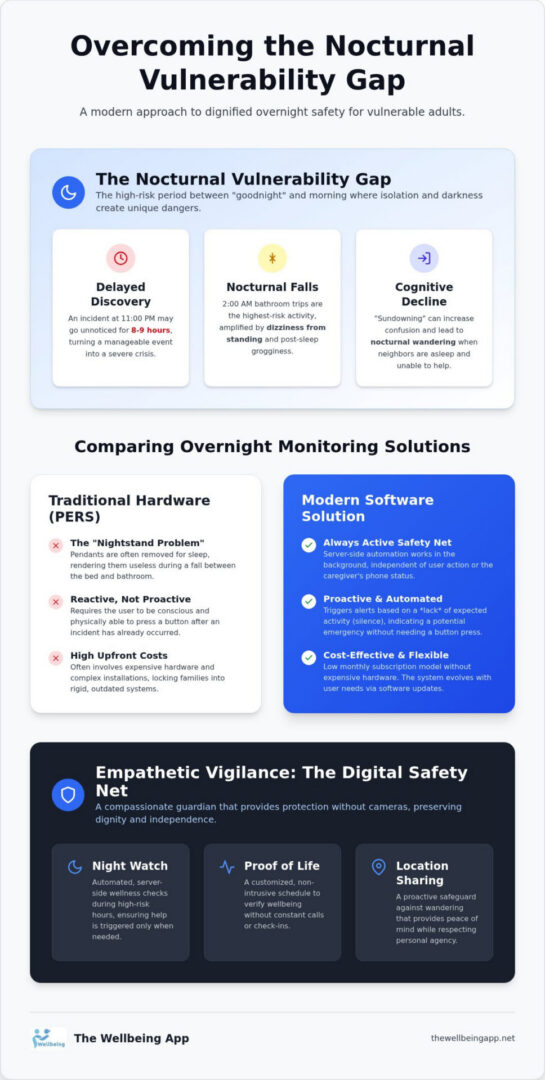
The period between the final “goodnight” and the first morning greeting represents more than just a block of time. We call this the Nocturnal Vulnerability Gap. It’s a window where isolation and reduced visibility combine to create a unique set of risks that daytime care doesn’t always address. During these hours, the environment changes. The house is dark, the community is asleep, and the immediate support system is often miles away. This gap makes overnight safety monitoring for vulnerable adults a vital component of any comprehensive care plan.
One of the most pressing issues is the “Delayed Discovery” problem. When an incident occurs shortly after bedtime, perhaps around 11:00 PM, it may go unnoticed for eight or nine hours. This delay in response can turn a manageable health event into a severe crisis. For caregivers, this reality creates a state of constant, low-level panic. You likely sleep with your phone on your pillow, jumping at every vibration, caught in a cycle of nocturnal anxiety that prevents true rest. It’s a heavy emotional toll that stems from the fear of what you might find when the sun comes up.
The Risk of Nocturnal Falls and Medical Emergencies
Bathroom trips at 2:00 AM are statistically the highest-risk activity for seniors. This is often due to orthostatic hypotension, a sudden drop in blood pressure that causes dizziness when standing up quickly. When combined with sleep inertia, the grogginess felt immediately after waking, the risk of a fall increases significantly. In the dark, a misplaced rug or a pet can become a dangerous obstacle. While medical alarm systems provide a way to call for help, they rely on the individual being conscious and able to press a button. If they can’t reach the device or are disoriented by the dark, the system fails to bridge the gap.
Cognitive Decline and the Danger of Wandering
For those living with cognitive decline, the onset of evening often brings “Sundowning,” a state of increased confusion and agitation. This can lead to nocturnal wandering or elopement. If a loved one leaves their home at 3:00 AM, the danger is magnified because neighbors aren’t awake to notice. Automated Location Sharing acts as a vital preventative measure here. It provides a way to verify their position without being intrusive or overbearing. By using a digital safety net, you ensure that if they do wander, you’re alerted immediately. This approach preserves their personal agency while maintaining a protective watch over their well-being.
Comparing Overnight Monitoring Solutions: Software vs. Hardware
When families begin looking for overnight safety monitoring for vulnerable adults, they usually encounter three distinct paths. You might consider hiring in-home help, installing physical sensors, or utilizing modern safety applications. While physical caregivers provide direct human contact, the costs can be prohibitive for many households. Hardware sensors offer a middle ground, but they often require complex installations and significant upfront investments. In contrast, cloud-based software solutions provide a flexible, cost-effective alternative that adapts to the natural rhythms of a home.
The shift toward monthly subscriptions reflects a broader change in how we manage safety. High upfront hardware costs often lock families into rigid systems that are difficult to update. Software-driven safety, however, evolves with the user. It functions as a digital safety net that doesn’t rely on expensive equipment that might break or become obsolete. This server-side approach ensures that monitoring continues independently of the user’s immediate actions or the caregiver’s phone status. If you’re looking for a way to achieve this balance, exploring app-based safety tools is a great first step toward mental tranquility.
Traditional PERS and the “Nightstand Problem”
Many households rely on Personal Emergency Response Systems (PERS), but these devices face a significant failure point during the night. Pendants are frequently left on the nightstand because they’re uncomfortable to wear while sleeping. This renders them useless if a fall occurs between the bed and the bathroom. There’s also a psychological barrier to overcome. Many adults resist wearing a device that feels like a constant reminder of their vulnerability. Personal Emergency Response Systems (PERS) are reactive tools that require the user to be conscious and capable of activating an alert.
App-Based Monitoring: Proactive vs. Reactive Safety
Proactive safety moves beyond waiting for a button press. Automated check-ins create a heartbeat of safety throughout the night. If a scheduled check-in is missed, the system triggers an alert automatically. This server-side monitoring ensures that family members are notified simultaneously through cloud-based alerts, even if a caregiver’s phone is silenced. Unlike standalone GPS trackers that require separate charging and constant maintenance, smartphone-based location sharing utilizes the device your loved one already carries. It’s a more reliable, dignified way to maintain a protective watch. By focusing on indicators of well-being rather than constant surveillance, you preserve harmony and personal agency for everyone involved.
Preserving Dignity through Empathetic Vigilance
Many families struggle with the “Dignity Gap.” This is the quiet tension between your desire to keep a loved one safe and their fundamental right to privacy. When protection feels like a spotlight, it can lead to resentment. Constant surveillance often makes vulnerable adults feel like they’ve lost their status as independent individuals, turning them into “subjects” to be watched rather than family members to be cared for. True overnight safety monitoring for vulnerable adults should feel like a digital safety net, not a prison cell.
We advocate for a philosophy called Empathetic Vigilance. This means providing a level of protection that is felt only when it’s truly needed. It’s about maintaining a watchful eye without intruding on the sacred quiet of a person’s home. Manual check-ins, such as constant texting or calling, often lead to “Check-in Fatigue.” If a loved one misses a text at 10:00 PM, the resulting panic can strain the relationship. Automated Proof of Life systems remove this friction. They allow the vulnerable adult to confirm their well-being on their own terms, preserving their agency while giving you the mental tranquility you need to sleep.
The Problem with Intrusive Surveillance (Cameras)
While cameras might seem like an easy fix, they are often the most damaging to a person’s sense of self. Placing lenses in private spaces like bedrooms or bathrooms can lead to social withdrawal. People tend to change their behavior when they know they’re being watched, which can cause significant psychological stress. Beyond the emotional impact, there are real security risks. Unencrypted or poorly managed video feeds can be vulnerable to outside access. Positioning software-only check-ins as a privacy-first alternative ensures that safety never comes at the cost of personal exposure.
Fostering Agency and Collective Responsibility
Safety is most effective when it’s a shared mission. We believe in moving away from the idea of “monitoring a subject” and toward participating in a community safety net. When you involve a loved one in setting their own Proof of Life schedule, you empower them. They aren’t just being watched; they’re actively confirming their own safety. Features like Night Watch act as a shared agreement of protection between family members. It’s a proactive promise that help is always available, framed as an instrument of empowerment rather than a tool of restriction. This collective approach fosters harmony and reinforces the bond of trust within the family.
How to Implement an Effective Nighttime Safety Protocol
Creating a structured response plan for overnight safety monitoring for vulnerable adults is the most effective way to turn anxiety into mental tranquility. It begins with a nighttime home safety audit. Walk through the residence during the dark hours to identify where motion-activated lighting is needed and where trip hazards, like loose rugs or cluttered hallways, become invisible. Once the physical space is secure, you can focus on the digital safety net that supports it.
Establishing a Proof of Life schedule is the next vital step. This schedule should mirror your loved one’s natural routine rather than forcing them into a rigid, external structure. You also need a defined emergency escalation path so everyone knows exactly who to call if an alert triggers. Educate your loved one on how to respond to automated prompts, framing it as a tool for their own empowerment. Finally, review and adjust the protocol monthly. Health needs often shift, and a proactive safety strategy must evolve to remain an effective compassionate guardian. If you’re ready to establish a reliable routine, you can start your nighttime safety protocol today.
Setting Up Automated Check-In Windows
Choosing the right times for verification ensures that monitoring remains a supportive presence rather than a disruption. Morning checks verify a safe start to the day, while evening checks confirm they’ve settled in for the night. For individuals prone to wandering, Night Watch periods provide specialized protection during high-risk nocturnal hours. A Safety Window is the specific timeframe in which a user is expected to acknowledge their wellbeing. By aligning these windows with natural habits, you reduce check-in fatigue and preserve personal agency.
Building the Emergency Contact Circle
A robust safety net requires at least three designated contacts to ensure someone is always reachable. We recommend a tiered approach to your alert chain. The “First Responder” is typically a nearby neighbor who can reach the home in minutes to provide immediate assistance. The “Decision Maker” is usually a family member who manages the overall care and communication. Ensure all contacts have the monitoring app installed. This allows for seamless real-time location sharing and ensures that everyone in the circle is informed the moment an indicator of well-being is missed. This collective responsibility fosters a sense of community and trust.
The Wellbeing App: Your Partner in Mental Tranquility
The Wellbeing App isn’t just a software solution; it’s a compassionate guardian designed to bridge the gaps in traditional care. We focus on a singular mission: preserving your mental tranquility while honoring the dignity of those you love. By providing specialized overnight safety monitoring for vulnerable adults, we ensure that the quietest hours of the night are also the safest. Our technology operates silently in the background, acting as a watchful protector that never sleeps. It’s about providing a safety net that is felt only when it’s truly needed.
Night Watch offers specialized 24/7 server-side monitoring for high-risk nocturnal hours. Unlike hardware that can fail or be forgotten on a bedside table, our server-side logic ensures that alerts are dispatched even if your own phone is switched off or in do-not-disturb mode. The Proof of Life feature uses automated check-ins to create a proactive digital safety net. This prevents missing person incidents by verifying well-being based on the user’s natural routine. For moments when a loved one needs to move through the house or venture outside during late hours, our Chaperone service acts as a virtual companion. This provides an extra layer of reassurance for them and peace for the family.
Why Families Choose Our Digital Safety Net
Families choose our digital safety net because it removes the single point of failure common in traditional security systems. We believe safety is a shared effort. Our system provides:
- Reliable Automated Alerts: Notifications reach your emergency circle even if the primary caregiver is asleep.
- Generational Simplicity: An interface designed for ease of use, ensuring that vulnerable adults feel empowered rather than overwhelmed.
- Real-Time Location Sharing: Powerful indicators of position are shared instantly during active alerts to facilitate a rapid response.
Starting Your Journey Toward Proactive Protection
Protection shouldn’t be complicated. Moving from a state of constant nocturnal anxiety to one of empowerment takes only minutes. We offer both monthly and annual subscription plans to fit your family’s specific needs, allowing you to scale your safety net as health requirements change. Onboarding is a seamless process that prioritizes your sense of duty toward your loved ones. You can move from worry to harmony today. Join The Wellbeing App community to ensure your loved one’s safety today. Peace is possible when you have a reliable partner watching over the group’s best interests.
Reclaiming Rest and Preserving Dignity
The night shouldn’t be a season of constant anxiety for your family. By bridging the Nocturnal Vulnerability Gap with empathetic, non-intrusive safety monitoring, you preserve both your loved one’s independence and your own mental health. We’ve explored how moving beyond reactive hardware to a proactive digital safety net ensures help is always ready, yet never intrusive. Implementing a personalized protocol with 24/7 automated Night Watch protection and Proof of Life indicators transforms safety from a burden into a shared agreement of care. This modern approach to overnight safety monitoring for vulnerable adults fosters personal agency and strengthens the bonds of trust within your home. You have the power to replace nocturnal fear with empowerment by choosing a system that values privacy as much as physical security. It’s time to reclaim your peace of mind while knowing your loved ones are never truly alone.
Secure your family’s peace of mind with The Wellbeing App
Frequently Asked Questions
What is the difference between a medical alert and overnight safety monitoring?
Medical alerts are typically reactive; they require the person to be conscious and able to press a button. In contrast, overnight safety monitoring for vulnerable adults is proactive. It uses automated indicators like Night Watch to verify well-being without requiring a specific action during high-risk hours. While a pendant might be left on a nightstand, server-side monitoring stays active to ensure help is triggered even if the individual can’t reach a device.
How does an automated Proof of Life check-in work for seniors?
A Proof of Life check-in uses scheduled digital prompts that the user acknowledges on their smartphone. Instead of constant surveillance, it creates a “Safety Window” where the senior confirms they are okay at times that fit their natural routine. If the prompt isn’t acknowledged within the set timeframe, the system automatically escalates the situation to the emergency contact circle. It’s a dignified way to verify safety without intrusive phone calls.
Can I monitor a vulnerable adult without using cameras?
Yes, you can provide a digital safety net using non-intrusive software indicators rather than visual surveillance. Systems like Chaperone focus on status verification and location sharing rather than watching private spaces. This preserves the individual’s privacy and dignity while still providing caregivers with mental tranquility. It’s a compassionate alternative that avoids the resentment and social withdrawal often caused by placing cameras in bedrooms or bathrooms.
What happens if a vulnerable adult misses a scheduled nighttime check-in?
If a check-in is missed, the server-side system immediately triggers an automated alert to the designated emergency contact circle. This alert chain typically starts with a “First Responder,” such as a nearby neighbor, before moving to family “Decision Makers.” Because the monitoring is automated, you don’t have to worry about missing a notification. The system ensures that silence is treated as a potential emergency, prompting a rapid and coordinated response.
Is overnight monitoring via an app reliable if the phone battery dies?
Server-side monitoring remains highly reliable because the logic lives in the cloud, not just on the physical device. If a phone battery dies or the device loses connection during a Night Watch period, the system treats that loss of signal as a missed check-in. This triggers an alert to the caregiver’s emergency circle. It ensures that protection continues even when hardware fails, providing a level of redundancy that traditional devices often lack.
Do I need to buy any extra hardware for The Wellbeing App to work?
No, you don’t need to purchase any proprietary hardware, sensors, or wearable pendants. The Wellbeing App is a software-first solution that utilizes the smartphone your loved one already owns. This approach eliminates high upfront costs and the technical frustration of installing physical devices. By using existing technology for location sharing and Proof of Life checks, you can begin your journey toward proactive protection and mental tranquility in just a few minutes.
How do automated safety alerts help prevent missing person incidents?
Automated safety alerts act as an early warning system for elopement or wandering. By establishing a Proof of Life schedule, caregivers are notified the moment a routine is broken, rather than discovering a disappearance hours later. Features like Chaperone provide a virtual companion during movement, while real-time location sharing ensures that if a vulnerable adult does leave their home, they can be found quickly. This proactive approach significantly reduces response times.
Is nighttime safety monitoring covered by insurance or Medicare?
Coverage for overnight safety monitoring for vulnerable adults varies significantly by plan and provider. Traditional Medicare generally doesn’t cover app-based monitoring services, though some Medicare Advantage plans or long-term care insurance policies may offer wellness benefits that apply. It’s best to check with your specific insurance coordinator. Many families find that the low monthly subscription cost is a manageable investment compared to the high expense of hiring physical overnight caregivers.