
Peace of Mind Check In App: The 2026 Guide to Automated Safety
With more than 14 million older adults falling each year and nearly 30% of U.S. households now living solo, the silence of an unreturned text message has become a major source of family anxiety. You’ve likely felt that familiar pang of worry when a loved one doesn’t pick up the phone. Perhaps you’ve also felt the guilt of checking in so often that it feels like surveillance. It’s a difficult tension to manage; you want to ensure everyone is safe, but you don’t want to strip away their independence or dignity in the process.
This guide shows you how a peace of mind check in app bridges that gap by acting as a compassionate, automated guardian. You’ll discover how server-side technology provides a reliable safety net for seniors and solo travelers without the need for intrusive hardware or constant manual updates. We’ll explore how modern tools like Proof of Life indicators and Night Watch protection offer a “set it and forget it” solution. This ensures that if something goes wrong, the right people are notified instantly while you maintain the freedom you’ve earned.
Key Takeaways
- Understand the shift from reactive emergency buttons to proactive monitoring that protects your dignity and independence.
- Learn why server-side automation ensures your safety net remains active even if your phone’s battery dies or the device is damaged.
- Discover how a peace of mind check in app eliminates the anxiety of unreturned texts through a reliable “set it and forget it” system.
- Evaluate specialized features like Night Watch and Chaperone to provide targeted protection during your most vulnerable hours or solo travels.
- Explore how automated Proof of Life indicators foster family harmony by replacing constant “checking up” with silent, watchful reassurance.
What is a Peace of Mind Check In App?
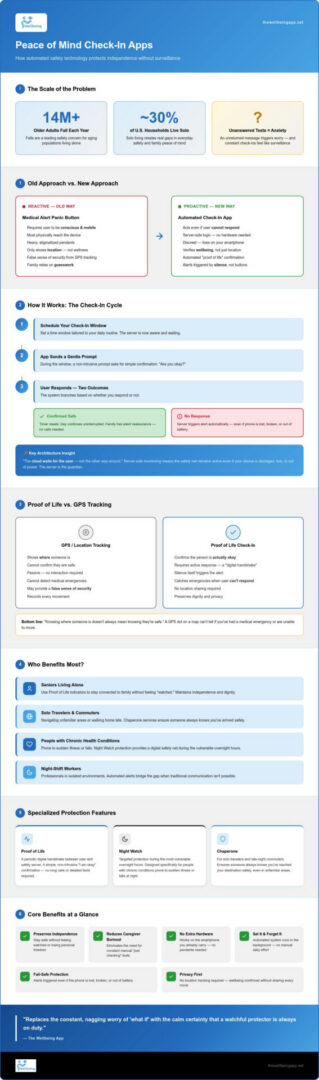
A peace of mind check in app is a proactive safety tool designed to monitor well being without the intrusion of active surveillance. Unlike traditional tracking software that records every movement, these systems act as a silent, digital safety net. They function on a simple yet powerful premise: the system waits for a signal from the user. If that signal doesn’t arrive within a scheduled window, the app takes action. This approach preserves personal dignity while ensuring that help is never more than a missed check in away.
We’re seeing a significant shift from reactive medical alerts to proactive “proof of life” indicators. Traditional panic buttons require a person to be conscious and mobile enough to reach a device. In contrast, an intelligent check in system assumes something might be wrong if you don’t respond, triggering a protective sequence automatically. This creates a state of mental tranquility for both the user and their family. It replaces the constant, nagging worry of “what if” with the calm certainty that a watchful protector is always on duty.
The Evolution of Personal Safety Technology
Personal safety has moved far beyond the heavy, stigmatized medical pendants of the past. Today’s technology lives on the smartphones we already carry, offering a sleek and discreet alternative. By 2026, the focus has shifted toward “silent” monitoring. Instead of loud, frightening alarms that can cause unnecessary stress, these apps use server side logic to manage safety behind the scenes. This automation is a vital tool in reducing caregiver burnout. It eliminates the need for family members to send “just checking” texts that often go unreplied, replacing manual anxiety with automated reliability.
Who Benefits Most from Automated Check-Ins?
While anyone can benefit from an extra layer of security, certain groups find these tools transformative for their daily lives:
- Seniors Living Alone: Those who value their independence use Proof of Life indicators to stay connected to family without feeling like they’re being “watched.”
- Solo Travelers and Commuters: Individuals navigating unfamiliar areas or walking home late use Chaperone services to ensure someone always knows they’ve reached their destination safely.
- People with Chronic Health Conditions: For those prone to sudden illness or falls, Night Watch protection offers a digital safety net during the vulnerable overnight hours.
- Night-Shift Workers: Professionals working in isolated environments rely on automated alerts to bridge the gap when traditional communication isn’t possible.
By distinguishing between standard GPS trackers, which only show location, and intelligent check in systems, which verify well being, users can maintain their privacy. You don’t need to share your every move to be safe; you just need a system that knows when to speak up if you can’t.
How Automated Check-In Technology Works
The true power of a peace of mind check in app lies in its underlying architecture. Most safety tools rely on the user’s phone to send an alert, but what happens if that phone is crushed in a fall or runs out of battery? Advanced systems use server side monitoring, where the cloud waits for you. Instead of your phone being the trigger, the server is the guardian. It expects a signal at a specific time. If that signal doesn’t arrive, the server initiates the alert sequence independently of your device’s status. The cloud waits for the user, not the other way around.
The process begins with a scheduled check in window tailored to your routine. During this time, the app sends a gentle prompt for user confirmation. If you acknowledge the prompt, the timer resets, and your day continues uninterrupted. However, if the window passes without a response, the automated alert trigger begins its work. This fail safe is critical; even if your phone is lost, broken, or out of range, the server knows you didn’t check in and will notify your emergency contacts as planned.
Proof of Life is a periodic digital handshake between the user and the safety server. It’s a simple, non intrusive confirmation that says “I am okay” without requiring a long phone call or a detailed text.
Proof of Life vs. Simple GPS Tracking
Knowing where someone is doesn’t always mean knowing they’re safe. A GPS dot on a map only shows a location; it can’t tell your family if you’ve had a medical emergency or are unable to move. Active confirmation requires a response, which provides a much higher level of certainty. While passive tracking often offers a false sense of security, automated systems require that “pulse” of interaction. This ensures that the help you need is triggered by your silence, rather than a family member’s guesswork. It’s a more reliable indicator of well being than a static coordinate on a map.
The Role of Emergency Contacts and Escalation
When a check in is missed, the system begins a structured escalation. You can customize who gets notified and in what order, ensuring your inner circle is the first to know. During an active alert, Location Sharing becomes critical, providing your contacts with the precise coordinates they need to help. This mirrors professional standards like the OSHA working alone safety standards, which emphasize the need for regular intervals of accountability. By creating a shared safety responsibility, you foster community unity and ensure no one is truly alone in a crisis. If you’re looking for a way to implement these layers of protection, you might consider how automated monitoring solutions can fit into your daily routine.
Why Automated Check-Ins Outperform Manual Safety Texts
Most of us have used the “text me when you get home” system. While well intentioned, this manual approach is inherently flawed because it relies on the person in potential danger to take the first step. If a loved one is incapacitated, unconscious, or simply loses their phone, they can’t send that text. This creates the “forgot to reply” syndrome, a common scenario where a simple lapse in memory triggers a full scale family panic. A peace of mind check in app removes this human error by flipping the script; the system handles the worrying so you don’t have to.
Relying on casual texting often leads to a cycle of over communication that can feel like “policing.” When a family member calls for the third time in a day to “just check in,” it can feel intrusive rather than supportive. Automation preserves the user’s dignity by replacing these high stakes phone calls with a silent, scheduled confirmation. It transitions the relationship from one of active surveillance to one of shared tranquility, where safety is a background process rather than a constant conversation.
The Anxiety of the Unanswered Text
Manual check ins often fail at the exact moment they’re needed most. In a real emergency, the ability to reach for a phone and type a message is frequently the first thing lost. For the family waiting on the other end, a “read” receipt without a reply is a psychological burden that causes immediate distress. By using a peace of mind check in app, you establish a disciplined routine that doesn’t depend on a person’s ability to initiate contact during a crisis. The app’s server side logic ensures that if the digital handshake doesn’t happen, the right people are notified without a single second of wasted time.
Consistency and Reliability in Safety
Human memory is inconsistent, but 24/7 server side vigilance is absolute. One of the greatest advantages of an automated system is the Night Watch feature. This concept provides continuous protection during the most vulnerable overnight hours, even when the user is asleep and unable to interact with their device. It’s a safety net that doesn’t require you to be active to be protected.
- Eliminating Human Error: Apps don’t get distracted or forget to check the clock.
- Reducing Caregiver Stress: Family members can rest easy knowing the system is watching the “check in window” for them.
- Proactive vs. Reactive: Instead of waiting for a text that might never come, the system proactively verifies well being at set intervals.
This level of consistency is impossible to achieve through manual texting. By moving to an automated platform, you ensure that the safety chain remains unbroken, regardless of how busy or tired anyone involved might be.
Choosing the Right Safety Features for Your Lifestyle
Not every user faces the same risks, so the best peace of mind check in app offers modular tools that adapt to your specific environment. If you’re a city dweller, you might prioritize transit safety during your evening commute. If you’re living alone in your golden years, you might focus on daily wellness verification. Choosing features that align with your routine ensures that safety feels like a natural extension of your life, not a technical burden. It’s about finding that perfect balance between privacy and protection.
Privacy is a cornerstone of mental tranquility. You should look for applications that offer Location Sharing only when an alert is triggered. This “incident-only” approach ensures that your movements aren’t being tracked during your normal daily activities, preserving your personal agency. Whether you choose a monthly or annual subscription, the goal is a long-term safety strategy that provides a consistent, reliable safety net without ever feeling like an intrusion.
For the Independent Senior
Independence is a hard-earned treasure. For seniors, the most effective tool is often Proof of Life check-ins. These scheduled prompts mirror your existing daily routine, such as waking up or finishing a morning walk. A simple, one-tap interface is essential; safety shouldn’t feel like a technical chore. We believe automated alerts to your family are far superior to third-party call centers. Your loved ones know your habits best and can provide a faster, more personal response when it matters most. This approach maintains your dignity while providing the “digital pulse” your family needs to stay connected.
For the Urban Professional and Solo Commuter
Navigating the city after dark requires a different kind of vigilance. The Chaperone feature acts as a virtual escort during timed walks or late-night transit. You can set a safety timer for the duration of your commute. If you don’t check in by the time you reach your destination, the escalation process begins automatically. This feature provides real-time data to your emergency contacts only when a threshold is breached. Discreet alert triggers are vital here, allowing you to maintain a sense of security without drawing unwanted attention to yourself in public spaces.
For those with nocturnal health concerns, Night Watch provides a silent guardian while you sleep. It monitors the “gap” hours when most family members are unreachable, ensuring you’re never truly alone. To begin building your personalized safety plan, explore our automated monitoring features and find the right balance for your unique lifestyle.
Restoring Tranquility with The Wellbeing App
The Wellbeing App stands as a compassionate guardian in a world that often feels unpredictable. We don’t believe in fear-based messaging. Instead, we focus on the concept of mental tranquility, providing a peace of mind check in app that empowers you to live fully while staying connected to those who matter most. Our technology is a reliable, always-on partner, dedicated to the welfare of our community members and their families.
By utilizing Proof of Life indicators, you aren’t just checking a box; you’re maintaining a digital pulse that keeps your care circle connected without the friction of constant surveillance. Specialized tools like Chaperone and Night Watch offer targeted protection for those high-stakes moments when you feel most vulnerable. Whether you’re walking home late or settling in for the night, these features ensure you’re never truly alone. Our mission goes beyond simple monitoring. We aim to prevent missing person incidents through proactive community unity, ensuring that silence is met with immediate, supportive action.
A Compassionate Approach to Security
Our protective reassurance differs fundamentally from traditional security systems. We don’t want you to feel anxious; we want you to feel empowered. The Wellbeing App acts as a technologically sophisticated protector that understands the nuances of human connection. We believe that safety is a shared effort, and our platform is designed to foster social cohesion by making it easy for families to look out for one another. This frames our technology as a means to a social and emotional end, rather than just a software utility.
This 24/7 digital partner is dedicated to your well-being, allowing you to maintain your personal agency. You don’t have to choose between your independence and your safety. With the right tools in place, you can explore the world, maintain your solo household, and pursue your passions with the quiet confidence that a safety net is always active. It’s about preserving your mental state so you can focus on what truly matters in life.
Getting Started with Your Digital Safety Net
Setting up your first scheduled check-in is a simple, purposeful act of self-care. It takes only a few moments to define your Proof of Life windows and invite your family members to join your safety circle. This collective responsibility ensures that everyone is on the same page, replacing the “policing” of the past with a harmonious, automated system. Your loved ones will appreciate the clarity that comes with automated notifications, as it relieves them of the duty of constant manual checking.
When you invite them into your circle, you’re giving them the gift of tranquility. You’re showing them that their peace of mind is just as important as your own. It’s time to move beyond the unreliability of manual check-ins and embrace a more disciplined, caring approach to personal welfare. Secure your peace of mind today and experience the difference a dedicated guardian can make.
Embracing a Future of Shared Tranquility
True safety isn’t found in constant surveillance, but in the quiet confidence that a digital guardian is always watching over your well-being. By moving beyond the unreliability of manual texts and adopting a peace of mind check in app, you replace family anxiety with structured harmony. We’ve explored how continuous server-side monitoring ensures your safety net remains intact even if your device fails. This proactive approach, powered by automated Proof of Life indicators, honors your personal agency while fulfilling your duty to those who care about you most.
Empathetic vigilance is the bridge between independence and security. It allows seniors to live on their own terms and solo travelers to explore with courage, knowing that silence will always be met with support. You don’t have to carry the burden of safety alone; it’s a collective responsibility that we’re honored to share with you. Start your journey toward mental tranquility with The Wellbeing App today. Let’s build a safer, more connected world where every individual feels empowered and every family finds rest.
Frequently Asked Questions
Is a peace of mind check-in app different from a medical alert button?
Yes, a peace of mind check in app is a proactive tool rather than a reactive one. Medical alert buttons require you to be conscious and mobile enough to press them during a crisis. In contrast, our Proof of Life feature assumes you need help if you miss a scheduled check-in. This digital safety net provides continuous protection without the need for bulky, stigmatized hardware pendants or proprietary devices.
Does the app track my location all the time?
No, the app is designed to preserve your privacy and personal agency. While Location Sharing is a core feature, it’s typically used as a protective measure during an active alert or when you’ve activated a specific service like Chaperone. Unlike standard GPS trackers that monitor every movement, our goal is to provide mental tranquility. Your location data is shared only with your designated contacts to ensure your safety when a threshold is breached.
What happens if I forget to check in and I am actually okay?
If you miss a scheduled window, the system begins a structured escalation process. You’ll receive a gentle reminder first to account for simple forgetfulness. If there’s still no response, the peace of mind check in app triggers Emergency Alerts to your chosen safety circle. This ensures that help is on the way if you truly can’t call for it, while allowing you to reset the timer quickly if you’re just busy.
Can I use this app for my elderly parents who aren’t tech-savvy?
Absolutely. We’ve designed the interface to be simple and accessible, requiring only a single tap to confirm you’re okay. This makes it an ideal solution for seniors who want to maintain their independence without managing complex technology. Family members can handle the initial setup on their own devices, inviting their parents into a safety circle that provides watchful protection without the burden of active surveillance or complicated menus.
Will the app still work if my phone battery dies or I lose service?
Yes, the system remains active because it uses server-side monitoring. Unlike other apps that rely on your phone to send a distress signal, our cloud servers wait for your digital handshake. If your battery dies or you lose cellular service, the server recognizes that your check-in didn’t arrive at the scheduled time. It will then initiate the alert sequence automatically, ensuring your safety net stays intact regardless of your device’s status.
How much does a peace of mind check-in app typically cost?
The Wellbeing App operates on a recurring subscription model, offering both monthly and annual plans to fit your long-term safety strategy. These fees grant you full access to our suite of monitoring tools, including Proof of Life indicators and Night Watch protection. By choosing a software-only solution, you avoid the high upfront equipment costs and installation fees often associated with traditional medical alert systems or proprietary hardware devices.
Can I customize who receives my emergency alerts?
You have complete control over who receives your Emergency Alerts. During setup, you’ll designate specific contacts, such as family members, friends, or trusted neighbors, to be part of your safety circle. You can customize the order of notification to ensure the right people are reached first. This fosters community unity and ensures that those who know your habits best are the ones responding to provide empathetic vigilance when you need it.
Is my data and location information kept private?
Privacy is a central pillar of our mission to restore mental tranquility. We use technical security terminology and robust server-side logic to ensure your data remains secure. Your location information is treated with the highest level of care and is only released to your designated contacts during an active emergency or a Chaperone session. We are a software provider dedicated to your welfare, not a data-sharing company, ensuring your personal information stays protected.