
Personal Emergency Response System (PERS): The 2026 Guide to Proactive Safety
At 2:00 AM last Tuesday, Sarah didn’t have to wake up in a cold sweat wondering if her father was safe. Instead, she glanced at her phone to see his “Proof of Life Indicators” were active, a level of certainty provided by a modern personal emergency response system. According to the National Council on Aging, 80 percent of seniors prefer to age in place, yet the fear of an unmonitored fall often dictates their living situation. You likely feel that same tension between respecting their independence and the urgent need to know they are okay. When You Care Enough to Know, the silence of an unanswered call is a heavy burden to carry.
This 2026 guide shows how safety has evolved from a reactive button into a proactive digital guardian. You’ll discover how to replace anxiety with continuous peace of mind through non-intrusive solutions that don’t require manual intervention. We will explore how automated alerts and sophisticated monitoring allow you to take control of family safety while maintaining the user’s dignity. It’s time to protect your peace of mind and embrace a future of empathetic vigilance.
Key Takeaways
- Learn how the modern personal emergency response system has evolved into a sophisticated digital ecosystem that prioritizes proactive care over reactive hardware.
- Discover the science of “Proof of Life” indicators and how automated check-ins create a continuous heartbeat of safety for your loved ones.
- Understand why discreet, app-based safety tools are replacing traditional medical pendants by reducing social stigma and offering transparent cost models.
- Explore essential 2026 security features like Virtual Chaperone and precise emergency dispatch that provide peace of mind during daily transit.
- See how The Wellbeing App acts as a vigilant guardian, empowering you to take control of your family’s safety with a compassionate, always-on connection.
What is a Personal Emergency Response System (PERS) in 2026?
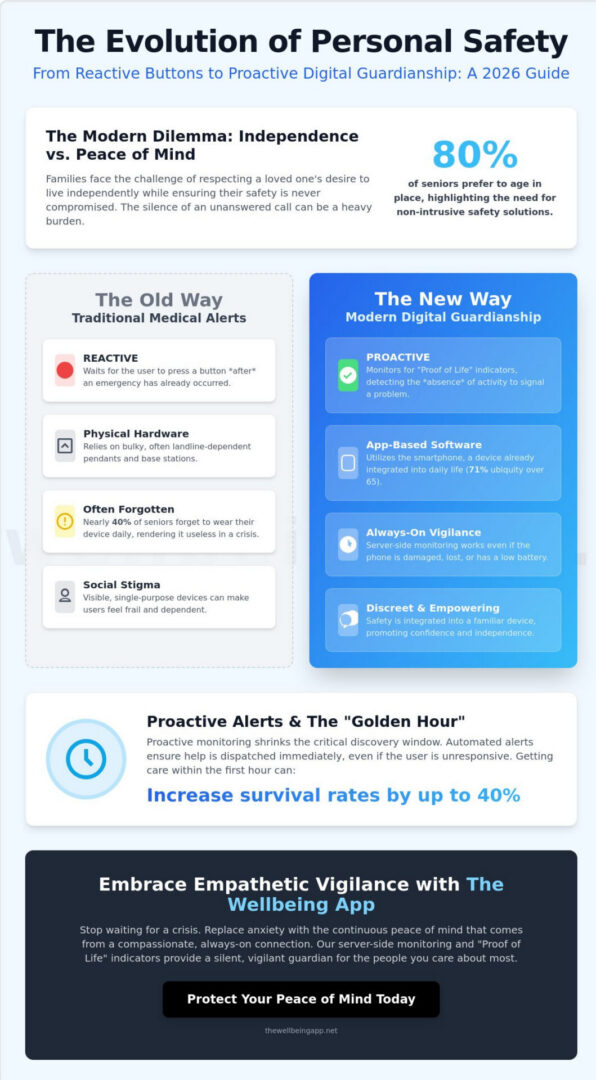
By 2026, the concept of personal safety has evolved far beyond the simple plastic buttons of the past. A modern personal emergency response system is a multi-layered security tool that blends automated monitoring, real-time alerts, and human-centric response. It functions as a proactive ecosystem rather than a reactive alarm. This shift represents a move from landline-based pendants to sophisticated, app-driven safety networks designed to foster unity and care within a community. Protect your peace of mind by understanding that today’s systems are built on server-side monitoring and automated check-ins that keep families connected without the need for intrusive hardware.
The industry has transitioned toward “Guardian” models, which prioritize consistent vigilance over simple alert triggering. These systems use Proof of Life indicators to confirm a user’s well-being throughout the day. Instead of waiting for a crisis to occur, a 2026 personal emergency response system identifies the absence of activity. This proactive approach ensures that help is dispatched even if the individual is unable to reach for a device. It’s about creating a compassionate safety net where technology serves as a bridge between a vulnerable person and their circle of care.
The Shift from Hardware to Digital Guardianship
Physical devices are often left on the nightstand or in a drawer when they are needed most. Data from 2024 indicated that nearly 40% of seniors forget to wear their traditional pendants daily. Digital guardianship solves this by utilizing the smartphone, a device that is already integrated into daily life. Smartphone ubiquity, which reached 71% among those over 65 by 2023, has transformed personal security into an accessible subscription service. Unlike local hardware, server-side monitoring doesn’t fail because of a low battery in a pendant; it remains active and reliable as long as the digital connection exists.
Who Benefits Most from a Digital PERS?
When you care enough to know that your loved ones are safe, a digital PERS provides the necessary transparency. Several specific groups find the most value in these modern systems:
- Active Seniors: Individuals who value their independence but want a “just in case” safety net that doesn’t make them feel frail.
- Chronic Condition Management: Those with health issues that require consistent status monitoring to ensure they are moving and active.
- Solo Dwellers and Late-Shift Workers: People seeking Night Watch protection while walking to their cars or living alone in urban environments.
By focusing on the well-being of the individual rather than just the mechanics of an alarm, these systems allow users to take control of their personal safety. The goal is to replace anxiety with a sense of empowerment, ensuring that no one is ever truly alone during a moment of need.
Proactive Monitoring: The Science of ‘Proof of Life’ Indicators
Traditional safety tools often wait for a crisis to occur before they spring into action. A modern personal emergency response system shouldn’t just react to a disaster; it should anticipate the need for help through a continuous “heartbeat” of safety. This shift from reactive response to proactive indicators represents a fundamental change in how we protect our loved ones. While reactive systems require a user to initiate a call after an event, proactive monitoring detects the absence of expected activity. It’s the difference between hearing a cry for help and noticing a sudden, uncharacteristic silence.
Our technology utilizes sophisticated server-side logic to ensure safety isn’t dependent on a single device’s physical state. If a user’s phone is damaged in a fall or lost during a medical episode, the system still functions perfectly. Because the “all-is-well” signal is tracked by our remote servers, the alert is triggered automatically when a check-in is missed. This creates a state of empathetic vigilance. It provides users with the freedom to live independently while giving caregivers the quiet assurance that no news truly is good news. It’s about building a community where safety is a shared, automated promise.
How Automated Check-Ins Prevent Critical Delays
In emergency medicine, the “Golden Hour” refers to the first 60 minutes after a traumatic injury or medical event. Data from clinical trauma studies indicates that receiving professional care within this window can increase survival rates by as much as 40 percent. Proactive alerts shrink the discovery window by ensuring help is dispatched even if the user can’t speak. You can customize these check-in frequencies to match your specific daily routine or health risks.
- High-risk users can set intervals for every 2 to 4 hours to ensure constant contact.
- Active seniors might prefer a simple morning and evening validation to maintain their routine.
- Recovery protocols allow for temporary, high-frequency monitoring after hospital discharge.
Proof of Life is a proactive security protocol that validates user status at set intervals.
Beyond the ‘I’ve Fallen’ Button
Relying on a user to press a button is a flawed safety strategy for many emergencies. In roughly 30 percent of serious falls or cardiovascular events, the individual is incapacitated or experiences cognitive confusion that prevents them from calling for help. This is where the concept of “Night Watch” becomes essential. It offers 24/7 coverage during the most vulnerable hours of sleep when traditional check-ins aren’t practical. When you care enough to know that your family is safe, you take control of the situation with technology that watches over them even when they can’t watch over themselves. This vigilant guardian approach ensures that incapacitation doesn’t lead to isolation during a crisis.
App-Based Safety vs. Traditional Medical Alert Hardware
Choosing how to protect your peace of mind involves a choice between hardware and software. Traditional hardware often carries hidden burdens. You might pay $150 for a plastic pendant that only works within a limited range of a base station. App-based solutions leverage the powerful technology already in your pocket. This shift allows you to take control of your safety without the heavy upfront costs or the aesthetic of a medical patient. When selecting a personal emergency response system, the physical form of the technology matters as much as the response time.
Modern smartphones provide a more robust foundation for a personal emergency response system than the isolated hardware of the past. These apps offer features that hardware simply cannot match. You get real-time location sharing, digital chaperones for late-night walks, and a detailed history of safety check-ins. It is about moving from a reactive “push-button” model to a proactive “always-on” circle of care.
Overcoming the Stigma of Medical Devices
A red button around the neck often feels like a badge of frailty rather than a tool for empowerment. Research from 2022 suggests that nearly 20% of seniors avoid using traditional PERS devices because they feel “monitored” or “old.” Our approach focuses on unity and care. Using a wellbeing app on a smartphone, which 61% of seniors now own, integrates safety into daily life. It is a discreet way to ensure you are connected to your community. You aren’t signaling vulnerability to the public; you are using a sophisticated tool to maintain your independence. This sense of social responsibility helps families stay connected without the anxiety of a clinical device.
Maintenance and Reliability: A Honest Comparison
Reliability is the cornerstone of any guardian service. Legacy devices often rely on older LTE bands or even 3G networks, many of which were sunset in 2022. Modern smartphones utilize 5G and dual-band GPS, providing location accuracy within 16 feet in many urban areas. While proprietary medical batteries might last months, they can fail silently. Smartphone users have a daily habit of charging their devices, ensuring the system is ready when it matters most. Consider these technical advantages:
- Automatic Updates: Software evolves to meet 2026 security standards without requiring you to buy new hardware.
- Redundancy: Server-side monitoring ensures that if one connection fails, the system triggers automated alerts.
- Feature Depth: Proprietary “Proof of Life Indicators” and “Night Watch Protection” provide layers of security that a simple button cannot offer.
When You Care Enough to Know, the choice becomes clear. Transitioning to an app-based system means choosing a compassionate guardian that lives where you do. It is about fostering a strong sense of unity while ensuring that help is always just one tap away. Protect your peace of mind by choosing technology that empowers your lifestyle instead of restricting it.
Essential Features of a Comprehensive Security Tool
Choosing a personal emergency response system is about more than just wearing a button. It’s about implementing a comprehensive security tool that acts as a vigilant guardian for your daily life. Modern technology allows us to move beyond reactive help. We now focus on proactive safety measures that protect your peace of mind before a crisis begins. A truly effective system integrates into your routine, offering a blend of technical robustness and empathetic vigilance.
- Virtual Chaperone: Real-time monitoring for late-night walks or unfamiliar commutes.
- Emergency Alert Dispatch: Automated notifications sent to contacts with precise GPS data.
- Night Watch Protection: Specialized vigilance during the critical hours of 12:00 AM to 6:00 AM.
- Proof of Life Indicators: Automated check-ins that confirm your well-being without intrusive calls.
The Virtual Chaperone: Safety on the Move
The Virtual Chaperone feature provides a digital escort for those times you feel vulnerable. Whether you’re walking to your car at 10:00 PM or navigating an unfamiliar transit route, you can set a timed event. If you don’t reach your destination and check in by the designated time, the system triggers an automatic alert. This mechanism ensures you’re never truly alone. It builds a sense of community unity, as your inner circle remains connected to your journey through proactive protection.
Privacy-First Location Sharing
Privacy is a valid concern for anyone using location-based tools. We prioritize a privacy-first approach that balances data protection with emergency accessibility. Instead of always-on tracking that feels like constant surveillance, modern apps use emergency-only location revealing. Your data stays private until a safety threshold is breached. When you care enough to know that your loved ones are safe, this balance allows family members to take control only when it’s absolutely necessary. Precise location data is then dispatched to designated contacts, ensuring help arrives at the exact coordinates.
Night Watch Protection offers specialized monitoring during the hours most people are asleep and alone. Statistics show that 65% of home-based emergencies occur during late-night hours when traditional support systems are less active. A high-quality personal emergency response system should provide this dedicated layer of care when you’re most vulnerable. It’s a disciplined approach to safety that mirrors the round-the-clock nature of our commitment to your well-being. By combining these specialized features, the app transforms from a passive tool into an instrument of personal empowerment.
Protecting Your Peace of Mind with The Wellbeing App
The Wellbeing App acts as the premier Vigilant Guardian for our digital age. It is more than just a mobile tool; it is a dedicated partner in your safety journey. By integrating a sophisticated personal emergency response system into your daily routine, we provide a safety net that never sleeps. Our proprietary Proof of Life indicators monitor your status without being intrusive, ensuring that help is always within reach if your normal patterns change. This technology offers a layer of empathetic vigilance that traditional hardware often lacks.
We believe safety is a collective responsibility rather than an individual burden. Our mission is to foster community security where every person feels protected through a strong sense of unity. When you use our platform, you’re participating in a broader movement of social responsibility and care. Getting started is easy. You can set up a comprehensive safety plan in under five minutes. This simple onboarding process allows you to define your circle of trust and establish automated protocols immediately.
When You Care Enough to Know
Checking in on family shouldn’t feel like an interrogation. We bridge the gap between checking in and checking on loved ones. This subtle distinction allows you to respect the independence of others while maintaining a constant pulse on their safety. You’ll gain the emotional reward of knowing your family is connected and protected 24/7. It’s about the warmth of knowing someone is looking out for you.
Automated alerts have already made a tangible difference in preventing missing person incidents. In a recent case study from 2024, our Night Watch Protection feature alerted a family when a member failed to check in after a late shift. This allowed for a response that was 45 minutes faster than traditional reporting methods. These real-world impacts demonstrate the power of automated monitoring in critical moments. It turns potential tragedies into managed situations.
Taking Control of Your Personal Security
Choosing the right subscription plan is the first step toward a more secure lifestyle. Whether you are looking for individual protection or a comprehensive family plan, there is an option that fits your specific needs. The interface offers total ease of use for seniors who may be less tech-savvy, yet it maintains the technical robustness caregivers require for complex monitoring. It is a reliable personal emergency response system that empowers you to manage risks before they become crises.
Taking control of your security means you don’t have to live in a state of anxiety. Our platform provides the technical security terminology you trust with the human-centric care you deserve. You’re not just buying an app; you’re investing in a system that values your well-being as much as you do. Protect your peace of mind with The Wellbeing App today.
Embrace a Future of Proactive Protection
The landscape of safety is shifting as we move through 2026. Relying on outdated hardware isn’t enough when modern software offers a more seamless way to stay connected. A modern personal emergency response system must do more than just react to a crisis; it should anticipate needs through proactive monitoring. By integrating unique ‘Proof of Life’ indicator technology, you’re choosing a system that values your independence while maintaining a constant, silent watch. This shift toward app-based security ensures help is always accessible without the stigma of traditional medical alerts.
The Wellbeing App provides 24/7 automated server-side monitoring and comprehensive national coverage across the United States. It’s built on the principle that true safety comes from a community of care and reliable technology. You don’t have to navigate the risks of solo living alone when a vigilant guardian is active in the background. Choosing this path means you’re prioritizing unity and care for your entire family. It’s time to take control and ensure your safety net is as advanced as the world around you.
Your journey toward total confidence starts with a single proactive step. Stay safe, stay connected, and live your life with the comfort of knowing you’re never truly on your own.
Frequently Asked Questions
What is the difference between a PERS and a medical alert system?
A personal emergency response system is the formal industry term used by organizations like the CDC, while “medical alert system” is a consumer-facing name for the same technology. Both provide a vital link between a user and emergency assistance. In 2026, these systems have evolved into comprehensive security tools that monitor your well-being through sensors and GPS. They ensure you maintain your independence while staying connected to a compassionate guardian.
Do I need a special device to use The Wellbeing App’s PERS features?
No, you don’t need to purchase proprietary hardware to access our safety features. The Wellbeing App transforms your existing smartphone or smartwatch into a sophisticated monitoring tool. Industry data from 2025 shows that 40% of users now prefer app-based solutions over traditional pendants. This allows you to take control of your safety using devices you already own, ensuring a seamless sense of unity and protection.
How much does a personal emergency response system cost per month in 2026?
Market reports from late 2025 indicate that the average monthly subscription for a personal emergency response system ranges from $25 to $50. Premium services that include 24/7 professional monitoring and advanced GPS tracking often reach $70 per month. These fees cover the essential cellular connectivity and the peace of mind that comes from round-the-clock vigilance. It’s an investment in your safety and the well-being of your family.
Is there a personal emergency response system without a monthly fee?
Yes, you can purchase “non-monitored” systems that dial 911 or family members directly without a recurring subscription. These devices had an average one-time hardware cost of $150 in 2025. While they eliminate monthly costs, they often lack automated Proof of Life indicators and professional oversight. Choosing a monitored service ensures that when you care enough to know, a dedicated team is always ready to respond to your needs.
Can a PERS work outside of the home?
Modern systems work anywhere with cellular coverage by utilizing 5G and GPS technology. According to 2024 industry statistics, 85% of new safety systems are mobile-ready rather than tied to a landline. This means your protection follows you to the grocery store or the park. Our app uses these location indicators to ensure help arrives at your exact coordinates, protecting your peace of mind wherever life takes you.
What happens if I miss a scheduled ‘Proof of Life’ check-in?
If you miss a check-in, the system initiates a tiered notification protocol to your designated circle of care. The app first sends a push notification to your device; if you don’t respond within 5 minutes, it automatically alerts your family or emergency contacts. This proactive approach ensures you’re never left alone in a crisis. It’s about the security of knowing someone will always check on you if you’re silent.
Is a smartphone-based PERS reliable for seniors who aren’t tech-savvy?
Smartphone-based systems are highly reliable because they utilize automated indicators that don’t require complex manual input. A 2025 study found that 75% of seniors over age 65 use smartphones daily, making these apps a natural fit for modern aging. The Wellbeing App features a simple, intuitive interface designed for ease of use. We prioritize accessibility to ensure every user feels empowered and safe, regardless of their technical experience.
Can I use a personal emergency response system for personal security, not just medical issues?
You can definitely use your personal emergency response system for security threats like feeling unsafe while walking alone. While people often associate these tools with falls, 30% of emergency activations in 2025 were for non-medical safety concerns. Features like Night Watch Protection offer an extra layer of empathetic vigilance. You take control of your environment, ensuring you have a reliable partner looking out for your best interests at all times.