
Proof of Life Monitoring Service: The 2026 Guide to Proactive Safety
What if the most dangerous part of living alone isn’t the risk of an accident, but the silent hours that follow when no one knows you need help? You likely already feel the heavy weight of this uncertainty, whether you’re a senior cherishing your independence or a caregiver constantly checking your phone for a status update. It’s an exhausting cycle of worry that often leads to burnout, yet the thought of invasive cameras or wearable trackers feels like a step too far. A modern proof of life monitoring service offers a different path, acting as a compassionate guardian that provides empathetic vigilance without the weight of constant surveillance.
We believe that true mental tranquility comes from knowing a safety net is always active, allowing you to live with confidence and personal agency. This guide explores how automated indicators and server-side alerts provide a proactive shield for solo dwellers and their families. You’ll learn how to maintain total peace of mind through technology that respects your privacy while ensuring a reliable response if a check-in is missed. We’ll walk through the ways these systems foster harmony and connection, proving that safety doesn’t have to come at the cost of your freedom.
Key Takeaways
- Understand the psychological benefits of transitioning from reactive emergency responses to a proactive system that guards your well-being every hour.
- Discover how a modern proof of life monitoring service uses server-side technology to ensure alerts are dispatched even if a device is powered off or destroyed.
- Compare the cost and discretion of mobile safety apps against traditional medical hardware to find a solution that respects your privacy and budget.
- Learn how to implement a proactive safety routine that balances your need for autonomy with your family’s desire for reliable, automated check-ins.
- Explore how focusing on personal agency and automated indicators can eliminate caregiver burnout while maintaining your independence.
What is a Proof of Life Monitoring Service?
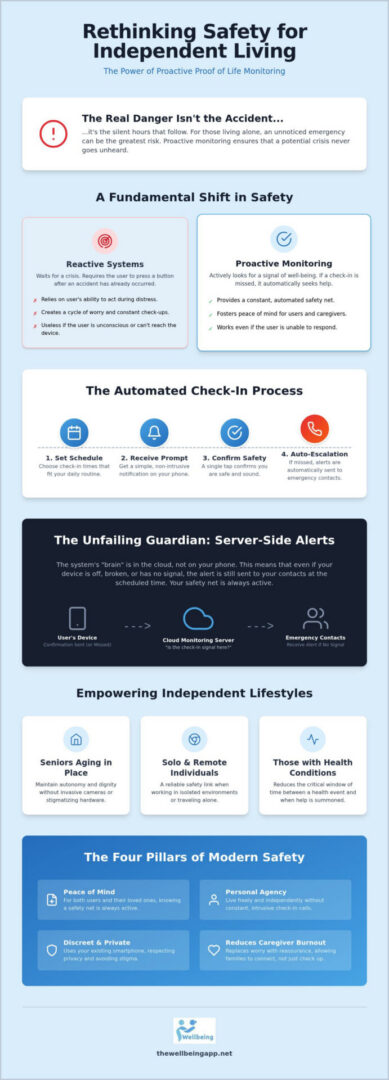
Traditional safety tools often wait for a crisis to happen before they provide any value. You press a button after a fall, or you call for help once an accident has occurred. A proof of life monitoring service flips this script by focusing on proactive wellness indicators. Instead of waiting for a signal of distress, these services look for a consistent signal of safety. This shift is fundamental for mental tranquility. It moves the focus from “what if something goes wrong” to “knowing everything is right.” It’s about preventing the silence that often follows an emergency.
For those living alone, the greatest danger isn’t necessarily the accident itself, but the time that passes before someone notices. Unnoticed emergencies can stretch for hours or even days if a person is unable to reach a phone or a wall-mounted alarm. By establishing a routine of automated check-ins, you eliminate the risk of a silent crisis. This automation also serves as a vital tool for families, effectively ending the cycle of caregiver burnout. You no longer need to send constant texts that can feel intrusive. The system handles the vigilance, so you can focus on the connection.
The Core Mechanism of Automated Check-ins
Modern safety relies on a logic similar to a “dead man’s switch,” where a system triggers an alert if a human operator stops providing a signal. In the context of personal safety, this means you set specific times to confirm you’re okay. If that confirmation doesn’t happen, server-side monitoring takes over to alert your emergency contacts. A proof of life monitoring service is a proactive digital safety net that ensures help is summoned automatically if a user fails to confirm their well-being at a scheduled time. It acts as a reliable, always-on partner that never forgets to check on you.
Who Benefits Most from Proof of Life Services?
While anyone living alone finds value in this protection, certain groups find it indispensable for maintaining their personal agency. These services foster social cohesion by allowing vulnerable individuals to stay connected without feeling like a burden to their loved ones. Key beneficiaries include:
- Seniors aging in place: They can maintain their independence without the stigma of bulky hardware or the privacy concerns of invasive cameras.
- Solo travelers and remote workers: These individuals gain a safety link when working in isolated environments or exploring new territories alone.
- Individuals with chronic health conditions: Daily monitoring ensures that if a health episode occurs, the window of time before help arrives is significantly reduced.
By choosing a system that prioritizes proactive check-ins, you’re not just buying a tool; you’re investing in a compassionate guardian. This approach ensures that safety is a shared effort, providing empowerment for the user and relief for the family. It is the most effective way to manage risks without sacrificing the dignity of a private, independent life.
How Modern Safety Monitoring Works in 2026
Safety used to be tethered to a wall. If you weren’t near your landline or hadn’t put on a bulky pendant, you were essentially unprotected. Modern safety monitoring in 2026 has moved entirely into the cloud, replacing clunky hardware with sophisticated software that follows you wherever life leads. This evolution focuses on empathetic vigilance, where the technology works silently in the background to preserve your mental tranquility. By utilizing a proof of life monitoring service, you’re no longer reliant on your ability to reach for help; instead, the system is designed to reach out to you.
This proactive approach integrates GPS and real-time location sharing into a seamless safety net. It doesn’t just wait for a signal. It expects one. When that signal doesn’t arrive, the system initiates an automated escalation process that bridges the gap between technology and human connection. It’s a disciplined, serious approach to safety that remains accessible and friendly, ensuring that help is never more than a missed check-in away.
Step-by-Step: The Automated Check-in Process
The journey to proactive safety begins with your personal routine. You don’t have to change your life to fit the technology. Instead, the service adapts to you through a simple, structured process:
- Set a customized schedule: You choose check-in times that align with your daily habits, such as waking up or returning from an evening walk.
- Receive a discreet prompt: At the scheduled time, your mobile device provides a gentle, non-intrusive notification.
- Automated escalation: If you don’t acknowledge the prompt within a pre-set window, the system recognizes the silence as a potential emergency.
- Location data dispatch: Your designated emergency contacts receive an immediate alert, which includes your real-time location data to help responders find you quickly.
Server-Side vs. Device-Side Monitoring
A common concern with mobile apps is what happens if the phone battery dies or the device is destroyed in an accident. Traditional apps often fail in these scenarios because the alert is triggered by the phone itself. A robust proof of life monitoring service uses server-side watchdog timers. This means the “brain” of the operation lives in the cloud, not just on your handset. If the server doesn’t receive your “I’m okay” signal because your phone is off or broken, it still triggers the escalation process. This level of technical robustness ensures 24/7 security across different network conditions. You can explore how this proactive guardian works to maintain your personal agency without the need for invasive trackers. This shared effort between technology and your support network creates a reliable safety net that never sleeps.
Proof of Life Apps vs. Traditional Medical Alert Hardware
Choosing between a physical device and a proof of life monitoring service often comes down to how you want to feel in your own home. Traditional hardware usually involves expensive equipment leases and base stations that only work within a limited range. If you step outside to the garden or walk down the street, that protection often vanishes. In contrast, a subscription-based app provides a global safety net that moves with you. It leverages the robust cellular networks we already rely on, ensuring that your connection to help isn’t tied to a specific room. This transition from hardware to software represents a significant leap in maintaining personal agency.
The reliability of modern software often surpasses that of proprietary hardware. While a base station might lose power or a pendant might be out of range, cloud-based monitoring remains active. This system isn’t just a passive tool; it’s an instrument of empowerment. It works silently to ensure your well-being without requiring you to tether yourself to a specific piece of plastic or a wall outlet. You gain the freedom to live your life while the system maintains a state of empathetic vigilance.
The Problem with Wearable Buttons
Many seniors find medical pendants stigmatizing. They’re a constant, visible reminder of vulnerability, which can lead to “forgetting” to wear them or leaving them on the nightstand. Beyond the aesthetics, there’s the practical issue of charging fatigue. It’s one more device to keep track of in an already busy world. If a fall occurs and you’re unconscious, a manual button is useless. A proactive proof of life monitoring service solves this by expecting a check-in. If you can’t press a button, the system notices your silence and acts on your behalf. This is the hallmark of a compassionate guardian; it watches over you even when you’re unable to ask for help.
Smartphones as the Ultimate Safety Tool
Your smartphone is likely already part of your daily routine. By using software rather than proprietary hardware, you’re leveraging a device you already know how to use and keep charged. This approach allows for sophisticated features like Chaperone or Night Watch, which provide specific layers of protection during higher-risk activities or late-night hours. Software can be updated instantly to improve your safety, whereas hardware eventually becomes obsolete and requires a costly replacement. This evolution ensures that your safety net remains technologically sophisticated and deeply caring without ever feeling like an intrusion. It’s about creating harmony between your digital life and your physical well-being.
Implementing a Proactive Safety Routine
Safety isn’t a static event; it’s a rhythm. Integrating a proof of life monitoring service into your daily life ensures that your independence is protected by a silent, supportive layer of technology. The first step in creating this routine is determining the right check-in frequency for your specific risk level. A healthy, active individual might only need a morning and evening confirmation. However, someone recovering from a medical procedure or managing a chronic condition might opt for more frequent intervals. This flexibility allows you to maintain your personal agency while providing your family with the reassurance they need.
Incorporating these check-ins into your Activities of Daily Living (ADLs) makes the process feel natural rather than clinical. You might set your check-in for right after your morning coffee or just before you settle in for the evening. For many, the Night Watch feature is particularly valuable. It provides specific protection during the hours when you’re most likely to be alone and stationary, offering a profound sense of mental tranquility as you rest. This empathetic vigilance ensures that your safety is a shared effort, even while you sleep.
Setting Up Your Circle of Protection
Your safety net is only as strong as the people within it. When choosing your emergency contacts, select individuals who are likely to be available and can act decisively. It’s important to verify their contact details and provide them with critical information beforehand, such as gate codes or where a spare key is hidden. Establishing a clear protocol for false alarms is equally vital. If you simply forget to check in, having a tiered response where a family member calls you first before emergency services are alerted helps minimize unnecessary stress for everyone involved.
Beyond the Home: Safety for Active Lifestyles
Modern safety shouldn’t stop at your front door. If you enjoy evening walks or travel frequently, utilizing a virtual Chaperone service can provide a temporary shield of protection. You can set high-frequency check-ins for specific high-risk activities, such as hiking a new trail or navigating an unfamiliar city alone. This proactive planning ensures that your safety is managed without limiting your adventures. By taking these steps, you transform safety from a reactive worry into a managed, proactive habit. You can start building your personalized proof of life monitoring service routine today to ensure you’re never truly alone.
The Wellbeing App: Your Compassionate Guardian
The Wellbeing App isn’t just a piece of software; it’s a commitment to your mental tranquility. We understand that the fear of the unknown can be a heavy burden for both solo dwellers and their families. Our mission is to transform that anxiety into a sense of secure empowerment. By positioning our app as a compassionate guardian, we provide a watchful eye that never sleeps, ensuring you can live life on your own terms. Our proof of life monitoring service is built on the foundation of personal agency, allowing you to maintain your independence while staying connected to those who care most.
Our flagship tool, the Proof of Life indicator, serves as the primary proactive shield in our safety suite. It works by establishing a rhythmic confirmation of your well-being, which prevents the silence that follows an unnoticed emergency. For those moments when you’re on the move, our Chaperone feature provides real-time protection during transit or evening walks. When the sun goes down, Night Watch takes over, offering specialized monitoring for the most vulnerable hours of the night. These tools are designed to foster harmony and connection, making safety a natural part of your daily life.
Proprietary Features for Total Peace of Mind
Technical robustness is the backbone of our protective reassurance. We utilize continuous server-side monitoring to ensure that your safety net remains intact even if your phone battery dies or network conditions fail. This fail-safe protection means that if a check-in is missed, the alert process begins automatically from our servers, not just your device. We also prioritize a location sharing model that respects your privacy. Your data remains yours until it’s needed in an emergency, at which point it is dispatched to your contacts to ensure help arrives exactly where it’s required. This bridges the gap between technical reliability and human care.
Joining a Community of Vigilance
Safety is a shared effort, and our platform is designed to foster collective responsibility within families and communities. By using The Wellbeing App, you’re joining a community of vigilance that values social cohesion and altruism. Our subscription plans are crafted to be an affordable alternative to expensive hardware leases, making proactive safety accessible to everyone. We believe that everyone deserves to feel safe and supported, regardless of their living situation. You can secure your peace of mind with The Wellbeing App today and take the first step toward a more tranquil and empowered future.
Embracing a Future of Proactive Peace of Mind
Proactive safety is no longer about bulky equipment or invasive tracking. It’s about a rhythmic confirmation of well-being that respects your independence while providing a reliable safety net. By choosing a modern proof of life monitoring service, you replace the anxiety of unnoticed emergencies with the calm of automated vigilance. This software-driven approach ensures that server-side monitoring stays active even if your device fails, offering a level of technical robustness that traditional hardware simply cannot match. You don’t need to worry about charging pendants or staying within range of a base station anymore.
You deserve to live with confidence and personal agency. Our compassionate guardian philosophy is built to support your mental state and foster social harmony within your family. It’s time to move beyond the stigma of medical pendants and embrace a solution that fits your active lifestyle. Download The Wellbeing App for Proactive Safety Monitoring to begin your journey toward total tranquility. You aren’t just installing an app; you’re joining a community of care that watches over you with sincere concern and altruism. Live your life fully, knowing we are always looking out for your best interests.
Frequently Asked Questions
Is a proof of life monitoring service better than a medical alert button?
It serves a different, more proactive purpose. A button requires you to be conscious and mobile enough to press it during a crisis. A proof of life monitoring service expects your signal and acts if you don’t provide it. This eliminates the danger of unnoticed emergencies where a user is incapacitated. It’s an essential layer of protection that works even when you’re unable to ask for help yourself, offering a compassionate guardian for solo dwellers.
What happens if I miss a check-in on the app by mistake?
The system follows a tiered escalation protocol to minimize stress. First, you’ll receive a gentle reminder on your phone. If you still don’t respond, the app alerts your designated emergency contacts. We recommend telling your support network to call you first before summoning emergency services. This shared responsibility ensures that a simple oversight doesn’t turn into a full-scale emergency. It’s designed to provide mental tranquility for everyone involved in your circle of protection.
Can I use a proof of life app if I live in a rural area?
Yes, as long as you have a cellular or Wi-Fi connection. Because the app uses server-side monitoring, your safety is managed in the cloud. If you lose signal exactly at your check-in time, the server will notice the lack of confirmation and trigger your alerts. This makes it more reliable than older landline systems that are tethered to a specific physical location. It’s a robust way to maintain harmony and connection regardless of your geography.
Do I need special hardware to use a safety monitoring service?
No proprietary hardware is required. You can manage everything through your existing smartphone, which you likely already carry and keep charged. This removes the stigma factor of wearing medical pendants and the charging fatigue of managing extra devices. It’s a discreet, software-based solution that leverages the technology you already own to provide a compassionate guardian for your daily life. This ensures your safety without the burden of invasive or bulky equipment.
How does a virtual chaperone service work for walking home alone?
The Chaperone feature provides real-time protection by increasing your check-in frequency during higher-risk moments. You set a timer for your walk, and the app prompts you to confirm your safety at regular intervals. If you don’t respond, the system immediately dispatches your location data to your emergency contacts. This ensures you’re never truly alone during evening walks, fostering a sense of security and trust while you move through the world with personal agency.
Is my location data private with The Wellbeing App?
Your privacy is a core pillar of our philosophy. Your location data isn’t shared or broadcast constantly to your contacts. Instead, the app only shares your real-time coordinates if a check-in is missed or if you manually trigger an emergency alert. This approach ensures you maintain your personal agency while knowing that help can find you if a crisis occurs. It’s about preserving your mental state while providing a reliable safety net for your loved ones.
Can I set different check-in times for day and night?
You have total control over your schedule to match your daily habits. Many users choose a morning check-in when they wake up and an evening confirmation before bed. You can also utilize the Night Watch feature for specialized monitoring during the late hours when you’re most stationary. This flexibility allows the system to act as a watchful protector that adapts to your specific lifestyle, ensuring that safety is always a shared effort between you and your circle.
What is the difference between reactive and proactive safety monitoring?
Reactive monitoring waits for you to initiate a call for help, such as pressing a fall button. Proactive monitoring, like our proof of life monitoring service, looks for a regular safety signal from you instead. If that signal is missing, the system assumes there’s a problem and acts on your behalf. This fundamental shift is vital for preventing long periods of silence after an accident, providing true mental tranquility for you and your family.