
Proof of Life: The Ultimate Guide to Modern Safety Monitoring in 2026
What if you could stop the constant cycle of “just checking in” calls and replace that nagging anxiety with a quiet, automated confidence? When families first ask how does a proof of life app work, they’re usually searching for an end to the “boy who cried wolf” effect of manual check-ins. You likely understand the heavy mental load of worrying if a vulnerable relative is safe, especially when silence stretches just a little too long between messages. You need a reliable way to bridge the gap between independence and safety without being intrusive or feeling like a burden.
This guide will show you how modern proof of life protocols and automated check-ins provide a proactive safety net for you and your loved ones. We’ll explore the technical robustness of server-side monitoring that ensures alerts go out even if a device is destroyed or lost. You’ll learn how these compassionate tools, from Night Watch to automated dispatch, reduce caregiver fatigue and ensure a faster response during a critical window. It’s time to reclaim your mental tranquility while acting as a watchful protector for those who matter most.
Key Takeaways
- Move beyond crisis management to embrace daily proactive monitoring, turning verifiable safety signals into a foundation for mental tranquility.
- Discover how does a proof of life app work by utilizing server-side technology that triggers alerts even if a user’s device is destroyed or offline.
- Replace the emotional toll of “nagging” loved ones with automated protocols that eliminate human error and provide consistent, reliable proof of well-being.
- Master the art of building a “Safety Circle” by selecting the right emergency contacts and establishing check-in windows based on your actual daily routines.
- Explore how specialized tools like Chaperone and Night Watch offer continuous, watchful protection during vulnerable moments like solo walks or late-night shifts.
Understanding the Concept of ‘Proof of Life’ for Daily Security
The term “Proof of Life” often brings to mind high-stakes thrillers or complex negotiations, but in 2026, it’s evolved into a vital tool for daily peace of mind. In a civilian context, it’s simply a verifiable signal of safety and well-being. This shift from crisis-only use to proactive monitoring allows families to maintain a connection without the intrusive weight of constant phone calls. Many people ask, how does a proof of life app work in a way that respects privacy? It functions by establishing a quiet, digital rhythm that confirms you’re okay without requiring you to stop what you’re doing.
The old philosophy that “no news is good news” is a dangerous gamble in modern personal security. Silence doesn’t always mean safety; sometimes, it means an individual is unable to reach for their phone. By moving toward a state of empathetic vigilance, caregivers can reduce their mental load. You aren’t waiting for a disaster to happen. Instead, you’re receiving gentle, automated confirmation that life is proceeding as planned. This approach fosters a sense of harmony, replacing the sharp spikes of panic with a steady stream of reassurance.
The Evolution of Safety Indicators
Safety monitoring has transitioned from manual, hit-or-miss phone calls to automated digital heartbeats that confirm wellness in real time. For solo travelers and seniors, this digitization of situational awareness provides a layer of protection that was previously impossible. It empowers individuals with personal agency, allowing them to manage their own safety protocols through a simple interface. Rather than being a passive recipient of care, the user becomes an active participant in their own security management, ensuring their well-being is always visible to those who care.
Why Modern Families Need a Digital Heartbeat
With smartphone penetration in the USA exceeding 82% as of 2025, the infrastructure for better safety is already in our pockets. Solo living is on the rise, and with it comes the risk of extended emergency response times if an accident occurs behind closed doors. Technology helps mitigate the “invisible” risks of late-night commutes or solo hikes by providing a constant, watchful presence. Proof of Life is a proactive indicator of human well-being. By understanding how does a proof of life app work, families can ensure that the digital heartbeat never stops, even when life takes them off the beaten path.
The Science of Proactive Monitoring: How Indicators Prevent Emergencies
How does a proof of life app work to prevent a crisis before it escalates? It starts with a fundamental shift from reactive panic to proactive indicators. Traditional security often relies on the user pressing a button, but true safety requires a system that notices when a button isn’t pressed. By establishing a predictable rhythm of automated check-ins, the technology creates a protective layer that operates in the background of your daily life. This isn’t about constant surveillance; it’s about confirming harmony and well-being through a non-intrusive digital pulse.
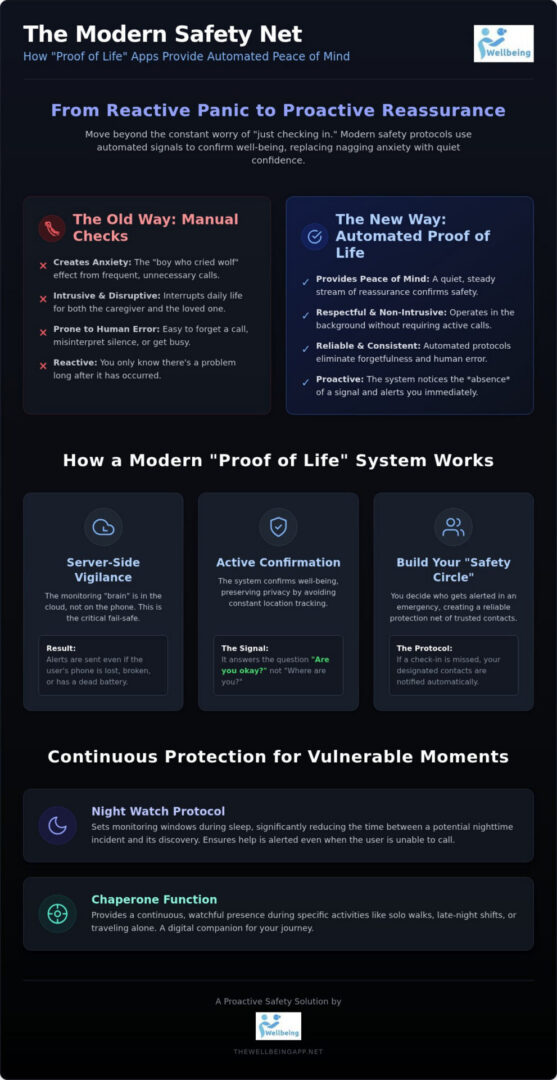
One of the most critical components is the Night Watch protocol. Vulnerability doesn’t sleep, and many medical emergencies occur during the quiet hours of the night when a person is least likely to be found quickly. By setting specific monitoring windows during rest, families can significantly reduce the window of vulnerability, which is the time elapsed between an incident and its discovery. This ensures that even if a loved one is unable to call for help, the system recognizes the absence of their safety signal and alerts the designated circle of support.
Automated Check-ins vs. Passive Tracking
Passive tracking, such as simple GPS location sharing, only tells you where a person is, not how they are. A dot on a map doesn’t reveal if someone has fallen or is in distress. Active confirmation shifts the narrative from “I am here” to “I am okay.” This distinction is vital for maintaining user privacy. Instead of being tracked every second, the user simply confirms their well-being at agreed-upon intervals. It’s a respectful balance that preserves personal agency while providing the family with much-needed protective reassurance. For those seeking this balance, exploring automated safety solutions can be the first step toward lasting mental tranquility.
The Role of Server-Side Vigilance
If a smartphone is lost, broken, or the battery dies, a local-only app becomes useless. Server-side monitoring is the fail-safe that solves this problem. Because the logic resides on a secure, remote server, the system is always counting down to the next check-in. If the server doesn’t receive the safety indicator from the device because the hardware is destroyed, it still triggers the emergency alert. This ensures that safety isn’t dependent on a piece of glass and plastic remaining intact. It’s a robust, always-on partner that guards the welfare of your family regardless of technical mishaps. Understanding how does a proof of life app work at this server level helps users trust that the safety net is always active, even when the phone is not.
Manual Wellness Checks vs. Automated Safety Protocols
Reliability is the cornerstone of safety. With smartphone penetration in the USA exceeding 82% as of 2025, the tools for protection are already in our hands, yet many families still rely on a simple text message: “Let me know when you get home.” While well-intentioned, this manual approach is inherently flawed because it relies on perfect human memory and a functioning device at a precise moment. When you ask how does a proof of life app work to solve this, the answer lies in the removal of the single point of failure. Manual systems are reactive; they only alert you when someone remembers to reach out. If they forget, the result is an agonizing silence that triggers unnecessary panic, often referred to as the “boy who cried wolf” effect.
This cycle of nagging takes a significant emotional toll on relationships. Caregivers often feel like they’re pestering their loved ones, while the individuals being monitored may feel their independence is being stifled. Automated protocols replace this tension with a state of mental tranquility. By 2026, the standard for personal safety has shifted toward these automated digital heartbeats, ensuring that wellness is confirmed without a single word being exchanged. It moves the family dynamic from one of constant anxiety to one of empathetic vigilance, where safety is a shared, quiet background process.
The Limitations of Manual Texting
Manual check-ins frequently fall into the “I’ll do it in a minute” trap. A user might be distracted by a conversation, a dead battery, or simply putting their phone on silent. In these moments, the absence of a text creates a false alarm that drains emotional energy. These systems are also limited by hardware; if a phone is lost or broken, the manual check-in simply never happens, leaving the family in the dark. This creates a reliability gap that manual methods simply cannot bridge, as they fail to provide a fail-safe when the user is unable to act.
The Advantages of Automated Indicators
Automated systems offer a level of consistency that human effort can’t match. They operate on a schedule that never forgets, providing a predictable safety rhythm that users can trust. When considering how does a proof of life app work, the focus is on clarity and efficiency. If a safety signal isn’t received, the system dispatches specific, actionable information to the designated contacts. This reduces the mental load for everyone involved. Instead of a vague sense of worry, your inner circle receives a clear indicator of when to start their response, turning a potential crisis into a managed, proactive event.
Building a Reliable Protection Net for Your Loved Ones
Safety is never a solitary endeavor; it is a shared effort rooted in community unity and collective responsibility. When people first investigate how does a proof of life app work, they often focus on the technical indicators, but the human element is just as vital. Establishing a protection net means moving beyond individual worry toward a structured system of empathetic vigilance. By creating a dedicated Safety Circle, you ensure that the responsibility for a loved one’s welfare is distributed among those who care most, fostering a sense of harmony and trust within the family unit.
Step-by-Step: Setting Up Your Safety Circle
Selecting your inner circle is a purposeful act of guardianship. You should choose emergency contacts based on their reliability and, ideally, their physical proximity to the user. A contact who lives five minutes away is often more effective during a medical window than someone across the country. Once you’ve selected your circle, you must define clear escalation protocols. If an automated alert is dispatched, every member should know exactly what to do. Should they call the user first? Should they perform a physical wellness check? Clear communication ensures that when the system identifies a potential risk, the response is calm, disciplined, and immediate.
- Select reliable responders: Choose people who are likely to have their phones active and accessible.
- Communicate the plan: Ensure every circle member understands the specific alerts they might receive.
- Assign roles: Designate a primary responder to lead the coordination during a safety event.
Customizing Monitoring for Different Needs
Every individual has a unique rhythm of life, and their safety protocols should reflect that. Seniors living independently may benefit from check-in windows aligned with their Activities of Daily Living (ADLs), such as morning coffee or evening rest. Conversely, solo travelers or night-shift workers might require more intense monitoring during high-risk transition periods. Tailoring these settings allows you to see exactly how does a proof of life app work as a personalized guardian for your unique situation.
Integrating specialized features adds layers of protective reassurance. For instance, the Chaperone service provides real-time monitoring during solo walks or commutes, while Night Watch offers 24/7 peace of mind while a loved one sleeps. With the personal safety app market projected to grow to $3.72 billion by 2035, more families are recognizing that proactive safety management is an essential part of modern living. You can adjust the intensity of these indicators based on situational risks, ensuring that your loved ones feel empowered rather than monitored. To begin creating your own customized safety net, explore our proactive safety features and start building your circle today.
How The Wellbeing App Redefines Proof of Life for Families
The Wellbeing App transforms the abstract concept of security into a tangible sense of well-being. By utilizing a proprietary Proof of Life indicator system, the app provides a constant, silent confirmation that your loved ones are safe. You might still be wondering, how does a proof of life app work when the user is on the move? Our Chaperone feature is specifically designed for those high-risk transition periods, such as a solo walk home or a late-night commute. It maintains a real-time connection to our servers, ensuring that if your progress stops unexpectedly, your Safety Circle is notified immediately.
For the quietest hours, the Night Watch feature acts as a compassionate guardian for vulnerable adults. It provides protective reassurance during the times when people are most isolated. Total reliability is achieved through continuous server-side monitoring. This means the dispatch of automated alerts doesn’t depend on the user’s phone remaining functional; if the server doesn’t receive the expected safety signal, the alert goes out regardless of hardware status. This fail-safe approach ensures that the safety net remains intact even in the most challenging circumstances.
A Watchful Protector in Your Pocket
The core of our technology is designed to create mental tranquility for the entire family unit. We’ve developed a user-friendly interface that is seamless and accessible across all generations, ensuring that even those who aren’t tech-savvy can feel empowered. Real-world impact is at the heart of what we do. We’ve seen how does a proof of life app work to prevent tragedies, such as the case of a solo hiker whose automated alert reached their family within minutes of an unexpected stop. These testimonials reinforce our commitment to providing a reliable, always-on partner that prioritizes human life above all else.
- Generational Accessibility: Simple, clear controls that anyone can master in minutes.
- Emotional Harmony: Reducing the friction between caregivers and those they protect.
- Technical Robustness: Alerts that bypass device failure through server-side logic.
The Future of Personal Agency and Safety
Empowering users to live independently is a cornerstone of our mission. We believe that everyone deserves to move through the world with confidence, protected by a digital safety net that respects their privacy and personal agency. Our altruistic mission is to end missing person incidents through proactive, human-centric technology. By shifting the focus from reaction to prevention, we foster social cohesion and a stronger sense of community responsibility. Every life protected is a step toward a world where no one is truly alone in a moment of need. Join The Wellbeing App today and secure your family’s peace of mind.
Embracing a Future of Proactive Safety and Peace of Mind
Choosing a modern security protocol means moving beyond the constant weight of “what if” scenarios. You’ve learned that true safety relies on a digital heartbeat that functions independently of human memory or hardware fragility. By replacing manual wellness checks with automated indicators, you eliminate the emotional toll of nagging while ensuring a faster emergency response. This transition from reactive worry to empathetic vigilance is the key to restoring harmony within your family circle. It’s about empowering your loved ones to live independently without ever feeling truly alone.
Understanding how does a proof of life app work gives you the power to protect those you care for with total reliability. Our proprietary Chaperone and Night Watch features provide a watchful eye during your most vulnerable moments, while server-side monitoring ensures the safety net never breaks. We are deeply dedicated to preventing missing person incidents by fostering a community of collective responsibility. It’s time to reclaim your personal agency and provide your family with the compassionate guardianship they deserve. Start your journey toward mental tranquility with The Wellbeing App and experience the confidence of always-on protection.
Frequently Asked Questions
What is a proof of life check-in app?
A proof of life check-in app is a proactive safety tool that confirms a user’s well-being through automated, scheduled indicators. It’s a digital heartbeat that requires a simple action to verify you’re okay. If you’re wondering how does a proof of life app work, it functions by expecting a signal; if that signal is missing, it dispatches alerts to your safety circle. This technology provides families with mental tranquility by replacing constant worry with reliable confirmation.
How does an automated safety alert work if my phone dies?
If your phone dies or is destroyed, the system remains effective because of server-side monitoring. The logic resides on a remote server that’s always counting down to your next scheduled check-in. If the server doesn’t receive your safety indicator because your device is offline, it automatically triggers the emergency alert. This fail-safe ensures your protection isn’t dependent on your hardware’s battery life or physical condition, providing a robust safety net during critical windows.
Is a safety monitoring app better than a medical alert necklace?
While medical alert necklaces are valuable, they’re reactive and require the user to be conscious and able to press a button during a crisis. A safety monitoring app is proactive, noticing when you fail to check in even if you’re incapacitated. This approach fills the gap for those who might not be able to reach for a physical device. It offers a more comprehensive layer of empathetic vigilance for daily life, ensuring help is called even if you can’t.
Can I use a proof of life app for someone living with dementia?
Yes, a proof of life app can be a powerful tool for individuals in the early stages of dementia who still maintain some independence. By setting check-in windows around their activities of daily living, families can receive automated confirmation that their loved one is safe. It acts as a watchful protector, providing a safety net that alerts you if a routine is broken. This is vital for preventing wandering incidents while respecting the user’s personal agency.
What is a virtual chaperone service?
A virtual chaperone service provides real-time monitoring during high-risk transition periods, such as walking home alone at night or a solo commute. It’s a temporary, heightened state of protective reassurance where the system tracks your progress until you reach your destination safely. If your movement stops or you fail to reach your goal within the expected timeframe, the Chaperone feature dispatches an immediate alert to your designated contacts, ensuring you’re never truly alone in a moment of need.
How much does a monthly safety monitoring subscription cost?
Monthly safety monitoring costs vary across the industry based on the level of technical robustness and features included. While some basic apps offer limited free versions, premium services that include server-side monitoring and specialized features like Night Watch typically involve a subscription fee. You should research individual providers to find a plan that aligns with your family’s specific safety needs and budget requirements in 2026. This ensures you’re investing in a reliable, always-on partner.
How do I set up emergency alerts for my elderly parents?
To set up emergency alerts, you first download the app on your parent’s device and invite yourself to their Safety Circle. You’ll then collaborate to establish check-in windows that match their daily routine, such as a morning wellness indicator. Understanding how does a proof of life app work is essential here; once the schedule is set, the system takes over the monitoring, sending you a notification only if they miss a check-in. This reduces your mental load.
Is my location data private when using a safety app?
Privacy is a central pillar of modern safety apps, which are designed to balance protection with personal agency. Your location data is typically only shared with your designated contacts during a specific emergency event or an active Chaperone session. Many developers are now focused on user-controlled features that comply with strict data protection laws. This ensures your movements remain private unless a verifiable safety indicator is missed, maintaining a state of harmony between security and privacy.