
Safety App for Adults with Disabilities: A Complete Guide to Proactive Protection in 2026
True independence shouldn’t feel like a choice between being completely alone or being under a microscope. For many, the search for a reliable safety app for adults with disabilities is driven by a simple desire for mental tranquility. You want to move through your day without the anxiety of a “what if” scenario and without the constant burden of texting family members every few hours just to say you’re okay. With nearly 38 million people living alone in the United States, the need for a compassionate guardian in your pocket has never been more vital, especially as 2026 digital accessibility regulations ensure these tools are more inclusive than ever.
We agree that you shouldn’t have to sacrifice your privacy to feel secure. This guide will show you how proactive safety monitoring and automated check-ins empower you to live on your own terms with total peace of mind. We’ll explore how modern tools like Proof of Life and Night Watch create a fail-safe system that only alerts others when something is wrong. You’ll learn how to use features like a virtual Chaperone and secure location sharing to maintain your agency while ensuring that help is always ready if you need it.
Key Takeaways
- Understand the vital shift from reactive emergency buttons to proactive monitoring systems that act as a compassionate guardian for your daily life.
- Discover how a modern safety app for adults with disabilities uses “Proof of Life” check-ins to ensure your well-being without the need for constant, manual updates.
- Compare the cost-effectiveness and reduced social stigma of app-based solutions against traditional, bulky medical alert hardware.
- Learn how specialized features like Chaperone and Night Watch provide tailored protection for both navigating the world and living independently at home.
- Find out how automated escalation processes preserve your mental tranquility by only involving family members when a genuine need arises.
The Shift to Proactive Safety: Why Traditional Apps Aren’t Enough
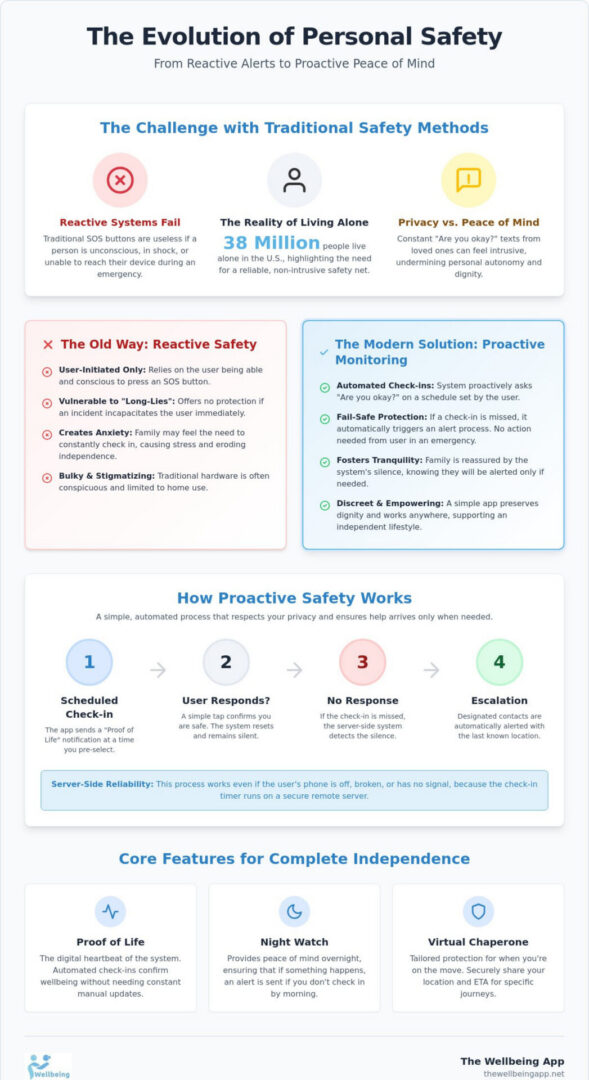
Safety isn’t just a button you press. It’s the quiet assurance that if you couldn’t press that button, someone would still come. This is the core of proactive safety. It is a fundamental shift from waiting for a crisis to monitoring for the presence of well-being. A traditional safety app for adults with disabilities often fails because it assumes the user is always capable of reaching out. If you’re incapacitated, in shock, or unable to reach your device, a manual SOS button is just a piece of glass in your pocket. Proactive systems flip this logic by monitoring for the absence of a “safe” signal. If you don’t confirm you’re okay at a scheduled time, the system acts on your behalf.
This approach creates a 24/7 digital safety net that works without constant human intervention. It doesn’t require a family member to sit by the phone or watch a GPS map all day. Instead, it uses automated logic to bridge the gap between independence and isolation. You gain the freedom to live alone without the fear that an accident could go unnoticed for hours or even days. It’s about building a foundation of mental tranquility that allows you to focus on living rather than worrying.
The Problem with Reactive Safety Systems
Reactive systems are inherently limited. They require you to be conscious, mobile, and calm enough to trigger an alert. In reality, many medical emergencies or falls lead to “long-lie” incidents. These are situations where a person remains on the floor for an extended period because they cannot summon help. The physical complications of a long-lie can be severe, but the psychological impact of being trapped is often worse. By integrating a safety app for adults with disabilities into your routine, you’re adopting a sophisticated form of assistive technology. This technology uses “Proof of Life” indicators to ensure help arrives even if you can’t call for it yourself. It moves beyond the limitations of human reaction to provide a truly fail-safe environment.
Balancing Autonomy and Vigilance
Living independently is a matter of dignity. Many people resist safety tools because they don’t want their family members “helicoptering” over their every move. Constant phone calls and “are you okay?” texts can feel like an intrusion rather than support. Proactive monitoring solves this by placing the user in control of their personal agency. You set the schedule. You decide when the check-ins happen. The system remains silent as long as you are safe.
This silence is where true harmony lives. It allows your family to relax, knowing they’ll be notified if something goes wrong, without them needing to check in manually every few hours. It fosters a sense of collective responsibility that is supportive rather than suffocating. You aren’t being watched; you’re being looked after by a compassionate guardian that respects your space and your right to privacy.
How ‘Proof of Life’ and Automated Check-ins Create a Fail-Safe
The technical heartbeat of a modern safety app for adults with disabilities relies on a simple yet profound concept: the Proof of Life check-in. Unlike traditional apps that wait for you to act, this system asks for confirmation of your well-being at intervals you choose. It’s a digital heartbeat that pulsates in the background of your day. If you confirm you’re okay, the system remains silent. If you don’t, it begins a structured, supportive escalation process. This ensures that help is never more than a missed check-in away, providing a level of security that manual SOS buttons simply cannot match.
One of the most critical components of this fail-safe is server-side monitoring. Most people worry that if their phone dies or loses signal, their safety net disappears. Proactive systems solve this by hosting the “timer” on a secure remote server rather than just on your device. If the server doesn’t receive your “I’m safe” signal because your phone is broken or the battery is drained, it recognizes the silence as a potential emergency. This specialized guardianship is a key part of enabling their health, well-being, inclusion and participation in everyday society.
Scheduled Check-ins vs. Real-Time Tracking
Privacy is a fundamental right, yet many safety tools demand you sacrifice it through constant GPS tracking. Scheduled check-ins offer a more dignified alternative. Instead of being watched 24/7, you simply provide a “Proof of Life” indicator at times that match your daily routine. You can set these intervals to align with your Activities of Daily Living, such as waking up, taking medication, or returning home. This approach preserves your personal agency. It ensures you’re never being monitored when you’re safe, but you’re never alone when you aren’t. You can learn more about balancing privacy and protection at thewellbeingapp.net.
The Escalation Protocol: What Happens in an Emergency?
A true fail-safe system is designed to prevent false alarms while ensuring a rapid response. When a check-in is missed, the app doesn’t immediately call emergency services. Instead, it starts with a gentle nudge, a notification or a call to your device. This is the “Grace Period.” It gives you a chance to confirm you’re safe if you simply forgot to tap the button.
If the grace period passes without a response, the system moves into high-stakes mode. It automatically dispatches Emergency Alerts to your designated safety circle, which can include family, friends, or trusted neighbors. Only at this point is your last known location shared with your contacts. This structured escalation maintains your mental tranquility, knowing that your loved ones won’t be unnecessarily alarmed, but they will be there the moment a genuine need arises.
App-Based Monitoring vs. Traditional Medical Alert Hardware
The choice between a physical medical alert button and a software solution often comes down to how you want to feel in your own home. Traditional hardware can feel like a constant reminder of vulnerability. Wearing a plastic pendant around your neck or a bulky wristband often carries a clinical stigma that many adults find discouraging. In contrast, using a safety app for adults with disabilities allows you to leverage the device you already own and carry. Your smartphone is a tool of empowerment; it’s a window to the world rather than a symbol of frailty. By integrating protection into your phone, you maintain your personal style and privacy while keeping a watchful protector close at hand.
Hardware devices are often limited by their physical nature. Most are designed for a single purpose: pressing a button during a crisis. This reactive approach doesn’t account for the many nuances of daily life. A smartphone app provides a dynamic suite of tools that can evolve as your needs change. It isn’t just about calling for help; it’s about creating an environment where help is never needed because the system is already looking out for you. This shift from a “panic button” to a comprehensive safety companion is a major step forward in personal security.
The Cost of Safety: Subscriptions vs. Equipment Fees
Proprietary hardware devices frequently come with significant upfront equipment fees before the first month of monitoring even begins. These devices are often locked into a single function and require specialized chargers or base stations. App-based solutions remove these financial barriers by focusing on a subscription model that utilizes your existing hardware. This approach ensures that you aren’t paying for plastic and circuits that will eventually become obsolete. Instead, your investment goes toward continuous software improvements and new safety features. App-based PERS solutions typically eliminate the need for expensive proprietary hardware purchases, making high-level security more accessible to everyone.
Integration with Daily Life
Modern smartphones are packed with sophisticated sensors, including accelerometers and high-precision GPS, that traditional pendants simply can’t match. These sensors allow for a more nuanced understanding of your well-being. This technology is a vital part of maintaining health and safety for people with disabilities, as it adapts to your specific needs. While a hardware button only reacts when pressed, a safety app for adults with disabilities can offer proactive features like Night Watch.
Night Watch provides an extra layer of security during your most vulnerable hours without requiring you to sleep with a lanyard around your neck. It’s a smarter, more integrated way to stay safe. While battery life is a common concern for phones, most users are already in the habit of charging their devices daily. This routine is often more reliable than remembering to check the battery status of a specialized pendant that might sit in a drawer for months. Reliability comes from consistent use, and there’s no device more consistently used than your smartphone.
Mastering Independence with Virtual Chaperones and Night Watch
True independence is the ability to move through the world with confidence. For many, a safety app for adults with disabilities acts as a silent partner that ensures you’re never truly alone during high-stakes moments. It isn’t about constant surveillance; it’s about having a digital buddy system that only steps in when the unexpected happens. By utilizing specialized features like Chaperone and Night Watch, you can maintain your personal agency while giving your loved ones the gift of mental tranquility. These tools are designed to be proactive, looking out for you when you’re most focused on your journey or resting for the day.
Setting up safety zones and geofencing adds another layer of sophisticated protection. You can designate “safe” areas, such as your home or workplace, and receive automated alerts if you deviate from a planned route. This level of customization ensures that the technology adapts to your life, rather than forcing you to adapt to the technology. It creates a seamless blend of freedom and vigilance that empowers you to explore new environments without fear. You are the architect of your own safety net.
The Virtual Chaperone: Safety on the Move
Navigating public transit or walking through unfamiliar neighborhoods can be stressful. The Chaperone feature addresses this by allowing you to set a specific timer for your journey. If you’re walking from a bus stop and expect to be home in ten minutes, you simply activate the timer. During this “active monitoring” phase, the system stays alert. Once you arrive and confirm your safety, the session ends. This is vital for adults with mobility or cognitive challenges who may be at a higher risk of becoming disoriented or needing help in public spaces. It ensures that if you don’t arrive as expected, your safety circle is notified immediately with your precise location.
Night Watch: Protecting the Most Vulnerable Hours
The night hours often represent the highest risk for those living alone. A medical event or a fall at 3 AM can go unnoticed for hours, leading to dangerous “long-lie” situations. Night Watch provides a compassionate solution by scheduling automated overnight check-ins. These aren’t intrusive; they’re designed to match your sleep patterns. For out-of-state family members, this feature provides immense relief. They no longer have to wake up wondering if you’re okay. The system handles the vigilance, only alerting them if a check-in is missed. Start your journey toward total peace of mind by exploring the full suite of protection features at thewellbeingapp.net.
Securing Your Peace of Mind with The Wellbeing App
Choosing a safety app for adults with disabilities is an act of empowerment. It is a decision to prioritize your independence while acknowledging the value of a compassionate guardian. The Wellbeing App is designed specifically for this purpose, acting as a silent, watchful partner that respects your privacy. By integrating the Proof of Life, Chaperone, and Night Watch suite into your daily routine, you create a fail-safe environment that adapts to your life. Our commitment goes beyond software; we strive to foster community unity and ensure that no one ever has to feel truly alone in a moment of need.
The setup process is intentionally simple, designed to be accessible for both individuals and their families. You don’t need proprietary hardware or complex installations. Instead, you gain a sophisticated monitoring system that lives on the smartphone you already use. It’s about moving away from the clinical feel of traditional alerts and toward a modern, human-centric approach to well-being. This technology ensures that your mental tranquility remains undisturbed unless a genuine emergency requires attention.
Why Families Trust the Wellbeing Safety Suite
Our mission is rooted in the belief that safety is a shared effort. We focus on preventing missing person incidents and long-lie scenarios by leveraging automated technology that bridges the gap between family members. This fosters social cohesion, allowing safety circles to provide support without being intrusive. When a family moves from a state of constant anxiety to one of quiet confidence, the user regains their personal agency. It is a shift that transforms the concept of caregiving into one of collective responsibility and mutual respect, where the technology serves as a bridge rather than a barrier.
Getting Started: Your Journey to Tranquility
Taking the first step toward proactive protection is straightforward. You begin by choosing a subscription plan that aligns with your specific daily needs and lifestyle. From there, you’ll invite your trusted safety circle, which can include family, friends, or neighbors who will receive Emergency Alerts if a check-in is missed. This process ensures that your digital safety net is populated by people who truly care about your well-being. Once your contacts are set, you can customize your check-in intervals to match your activities of daily living.
You have the power to define the boundaries of your protection. Whether you need a virtual Chaperone for your commute or a Night Watch for your sleeping hours, the system is yours to command. It’s time to embrace a life where mental tranquility is the standard, not the exception. Start your journey toward proactive safety today and experience the freedom of being truly protected.
Embracing a Future of Fearless Independence
The transition from reactive panic buttons to proactive monitoring marks a new era of personal agency. By choosing a system that values your privacy while maintaining a constant, silent vigil, you’re reclaiming your right to live on your own terms. You’ve seen how automated Proof of Life indicators and advanced Night Watch protection can eliminate the risks that once stood in the way of independent living. This isn’t just about software; it’s about fostering a sense of harmony for you and your safety circle.
Finding the right safety app for adults with disabilities means selecting a partner that understands the delicate balance between autonomy and support. Whether you’re using a Virtual Chaperone for safe transit or relying on scheduled check-ins, you’re never truly alone. It’s time to replace the burden of manual check-ins with a sophisticated digital safety net that works behind the scenes. Secure your independence with The Wellbeing App’s 24/7 monitoring and enjoy the mental tranquility you deserve. Your journey toward a more empowered and protected future begins today.
Frequently Asked Questions
Is a safety app better than a medical alert necklace for adults with disabilities?
A safety app is often a more versatile choice because it offers proactive protection rather than just a reactive emergency button. While a necklace is a single-purpose device that can feel clinical, an app provides a suite of tools like Night Watch and Chaperone. This approach reduces social stigma and ensures that help is summoned even if you’re unable to reach for a physical pendant.
How does the ‘Proof of Life’ check-in actually work if I forget to press it?
If you miss a scheduled check-in, the system begins a structured escalation process to ensure your well-being. It starts with a gentle nudge to your phone, giving you a grace period to confirm you’re safe. If the silence continues, the app dispatches Emergency Alerts to your designated safety circle. This fail-safe mechanism ensures that help is on the way even when you can’t ask for it.
Will a safety app drain my phone’s battery significantly?
Modern safety apps are designed to be highly efficient and won’t significantly drain your battery. They utilize background processing and optimized location services that only activate when a check-in is due or a session is active. Most users find that charging their phone once a day, as they already do, is more than enough to maintain continuous, 24/7 protection.
Can my family see my location all the time, or only in an emergency?
Your privacy is a priority, so your family typically only sees your location when a safety event is triggered. Unlike constant tracking tools, a safety app for adults with disabilities often uses event-based Location Sharing. This means your safety circle is only alerted if you miss a check-in or activate a Chaperone session, preserving your personal agency and mental tranquility.
What happens if my phone dies or I lose internet connection?
If your phone loses connection or power, the server-side monitoring system acts as your ultimate fail-safe. Because the check-in timer lives on a remote server rather than just your device, it recognizes the absence of your “safe” signal even if your phone is offline. This ensures that help is still dispatched to your last recorded location if the grace period expires without a response.
Is there a specific safety app for people with intellectual disabilities?
While many apps are general, those focusing on automated check-ins are particularly effective for people with intellectual disabilities. These tools remove the burden of complex manual communication and replace it with simple, routine-based confirmations. This structured approach fosters a sense of harmony for both the user and their family by providing a reliable, always-on digital buddy system.
Can I use a safety app if I have limited manual dexterity?
Yes, these apps are designed with accessibility in mind to accommodate users with limited manual dexterity. Many features are automated or require only a single, simple tap to confirm your status. You can also integrate voice commands or assistive touch features already built into your smartphone to manage your safety monitoring suite with ease and confidence.
How much does a professional safety monitoring app cost per month?
Professional safety monitoring typically follows a monthly or annual subscription model, avoiding the high upfront costs of proprietary hardware. This allows for continuous software updates and the rollout of new protective features. While prices vary across the industry, choosing a software-based safety app for adults with disabilities is generally a more cost-effective way to secure long-term peace of mind without hidden equipment fees.