
Solo Traveler Proof of Life: 2026 Safety Guide
What if the ultimate freedom of solo travel didn’t come from being completely off the grid, but from knowing a silent, digital heartbeat is watching over you? You want to experience the world on your own terms, yet the anxiety of “what if I stop responding” can often cast a shadow over even the most breathtaking landscapes. It’s a common struggle to balance the desire for total autonomy with the responsibility we feel toward those who love us. We all know the frustration of manual check-ins that are easy to forget, leading to frantic messages from worried family members when you were simply enjoying a sunset without service.
This guide teaches you how to implement a reliable system for proof of life for solo travelers that ensures you’re never truly alone, even on the most remote adventures. You’ll learn how to transition from stressful, manual updates to automated, server-side monitoring that only alerts your circle if something is actually wrong. We’ll preview the latest 2026 safety protocols, including specialized tools like Night Watch and virtual chaperones. By the end of this article, you’ll have a blueprint for mental tranquility that protects your independence and provides absolute peace of mind for everyone involved.
Key Takeaways
- Redefine your safety by shifting from reactive crisis management to a proactive, recurring signal of your daily well-being.
- Learn why automated, server-side monitoring is superior to manual check-ins, ensuring your safety net stays active even if your phone is offline or lost.
- Master the setup of a reliable system for proof of life for solo travelers that balances your need for independence with your family’s need for peace of mind.
- Discover how features like virtual chaperones and night watch protection provide empathetic vigilance during late-night transit or overnight stays in unfamiliar places.
- Identify how to select your compassionate guardians and establish a check-in cadence that respects your personal agency and unique travel pace.
What is “Proof of Life” for Solo Travelers?
Historically, the term “proof of life” belonged to the dark world of high-stakes negotiations. In 2026, the definition has evolved into something far more supportive and empowering. For the modern solo adventurer, it represents a recurring, active signal of wellbeing. It’s the digital heartbeat that tells your loved ones you’re safe without requiring a constant stream of texts or calls. This modern standard moves safety away from fear and toward a proactive state of tranquility.
Many travelers believe that leaving a copy of their itinerary with a parent or friend is enough. While an itinerary is a helpful baseline, it’s a static document. It can’t account for the unexpected or alert anyone if you fail to reach your destination. A true safety net requires more than just a plan; it requires a system that notices your absence. This creates what we call the “Silent Guardian” effect, where safety is managed quietly in the background so you can focus on the horizon ahead.
Proof of Life vs. Passive Location Sharing
There’s a critical distinction between being trackable and being monitored. Passive location sharing, like a GPS dot on a map, only tells people where you are. It doesn’t tell them how you are. If your phone battery dies or you’re in an area without signal, that dot simply vanishes or stays frozen. This “Signal Trap” often leads to unnecessary panic for family members or, worse, a delayed response in a real emergency because no one realized the lack of movement was a problem.
Being monitored through a dedicated system for proof of life for solo travelers means there’s an active expectation of your wellbeing. If you don’t check in, the system takes notice. Proof of Life is a reactive indicator of human activity that confirms a traveler’s wellbeing through a deliberate, scheduled interaction with a monitoring system. It moves safety from a passive “maybe they’re okay” to an active “we know they’re okay.”
The Mental Tranquility of Automated Safety
The goal of any safety protocol isn’t to restrict your freedom, but to enhance it. We call this “Empathetic Vigilance.” It’s a form of protection that feels like a warm presence rather than an overbearing “Big Brother” eye. When you know an automated system is ready to alert your compassionate guardians only if something goes wrong, you gain a profound sense of mental tranquility that allows for deeper immersion in your journey.
This structured approach reduces the emotional burden on both the traveler and their family. You don’t have to worry about forgetting to call home and causing a scare. Your family doesn’t have to spend their day refreshing a map. By securing your connection to home through proof of life for solo travelers, you’re empowered to explore further, knowing your safety net is always on and watching over you.
Manual vs. Automated Check-ins: Why Automation Wins
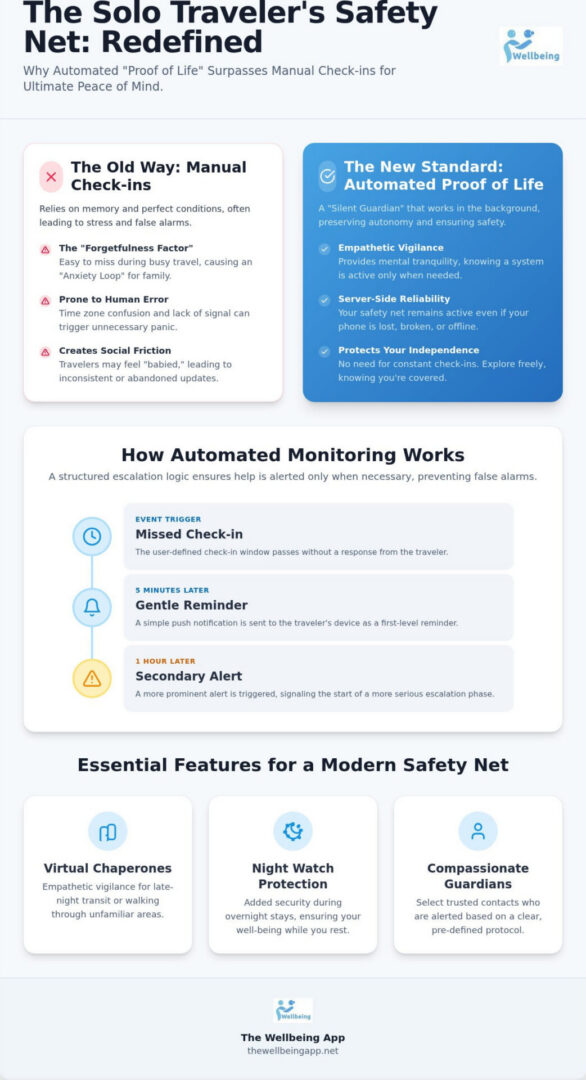
Solo travel is about immersion. You’re lost in the beauty of a new city, and the last thing on your mind is your phone. This is where the “Forgetfulness Factor” becomes a real risk. Manual check-ins, like a nightly WhatsApp message, are often the first thing to fail during a busy trip. When you miss that window, you inadvertently trigger an “Anxiety Loop” for your loved ones at home. They’re left wondering if you’re in trouble or just having too much fun to text. This uncertainty is the enemy of mental tranquility for everyone involved.
The Failure Points of Manual Texting
Manual systems rely on human memory and perfect conditions, which are rarely guaranteed on the road. Time zone confusion is the most common culprit for missed check-in panics. You might think it’s early evening, but for your family, the deadline passed hours ago. There’s also a significant element of social friction. Many travelers stop sending manual updates because they feel “babied” or monitored in a way that stifles their independence. This leads to inconsistent updates, creating a dangerous “Boy Who Cried Wolf” scenario where your contacts might ignore a genuine silence because you’ve forgotten to text so many times before.
How Automated Proof of Life Indicators Work
Automation removes the burden of memory while preserving your personal agency. A sophisticated system for proof of life for solo travelers uses user-defined intervals to confirm your safety. You might set a check-in for every twelve hours based on your itinerary’s risk level. If you miss that mark, a structured escalation logic begins to ensure you aren’t actually in need of help.
- 5 Minutes: A gentle push notification reminds you to check in.
- 1 Hour: A secondary alert is sent to your device to capture your attention.
- 4 Hours: Your designated compassionate guardians are notified that you’ve missed a window.
The true power of this system lies in server-side monitoring. Because the countdown happens on a remote server rather than your local device, the system will trigger an alert even if your phone is dead, destroyed, or out of signal range. This ensures that a lack of battery never results in a lack of safety. Setting up proof of life for solo travelers through an automated system allows you to maintain total travel autonomy while providing your family with a reliable, quiet assurance of your well-being.
Essential Features for a Solo Traveler Safety Net
A robust safety net isn’t a rigid cage; it’s a flexible layer of protection that adjusts to your environment. Whether you are exploring a bustling downtown district or navigating a quiet coastal trail, your safety needs differ. A reliable system for proof of life for solo travelers allows you to customize check-in windows to match your specific travel pace. This flexibility ensures that the system remains a supportive partner rather than an annoying distraction. By setting shorter windows during high-activity days and longer ones for rest periods, you maintain total agency over your journey.
Effective safety protocols must also differentiate between a simple lapse in memory and a genuine crisis. This is where tiered escalation becomes vital. Most missed check-ins are just moments of forgetfulness, which is why the first alerts go directly to you. If the silence continues, the system engages your compassionate guardians, those primary contacts who know you best. Only in confirmed high-stakes situations are emergency services involved, preventing the “false alarm” fatigue that often plagues manual safety methods.
The Virtual Chaperone: Safety in Transit
Transit is often when travelers feel most vulnerable. Whether you’re taking a late-night rideshare or walking back to your accommodation after dinner, the Chaperone feature acts as a digital escort. It provides active monitoring during these high-risk transitions. If you deviate from your expected route or stop moving for an unusual amount of time, the system takes notice. It’s a way to ensure you’re never truly walking alone, even when you’re the only one on the street.
This vigilance extends into the night with Night Watch protection. Safety monitoring shouldn’t stop when you close your eyes. Sleeping in a new hotel or hostel can often trigger a subconscious hyper-vigilance that prevents deep rest. By activating Night Watch, you’re essentially setting a digital sentry. It monitors for your “all is well” signal at a designated wake-up time, providing a layer of security that traditional door locks simply can’t offer. This ensures your mental state remains calm while you sleep in unfamiliar places, allowing you to wake up refreshed for another day of discovery.
Escalation and Emergency Alerts
A critical component of any automated alert is the inclusion of “last known location” data. While location sharing is a helpful tool, integrating it with a system for proof of life for solo travelers creates a complete safety profile. It provides responders or family members with a precise starting point, even if your phone is no longer active or has been destroyed. This combination of active monitoring and passive data ensures help can be dispatched with precision if it’s ever truly needed. By combining these features, you create a circle of protection that respects your independence while prioritizing your well-being.
How to Set Up Your Personal Safety Protocol
Building a personal safety net isn’t about creating restrictions; it’s about building a foundation for true freedom. A well-designed protocol turns a static itinerary into a living, responsive system. Establishing a reliable system for proof of life for solo travelers requires a few minutes of intentional planning before you depart. This proactive approach ensures that your mental tranquility remains intact, knowing that your safety is being managed by a sophisticated, watchful protector.
The first step is to synchronize your technology. Ensure your app, GPS settings, and server-side alerts are all linked to your central safety profile. This synchronization is what allows the system to function even if your device is lost or the battery fails. You can set up your safety profile to begin establishing these vital connections before your next journey begins.
Choosing Your Check-in Cadence
Your “Check-in Cadence” should reflect the risk level of your specific itinerary. While urban environments might allow for a broader twenty-four-hour window, remote wilderness treks demand more frequent check-ins to account for increased physical risks. The goal is to balance safety with spontaneity. By setting wide windows, such as a “by 10 PM” confirmation, you ensure the system doesn’t interrupt a sunset dinner or a deep conversation with a new friend.
Communicating this protocol to your family is just as important as setting it up. Explain that the system is automated and that a missed indicator doesn’t immediately mean a crisis. When they understand the logic behind the windows, their anxiety decreases. This shared understanding fosters a sense of collective responsibility and trust, allowing everyone to feel more connected and secure.
The Response Plan: What Should Your Contacts Do?
Designate your “Compassionate Guardians” with care. These should be individuals who remain calm under pressure and are easily reachable. A clear, written escalation path ensures that every action taken is measured, purposeful, and effective. This prevents the unnecessary panic that often follows a simple missed text message.
- Step 1: The guardian attempts to reach the traveler directly via multiple channels.
- Step 2: They contact the traveler’s last known accommodation to see if they’ve been seen.
- Step 3: If the traveler is still unreachable after a set time, they initiate a formal wellness check.
This “no-panic” first-response step is essential for maintaining harmony. It allows for human error while ensuring that a genuine silence is met with a swift, organized response. By defining these steps in advance, you empower your guardians to act as effective protectors rather than anxious observers.
How The Wellbeing App Protects Solo Adventures
The Wellbeing App stands as a sophisticated guardian for those who seek the horizon alone. It’s built on the belief that safety should never come at the cost of your freedom. By providing a reliable system for proof of life for solo travelers, the app ensures you’re never truly isolated, even when you’re miles from the nearest city. Our technology isn’t designed to monitor your every move like a traditional tracking service; instead, it’s a silent partner that only speaks up when you can’t.
One of the most powerful tools in our ecosystem is the proprietary Proof of Life indicator. This feature respects your personal agency by allowing you to define your own check-in windows. It’s a non-intrusive way to signal that all is well. Because the monitoring happens on our secure servers, the safety net remains active even if your phone is lost, stolen, or runs out of battery. This server-side vigilance is what separates a true safety system from a simple mobile app.
Technology Rooted in Mental Tranquility
We deliberately avoid the fear-based messaging common in the security industry. Our mission is to foster empowerment and mental tranquility. Travelers choose The Wellbeing App because it focuses on the emotional well-being of both the traveler and their family. Our server-side logic means your safety protocol exists in the cloud, independent of your hardware’s status. This ensures that the “Night Watch” advantage is always active, providing 24/7 monitoring while you rest in unfamiliar accommodations. It’s about creating a sustainable culture of safety that doesn’t feel like a burden.
Our subscription plans are designed to be an affordable investment in your peace of mind. Whether you’re a frequent solo explorer or a family looking to stay connected during separate journeys, there’s a tier that fits your lifestyle. This accessibility ensures that every traveler has the opportunity to experience the world with a compassionate guardian by their side.
Getting Started: Your First Safe Journey
Setting up your first protocol is a simple, intuitive process. You can define your check-in cadence, designate your compassionate guardians, and activate features like the Virtual Chaperone in just a few minutes. By inviting your family into your “Circle of Protection,” you transform their anxiety into a shared sense of security. The app guides you through every step, ensuring you feel confident before you ever leave home.
You’re always in control of the data and the frequency of updates. This level of customization ensures that your travel remains spontaneous and exciting. When you’re ready to explore with absolute confidence, you can secure your next adventure with The Wellbeing App. It’s time to travel further, knowing someone is always looking out for your best interests and your mental state.
Embrace Your Next Great Adventure with Confidence
Solo travel is one of the most rewarding ways to discover your own strength, but it shouldn’t mean leaving your loved ones in a state of worry. We’ve explored how moving from manual check-ins to a sophisticated system for proof of life for solo travelers preserves your independence while securing your safety. By relying on automated indicators, you eliminate the friction of constant texting and the risk of false alarms caused by forgotten messages or dead batteries.
The Wellbeing App acts as your watchful protector, using 24/7 server-side monitoring to ensure help is always reachable, even if your device isn’t. Our empathetic, non-intrusive safety design is built to foster mental tranquility rather than fear. You deserve to explore the world with the confidence that your safety net is always on and watching over you.
Start your safe solo journey today with The Wellbeing App.
Your next adventure is waiting, and we’re here to ensure you can enjoy every moment of it with a clear heart and a peaceful mind.
Frequently Asked Questions
What is a proof of life check-in app?
A proof of life check-in app is a safety tool that requires you to confirm your well-being at scheduled intervals. If a check-in is missed, the system automatically alerts your designated contacts. It serves as a reliable system for proof of life for solo travelers, ensuring that silence is treated as a call for help. This proactive approach provides mental tranquility for you and your loved ones by removing the burden of manual texting.
Does the app track my location 24/7?
The app provides location sharing features, but it prioritizes your personal agency and privacy. You control when and how your location is shared with your compassionate guardians. While the system monitors your “all is well” status constantly, it doesn’t necessarily broadcast your precise coordinates every second unless you’ve activated a specific transit feature or missed a critical check-in window. This balance respects your independence while maintaining empathetic vigilance.
What happens if my phone dies or I lose signal?
Your safety net remains active because the system uses server-side monitoring. Since the countdown for your next check-in happens on our remote servers, an alert will still be dispatched to your contacts even if your phone is destroyed, dead, or offline. This protection is a core benefit of proof of life for solo travelers, ensuring that technical failures or dead batteries don’t lead to a lapse in your personal security.
How is this different from sharing my location on Google Maps?
Passive location sharing only shows where you are, whereas a proof of life system monitors how you are. Google Maps won’t notify anyone if you stop moving or if your phone turns off unexpectedly. The Wellbeing App is a proactive guardian that expects a regular signal from you. If that signal doesn’t arrive, it initiates a structured escalation plan to ensure you’re safe, rather than leaving family to guess your status.
Can I use the app for international solo travel?
Yes, the app is designed to support your adventures wherever your journey takes you. While our primary focus is on the national US market for emergency coordination, the automated check-in and notification features work globally. As long as you can access data or Wi-Fi to confirm your status periodically, your compassionate guardians will receive updates regardless of which time zone you’re currently exploring. It’s a borderless safety net for the modern explorer.
Who should I set as my emergency contacts?
You should choose “Compassionate Guardians” who are reliable, calm under pressure, and likely to be available when you’re traveling. It’s best to select people who understand your itinerary and know your typical habits. We recommend having at least two contacts to ensure that if one person is busy or sleeping, another can receive the automated alert and begin the agreed-upon response plan immediately. This ensures a circle of collective responsibility.
Is there a virtual chaperone for walking home alone at night?
Yes, the Chaperone feature is specifically designed for high-risk transit moments like walking home late or taking a rideshare. When activated, it provides active monitoring of your journey. If the system detects that you’ve deviated from your route or stopped moving for an unusual duration, it can trigger immediate alerts to your contacts. This feature acts as a digital escort, providing warmth and security during vulnerable transitions in unfamiliar environments.
How much does a safety monitoring subscription cost?
The Wellbeing App generates revenue through recurring monthly and annual subscription plans. These fees cover the cost of continuous, 24/7 server-side monitoring and the automated dispatch of notifications to your circle. By choosing a subscription, you gain access to our complete suite of safety tools, including Night Watch and Chaperone features. Our plans are designed to be an accessible, long-term investment in your personal security and the peace of mind of your family.