
The Best Virtual Companion for Walking at Night: A 2026 Safety Guide
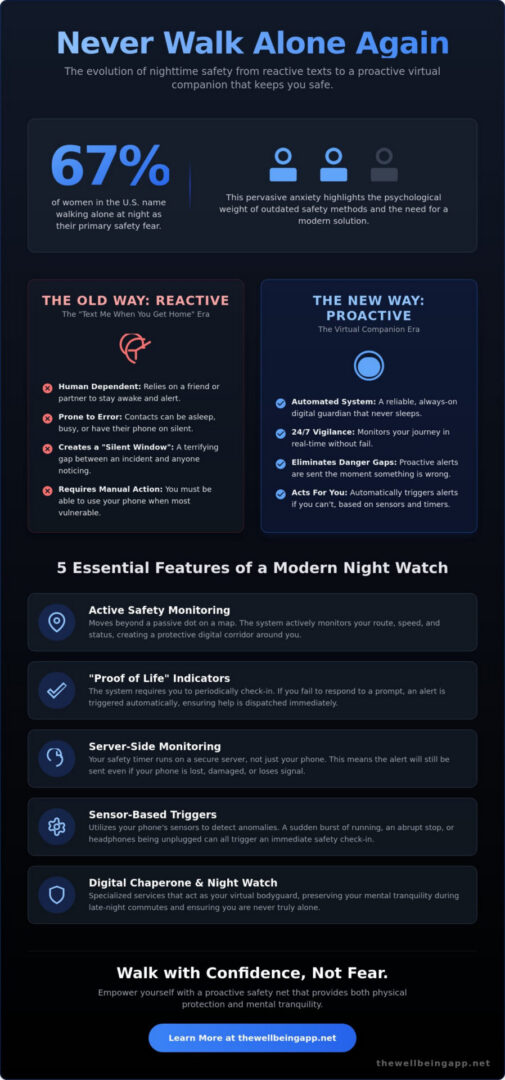
Did you know that 67% of women in the U.S. still name walking alone at night as their primary safety fear? It’s a heavy weight to carry, especially when you’re just trying to get home after a long shift or a night out with friends. You want to feel secure, but you also don’t want to wake your partner at 2:00 AM for a check-in text. This is where a virtual companion for walking at night changes everything. It isn’t just a passive map on your screen; it’s a watchful protector that stays awake so your loved ones can sleep.
You’ve likely felt that spike of anxiety when a GPS app glitches or felt the guilt of asking a friend to stay on the phone until you’re safely inside. We understand that mental tranquility is just as important as physical safety. This guide reveals how 2026 technology has moved beyond simple tracking to offer automated, active guardianship that intervenes when your human contacts can’t. We’ll explore the latest in proactive protection, from Proof of Life indicators to specialized Night Watch services, ensuring you never have to face the dark alone again.
Key Takeaways
- Transition from the uncertainty of reactive text messages to the protective reassurance of a proactive digital escort.
- Understand the vital safety difference between passive GPS dots and a virtual companion for walking at night that requires active responses to ensure your well-being.
- Discover how “Proof of Life” indicators and server-side monitoring provide a safety net that remains active even if your device is compromised.
- Learn how specialized features like Chaperone and Night Watch act as a watchful protector, preserving your mental tranquility during late-night commutes.
- Identify the essential technological markers that empower you to walk with confidence, knowing you are never truly alone in the dark.
Why the ‘Text Me When You Get Home’ Era is Evolving
For years, the phrase “text me when you get home” has been our collective social safety net. It is a well-intentioned request, born from a place of love and concern. Yet, as we move through 2026, we’re realizing that this manual ritual carries a heavy psychological weight. When you’re walking alone at night, every shadow can feel like a threat, and the pressure to remember to send that final text adds another layer of stress to an already tense journey. Relying on a friend or partner to stay awake and monitor their phone isn’t just unreliable; it’s a reactive approach to a situation that demands proactive vigilance.
The Limits of Human-to-Human Safety Checks
We often hesitate to call a loved one during a late-night commute because we don’t want to be a burden. You might tell yourself that you’re fine, or you might worry about waking someone up for a walk that only takes ten minutes. This hesitation creates a dangerous vulnerability. Even if you do reach out, human error is an ever-present risk. Your emergency contact might have their phone on “Do Not Disturb,” or they might simply fall asleep before you reach your door. This creates the “silent window,” a terrifying gap of time between an incident occurring and someone actually noticing that you haven’t checked in.
Manual check-ins are no longer sufficient for high-stakes safety because they require you to be able to use your phone at the exact moment you’re most vulnerable. If a situation escalates quickly, you may not have the luxury of typing a message or making a call. This is why the shift toward automated protection is so vital for preserving your mental tranquility.
Understanding the Virtual Chaperone Concept
This is where the concept of a virtual companion for walking at night becomes a game-changer. Rather than a passive tool, a virtual companion acts as a digital safety net that simulates the experience of having a trusted friend walk right beside you. By utilizing the sophisticated features of a modern personal safety app, you can ensure that your journey is being monitored in real-time by a system that never gets tired and never misses a notification.
Modern technology has evolved to include sensor-based triggers and automated timers that provide a level of oversight a human contact simply can’t match. For instance, features like our Chaperone service use GPS pathing to notice if you’ve deviated from your route or if your movement has suddenly stopped. This isn’t just about tracking a dot on a map; it’s about having an active guardian that recognizes when something isn’t right. Using a virtual companion for walking at night means that if you don’t reach your destination by the expected time, or if you fail to respond to a Proof of Life prompt, an alert is triggered immediately.
Shifting from reactive safety, like dialing 911 after an event, to proactive protection ensures that help is already on the way before a situation becomes a crisis. It empowers you to move through your community with confidence, knowing that your safety is a shared responsibility managed by a reliable, always-on partner.
How Modern Safety Apps Act as Your Digital Chaperone
The safety landscape has shifted dramatically from the days of static maps. A modern virtual companion for walking at night does more than just broadcast your location; it actively interprets your environment through a sophisticated array of sensors and logic. While early iterations of safety technology relied on you having the presence of mind to press a button, 2026 tools are designed to recognize distress before you even realize you’re in a high-stakes situation. This evolution mirrors the university’s research into safety apps, which emphasizes the need for systems that remain active when the user cannot manually call for help.
Your digital chaperone uses real-time GPS pathing to create a protective corridor along your route. If you deviate from your planned path or enter a geofenced “Safe Zone” late, the system initiates a silent check-in. Beyond location, your phone’s internal sensors now act as vigilant observers. Sudden changes in movement, such as a burst of running or the abrupt disconnection of your headphones, can trigger an automated alert. This hands-free approach extends to wearable integration, allowing you to signal for help through a smartwatch gesture without ever reaching for your pocket. By using a service like The Wellbeing App, you can ensure your mental tranquility remains intact through every city block.
Proof of Life: The Gold Standard of 2026 Safety
The most significant advancement in personal security is the move toward automated accountability. Instead of your friends worrying in silence, the app periodically asks you to confirm your safety. Proof of Life is a server-side monitoring protocol that guarantees an alert will trigger even if your device is lost or powered off during an incident. If you miss a scheduled check-in, the system initiates a tiered escalation, notifying your primary contacts and providing them with your last known coordinates and sensor data immediately.
Advanced Night Watch Features
Nighttime presents unique challenges that require specialized solutions. Modern apps now feature a dedicated Night Watch mode with a low-light UI to preserve your night vision and prevent your screen from becoming a beacon. Ambient sound detection uses the microphone to identify specific acoustic signatures of distress, such as shouting or glass breaking, while battery-optimized tracking ensures the service stays live even on a 5% charge. These features work in harmony to provide a constant, supportive presence that watches over you until you are safely behind your own front door.
Passive GPS Tracking vs. Active Safety Monitoring: Which is Safer?
Many people believe that simply sharing their location with a friend is enough to stay safe. However, passive tracking is often a reactive measure rather than a protective one. If a situation arises where you cannot call for help, a static dot on a map doesn’t provide an immediate solution. This is where an active virtual companion for walking at night differs from standard GPS tools. While traditional personal safety alarms and tracking apps provide a record of where you’ve been, active monitoring systems require you to prove you’re okay through a structured response protocol.
When the system detects an anomaly, such as a deviation from your path or a missed timer, it doesn’t wait for a human to notice. It initiates an intervention protocol immediately. This proactive stance ensures that the burden of vigilance doesn’t rest solely on your shoulders or those of your busy friends. It’s about building a bridge between technical robustness and human well-being. By requiring a response, the technology ensures that “no news” actually means you are safe, rather than just unnoticed.
The ‘Asleep Contact’ Problem
Imagine walking home at 2 AM. You’ve shared your location with your best friend, but they’ve fallen asleep and their phone is on “Do Not Disturb.” In a passive system, your safety is compromised by their exhaustion. An active virtual companion for walking at night solves this by using redundant notification systems. If you fail a Proof of Life check, the system can trigger high-priority alerts that bypass silent modes, using a mix of automated calls and SMS to ensure your situation gets the attention it deserves even when your contacts are dreaming.
Data Security and Personal Agency
Privacy matters. In 2026, privacy is a fundamental component of mental tranquility. You shouldn’t have to trade your data for your safety. Choosing a session-based chaperone service means your location is only shared when you’re actually in transit. Unlike “always-on” apps that may sell your movement patterns to third parties, a dedicated safety tool uses high-level encryption to ensure your data is for your eyes and your chosen contacts only. You maintain full agency over your digital footprint while staying protected. This empowerment allows you to use safety features without feeling like you’re under constant surveillance.
5 Essential Features to Look for in a Nighttime Companion App
Selecting the right technology for your commute requires looking beyond basic GPS tracking. A true virtual companion for walking at night should act as an extension of your own awareness, providing layers of protection that function even when you can’t reach your phone. While many apps offer a simple panic button, these are often reactive and require you to be physically able to trigger an alarm during a crisis. In 2026, the standard for safety has moved toward automated, intelligent systems that prioritize your mental tranquility through proactive features.
When evaluating your options, look for these five non-negotiable pillars of digital safety:
- Server-Side Monitoring: This ensures that your safety timer lives on a remote server, not just your device. If your phone is destroyed or loses power, the alert still triggers.
- Automated Check-ins (Proof of Life): The system should prompt you to confirm your safety at set intervals, removing the burden of manual texting.
- Customizable Escalation Paths: You should have the power to decide who gets notified first and how, whether through a phone call, SMS, or a high-priority push notification.
- Low-Battery Intelligence: A smart app will send a final location update to your contacts before your phone reaches a critical 1% or 2% battery level.
- Discreet Activation: Look for ways to signal for help without alerting an aggressor, such as specific voice commands or haptic gestures on a smartwatch.
Evaluating Reliability and Response Time
Reliability is the foundation of trust. Server-side timers are vastly superior to device-side timers because they remain active even if your phone is snatched or smashed. Before trusting a new service with your walk, test its responsiveness in a controlled environment. You also want a system with sophisticated false alarm management. If an app triggers too many accidental alerts, your loved ones may suffer from alert fatigue, potentially ignoring a genuine emergency. A balanced system allows you to cancel an accidental trigger easily while maintaining a high state of vigilance.
User Interface and Accessibility
In high-stress situations, your fine motor skills can diminish. This makes one-tap functionality and voice-activated “safe words” essential for hands-free help. Your chosen app must also be accessible across different platforms to ensure that family groups can stay connected regardless of whether they use iOS or Android. By prioritizing these advanced features, you empower yourself with a tool that is both a sophisticated guardian and a reliable partner. To experience this level of proactive protection, download The Wellbeing App today and reclaim your confidence in the dark.
Beyond the Map: Why The Wellbeing App is the Ultimate Night Watch
True safety isn’t found in a passive map; it’s found in the certainty that someone is looking out for you. While other tools leave you to manage your own monitoring, The Wellbeing App steps in as a watchful protector dedicated to the preservation of your mental state. It’s designed for those moments when the streetlights feel too dim and the walk home feels too long. By positioning itself as a compassionate guardian, this virtual companion for walking at night ensures that your tranquility is never sacrificed for the sake of a commute.
Our Chaperone feature provides an active digital escort that follows your every step. Unlike standard apps that fail if your device is snatched or destroyed, our server-side monitoring protocol keeps the countdown running. If your phone goes offline mid-walk, the system doesn’t just go silent. It recognizes the interruption as a potential anomaly and prepares to notify your circle. This addresses the critical vulnerability of modern tech: the “dead phone” or stolen device scenario. We believe safety is a shared effort, and our Night Watch protocol fosters this collective responsibility by keeping your family and community in a state of empowered harmony.
How Our Automated Alerts Save Lives
The power of the Proof of Life indicator is best understood through the lens of real-world vigilance. Consider a scenario where a user is separated from their phone during a late-night walk. In a traditional setup, loved ones might not realize anything is wrong until the next morning. With our automated alerts, a missed check-in triggers an immediate escalation. This rapid response is vital in preventing missing person incidents, turning a period of silence into a call for action. Providing a subscription to these services is the ultimate gift for loved ones, as it offers the lasting reward of peace of mind.
Getting Started with Your Virtual Companion
Empowerment shouldn’t be complicated. You can set up your first Safe Walk session in under 60 seconds, allowing the technology to adapt to your life rather than the other way around. Within the app, you can easily manage your circle of guardians and set specific escalation preferences to ensure the right people are notified in the right order. You hold the agency. You decide when the escort begins and when you are safely home. Don’t leave your well-being to chance when you can have a dedicated partner by your side. Secure your peace of mind with The Wellbeing App today and never walk alone in the dark again.
Step Into the Light with Proactive Protection
The transition from passive tracking to active guardianship marks a new chapter in personal safety. You’ve learned that a simple dot on a map isn’t enough when high stakes are involved. True security comes from a system that acts when you can’t. By prioritizing server-side timers and automated response protocols, you ensure that your safety is never dependent on a sleeping contact or a functioning phone screen. Embracing a virtual companion for walking at night is about more than just technology; it’s about reclaiming your mental tranquility and fulfilling a duty to yourself and your loved ones.
Empowerment is a choice you make before you leave the house. Trusted by families nationwide, our system provides 24/7 automated monitoring that remains vigilant even during the most vulnerable hours. If a Proof of Life check is missed, our missed check-in alerts ensure that help is mobilized immediately. You don’t have to carry the burden of nighttime anxiety alone when a compassionate guardian is ready to walk with you.
Protect your walk home with The Wellbeing App’s Virtual Chaperone. Your peace of mind is a priority; step out with confidence and know that you are never truly alone.
Frequently Asked Questions
What is a virtual companion for walking at night?
A virtual companion for walking at night is an automated software system that monitors your journey in real-time to ensure you reach your destination safely. Unlike passive tracking, it uses active timers and sensor-based triggers to detect anomalies. It serves as a digital escort, providing a sense of security and mental tranquility for those commuting after dark without the need for a physical presence or a phone call.
How do virtual chaperone apps handle privacy and location tracking?
Most virtual chaperone apps prioritize user agency by allowing you to choose exactly when and with whom your location is shared. Privacy is maintained through session-based tracking, which means the app only monitors your path during an active walk. High-level encryption protects your data from unauthorized access. You should check each provider’s policy to ensure they do not sell your movement patterns to third-party advertisers.
Will a safety app work if my phone battery dies mid-walk?
A sophisticated safety app uses server-side monitoring to handle battery failure effectively. If your phone dies mid-walk, the timer on the remote server continues to count down independently of your device. When the timer expires without a confirmation of your safe arrival, the system recognizes the silence as a potential emergency. It then triggers an alert to your chosen contacts, providing your last known coordinates.
What happens if I forget to check in and a false alarm is triggered?
If you forget to check in, the app will typically send a series of high-priority haptic and audio prompts before escalating the situation to your guardians. You can usually cancel a false alarm quickly with a secure PIN or biometric verification. While false alarms can happen, modern systems include management tools to minimize alert fatigue, ensuring your family stays responsive to genuine emergencies when they occur.
Can a virtual companion app call the police for me?
Virtual companion apps primarily focus on notifying your personal circle of trusted guardians rather than calling the police directly. This approach ensures that the people who care most about you are the first to respond to any situation. While some apps may offer integration with emergency services, you should check specific feature lists to see if they facilitate direct dispatch or simply provide your location to contacts.
Do I need a subscription for a reliable virtual companion app?
While many apps offer basic location sharing for free, a reliable virtual companion for walking at night often requires a subscription for advanced automated features. Premium tiers typically fund the server-side monitoring, Proof of Life protocols, and high-priority alert systems that make these apps effective. Investing in a subscription ensures you have access to the most robust and proactive protection available for your late-night commutes.
How is ‘Proof of Life’ different from standard GPS sharing?
Proof of Life is an active safety protocol that requires a deliberate response from the user to confirm their well-being at set intervals. Standard GPS sharing is passive; it only shows your location without verifying if you are actually safe. By requiring periodic check-ins, Proof of Life ensures that a lack of response is treated as a potential incident, whereas passive tracking relies on a friend noticing a stationary dot.
Are virtual companions effective for people living in rural areas?
Virtual companions are highly effective in rural areas as long as there is a stable cellular data or GPS connection available. In remote locations where physical help may be farther away, having an automated system that monitors your progress is even more critical. Features like server-side timers are especially valuable in these settings, as they guarantee that an alert will be sent even if you enter a dead zone.