
The Ultimate Guide to Scheduled Check-in Systems for Personal Safety in 2026
What if the greatest gift you could give your family wasn’t a constant stream of “I’m okay” texts, but the freedom to stop worrying altogether? We all feel that familiar weight of unspoken anxiety. For solo travelers and seniors living alone, the burden of manual check-ins often feels like a tax on your independence. You shouldn’t have to choose between your privacy and your protection. It’s time to shift the responsibility from your memory to a reliable, automated partner that watches over you.
By implementing a scheduled check-in system, you create a digital “proof of life” that works silently in the background. This guide will show you how an automated safety net provides total peace of mind by only triggering alerts when silence becomes the signal. You’ll learn how to leverage Proof of Life protocols and Chaperone features to ensure help arrives exactly when it is needed. We will explore the best ways to maintain your personal agency while giving your family the mental tranquility they deserve in 2026.
Key Takeaways
- Understand why a modern scheduled check-in system is a vital proactive safety protocol that prioritizes your personal well-being over simple corporate attendance.
- Learn how server-side monitoring and Proof of Life technology act as a silent guardian, triggering alerts only when your silence indicates a potential emergency.
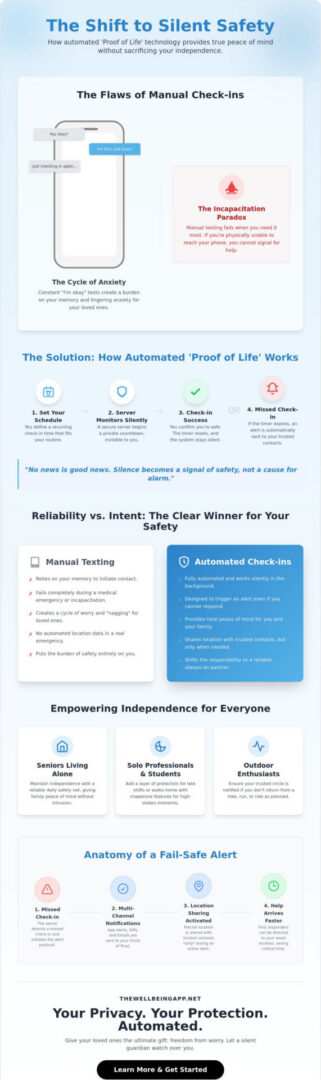
- Discover the “Incapacitation Paradox” and why relying on manual texting fails to protect you when you are physically unable to reach your phone.
- Learn to design a customized safety routine by identifying high-stakes moments and establishing a trusted circle of contacts for automated alerts.
- Explore how specialized features like Night Watch and Chaperone empower you to maintain your independence while ensuring your loved ones remain at ease.
Beyond the Office: What is a Personal Scheduled Check-in System?
A scheduled check-in system isn’t just another notification on your phone. In a world where we’re constantly tethered to our devices, this technology serves a deeper purpose. It’s a proactive safety protocol designed to act as a silent guardian. Unlike corporate systems that track employee attendance for logistical reasons, a personal system focuses entirely on well-being verification. It’s the difference between being monitored for productivity and being cared for out of love. The goal isn’t to watch your every move, but to ensure you’re safe when you’re out of sight.
The core philosophy here is simple: no news is good news. This concept of “silent monitoring” means the technology stays in the background until it’s actually needed. You set a specific time to check in, and as long as you do, the system remains quiet. It doesn’t intrude on your dinner or interrupt your sleep. However, if that check-in window passes without a word, the system springs into action. This creates a state of mental tranquility for everyone involved. You feel empowered to live your life, and your family feels secure knowing that silence is a signal of safety, not a cause for alarm.
The Evolution of the Wellness Check
We’ve come a long way from the days of manual phone trees or relying on a neighbor to notice an untouched newspaper. Historically, a wellness check was a reactive measure. It often involved emergency services or family members rushing over after a problem was already suspected. Modern digital chaperones have flipped this script. By 2026, technology like Proof of Life focuses on proactive indicators rather than reactive panic. These systems prioritize user agency. You aren’t under constant surveillance. Instead, you’re using a tool that respects your privacy while ensuring you’re never truly alone.
Who Benefits Most from Scheduled Monitoring?
Personal safety is a universal need, but specific groups find these tools especially transformative for their daily lives:
- Seniors: Maintaining independence is vital. A daily check-in allows them to live on their own terms while providing a safety net for their children.
- Solo Professionals and Students: For those walking home late or working late shifts, features like Night Watch offer a layer of protection that manual texting can’t match.
- Outdoor Enthusiasts: Hikers and runners often venture into areas where help is far away. A scheduled check-in ensures that if they don’t return as planned, their Circle of Trust is notified.
This isn’t about fear. It’s about the harmony that comes from knowing you have a reliable, always-on partner watching over you. By automating the process, you remove the burden of remembering to text, allowing you to focus on the moment while staying safe.
The Science of ‘Proof of Life’: How Automated Verification Saves Lives
The effectiveness of a modern scheduled check-in system lies in its technical invisibility. It operates on a sophisticated “if-then” logic that acts as a guardian that never sleeps. When you set a check-in time, a secure remote server begins a countdown. If you confirm your safety, the timer resets, and the system remains silent. However, if that signal is missing, the server initiates a multi-channel notification sequence. By using a combination of App alerts, SMS, and Email, the system ensures that your Circle of Trust is reached even if one communication path is blocked. This technical robustness mirrors professional standards, much like the OSHA ‘Working alone’ regulation which requires employers to account for the safety of solo workers.
During an active alert, real-time Location Sharing becomes a vital tool for those you trust. The system doesn’t just say something is wrong; it provides the precise coordinates needed for help to arrive. This isn’t constant surveillance. It’s a purposeful release of information that only occurs when silence becomes a signal for help. By implementing a robust scheduled check-in system, you’re not just using an app; you’re activating a compassionate safety net that preserves your personal agency while having a fail-safe in place.
The Critical Window: What Happens During a Missed Check-in?
Every second counts, but so does preventing false alarms. A well-designed system includes a grace period, giving you a final chance to respond before the situation escalates. Because the monitoring is server-side, the alert will fire even if your phone’s battery dies or the device is destroyed. This ensures that your safety isn’t dependent on the physical state of your hardware, providing a level of reliability that manual methods simply can’t match.
Proprietary Indicators and Night Watch Protection
For times of higher risk, Night Watch mode increases the vigilance of the system. It uses proprietary indicators to provide a constant “pulse” of safety without the need for active tracking. This high-stakes monitoring is supported by 24/7 server-side status checks that maintain a consistent watch over your well-being. Choosing a platform that prioritizes this technical robustness, such as The Wellbeing App, ensures your safety net is always active and your mental tranquility remains intact.
Reliability vs. Intent: Why Manual Texting Fails as a Safety Protocol
Most families start with a simple, heartfelt promise: “I’ll text you every morning to let you know I’m okay.” While this comes from a place of deep care, it relies entirely on a perfect memory and physical ability. A scheduled check-in system transforms this well-intentioned habit into a rigorous, reliable safety protocol. The reality is that manual texting is prone to the “Incapacitation Paradox.” If you are unconscious, injured, or unable to reach your device, you cannot send the very message that would trigger a rescue. Manual systems require you to act when you are at your most vulnerable. Automated systems, however, only require you to be silent for help to be summoned.
This shift in logic removes the crushing weight of “Alert Fatigue.” When manual check-ins are inconsistent, family members often stop taking a missed text seriously, assuming their loved one just forgot or is busy. This “Boy Who Cried Wolf” effect is dangerous. Reviews for the best personal safety alarms often highlight the need for reliability, yet many standalone devices still lack the sophisticated logic of a server-side check-in. With an automated system, the certainty of the protocol replaces the anxiety of the unknown. You don’t have to wonder if a silence is an oversight or an emergency; the system provides the answer for you.
The Human Error Factor in Personal Safety
Life is busy, and even the most disciplined people forget to send a text now and then. In a manual setup, this forgetfulness causes unnecessary panic for the Circle of Trust. It turns safety into a shared burden that creates friction in relationships. By using a scheduled check-in system, you ensure that safety remains a shared effort. The technology handles the remembering, so you can focus on enjoying your day. This preservation of mental tranquility is what allows families to stay connected without the constant shadow of worry.
Privacy vs. Protection: The Autonomy Debate
Many people resist safety tools because they fear constant surveillance. GPS breadcrumbing, where your every move is tracked in real-time, can feel like an invasion of privacy. A check-in model is different. It offers a “Virtual Chaperone” that only watches when you ask it to. Features like Chaperone or Night Watch provide temporary, high-stakes vigilance for specific moments, such as a late-night walk or a solo hike. This empowers you to control your own safety data. You maintain your personal agency while ensuring that if something goes wrong, you won’t be left alone. It’s about finding the perfect harmony between total independence and proactive protection.
Designing Your Safety Routine: Best Practices for Scheduled Monitoring
Creating a compassionate safety net requires more than just downloading an app; it involves designing a routine that respects your lifestyle while providing unwavering protection. A well-configured scheduled check-in system should feel like a natural part of your day, not a chore. To achieve this harmony, you must first identify your “High-Stakes” times. These are the specific moments when silence would be most concerning, such as a morning wake-up call for a senior living alone or the conclusion of a late-night shift for a professional. By pinpointing these windows, you ensure the system is vigilant when it matters most.
Once you’ve identified these times, follow these essential steps to build your protocol:
- Define your Circle of Trust: Select emergency contacts who are reliable and understand their role. These individuals should be the first to receive your Emergency Alerts.
- Set Realistic Intervals: Choose check-in windows that provide safety without causing annoyance. A single daily check-in might suffice for a retiree, while a solo traveler might prefer hourly updates.
- Establish an Action Plan: Ensure your Circle of Trust knows exactly what to do if they receive an alert. Should they call you first, check your Location Sharing data, or contact local authorities?
- Test the Protocol: Run a scheduled trial to ensure everyone understands how the notifications look and feel. This builds confidence in the system’s technical robustness.
Tailoring Check-ins for Senior Care
For families supporting an aging parent, a scheduled check-in system acts as a gentle bridge between independence and safety. Use morning check-ins to verify Activities of Daily Living (ADLs) without the need for an intrusive phone call. If a parent is hesitant, introduce the system with empathy. Frame it as a way to preserve their autonomy and your mental tranquility, rather than a tool for surveillance. Integrating Night Watch protection provides an extra layer of security during the quiet hours when seniors are often most vulnerable to falls or medical events.
Setting Up a Virtual Chaperone for Solo Travel
Solo travelers and commuters can benefit from a more tactical approach. Configure your Chaperone settings for specific journeys, such as the walk from the train station to your front door. During these times, use Location Sharing as a temporary tool that only stays active until you are safely inside. One-touch “I am safe” buttons make it effortless to reset the timer, ensuring your protection never feels like a burden. To start building your personalized safety routine today, explore the features of The Wellbeing App and discover how proactive monitoring empowers your daily life.
The Wellbeing App: Your Compassionate Guardian for Every Check-in
The Wellbeing App isn’t just a technical solution; it’s a mission-driven platform dedicated to the preservation of mental tranquility. While typical software focuses on corporate logistics, we’ve built a scheduled check-in system rooted in sincere concern for the vulnerable. Our mission is to foster social cohesion through proactive protection, ensuring that no one is ever truly alone when they need a helping hand. By bridging the gap between sophisticated technology and human connection, we provide a safety net that empowers individuals to live with confidence and grace.
At the heart of our service is the Proof of Life feature. This acts as our core differentiator, moving beyond simple tracking to provide a meaningful verification of well-being. It operates on the principle that your safety should be managed with dignity and respect for your personal agency. When you use our system, you aren’t just a dot on a map. You’re a member of a community where safety is a shared effort. This collective responsibility is a central pillar of our philosophy, helping to prevent missing person incidents by ensuring that silence is never ignored and help is always within reach.
A Specialized Suite for Total Peace of Mind
Our platform offers a comprehensive suite of tools designed for high-stakes safety. Whether you’re using Chaperone for a short walk or activating Night Watch for overnight protection, the system provides 24/7 empathetic vigilance. Because our monitoring is server-side, your safety net remains active even if your phone fails or the battery dies. We’ve designed these features to be both technologically robust and deeply caring, providing the logical and emotional support your family needs. Our mission is to foster social cohesion through proactive protection, creating a world where every individual feels secure and every family finds peace.
Join the Community of Watchful Protectors
Getting started is a simple, purposeful process designed for both families and individuals. You can choose between a monthly or annual subscription, depending on your specific needs for long-term mental tranquility. The setup is intuitive, allowing you to establish your Circle of Trust and configure your scheduled check-in system intervals in just a few minutes. We believe that safety shouldn’t be a burden, but a seamless part of your daily harmony. By joining our community, you take a proactive step toward securing your future and fulfilling your duty toward those you love. Secure your peace of mind with The Wellbeing App today.
Embrace a Future of Fearless Independence
Personal safety is about more than just surviving. It’s about thriving with the confidence that you’re never truly alone. We’ve explored how a modern scheduled check-in system moves beyond the limitations of manual texting to provide a fail-safe that respects your autonomy. By utilizing server-side monitoring, you ensure that alerts fire even if your phone is off or out of reach. This technical robustness, combined with proprietary Proof of Life indicators, shifts the burden of vigilance from your loved ones to a reliable, automated partner.
This isn’t about constant surveillance; it’s a specialized approach designed for empathetic vigilance. You can maintain your privacy while providing your family with the mental tranquility they deserve. Every check-in is an opportunity to reinforce the bonds of trust and care within your community. Don’t let another day pass under the shadow of worry when a solution is ready to watch over you. Start your journey toward mental tranquility with The Wellbeing App. You deserve to live life on your own terms with a compassionate guardian by your side.
Frequently Asked Questions
What is a scheduled check-in system exactly?
A scheduled check-in system is a proactive safety protocol that requires you to confirm your well-being at pre-set intervals. It acts as a silent guardian, staying in the background as long as you are safe. If a check-in is missed, the system automatically triggers notifications to your designated Circle of Trust to ensure help is on the way.
How does an automated check-in differ from a standard GPS tracker?
Automated check-ins prioritize your personal agency and privacy by only sharing your coordinates during an active alert. Standard trackers often rely on constant “breadcrumb” surveillance, which can feel invasive. A check-in model focuses on well-being verification, only sharing Location Sharing data when silence indicates a potential emergency.
What happens if I forget to check in but I am actually safe?
Most systems include a grace period that sends a final reminder before escalating the situation to your emergency contacts. This window allows you to reset the timer and maintain your mental tranquility without causing unnecessary alarm. It ensures that the system remains a supportive partner rather than a source of stress for you or your family.
Can a check-in system work if my phone battery dies?
Yes, because the monitoring occurs on a secure remote server rather than just on your local device. This server-side logic ensures that a scheduled check-in system remains active even if your phone is powered off or destroyed. The alert will still fire at the appointed time, providing a level of reliability that manual texting cannot match.
Is a scheduled check-in system better than a medical alert button?
It provides a proactive layer of protection that addresses the “Incapacitation Paradox” where a user might be unable to physically press a button. While buttons are reactive tools for conscious emergencies, a check-in system acts automatically when you cannot. It’s a compassionate safety net designed to catch incidents where silence is the only signal for help.
How much does a professional safety monitoring subscription cost?
Subscription costs generally vary based on the frequency of check-ins and the specialized features included, such as Night Watch or Chaperone. These services are typically offered as monthly or annual plans to provide consistent, uninterrupted protection. You should review the specific plan details to find the balance of features that best fits your family’s needs.
Can I use a scheduled check-in system for my elderly parents who are not tech-savvy?
These platforms are designed for extreme simplicity, often requiring only a single tap on a notification to verify safety. It is an ideal way to foster social cohesion and provide a safety net without requiring them to navigate complex menus. This approach respects their independence while fulfilling your duty to ensure their well-being.
What is “Proof of Life” in the context of a safety app?
Proof of Life is a specialized indicator that confirms a user is active and safe at a specific moment. It serves as the emotional and technical anchor of the service, providing your loved ones with a pulse of safety. This feature ensures that silence is never ignored, allowing your family to rest easy knowing you are protected by empathetic vigilance.